
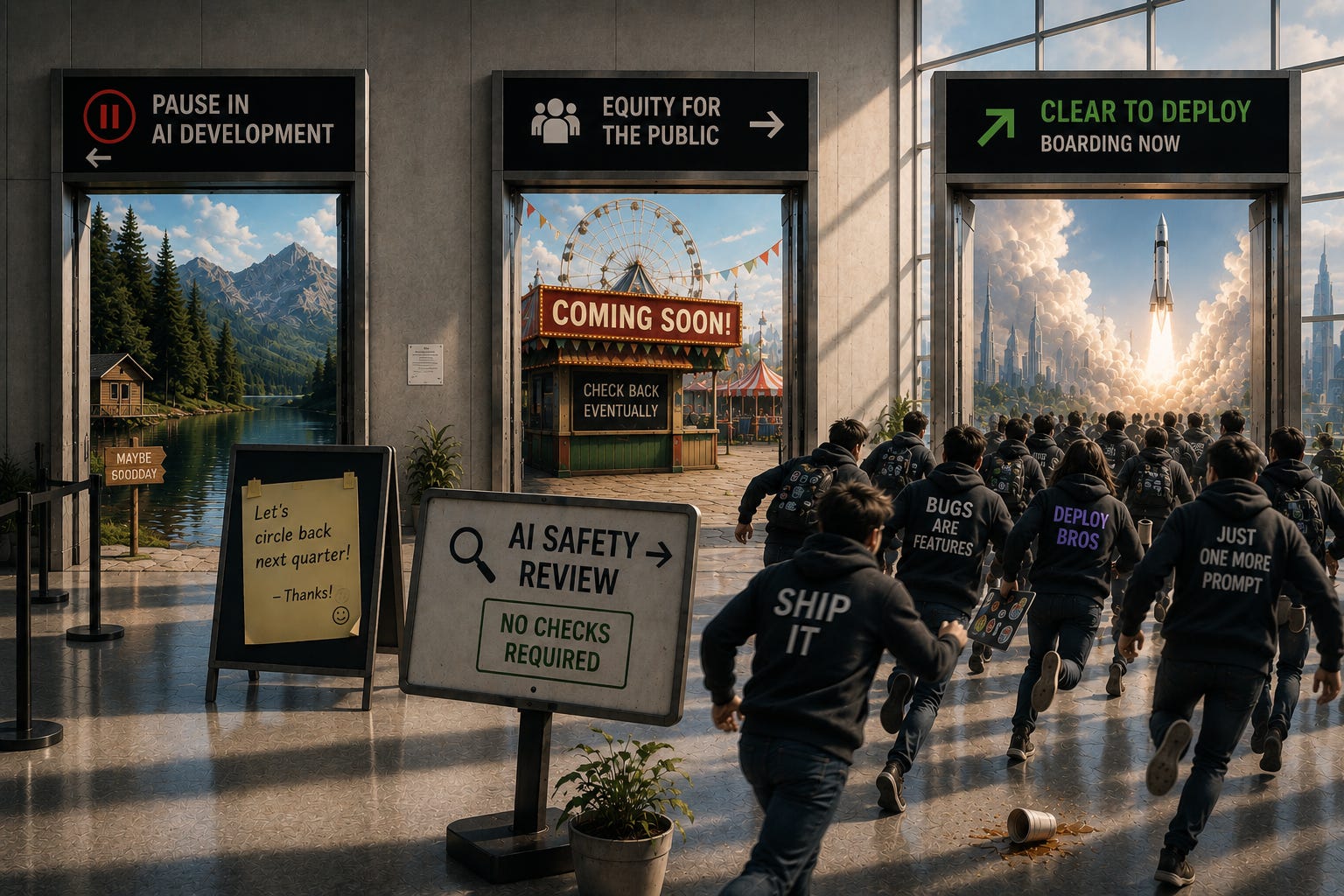
Inside seventy-two hours this week we’ve had Trump’s executive order, a debate on handing the public equity in the labs, OpenAI’s federal-framework blueprint, and Anthropic’s recursive-self-improvement essay.
The coverage treated them as some mix of regulatory awakening and doomsday warning. Read together they are the opposite: a coordinated effort to be seen governing while authoring the regulatory agenda in their own favour, committing to nothing enforceable along the way. The government asked nicely and reserved the right to keep asking nicely. The two leading labs each handed over a framework engineered to look like restraint while leaving their hands free. The playbook is now familiar: broad enough to read as caution, loose enough to keep shipping - and somehow always avoiding the more interesting conversation about what the technology unlocks for us.
When Asking Nicely Is the Strategy
Trump signed the AI executive order on June 2nd, finally, after a signing ceremony reportedly cancelled hours before it was due to happen two weeks ago. The final text is a watered-down version that signals the non-interventionist camp won the argument: the pre-release review window was trimmed from 90 days to 30, the mechanism is voluntary, and it ends with a promise to the industry: “Nothing in this section shall be construed to authorize the creation of a mandatory governmental licensing, preclearance, or permitting requirement for the development, publication, release, or distribution of new AI models”. It was signed in private with zero fanfare, which tells me the administration sees AI safety regulation as something it has to do, not something it wants to claim credit for.
The order sets up a classified NSA benchmarking process to flag models with sufficiently advanced cyber capabilities. Only developers whose models cross that threshold are invited to participate, with the developer and the government jointly deciding whether a model even meets the “covered frontier model” definition. In practice it’s aimed at Mythos-class step-changes. Sacks himself was explicit that incremental updates and fine-tunes are nowhere near it. The government can ask but it cannot compel.
The labs all reached for “important step forward” - coordinated language so obvious it barely deserves acknowledgement. Steve Bannon declared mandatory testing is months away; Bernie Sanders dismissed the whole thing as doing “almost nothing.” Everyone claims the outcome they wanted from a policy that doesn’t do much.
The broader Trump position on AI remains visibly unsettled, with the administration arguably at war with itself over whether to regulate at all. An “FDA for AI” moment was calling for mandatory pre-release approval, statutory safety thresholds, and enforcement with teeth. What we have is a private preview window on the most dangerous frontier models, framed around “can this break into critical systems, and if so, who sees it before the public does”. The door is now open, though. It is the first time an administration has asserted any pre-release visibility into frontier models, even voluntarily. My guess is that Bannon is probably right that mandatory follows; the question is how many capability jumps it takes before voluntary becomes untenable.
Then came the equity story. While interviewed on Air Force One on Friday, Trump suggested “pieces (of AI Labs) could be given to the American public” - throwing his weight behind a proposal that caught much of the industry by surprise. It didn’t come from nowhere: Sam Altman has been talking to the administration about government equity in OpenAI for over a year, formalised in OpenAI’s April policy paper proposing a “Public Wealth Fund” seeded by voluntary lab contributions. Per the FT, US citizens would own shares directly rather than the government holding equity. The model floated is Alaska's oil-dividend scheme, with donated founder shares filtering to citizens through the existing $1,000-per-child "Trump accounts" plan.
It is a shrewd attempt to defuse the public backlash over the data-centre buildout and how Americans feel about who benefits from all this. All while Trump is still in the chair and the terms are soft. It is also an obvious regulatory capture play - a voluntary donation, designed by OpenAI themselves. A company defining the fence before anyone else gets to build it.
But these have been a 1:1 conversation so far: Anthropic isn’t in on it, and the US Gov has no mechanism to compel Google, xAI, or anyone else who didn’t volunteer. A fund seeded only by OpenAI isn’t a public stake in AI, it’s a public stake in one company’s pre-IPO valuation event.
Google is a different problem entirely: a deeply global behemoth where US government equity (even partial, even indirect) hands every company or government considering alternatives a ready-made justification about whose interests the technology serves. A recipe for political favouritism, Sacks himself warned against the government taking "direct ownership and control", a post Ted Cruz endorsed. Meanwhile Bernie Sanders, confirming AI was taking centre stage in US politics, put forward a bill that would impose a one-time 50% tax on the labs, paid in shares, with voting rights and board seats attached. I think it’s what we call nationalisation.
The government knows it has to act, and it knows the public will punish a stance that looks too soft ahead of November - but it either doesn't want to legislate or doesn't know how to. The voluntary fund will get enough momentum to become a PR story and not much else. The coercion problem is unsolvable without legislation, the favouritism critique makes the global labs resistant, and the administration has shown no appetite for the statutory fight that forcing Google’s hand would require. Same pattern as the executive order, really: the government asking nicely, hoping it doesn’t have to ask any other way.
OpenAI Brings Its Own Rulebook
On the same day Trump signed the order, OpenAI published its own blueprint for a federal framework, and the press largely filed it as a constructive contribution from a company breaking with the White House to ask for more oversight. The headline framing is impeccable: democratic governments, “not private companies acting alone,” should set the rules; transparency, independent oversight, the rule of law.
The centrepiece is what OpenAI calls reverse federalism. States have done the hard regulatory work (California’s SB 53, New York’s RAISE Act, Illinois’s SB 315) and the blueprint praises them warmly as an “emerging consensus,” then proposes that Congress lift a baseline version to the federal level and, in the same breath, “preempt state laws that seek to regulate the same frontier safety risks.” The states that wrote rules with teeth would be barred from going further than the federal floor. The language of laboratories-of-democracy gets deployed to shut the laboratories.
The institution at the heart of it, a strengthened CAISI, runs mandatory pre-release evaluations of the most capable models, which sounds like the binding mechanism the executive order lacks, until you read the fine print. “CAISI’s role should be to conduct evaluations and recommend mitigations - not to approve or block deployments. Developers should remain responsible for deployment decisions.” And if the evaluator runs out of time, the blueprint provides an exit: should CAISI fail to complete its review within the statutory window “due to bandwidth, hardware, personnel, or other constraints,” developers “should be permitted to deploy without penalty.” So the evaluation is mandatory to submit, never mandatory to wait for, and never able to stop anything. It is the order’s voluntary thirty-day window again, wearing the clothes of a permanent federal agency.
The rest follows the same grain. “Protect America’s compute advantage,” strengthen export controls: the China lever that turns any call to slow down into a national-security risk, which is the exact justification the labs reach for whenever a pause is mentioned.
OpenAI then proceeds to flag “early signs of recursive self-improvement in today’s systems” and calls it potentially the most consequential frontier-safety issue of the coming decade. Hold that thought, because two days later the other lab built an entire essay on it.
Anthropic Calls For The Pause That Wasn’t
The market lost its mind over a piece it failed to read properly. Name your publication and the headline ran “Anthropic calls for global pause in AI development”.
“When AI builds itself” does spend its closing pages on the idea of pausing, citing the risk that models could reach “recursive self-improvement” - but does not call for one. It explicitly says a unilateral pause by a single lab would not be “accomplishing much” beyond changing who’s in front and allowing other actors to catch up. It proceeds to claim a pause worth having would need multiple frontier labs, across multiple countries, stopping under the same conditions, each able to verify the others actually stopped, but that this machinery doesn’t exist. So the real position is “we’d like to have the option and we’d slow down if we could trust everyone else had, but we can’t.”
The thesis: we might be close to AI being good enough to design and build its own successor, with the supporting claim being that it is already doing much of the building. As of May 2026, more than 80% of the code merged into Anthropic’s own codebase was authored by Claude, with the typical engineer shipping 8x as much per day as in 2024. They grant we’re not at recursive self-improvement and that it isn’t inevitable, but every chart is built to make the trend line feel like a slope toward it.
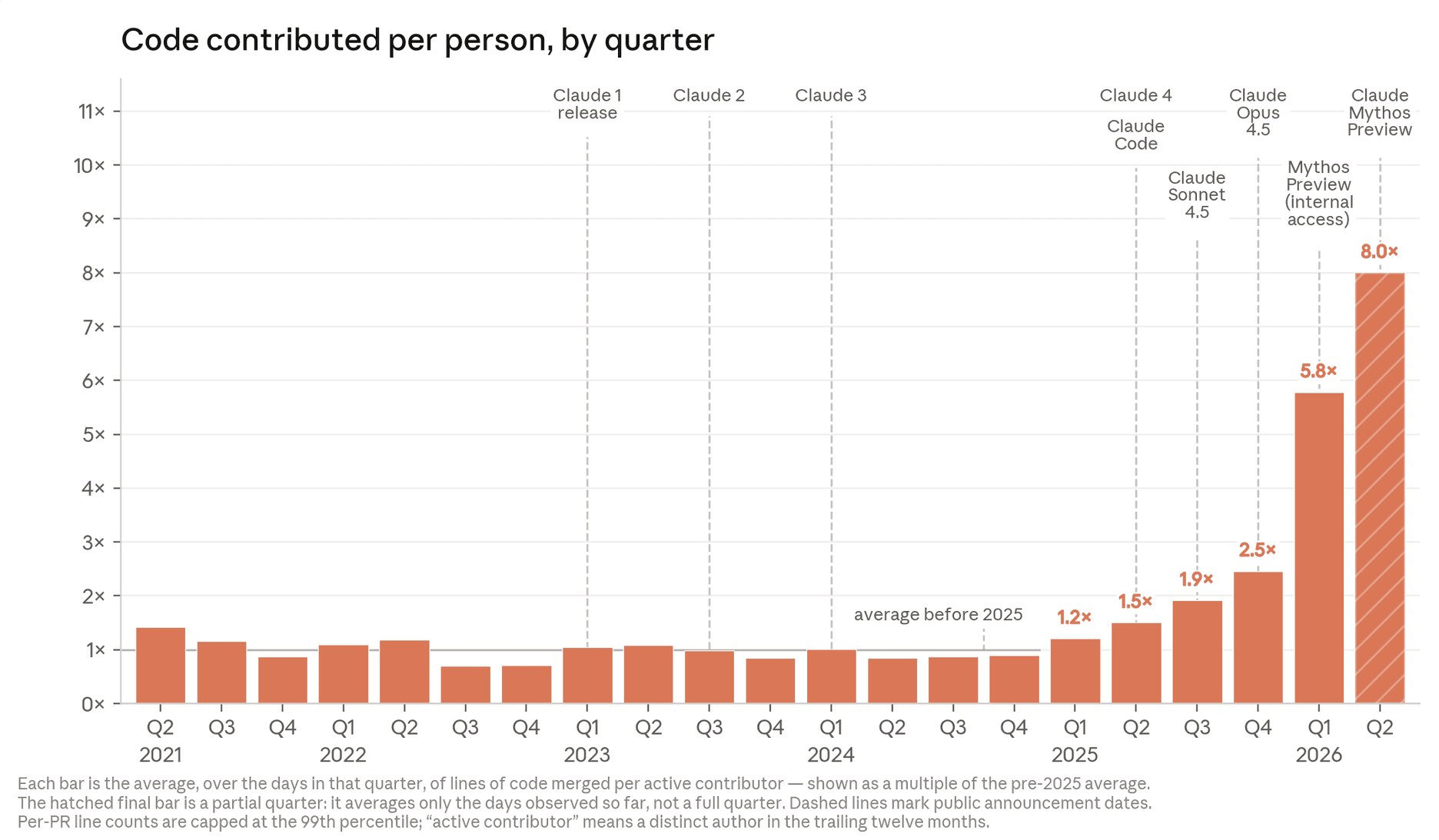
As often the most picked-up “evidence” (the 8x contribution) is also the softest number in the piece. A new MIT and Wharton study (Demirer, Musolff and Yang) tracked more than 100,000 GitHub developers against their real AI-usage telemetry and found that autonomous coding agents lift commits by 180%; then watched that gain drain away down the pipeline. The same 180% falls to 50% at the level of projects and to just 30% at actual releases. They even showed that across app marketplaces more apps shipped did not translate into higher usage.
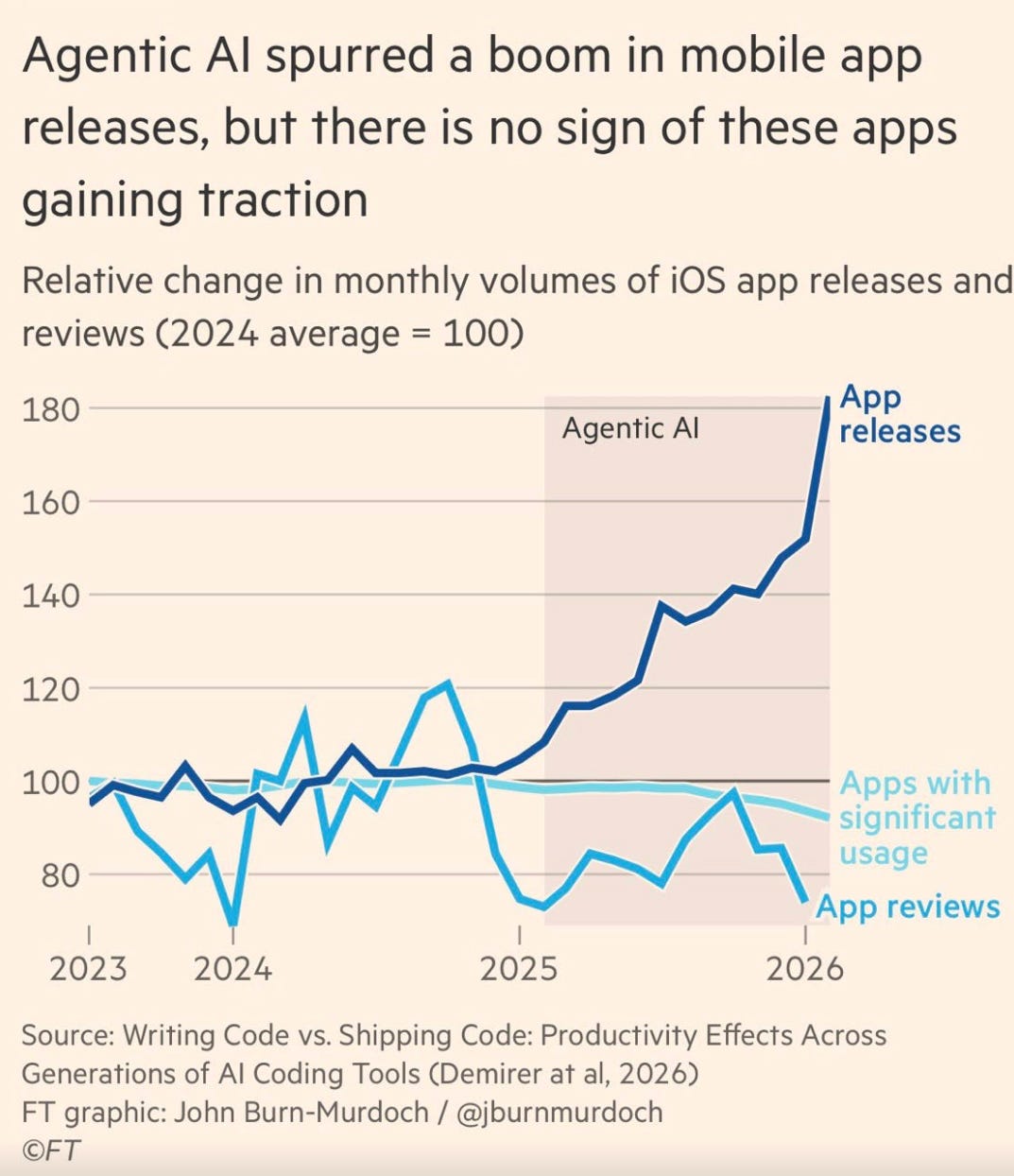
Lines of code measures typing, not shipping. Anthropic’s 8x is measured at the precise point in the chain where AI looks most impressive. To be fair they acknowledge the rather obvious pushback I am making. They even name the mechanism, invoking Amdahl’s law and conceding human code review has become their new bottleneck. But it gets a passing nod where the academic work quantifies it and finds the leak is most of the flow.
The stronger evidence is on the research side. Claude’s code is now good and improving, roughly at parity with human-written code. It reliably runs experiments to hit a goal someone else has set. It’s getting better at proposing its own experiments. And it’s getting better at steering a stuck research session toward an actual finding. Even on the so-called “taste” barrier, meaning human ability to determine which problems are worth chasing and which results to trust - the edge is narrowing, with the model out-choosing the human’s next move in a derailed research session.
But there’s a sleight of hand underneath all of it. What Anthropic has demonstrated is recursive self-improvement in the narrowest possible sense: a coding tool that’s very good at optimising code under human direction. The frightening version needs something else entirely: autonomous research, a system that decides what to build next and knows whether it worked. Faster code generation, even superhuman experiment-tuning, tells us nothing about that capability, and the leap from “Claude writes most of our code” to “Claude might build its own successor” is not one they can substantiate.
From there the piece offers three scenarios: the curve turns out to be an S-curve and stalls, though today’s capabilities diffuse anyway (included for completeness and openly disbelieved); compounding efficiency gains where AI does the work and humans keep setting direction (the one they’re betting on); and full recursive self-improvement, where models build their successors and humans retreat to oversight. The third is the one that justifies all the drama, but it rests on the same internal, self-judged trend data the rest of the piece runs on.
This is where the whole exercise starts to look self-serving. In February 2026, Anthropic dropped the central pledge of its own Responsible Scaling Policy: the commitment not to train more capable models without proven safety measures already in place. The argument back then will sound familiar: “We didn’t really feel, with the rapid advance of AI, that it made sense for us to make unilateral commitments … if competitors are blazing ahead”. Now it publishes an essay about wanting the option to pause.
Self-serving is the easy charge, though. The one that sticks for me is that the piece is self-defeating. A document built to look like caution does almost none of the work caution is meant to do. It won’t calm a nervous public, because “we may lose control, and we’re racing ahead regardless” is about the least reassuring thing a frontier lab can say out loud. It won’t move the policy conversation anywhere useful, because the one concrete ask: a verifiable global pause mechanism, is parked in a future nobody has to act on today. And it sells short the thing that deserves the airtime: how much human progress this technology can unlock.
Anthropic may now be at the front on revenue and capability. The whole identity it has built is that it would hold the line when holding the line got costly, and be the steady hand once it had the standing to be one. They have that standing now.
Their position has the merit of being coherent: if you accept that unilateral restraint hands the frontier to someone less careful, then racing with a published conscience is the rational move. The question is whether a company that has accepted that logic retains any meaningful claim to the word "responsible," or whether responsible was always just the marketing story a lab tells when it's behind.
Whose Fence?
The executive order asks and cannot compel.
The equity fund is a donation the donor designs.
OpenAI’s blueprint builds an evaluator that cannot block and a federal floor that bars the states from building higher.
Anthropic would pause if a verification regime existed, and offers to spend the next year helping to build the regime that would one day let it.
Four instruments, seventy-two hours, and a binding force that rounds, in every case, to nothing. A flawless piece of corporate choreography. A fence built around the frontier and engineered entirely to ensure the labs hold the keys.
Thanks for reading my substack! Subscribe for free to receive new posts and support my work.
About
I analyse AI progress beyond the headlines, focusing on enterprise execution, incentives, and real-world economic impact.
Comments
Nothing yet. Say the first thing.
Sign in to join the conversation.