
Rejection sucks.

Especially when you’ve poured your heart, sweat, and time into a piece. You’ve edited it, rephrased it, shifted some lines, deleted others, agonized over a comma, and finally deemed it polished enough to submit, only to have it receive an ignominious boilerplate rejection. You look at that piece, which now may have lost its patina. Maybe you tweak it a little more and send it out again—this time to a dozen more lit mags.
And wait.
No matter how many rejections one receives, it’s worth remembering how subjective it is.
If it’s an entire manuscript, you’ve grown a few grey hairs or lost some, positioning your query, your synopsis, your cover letter. You’ve even managed, after five thousand stabs at it, to create a one-line pitch. You’ve done your research into each agent and publisher’s requirements.
Off those submissions go, like schoolchildren on their first day of school – bright-eyed and bushy-tailed – sure they’ll be the teacher’s pet.
Now you wait.
Sometimes the rejections come in a flurry of ulcer-inducing “Unfortunately, your piece…” s. There are rare times when you receive, “While our judges/editors found your piece compelling, we won’t be…” Or “We’d love to see more of your work.” Just not this piece. Sigh. Then, maybe, just maybe, you receive a “We loved it!”
Rejections may make us question why we write. It’s good to remind yourself why, indeed, you put pen to page, fingers to keyboard. For most of us, the answer is because we must. It’s a strange compulsion, isn’t it, given the proportion of rejections to acceptances? And how many of us can claim a living from our creative efforts?
Right.
So take heart, and please keep writing. Whether it’s to find out what you know, to make sense of the senseless, to document your life for your descendants, or to transcribe wonder onto the page. Write. Just keep writing.

Here is what Susan Wingert has to say about rejection:
On Rejection
The very first time I got rejected, I thought, Now I’m a real writer. The second time, I was disappointed. The third, I took to my bed.
Our culture worships the phenom, the newcomer who wins the Booker. I clearly was not a phenom. That’s when the self-doubt crept in like a thunderstorm at a picnic. My inner critic began to chirp: Who do you think you are? You’re making a fool of yourself. Nobody even reads anymore. Only five people in the whole world make a living as writers. Your stuff’s no good. And always the kicker, you’re no good.
Then I remembered Stephen King. His memoir/craft book, On Writing, was one of the first I read when I returned to creative writing in my forties. As a teenager, King pounded a nail into the wall above his writing space, on which he hung his first rejection letter. Within a few years, he’d accumulated so many that he had to replace the nail with a spike.
Without that story, I might not have had the revelation that the world wasn’t telling Stephen King he was a terrible writer who would never amount to anything. It was one editor telling him this piece wasn’t quite there, but it would get there if he kept working on it; or this piece is good, others were better; or we published something like this last issue; or it didn’t grab me, but it would have been a yes if the editor at the next desk had been assigned it. King’s success isn’t because he’s a phenom. It’s because he’s a guy with a talent for words who kept writing through all the rejection.
I danced around the room when I got my first yes. I still get rejected (a lot). In recent years, what’s kept me going is the feedback I’ve received from readers. It’s a beautiful thing to know my words touched someone, helped them recall the past, made them look at something differently, or just gave them a good laugh after a long day. And I’m grateful to everyone who has put words on the page and done the same for me. There’s no more perfect gift.
Nicole Zimmerman has shared her astounding number of submissions and the corresponding number of acceptances. Hers is a testament to perseverance and dedication. Here is some of her advice and a glimpse into her process.
Nicole says:
Becoming a successful writer certainly requires skill, but even more so, perseverance. Just like that 1970s TV commercial jingle: “Weebles wobble, but they don’t fall down.”
Rejection stings. If I don’t feel somewhat disappointed, then it probably means one of two things: either the draft I submitted isn’t quite ready for publication, or I wasn’t all that excited about a particular publication. (Be careful in both instances; it’s important to feel proud of your published work as well as where—and how—it appears.) Conversely, receiving a positive note from editors, such as “it received praise from our readers,” or placing as a semi-finalist or finalist in a contest, confirms the piece has promise: I either need to revise it or keep sending it out. I consider myself especially fortunate if I get any specific feedback.
Understanding how competitive and subjective the playing field is helps me to depersonalize rejection and maintain perspective.
To offer some perspective, Nicole shares that in her Submittable submissions tracker, she found that since August 2010, she’s received 225 rejections for 35 essays and a dozen or so poems submitted to 125 lit mags. She’s had 30 essays published and “a few” poems. Some pieces, such as “Fallen” (published in The Rumpus: Voices on Addiction and an editor’s selection for Memoir Monday), were rejected more than 20 times before acceptance.
She adds that a “select few,” such as “Unconditionally Loved,” published in a Pride issue of Boudin, which nominated it for Best of the Net, were accepted quickly. This one, after setting it aside for two years following rejections.
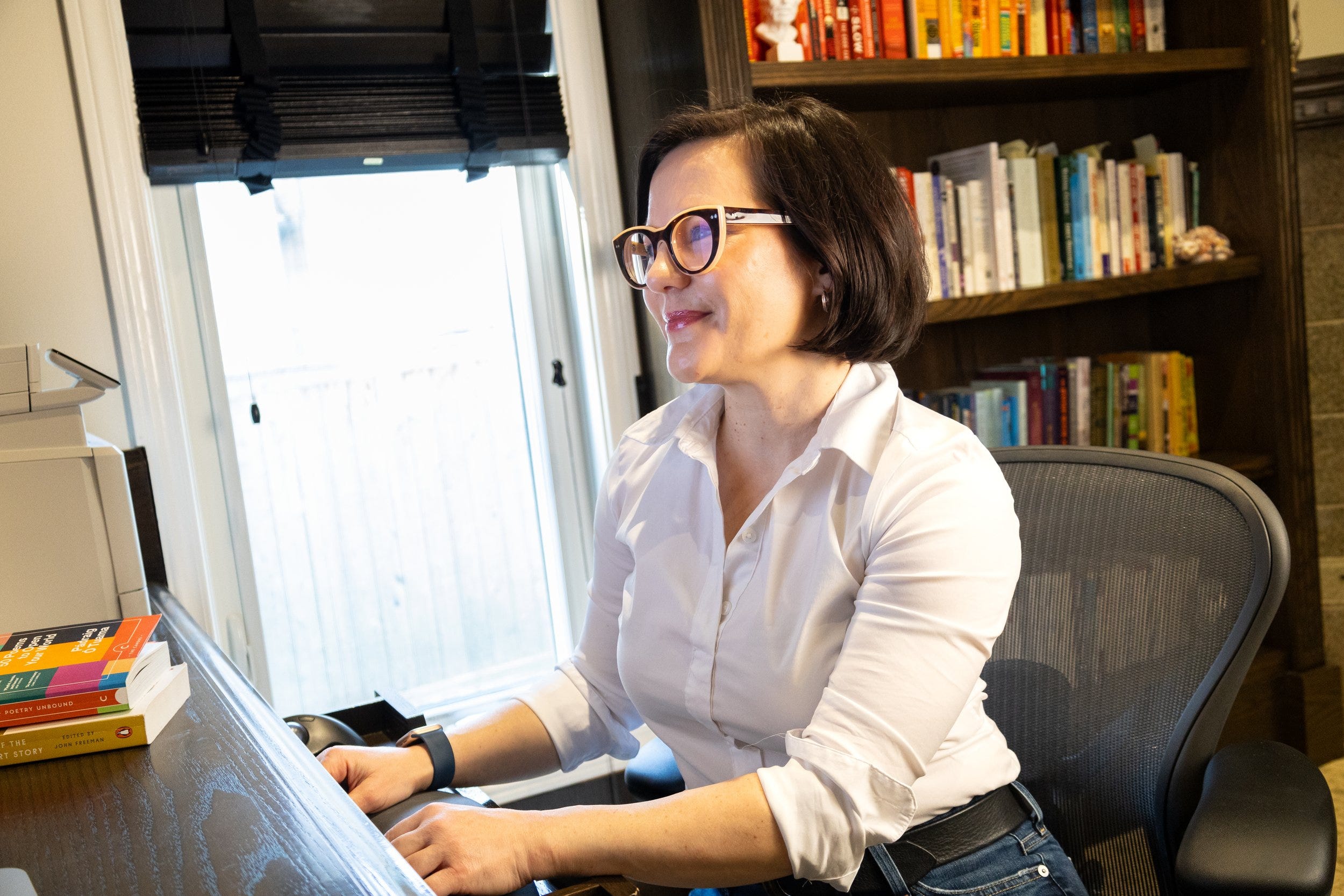
Susan Wingert holds a dusty doctorate in sociology from Western University, where she was the managing editor of The International Indigenous Policy Journal. She is a student in the Narrative Medicine program at Columbia University. She is Vice Chair of the Amherst Writers & Artists Board of Directors and has led writing workshops with health professionals and students, cancer patients, caregivers, and middle schoolers. She has published in DarkWinter, Peregrine, and The White Wall Review. Her story, “Mending Fences,” was nominated for Best of the Net Anthology.
You can find more about Susan and what she offers here.

Nicole R. Zimmerman (she/her) holds an MFA in Writing from the University of San Francisco and was a 2020 recipient of Creative Sonoma's Discovered Awards for Emerging Literary Artists. Her writing has been nominated for a Pushcart Prize, Best of the Net, and The Best American Essays series, and appears in the New York Times (Tiny Love Stories), Longreads, Sonora Review, The Rumpus, and Creative Nonfiction, among other publications. She is a certified AWA Affiliate and Blue Pencil editor, offering writing workshops and manuscript support at Pencil & Pen. Nicole lives with her wife in Northern California, where she is working on a literary memoir titled Just Some Things We Can’t Talk About.
Amherst Writers & Artists offers a monthly online writing workshop for all writers.
This month, on Saturday, April 25, Holly Holt facilitates this two-hour session with unique prompts. Join us for a taste of AWA’s magic!
Thanks for reading Writing Alone and With Others! This post is public so feel free to share it.
Comments
Nothing yet. Say the first thing.
Sign in to join the conversation.