
It wasn’t until my wife and Substack partner Sheryl mentioned it last Saturday morning that I realized the attack in New York the previous night had been at Central Synagogue.
There have been so many attacks on Jewish houses of worship and organizations, not to mention persons, lately that when I first heard about this one, I just exhaled from grim familiarity, rolled my eyes, and paid little attention to the actual venue. It could have been anywhere. After all, New York City has around 400 synagogues, not including Chabad houses and neighborhood shtiebels (small prayer rooms).
AMERICAN REFUGEES: THE ROGER SIMON/SHERYL LONGIN SUBSTACK is a reader-supported publication. To receive new posts and support our work, consider becoming a free or paid subscriber.
But I should have paid attention, for a good reason. It was, as they say, up close and personal, but by a remove of 70 years.
Midtown Manhattan’s Central Synagogue, where Larry Montes (46) barged into Shabbat services Aug. 14, spewing Jew hatred and striking a 63-year-old female congregant before spitting at and headbutting a security guard who was trying to escort him out, was also the house of worship where the 13-year-old Roger Simon was bar mitzvahed in November 1956.
At best, it is a mixed memory. I wasn’t enthralled by my bar mitzvah. It was more of a duty. I felt I was doing it more for my parents, who themselves weren’t particularly devout, far from it, than for myself, and once it was over, I walked away from the experience and subsequent religious training as quickly as I could.
Part of that was me. I was a child of my times. I was barely more than a decade away from the young, left-leaning screenwriter who would hang out with Tom Hayden and the Students for a Democratic Society (SDS) while helping finance the Black Panther breakfast program.
But part of it was the education being offered at the super-reform Central Synagogue, and the even more reformed Temple Emanuel-El, where I also attended. To call it pabulum might be an understatement. (My friends and I called it “marshmallow school.”)
The synagogues’ Sunday schools were more like junior social justice clubs avant la lettre with God, or G-d, as an afterthought. It wasn’t far off what my friends were getting at “The Ethical Culture School,” many of whom were Jewish and whose families desperately wanted to assimilate (one of the roots of leftism from Trotsky onwards).
We are in very different times, to say the least. Well, some of us are, anyway. And I am, because of that, a very different person. Or, to put it another way, perhaps I am much the same, but the world around me isn’t.
I have always been aware of my Jewishness; I wrote the Moses Wine detective stories, but they were secular almost to an extreme. Nevertheless, gradually, inexorably, inevitably, I have found myself being increasingly intrigued by and involved in Judaism as an actual faith. This led me to Chabad. (Simultaneously, I have become more respectful, even admiring, of the Christian faith.)
So Friday night, when Mr. Montes was storming into my childhood Central Synagogue, I was at services and then, with roughly 40 others, at Shabbat dinner at Chabad of the Venetian & Sunset Islands. (Chabad, for those living under the proverbial rock, is a Hasidic movement, but unlike the others, admits heathens like myself, indeed welcomes us.)
This marked the beginning of the month of Elul on the Jewish calendar, which leads into Rosh Hashanah, the Jewish New Year, a great period of reflection and renewal for Jews. Shmuel Mann, the local Chabad’s rabbi, asked everyone at dinner to make one resolution for the new year.
The congregants were polite and responsive, pledging all the good things: being more loving to friends and family, learning more about our tradition, honoring the Sabbath, and so forth. But I was quietly seething—or something close to it.
I wanted someone to say what I knew to be the truth, that we were living through what is by far the greatest period of antisemitism in any of our lifetimes, far too reminiscent of the Weimar Republic with its horrifying aftermath, and that it should be the most important resolution for all of us this new year to fight it with all our might.
But I didn’t want to be the one saying it. I am not a rabbi and, though not shy, didn’t want to be the one calling attention to myself at such events.
And yet I did. Most seemed to approve, but I sensed a bit of discomfort among a few; I am not sure how accurately.
I also sensed a bit of discomfort in myself. I did not feel I had accomplished much, if anything. The next morning I realized where some of this feeling was coming from. Although I have this Substack, my novels, and other venues for my writing—not that they move the needle that much —I doubted whether any of the others present had any such outlet. Not only that, I didn’t have concrete recommendations for what they could do, if they didn’t, other than the usual “call your congressman” nonsense or sign a petition, which is often just an excuse for fundraising.
Do demonstrations work? Well, maybe, but only if large enough. There aren’t enough of us for that, and these days the number of allies seems to be dwindling—rapidly.
I hate to be so dark, especially since the main thing I learned at Chabad is the importance of positivity in all our lives (not just Jewish ones, obviously), the necessity of adding light to counteract the darkness. The Lubavitcher Rebbe preached that even in the face of the Holocaust, as did Viktor Frankl in his magnificent Man’s Search for Meaning.
Being happy or at least not succumbing to depression or misery in the face of adversity, maintaining a decent demeanor, may be the most powerful weapon against evil and also, in the end, the best instrument for change. (Please note: I am not denigrating activism for a good cause in the slightest.)
Returning to Central Synagogue, the scene of my “marshmallow” bar mitzvah 70 years ago, I saw evidence of that change through some AI research. Unbeknownst to me—no longer a New York resident, I had lost interest—the synagogue now has a female rabbi, Angela Buchdahl, who is Korean-American, not surprisingly, the first of her kind. She is part Buddhist (mother’s side) and part Jewish (father’s).
You would expect this to be the last person to take a firm stand against the current wave of antisemitism and to fall into line like the Chuck Schumers of the world. Not so. This woman has made herself very clear about New York’s current mayor and others leading the charge of Jew hatred. She is the furthest thing from the “House Rabbis” Mamdani’s staff chose for a recent discussion with the mayor.
In an apparently widely reported sermon at Central Synagogue, Rabbi Buchdahl said that Mayor Zohran Mamdani “contributed to the mainstreaming of the most abhorrent antisemitism.” In an open letter to the mayor, she criticized him for breaking his promises of civic unity and continuing to “divide Jews into those whose politics you deem acceptable and Zionists whom you cast beyond the pale.” More recently (July 26, 2026), she called on Mamdani to abandon his rhetoric that “helps create the climate in which threats and violence flourish.”
He won’t, but nevertheless, “Brava, Reb Angela!” or, as they say in Hebrew, “Yasher Koach!”
I gather too that… some of… the reform movement, including to some extent Central Synagogue, has toughened up after Oct. 7. They should.
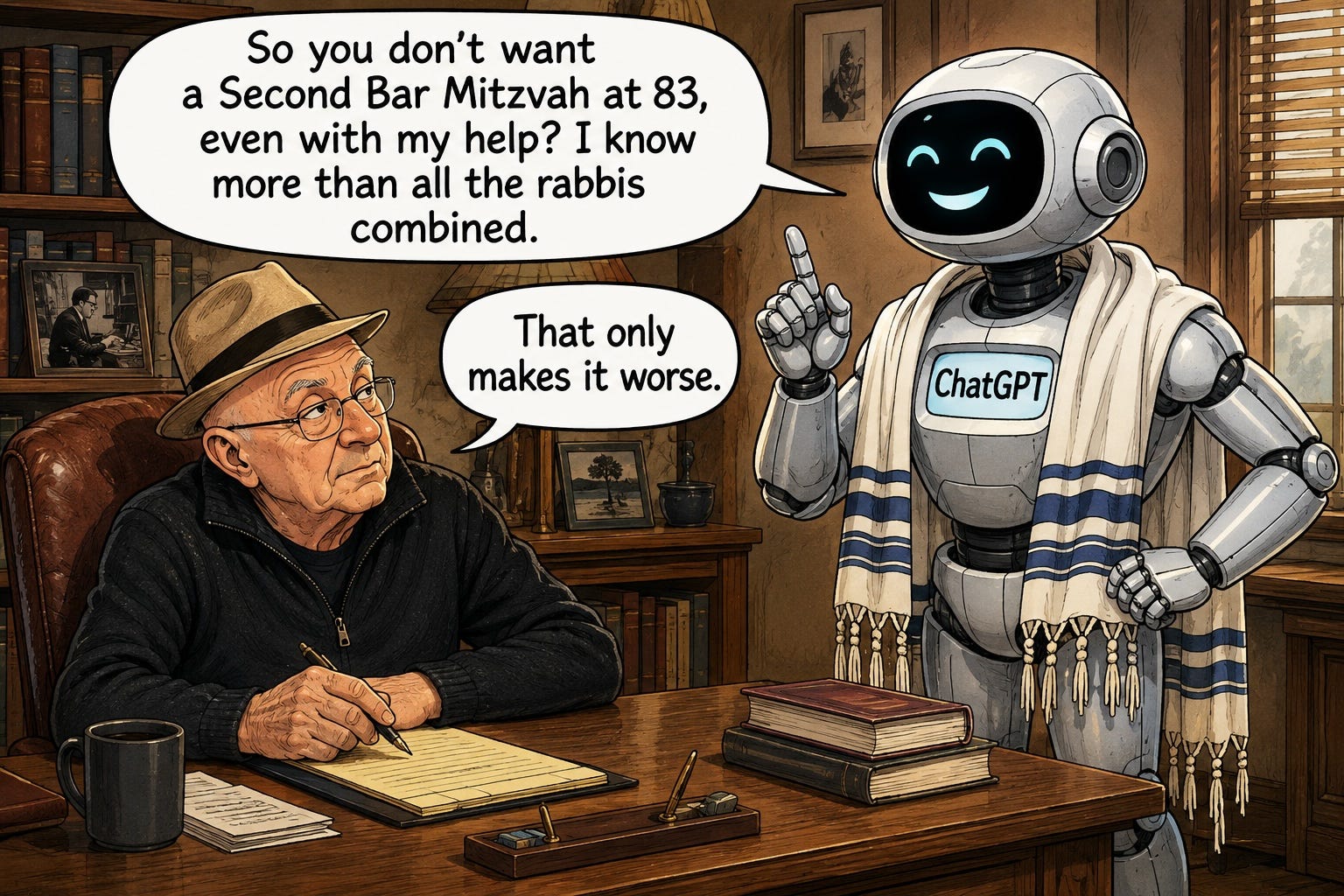
Apropos, on November 22, 2026, I will turn 83. This qualifies me for something called a second bar mitzvah. Evidently, since I lived the expected 70 years, and now another 13, I am on my second life and thus qualify. (Don’t ask the reasoning behind this. You already know.). Anyway, this entitles me to a second bar mitzvah that would make up for my pallid first one. Do I want it—either at Central Synagogue or at the local Chabad, which I'd prefer?
The answer is no, as I explained to the Chabad rabbi minutes before I typed this. He had stopped by to wrap teffilin, a ritual that was once foreign to me but is becoming less so. As I told him, I feel that since HaShem gave me whatever writing talent I have, he intends for me to use it. Spending the time I have left on bar mitzvah lessons would be a waste. That explanation almost seemed pretentious to me when I said it, but it wasn’t to the rabbi.
SPEAKING OF WRITING
I am pleased to say that the positive response to EMET continues to grow, with Amazon reviews now numbering 129 at 4.5. It’s also doing well on the more astringent Goodreads, where it gets 4.3 on 64 ratings. How astringent? Supposed classics Heart of Darkness, Moby Dick, and The Scarlet Letter receive, in order, 3.44, 3.5, and 3.43 stars. Does this make me better than Conrad, Melville, and Hawthorne? That’s, of course, ludicrous, but it is amusing to look up some of your favorites. The Sun Also Rises is 3.78, not so great for Papa. Alexandre Dumas is a perpetual favorite (of mine too). What does this all mean? In the end, it’s daunting for authors to know what people actually prefer to read, even particularly literary readers like the ones that apparently haunt Goodreads. Sometimes I think it’s better not to know and just go about your work (but that doesn’t mean good reviews aren’t highly appreciated!).
AMERICAN REFUGEES: THE ROGER SIMON/SHERYL LONGIN SUBSTACK is a reader-supported publication. To receive new posts and support our work, consider becoming a free or paid subscriber.
Comments
Nothing yet. Say the first thing.
Sign in to join the conversation.