
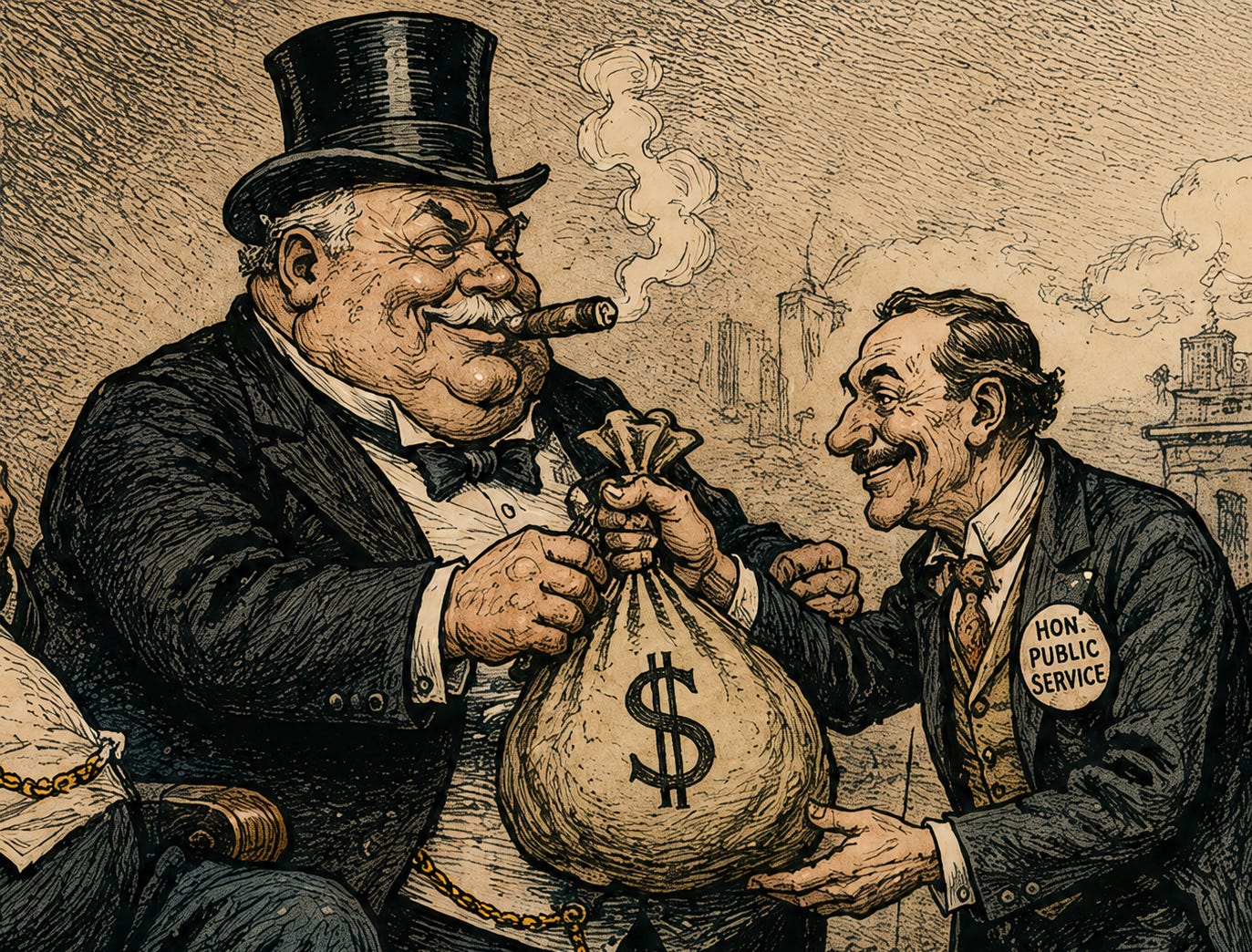
After a harrowing and discriminatory ordeal at the hands of the Michigan State Police, Dakarai Larriett could have become deeply disenchanted. When troopers pulled him over, exhaustively searched his vehicle, subjected him to a battery of groundless sobriety tests, mocked his sexual orientation, detained him at the police station, and required him to defecate in front of officers, he could have become jaded and cynical. When police body cam footage appeared to show that, upon finding no contraband, the troopers allegedly attempted to plant drugs in his vehicle, he could have decided that the system needed to be burned to the ground.
Instead, he became a liberal reformer, running for Tommy Tuberville’s vacant US Senate seat in his home state of Alabama in the 2026 midterm elections.
Larriett, a Democrat, campaigned on a platform centered around pocket-book issues and accountability, led by his flagship proposal of a “Motorist Bill of Rights”, which would hold state and local law enforcement to the same standards of probable cause to which federal agents must adhere. For nearly a year, the former executive and entrepreneur ran as the frontrunner in the Democratic primary. He put in the work, raised an impressive sum of money, and built a strong grassroots base. Then Everett Wess, a last-minute entrant to the race, flipped the script, taking Larriett to a runoff election in June and defeating him by just 8,000 votes. Under ordinary circumstances, kudos to Wess would be in order — or a postmortem of whatever costly errors the Larriett campaign must surely have committed. Only, these weren’t ordinary circumstances — or rather, they were, just in ways most voters would be shocked to discover. Once again, it would seem, Larriett’s faith in the system is being tested, but he’s still not giving up.
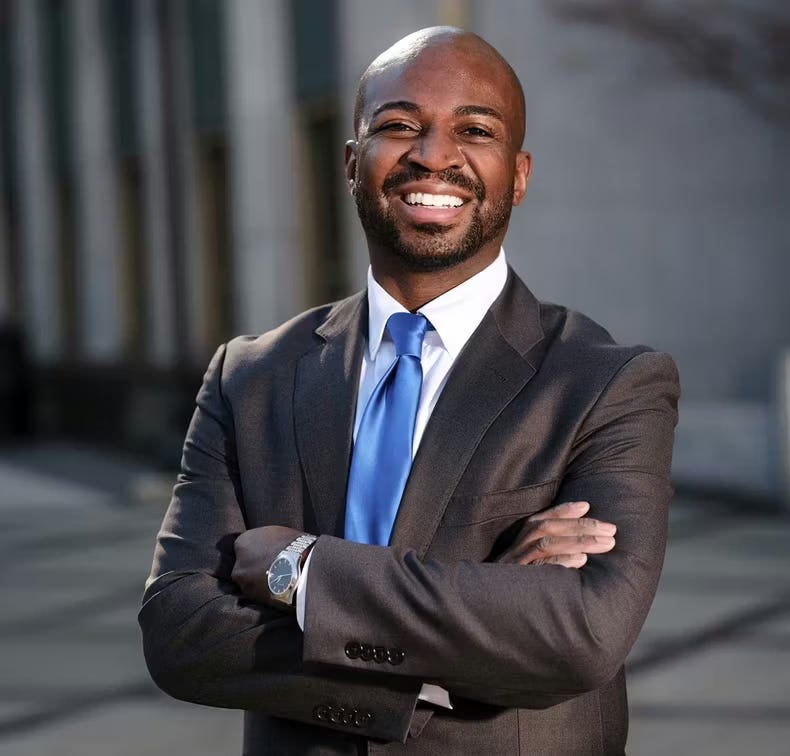
“There was something to do at every single moment”, Larriett told me, looking back on his campaign. “You’re either raising money or raising votes. I started on the phone in February of 2025. I would literally be [raising money] on the phone from nine to six.” As he gained traction, his campaigning increasingly shifted to in-person events, “traveling to different counties, talking to Democratic groups, talking to the police union, talking to the steel workers, every single kind of constituent group you can think of.”
Larriett wasn’t running unopposed during those months. It was an unusually crowded Democratic field in a deep red state. “There were four Democrats running for the nomination, and two write-in candidates,” he said. “It was a very competitive field. Keep in mind, in Alabama, we have to go out and recruit candidates to run for these types of offices. Sometimes no one runs. Sometimes one person runs.”
When no candidate earned at least 50 percent of the vote in May, Larriett, a first-time political candidate, advanced to a runoff and lost with just over 45 percent of the vote. What went wrong?
“There are really two major black endorsement groups,” Larriett explained. Black Alabamians make up about a quarter of the state, but half of the Democratic electorate. “There’s the Alabama New South Coalition, which is actually chaired by my opponent, Everett Wess. He did not recuse himself from the endorsement conference process where we go before the members and pitch our candidacy, our fundraising, and our path to success. I think most people would agree that it was unethical for him to participate in that process and to then nominate himself.
“Then the most important endorsement group is the Alabama Democratic Conference, which is essentially the Black Caucus. It’s been run in a very unethical manner for a couple of generations, and very credible evidence has been shown that they sell endorsements. The chair of the Black Caucus, after nominating you, calls you or sends you a note and says, hey, we need you to put your fair share into the pot for this nomination or we’re going to rescind it. For the office of Senator, it’s $20,000. For Governor, it’s $35,000.”
Wess got that endorsement, as well as a return on his investment. To those who only follow presidential general elections, it might seem as though endorsements are symbolic but largely inconsequential. After all, Donald Trump won the presidency twice while being overwhelmingly out-endorsed by his opponents among newspapers, celebrities, and political groups. But down-ballot races, especially in primary and midterm elections, are far less sensational affairs than presidential politics. Voters often know very few details about the candidates, and beyond party affiliation or snap judgments based on candidates’ names, the endorsements from prominent local political organizations have a disproportionate impact. The picture Larriett paints is stark.
“I outperformed Wess in the conference’s presentation and in fundraising. I raised $150,000, which is very commendable as a Democrat in our state for the primary — the same amount that Senator Doug Jones [Alabama’s most recent Democratic Senator] raised when he won this very same seat [defeating the infamous Roy Moore in 2017]. My opponent raised $12,000 in total for his entire campaign. And at the time of the endorsement conference, he had raised just $2,500.”1
To put this in perspective, a typical Girl Scout sells 293 packages of cookies at around $6 a box — or about $1,750. Sometimes money in politics isn’t about how much you raise, but who the checks are made out to.
“He purchased this endorsement from the Black Caucus. And in the primary, that is a very significant proportion of votes. Even as another black man myself, and with my connection to the community, I couldn’t get quite to 50 percent [...] That’s frankly why I lost.”
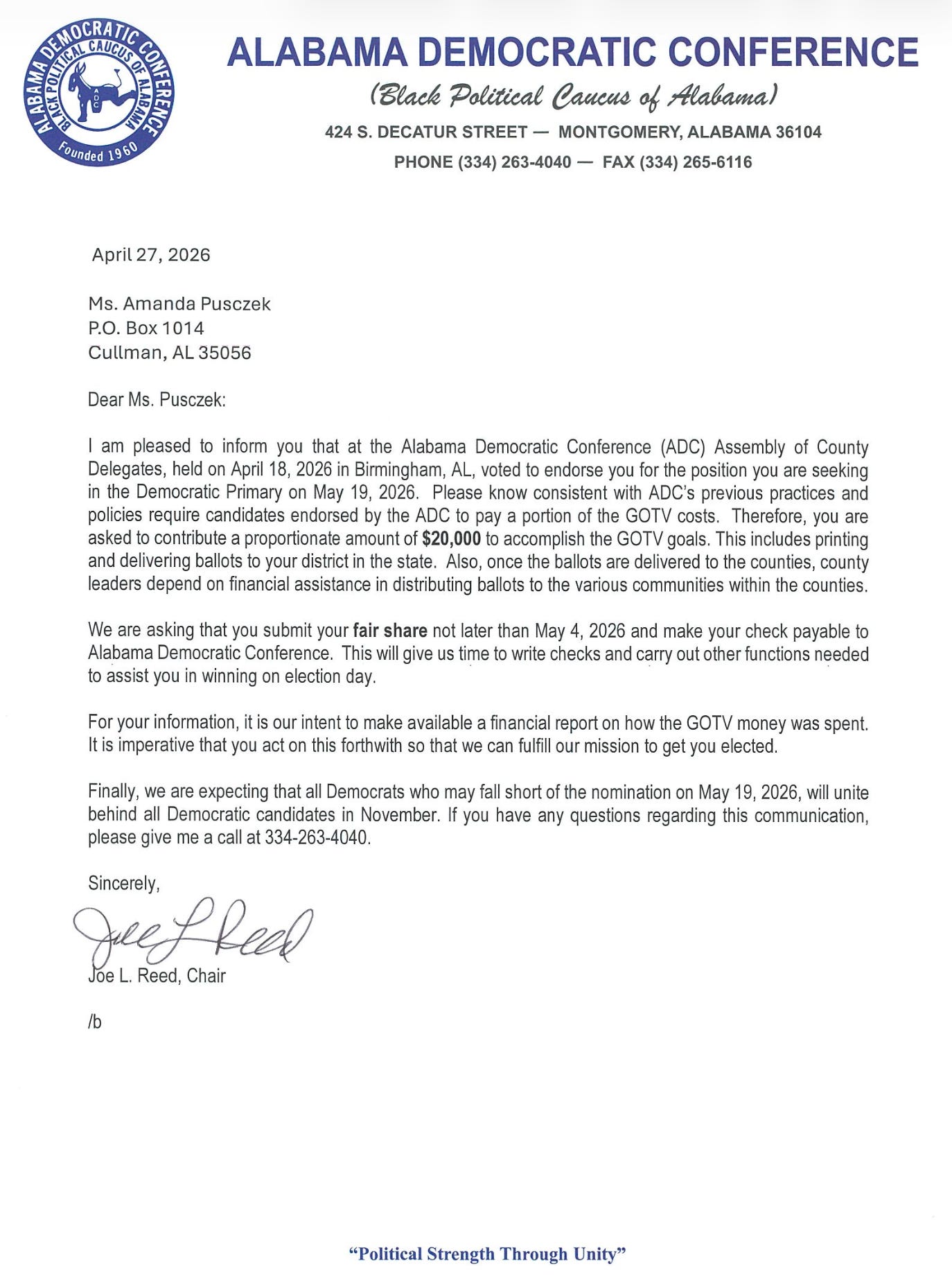
According to Larriett, this kind of quid pro quo endorsement scheme is unlawful, but it’s “selectively reviewed and prosecuted. The bottom line is that everyone is doing it — the Republicans and the Democrats.”
He’s not alone in this view. Tabitha Isner, Vice Chair of the Alabama Democratic Party, has been leading the call for reform. While running for Congress in 2018, Isner also faced demands from the Alabama Democratic Conference to make five-figure payments broken up into $5,000 installments to circumvent federal law. State and local law, however, is another matter.
Isner told me that the Alabama Democratic Conference’s modus operandi “is not being done within the law, within campaign finance rules” and is “hurting the ability for the Alabama Democratic Party to grow.” I asked whether this was a legal loophole being exploited, similar to “dark money” in political action groups. She indicated that it wasn’t a loophole, “It’s just not being enforced.”
“There definitely should be a black political organization in Alabama,” Isner continued, “but it should not be operating outside the law. It should not be trapping candidates in an impossible situation [...] I’d like to see them get their paperwork in order and become a functioning legal organization.”
The reason these kinds of shenanigans are tolerated, Larriett suggested, is that many officials see red-state Dem primaries as meaningless. “What we see with our party is there is kind of this sad, defeatist belief that we can never win the general [election] anyway, so it doesn’t matter per se who wins the primary. It’s really, really sad.”
The problem may be considerably larger than Larriett and Isner believe. This isn’t just an issue for Democrats, for primary elections, or for Alabama politics. Pay-to-play endorsement-selling hearkens back to the blatant campaign corruption rife in 19th- and 20th-century city machine politics, but though practices of this sort have declined over the generations, they’re far from stamped out. Thanks in part to the decline of local journalism, they’re simply flying under the radar. The machine never died.
In Texas, the Harris County GOP passed a resolution in 2014 condemning pay-to-play endorsements within the party. As a local precinct chairman and teacher who led the charge said, “I keep seeing people come in [to polling locations] with these pay-to-play mailers and all the slates [...] They simply vote down the ballot. Whatever [these endorsements] say, they vote that way.” In Collin County in 2022, pay-to-play voting guides recommended the “most conservative” Republican primary candidates who just so happened to purchase ads in the mailer. On the other side of the aisle in 2023, two leaders of the Texas Coalition of Black Democrats – Harris County, a Houston-based political action group, were investigated by the Texas Ethics Commission and fined a total of $45,000 for campaign finance violations. As the Commission stated: “it appears from TCBD-HC’s 2020 endorsement slate and its banking records that TCBD-HC may be ‘selling’ its endorsements in exchange for financial contributions.”
In Marion County, Indiana, inquiries were launched in the 2010s to investigate the process by which judicial candidates were endorsed by their parties after paying five-figure “slating fees” ($12,000 for Republicans, $13,500 for Democrats). As the Indianapolis Business Journal noted in 2016, “People who ran against the party’s endorsed candidates in the primary almost never won.” Similarly, Pennsylvania’s Allegheny County Democratic Committee has been criticized as “undemocratic” for charging city-level candidates in Pittsburgh thousands of dollars just to be considered for an endorsement. In Illinois, the Cook County Democratic Party reportedly endorses candidates if they commit to raising $45,000 for the Party. According to the Chicago-based nonprofit Injustice Watch, in 2024, “The party’s picks all won — most of them by substantial margins.” In California, Alice Huffman, a high-profile campaign consultant as well as the leader of the California NAACP, came under fire in 2020 after news broke that the campaigns that hired her always seemed to earn the NAACP’s seal of approval over their competitors. This is merely a sampling.
“It’s not just the money in politics,” Larriett told me. “It’s these gatekeepers who are self-dealing and enriching themselves, like Joe Reed, who is the Alabama Democratic Conference Chair. We’ve really got to clamp down on that. And we do have laws, but they’ve got to be enforced.”
Larriett’s fight isn’t over. He’s been recruited to pursue a position in the Alabama Democrats’ LGBT caucus, which he’ll vie for in August, and is continuing to fight his suit against the Michigan State Police. He’s hoping that a victory in court could help get more traction behind his Motorist Bill of Rights. The machine may be grinding implacably on, but so is Dakarai Larriett.
See also: “Down the Rabbit Hole of Money in Politics”
American Dreaming is a reader-supported publication. To receive new posts and support our work, consider becoming a free or paid subscriber.
Subscribe now and never miss a new post. You can also support the work on Patreon. Please consider sharing this article on your social networks, and hit the like button so more people can discover it. You can reach me at @AmericnDreaming on Twitter, @jamie-paul.bsky.social on Bluesky, or at AmericanDreaming08@Gmail.com. Cover image generated by ChatGPT.
Comments
Nothing yet. Say the first thing.
Sign in to join the conversation.