
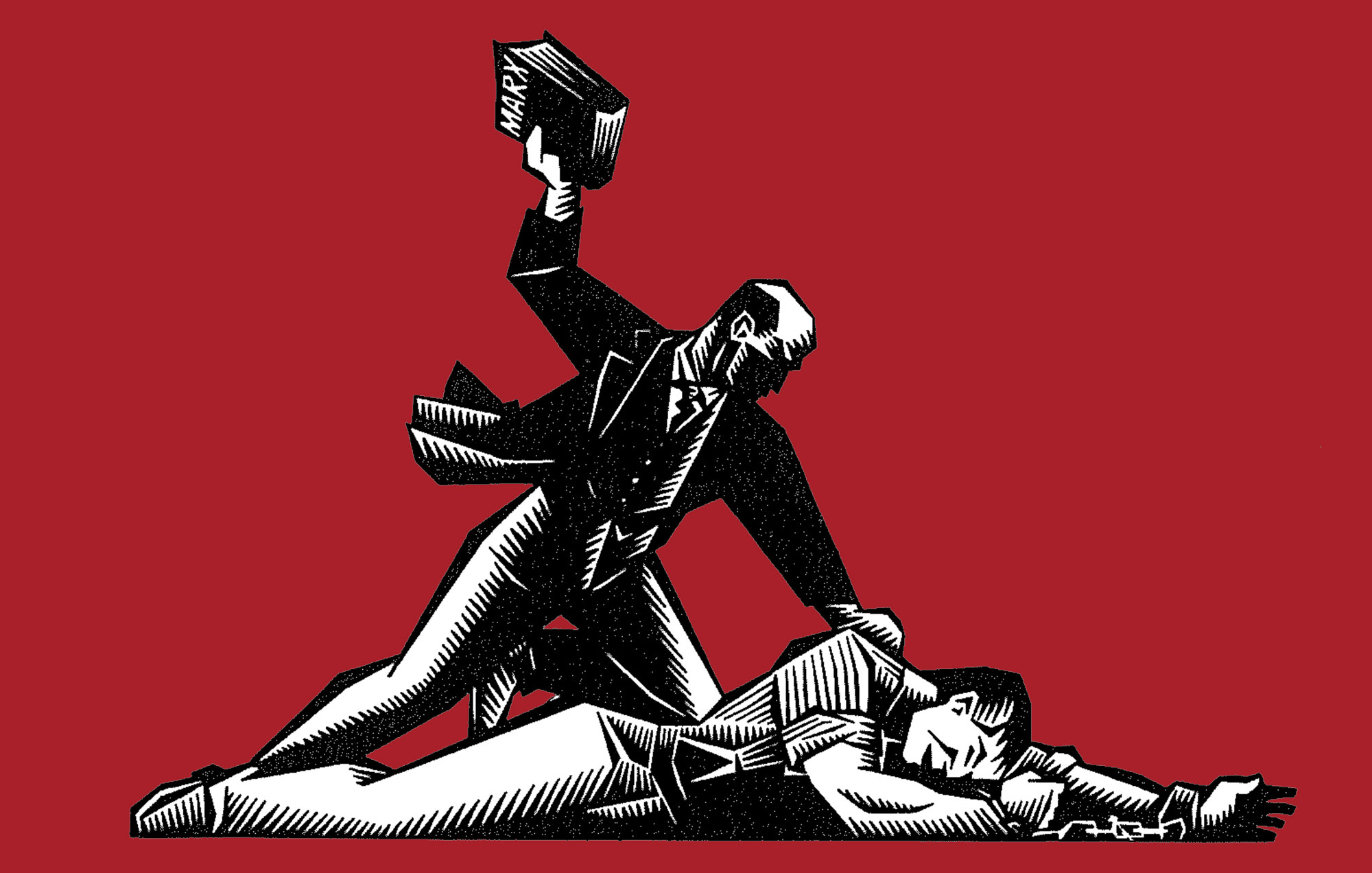
This post is by contributor Alexander von Sternberg.
“Marx called religion the opium of the people. Whether it wants to or not, the Church consolidates the established injustice. It helps men to support and to forget their ills instead of curing them. Obsessed by the hereafter, the believer is indifferent to temporal things. Marxist ideology, as soon as a State has built it up into an orthodoxy, lays itself open to the same criticism: it also teaches the masses obedience and confirms the authority of the rulers. […] The concept of the classless society is emptied of meaning as the regime born of the Revolution becomes stabilized into an old-fashioned bureaucratic despotism.”
— Raymond Aron
In early 2026, a left-wing convoy of 650 delegates from 120 organizations — including political celebrities like the streamer Hasan Piker, former British Labour Party leader Jeremy Corbyn, Code Pink co-founder Medea Benjamin, and the Irish rap group Kneecap — descended upon Cuba armed with 20 tons of goods. Perhaps more importantly, they also brought ample video and audio equipment to promote themselves and their noble cause. This ostensibly humanitarian excursion was in response to the Trump administration’s blockade of the communist island nation, and the trip quickly made headlines across the English-speaking world, though not necessarily for the reasons the celebrity activists preferred.
It would be unfair to call the convoy a disaster; indeed, 20 tons of goods were supposedly provided to the Cuban people, who are in genuine need. Whether the influencer-activists were aware that those needs were not being met by the country’s dictatorship long before the Trump administration’s blockade is beside the point, as are the activists’ intentions. It became clear, as footage was beamed back to the United States, that these progressive pilgrims were upholding the time-honored tradition known as “champagne socialism.” A better moniker these days may be “couture communism”, especially when gazing upon the haute couture Piker bore, complete with a $695 button-down from Glass Cyprus and a $1,360 pair of Cartier glasses. Meanwhile, Piker and company stayed in 5-star hotels like the Gran Hotel Bristol Habana Vieja. While there’s nothing wrong with living in luxury when you can afford it, this stands in stark contrast to the lives of everyday Cubans, many of whom make less than $200 a year — the very people with whom Piker and his fellow travelers claimed to be in solidarity.
More to the point, the gathering of self-described Marxists and socialists not only sojourned in tone-deaf luxury, but they did so in the midst of Havana’s widespread power outages and blackouts, from which upscale hotels and tourist attractions were largely shielded.1
It is tempting to simply call out the hypocrisy of this entire affair and call it a day; after all, it’s a common critique of Western socialists, given the amount of energy they expend posturing as tribunes of the working class. But to stop at the hypocrisy is to miss something crucial: contrary to its PR branding, the philosophy that undergirds the Western far left — Marxism — has never been particularly interested in helping the poor or even leveling the playing field. The glorified field trip to Cuba may merely seem out of touch, and it certainly is that, but it also perfectly encapsulates an underappreciated aspect of Marxism. The writer Paul Friesen penned a thorough and deeply researched historical accounting of Marxism, both in theory and practice, that brilliantly summarizes the big-picture view:
“Step back from the individual cases and look at the pattern. Russia, China, Cambodia, North Korea, Cuba, Vietnam, Ethiopia, Mozambique, Angola — different continents, different cultures, different histories, different levels of industrial development, different national traditions, different leaders with different personalities, and different relationships to the theoretical texts. The same outcome: consolidation of power in a vanguard party, elimination of political pluralism, suppression of independent institutions, secret police, show trials, forced labor, famine as a policy instrument, and a death toll that in aggregate runs to somewhere between eighty and one hundred million human beings in the twentieth century alone.”
Friesen’s comprehensive exploration of communism’s monstrous failures is well worth a read, but there may be an even simpler way to characterize Marxist thought that reflects the realities of both its implementation and the mindset of its adherents. As Friesen explains, in practice, the Marxist fundamentally believes that “The actual proletariat […] cannot be trusted to embody their own historical role without guidance.” This way of thinking is a symptom of crude elitism: the idea that one group is inherently superior to most or all others and is therefore better suited to holding power and the privileges that entails. From its foundational texts to its real-world track record, Marxism has shown itself to be just another aristocratic and elitist project that subjugates the lower classes while merely replacing the old upper classes with newer and smaller ones.
The core argument of Karl Marx and Friedrich Engels throughout The Communist Manifesto (1848) is that capitalism contains the seeds of its own (and necessary) destruction. In the preface, Engels summarizes their proposition that “in every historical epoch, the prevailing mode of economic production and exchange” alone explains “the political and intellectual history of that epoch,” and that “the whole history of mankind […] has been a history of class struggles, contests between exploiting and being exploited, ruling and oppressed classes.” Engels and Marx thus claim that the structure of existing societies is an eternal antagonistic struggle between the bourgeoisie and the proletariat. This deterministic view of society allows room for further generalizations regarding social classes, which quickly become clear.
For all that they lionize the proletariat, Marx and Engels are careful to delineate what they consider to be the better and worse elements of each class. To these ends, they assert that the lowest level of existing class systems consist of “social scum, that passively rotting mass thrown off by the lowest layers of old society” who are the “bribed tool of reactionary intrigue.” At the same time, they also seem to praise the bourgeois “ideologists” who “comprehend the historical movement as a whole.” According to Marx and Engels, the poorest and least educated people are little more than pawns of the bourgeoisie and cannot be trusted, despite their exploitation. This elitist sentiment bears more than a little resemblance to trends in modern progressive politics. We can see its echoes in the general sneering that many working-class Americans have received and perceived from the Democratic establishment for the past decade, ranging from Hillary Clinton’s infamous “basket of deplorables” remark to blaming poor white women for their own problems to outright NIMBYism.
This idea of subversive elements from below had deep roots in Marx’s mind. In his 18th Brumaire of Louis Bonaparte (1852), Marx bemoaned the lack of true revolutionary verve in the 1848 Revolution in France, and saw it simply as a perpetuation of the bourgeoisie that had already been dominating the country. In his text, he claimed that the insufficiency of the Revolution was thanks to the revolutionary republicans who amounted to class enemies for establishing a system which, “like Achilles, [was] vulnerable in one point — not in the heel, but in the head, or rather in the two heads it wound up with: the Legislative Assembly on the one hand, the President on the other.” To Marx, these revolutionaries were insufficient vessels for the necessary societal change in post-Napoleonic France. Yet while he singled out the elite strata of French society, Marx also presaged his and Engels’s later contempt for the “social scum” of Europe’s poor. Expressing an idea of apartness, Marx wrote of the special knowledge possessed only by those few who truly understood the world, who just so happened to be the same class of bourgeois “ideologists” Marx and Engels valorized and to which they belonged. That apartness absolved the ideologist class of any failures, pinning all blame on subversive elements both above and below. Conspiratorial scapegoating of this kind is, of course, among the bedrocks of elitism.
Indeed, the elitism of Marx and Engels habitually tended toward this circular thinking, creating a Manichean foundation that always necessitated violence. For example, when addressing their critics on the question of private property, they write in the Manifesto, “you reproach us with intending to do away with your property. Precisely so; that is just what we intend.” The forcible confiscation of property against someone’s will is, in essence, an act of violence, and one that likely results in greater violence and oppression. Marx and Engels understood this. They created a logical structure whereby the eternal enemy — the bourgeoisie — was deemed the only true owner of property. Variations of this concept have filtered down to this very day, usually revolving around the term “landlord.”
The self-imposed convenience of the model is laid bare whenever there is an exception to the rule, such as a member of the working class managing to afford their own rental property, in which case they suddenly — magically — become part of the bourgeoisie. This creates a perpetual enemy in need of destruction. More importantly, this type of thinking denies the messy realities of capitalism, in which individuals do not live as classes but as individuals that often share hardships. Through their collectivist and deterministic lens, Marx and Engels have no patience for human agency, reality be damned.
The elitist is, above all else, at odds with messy realities; they have no tolerance for the exceptions to their rules, which exist simply to justify their own apartness and specialness. Marxism is one of the purest ideological embodiments of this characteristic — and it goes beyond mere theory, which is, ultimately, subjective. If we examine the various implementations of Marxism in practice, particularly in the Soviet Union and its satellites, it’s clear that the elitism was not due only to Marx’s and Engels’s individual worldviews or choice of phrasing. Elitism was baked into Marxism itself, such that it inevitably bled (figuratively and literally) into nearly every large-scale attempt at practical application, as has been observed by critics both without and within the communist systems of the 20th century.
No one outside the Communist Bloc better understood the nature of communism in practice and the type of person it appealed to than the philosopher and liberal anti-communist Raymond Aron. Aron is a figure many today may be unfamiliar with, but as the cultural critic Clive James explained, his contributions to 20th-century thought “did most to offset the more famous Jean-Paul Sartre’s support for communism” in the French intelligentsia, which served as the intellectual bedrock of the pro-communist West. In 1955, he published L’Opium des intellectuels (The Opium of the Intellectuals), an incisive critique that in a single stroke made both him an enemy of the Marxist intelligentsia and also its most effective critic. A keen observer of revolutionary dynamics, Aron made it clear in Opium that “the Marxist type of revolution has never come about because its very conception was mythical”, given that “proletarian revolutions, like all the revolutions of the past, merely entail the violent replacement of one elite by another.”
Aron also questioned the idea of a uniform “proletariat” to begin with, rightly noting that there was no way an entire class of people would share the same values at all times or neatly align with what Marx and Engels would have seen as proper guidance. There was no evidence, Aron explained, of “the characteristics which make [the proletariat] a unity.” Philosophers such as M. Merleau-Ponty or Jean-Paul Sartre could hope all they wanted for a Marxist awakening, but crucially, “they cannot […] represent as a fact the universality of the industrial worker.”
The fact that Marxism was so insistent on the inevitability of its generalizations led Aron to realize what was really going on: the opportunism of a counter-elite. Refuting the idea that Marxism was “the science of working class misfortune,” Aron noted that “communism merely makes use of this pseudo-science in order to attain its own end, the seizure of power” by enticing those in the working class not through promises of equality, but by bringing down the dominance of the bourgeoisie. Taking the point further, Aron wrote, Marxists “have not the honesty to admit that the proletariat, as it becomes gradually and inevitably more bourgeois, loses the virtues which seemed to make it worthy of this high calling,” referring to the ending of all supposed evils of industrial society. Given the contempt Marxists have for the poor and uneducated — the “social scum” — it should hardly be surprising that their proletarian revolutions invariably take the form of replacing one bourgeoisie with another.
These critiques were not confined to Western or capitalist observers of communism. In fact, they included communism’s participants. The first, loudest, and perhaps most significant to notice the bureaucratization of Soviet communism was Leon Trotsky, though his solution was essentially to birth the meme of “real communism has never been tried” via his call for permanent world revolution. As heroic a figure as Trotsky became to so many socialists, he was ultimately an insufficient critic of Marxist thought put into practice. In contrast stood one of the great democratic socialist dissidents of the 20th century, Yugoslavia’s Milovan Djilas, who served as communist dictator Josip Broz Tito’s President of the Federal People’s Assembly of Yugoslavia before being expelled from the party for his advocacy of freethinking and more democratic forms of governance. His most famous work, The New Class: An Analysis of the Communist System (1957), was published abroad after he had been arrested for speaking out against Yugoslavia’s silence on the brutal Soviet occupation of Hungary in 1956. Thanks to the book’s content and, it should be said, wild success, his prison sentence was extended to 10 years.
Through his experiences as a communist, Djilas wrote that unlike what he saw as more humane and democratic forms of socialism, “power is almost exclusively an end in Communism, because it is both the source and the guarantee of all privileges,” with power determining “the material privileges and ownership of the ruling class over national goods” and “the value of ideas.” In essence, Djilas saw the truth firsthand of what Aron had observed from afar: that communism was not an act of liberation or a purveyor of dignity upon the downtrodden, but the creation of a new ruling class: a new elite. As Djilas explains, communist regimes’ “fundamental distinction lies in the fact that a bureaucracy, organized in a special stratum, rules over the people.” Thus, “in practice, the ownership privilege of the new class manifests itself as an exclusive right, as a party monopoly, for the political bureaucracy to distribute the national income, to set wages, direct economic development, and dispose of nationalized and other property.” Socialist catchphrases and rhetoric about workers and the people, Djilas argued, served to mask this elitist reality of communist states.
Djilas’s critique was different from Trotsky’s, who sincerely believed that, due to the Soviet Union’s transformation into a Stalinist nightmare, true communism had never actually been tried. Contrary to that desperately tired talking point, Djilas recognized that the elitist tendency within communist regimes was baked into Marxist theory itself. As he noted, “every ideology, every opinion, tries to represent itself as the only true and complete one,” a fact especially true of Marxism. Marx and Engels were distinguished, Djilas wrote, by “[denying] every scientific and progressive socialist value in the thinking of their contemporaries, usually lumping such ideas into ‘bourgeois science,’ thus banning every serious discussion and study in advance.” Therefore, “if it was independent of the movement, it was not important.” In other words, there was no room for alternative explanations, interpretations, or even questions. This circular logic is a hallmark of elitist thinking because nothing worthwhile exists outside of itself; it necessitates exclusivity.
Compelling as his observations were, Djilas was by no means the most significant critic of this aspect of Marxism. Some of Marx and Engels’s contemporaries saw the writing on the wall from the very beginning, particularly the Russian anarchist Mikhail Bakunin. Anticipating Trotsky’s and especially Djilas’s critiques by nearly a century, Bakunin repeatedly warned that “scientific socialism” and the “dictatorship of the proletariat” would, in practice, mean rule by party intellectuals and administrators rather than self-emancipation by workers (to say nothing of those Marx and Engels termed “social scum”). In his words, it would be “the rule of socialist savants,” in which “the upper layer, the aristocracy of labor” would possess all of the privileges promised to the people by the revolution. Bakunin perceived clearly that Marxism’s insistence on a single official program necessitated centralized authority and that its so-called “scientific” leadership would inevitably lead to a small cadre ruling in the name of the people it claimed to have freed. As Bakunin wrote:
“The differences between revolutionary dictatorship and statism are superficial. Fundamentally they both represent the same principle of minority rule over the majority in the name of the alleged ‘stupidity’ of the latter and the alleged ‘intelligence’ of the former. Therefore they are both equally reactionary since both directly and inevitably must preserve and perpetuate the political and economic privileges of the ruling minority and the political and economic subjugation of the masses of the people.”
Bakunin went on to write:
“There is a flagrant contradiction in this theory. If their state would be really of the people, why eliminate it? And if the State is needed to emancipate the workers, then the workers are not yet free, so why call it a People’s State? […] They insist that only dictatorship (of course their own) can create freedom for the people. We reply that all dictatorship has no objective other than self-perpetuation, and that slavery is all it can generate and instill in the people who suffer it.”
Had he lived another 100 years, Bakunin would likely have been aghast at the human destruction Marxism in practice had wrought, but he would not have been surprised at what he saw. He knew such things would come to pass: elite cadres, acting in the name of an ideal they were no closer to implementing than when they began their rule, instead satisfying themselves with Orwell’s maxim of a boot stamping on a human face forever.
As of the summer of 2026, Marxism seems to be en vogue again. With the election of Zohran Mamdani at the end of 2025, the surprise victories of Marxist and Marxism-aligned candidates in places like New York City, Los Angeles, and Colorado, and a third of Democrats and Dem-leaning voters self-describing as democratic socialists, Marxism is, once again, having a moment.2
In 2025, the sociologist Tibor Rutar wrote in Quillette that Marxism was an idea that refused to die. When we see through Marxism’s liberationist trappings to perceive the elitist project underneath, it’s not difficult to understand why. Marxism is an ideology born from and perpetuated by segments of the intelligentsia. Theory is generally the province of the affluent and privileged, and those who traffic in ideas are almost never “workers” themselves. Liberation on a Marxist scale is an attractive idea to many bourgeois radicals, and the replacement of one ruling class with another led by themselves and justified by this promise seems all the more attractive because, unlike Trotsky’s mythical “true communism”, it is actually attainable. That promise of liberation is the fuel that can bring thousands, if not millions, willingly along for the ride. But like all utopian promises, it is and always has been an illusion. As Rutar explains, “Marx’s theory of history has proved unfounded and unworkable,” with modern Marxists simply “reframing older [ideas] every time they are empirically falsified by new data — a kind of ideological p-hacking.”
Marxism has an enduring power that cannot be denied, but given its track record, it must be refuted, just as fascism has been. Like all utopian ideologies, Marxism possesses the power to convince many of its promises when in fact it simply enriches very few. “The billionaires” among us may be brought low by an applied Marxist project, but as history has shown, that only results in a new elite class, one whose power rests less on money, but on the ability to crush dissent and weaponize a vast bureaucracy against its ever-expanding list of enemies.
As Clive James noted, “no ideology can tolerate a full historical consciousness.” Despite its baffling endurance, Marxism is no different. Like feudalism, theocracy, and other outdated organizing principles, Marxism rests not only upon the notion that the unwashed masses cannot think and decide for themselves, but also that it is dangerous to let them try. While the historical record provides all the worldly, material evidence necessary to demonstrate Marxism’s repeated and destructive failures, those failures were there from the beginning for anyone to see, in Marx’s and Engels’s own words.
See also: “The Myth of European Progressivism”
Subscribe now and never miss a new post. You can also support the work on Patreon. Please consider sharing this article on your social networks, and hit the like button so more people can discover it. You can reach me at @AmericnDreaming on Twitter, @jamie-paul.bsky.social on Bluesky, or at AmericanDreaming08@Gmail.com. Cover image source: Crimethink
Accusations spread online that a concert held by activists, which included a light show, caused these power outages. Florida Representative Maria Salazar even claimed that “Seven Cubans died because they were on ventilators, and since the hospital lost power, the people couldn’t continue breathing,” directly tying these alleged deaths to Code Pink and the other activists. The hospital in question, Hermanos Ameijeiras Hospital, later denied that any of their patients died, and there is little evidence that the activists’ presence and use of the Cuban power grid directly caused any blackouts.
Some might take issue with referring to these victories as Marxist. After all, these people identify as democratic socialists, and many are members of the Democratic Socialists of America (DSA), which, we are told, is not a communist or Marxist organization and wants only to provide free healthcare and raise affordability. Unfortunately, this does not track with the realities inside the DSA. As the journalist Stu Smith reported, “the majority of the DSA’s governing board, the National Political Committee (NPC), openly identifies with Communist ideology.” This shift away from the social democratic goals that once defined the DSA over a decade ago (a shift best understood via its internal sectarian dynamics) was made apparent both by the organization’s “radical new platform” and DSA members’ own statements, helpfully compiled by Smith. Marxism, it appears, has a new lease on life, making a critical analysis of its central character all the more urgent.
Comments
Nothing yet. Say the first thing.
Sign in to join the conversation.