
This post is by contributor Jacob Bielecki.
The recent Supreme Court decision Louisiana v. Callais ruled that a Louisiana congressional map updated to include two majority-black voting districts was unconstitutional after a legal challenge from self-described “non-African-American” voters. The lawsuit claimed that the map was an example of racial gerrymandering despite the fact that black people comprise 30 percent of Louisiana’s population and the previous congressional map contained only one majority-black district out of the state’s six — a nearly twofold underrepresentation. While the Court’s Republican majority did not gut Section 2 of the Voting Rights Act, Justice Elena Kagan in her dissent said the Court’s majority opinion rendered it “all but a dead letter.” The Louisiana legislature is now redrawing a map that will once again leave the state’s black voters with just one majority district and give Republicans another seat in the House of Representatives.
This is merely the latest salvo in Republicans’ systematic attack on civil rights, and one that sets a troubling precedent other states may follow. The South’s GOP strongholds are continuing an old legacy, one that has wavered on occasion but never truly died. It’s the legacy of “The Great White Chief” James K. Vardaman, the early-20th-century Governor and later Senator from Mississippi. In the post-Reconstruction era, Vardaman and white southerners implemented a white supremacist regime of disenfranchisement and terror. Now, sixty years later, this regime is making its return.
The story of America’s most odious Senator begins in Edna, Texas on July 26, 1861, where James Kimble Vardaman was born under the stars and bars of the Confederacy to Mollie Fox and William Sylvester Vardaman.1 William had moved his family to Texas in 1858 and bought a plantation; however the amount of money he had to borrow left him too heavily in debt to purchase the necessary number of slaves to work the land. When Texas seceded from the Union in 1861, William Sylvester Vardaman joined the Confederate Army and served under General Lawrence Sullivan Ross, a former Texas ranger who would serve as the 19th Governor of Texas from 1887-1891 and as the fourth President of Texas A&M University from 1891-1898. The elder Vardaman was wounded in action and disabled for the rest of his life. Upon the Civil War’s conclusion, William returned to a dilapidated plantation whose liberated slaves had left. He also still hadn’t paid off his loans. With his dream of becoming a wealthy plantation master and slave owner dashed, William packed his family and a few of their possessions into a wagon and travelled to Yalobusha County, Mississippi in 1868.
Because of William Sylvester Vardaman’s disability, James and his two brothers had to work on the family cotton farm as well as picking cotton on neighboring farms just to make ends meet. Neighbors said the Vardaman brothers were the best cotton pickers in Mississippi. But to the young Vardaman, picking cotton was ignominious work. Slave’s work. And the fact that he had to do it was a humiliation that fueled his white supremacist views for the rest of his life. James K. Vardaman, like his father, resented that the Union’s victory in the Civil War deprived him of his dream of owning a great plantation where slaves toiled the land. He wasn’t the only white Southerner who thought this way.
Vardaman aspired to be a lawyer and politician from an early age. So strong was his desire that when he had his tonsils removed, his parents told him that if he put up a fuss during the surgery he would lose his voice and never become a lawyer. As a young man, after saving up 200 dollars from making and selling cross ties to the local train station, Vardaman moved in with an uncle, was formally educated by his cousin, and passed the bar exam, which was an oral examination in those days.
Though a practicing lawyer in Winona, Mississippi, journalism came to occupy a growing portion of Vardaman’s time as he edited the Winona Advance and later moved to Greenwood, Mississippi where he founded the Greenwood Enterprise. Much like Benito Mussolini, Vardaman’s journalism career was pivotal to gaining a following he could transfer to politics. His populist editorials criticizing Mississippi’s elite quickly made him a hero among the state’s poor whites.
In 1890, Vardaman made the jump to elected office, winning a seat in Mississippi’s House of Representatives. With his finger on the pulse of the electorate and the shame of his youth still burning in his belly, James K. Vardaman knew exactly what his base wanted. He gave them unabashed racism, and they loved him for it. But not everyone welcomed this rising political star. Vardaman’s vow to break up large plantations and redistribute the land to poor white farmers put him in direct opposition to Mississippi’s planter elite, who also feared that his white supremacist policies would cause black sharecroppers, the backbone of the state’s economy, to flee North. Mississippi’s upper crust sneered at Vardaman’s supporters and called them “rednecks”, but their disdain only strengthened Vardaman’s support among poor whites, who proudly embraced the moniker and even wore red handkerchiefs to Vardaman’s rallies.
Ultimately, it didn’t matter what Mississippi’s elite wanted. The state’s poor whites demanded a white supremacist government, and they voted en masse for men like James K. Vardaman to give it to them.
Decades later, another infamous demagogue would learn the hard way what Southern whites really wanted from their elected leaders. George Wallace was the symbol of white Southerners’ resistance to the Civil Rights movement, but he wasn’t always a segregationist. Before his entry into politics, Wallace was a judge for Alabama’s Third Judicial Circuit noted for his fairness regardless of race. While other judges called black attorneys by their first names, Wallace paid them the respect of addressing them as “mister.” When Wallace ran for Alabama governor in 1958, he steered clear of race, speaking against the Ku Klux Klan and being endorsed by the NAACP. He was soundly defeated in the Democratic Primary by John Malcolm Patterson, who promised to close any schools the federal government attempted to integrate and flaunted his Ku Klux Klan endorsement. Lamenting his loss, Wallace said, “You know why I lost that governor’s race? […] I was outniggered by John Patterson. And I’ll tell you here and now, I will never be outniggered again.”
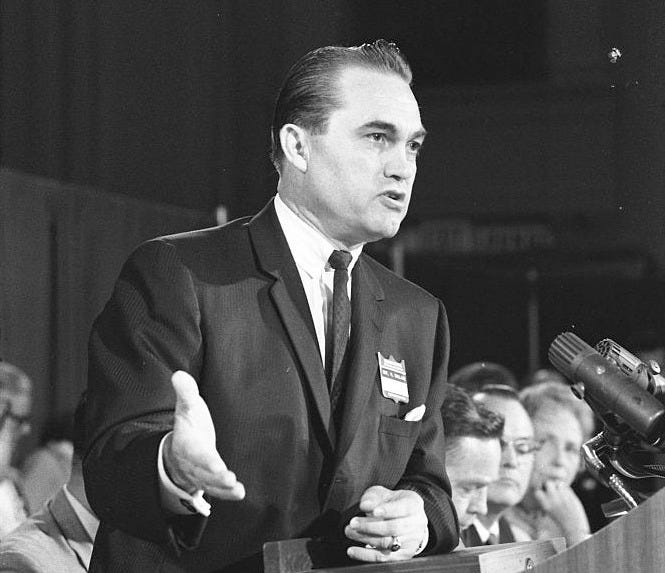
Moving forward, Wallace took a hard-line stance against integration, justifying this change in direction with perhaps the most damning remark ever made about Southern voters: “You know, I tried to talk about good roads and good schools and all these things that have been part of my career, and nobody listened. And then I began talking about niggers, and they stomped the floor.”
James K. Vardaman’s policy positions were eye-opening, not because of what they said about him but because of what they said about white Southern voters. Vardaman favored strictly regulating corporations, the prohibition of alcohol, and nationalizing coal mines, railroads, and telephone lines. He also supported raising taxes on the wealthy and government-funded pensions for the elderly, a forerunner to what would become Social Security. Anyone running on a similar platform today would be called a socialist, yet Vardaman’s voters wholeheartedly supported his policies. White voters were all for a little economic planning so long as those plans excluded black people — a sentiment that lingers to this day.
Vardaman’s 1890 victory coincided with white Southerners seizing control of legislatures throughout the former Confederate states in the late 19th Century. Contrary to popular belief, what we know today as Jim Crow laws were not immediately implemented after Reconstruction ended with the Compromise of 1877. These discriminatory laws were the culmination of rampant voter fraud on the part of white Southerners and racial terror campaigns against African-Americans to prevent them from voting. During Mississippi’s convention to replace its 1868 Reconstruction-era constitution, 133 of the 134 delegates were white Democrats. The only black or Republican delegate was Isaiah T. Montgomery, despite black people making up 58 percent of Mississippi’s population. Montgomery, a prominent leader in Mississippi’s black community who founded the all-black town Mound Bayou, was chosen as a delegate because of his accommodationist views on race. “Marsh” Cook, a white Republican, had also campaigned to be a convention delegate and attempted to organize black Mississippians to oppose the Constitution, but he was shot 27 times by six assailants. No one was arrested for Cook’s murder.
The new constitution enshrined a literacy test and poll tax, both required for any voter to cast a ballot. In practice, these provisions were primarily enforced to restrict the voting access of African-Americans. Similarly, black people were barred from owning firearms, part of a consistent pattern throughout US history in which the right to bear arms has been unequivocally championed for white Americans while remaining conditional for black Americans. The state Constitution also included a grandfather clause that prevented Mississippians from voting if their grandfather had never voted. As it had only been 25 years since the end of the Civil War, virtually every African-American’s grandfather, having been enslaved for most of their lives, would have never cast a ballot.
In some former Confederate states, these grandfather clauses acted as loopholes to allow those poor whites who could not pass a literacy test or pay a poll tax to continue to vote. However, this was not the case in Mississippi, as thousands of poor white and illiterate men were barred from voting. In 1890, Mississippi had 110,000 registered white male voters. By 1892, there were only 68,000. Mississippi’s 1890 Constitution was the blueprint every former Confederate state legislature followed when enacting their post-Reconstruction-era constitutions from 1890-1908.
While the Constitution’s language was vague, the delegates were anything but. Sol S. Calhoun, the Constitutional Convention’s President and a justice on the Mississippi Supreme Court, proclaimed, “Negro suffrage is an evil […] The negro race seems unable to maintain even its own imitative acquirements. It seems unfit to rule. Its rule seems to mean, as it has always meant, stagnation, the enslavement of woman, the brutalization of man, animal savagery, universal ruin.”
Isaiah T. Montgomery, the lone black delegate, found himself in an impossible position. If he voted in favor of the Constitution, it would be a betrayal of his own community. If he voted against it, he and his family may very well have been lynched. In the hopes that black Mississippians would be spared from further racial terror if they kept their heads down, Montgomery voted to ratify the Constitution. Former Confederate General William T. Martin, who was one of only three delegates to vote against enacting the Constitution (over a dispute about state debt), said to the assembled men during deliberations, “What are you here for, if not to maintain white supremacy?”
The new Constitution worked exactly as intended. In 1890, there were 130,000 black voters registered in the state of Mississippi. By 1900, there were less than 1,300. And in 1898, the United States Supreme Court ruled that Mississippi’s constitution was legal as it did not explicitly state that it discriminated against black people.
No delegate was more proud of Mississippi’s 1890 Constitution than James K. Vardaman, who had no qualms admitting what its purpose was, stating: “There is no use to equivocate or lie about the matter. [...] Mississippi’s Constitutional Convention of 1890 was held for no other purpose than to eliminate the nigger from politics. Not the ‘ignorant and vicious’, as some of the apologists would have you believe, but the nigger. [...] Let the world know it just as it is. [...] In Mississippi, we have in our constitution legislated against the racial peculiarities of the Negro. [...] When that device fails, we will resort to something else.”
Vardaman was made Mississippi’s Speaker of the House in 1894, a powerful role that positioned him to make a run for Governor. After his bid for the governorship failed in 1895, however, Vardaman volunteered to serve in the Spanish-American War where he was commissioned as a Captain in the United States Army. While serving in Cuba, he was promoted to Major. As the war continued into 1899, Vardaman requested to be discharged so he could run for governor again but ultimately chose to stay in the Army.2 When he was finally discharged, there were only a few weeks left to campaign for the Democratic Party’s nomination.
With the mass disenfranchisement of African-Americans, Mississippi was effectively a one-party state where winning the Democratic nomination for any office was tantamount to winning the general election. At the time, Mississippi counties could choose whether to hold the nomination process through popular vote or by electing a delegate who would then cast a vote on the county’s behalf at the Mississippi Democratic Party Convention. Just like in 1895, Vardaman won all the counties where the nominee was selected through a popular vote and lost the counties where a delegate was selected. This allowed Andrew H. Longino to win the nomination and the governorship. However, Vardaman’s many supporters applied immense pressure to the state legislature to change the primary system, which they did, passing a law decreeing that nominees for all statewide offices would be decided by popular vote.
On October 16, 1901, African-American civil rights leader and Tuskegee Institute President Booker T. Washington had dinner with President Theodore Roosevelt at the White House. The dinner should have been a routine event that went largely unremarked upon. Instead, an explosion of racist denunciations rang out across the American South.
The Memphis Scimitar said the “dinner was the most damnable outrage which has ever been perpetrated by any citizen of the United States.” Infamous South Carolina Senator “Pitchfork” Ben Tillman told reporters, “The action of President Roosevelt in entertaining that nigger will necessitate our killing a thousand niggers in the South before they learn their place again.” Vardaman somehow managed to one-up this disgusting statement by saying that the White House was “so saturated with the odor of nigger that the rats had taken refuge in the stable.” The Birmingham, Alabama newspaper The Enterprise ran an editorial reading, “The Incident of counseling with a negro and dining with his establishes a precedent humiliating to the South.” Georgia Governor Allen D. Candler said, “No self-respecting man can ally himself with the President, after what has occurred […] and no Southerner can respect any white man who would eat with a negro.” One week after Washington and Roosevelt’s dinner, the Missouri newspaper The Sedalia Sentinel published the anonymously written poem “Niggers in the White House”, which was republished in newspapers throughout the South.
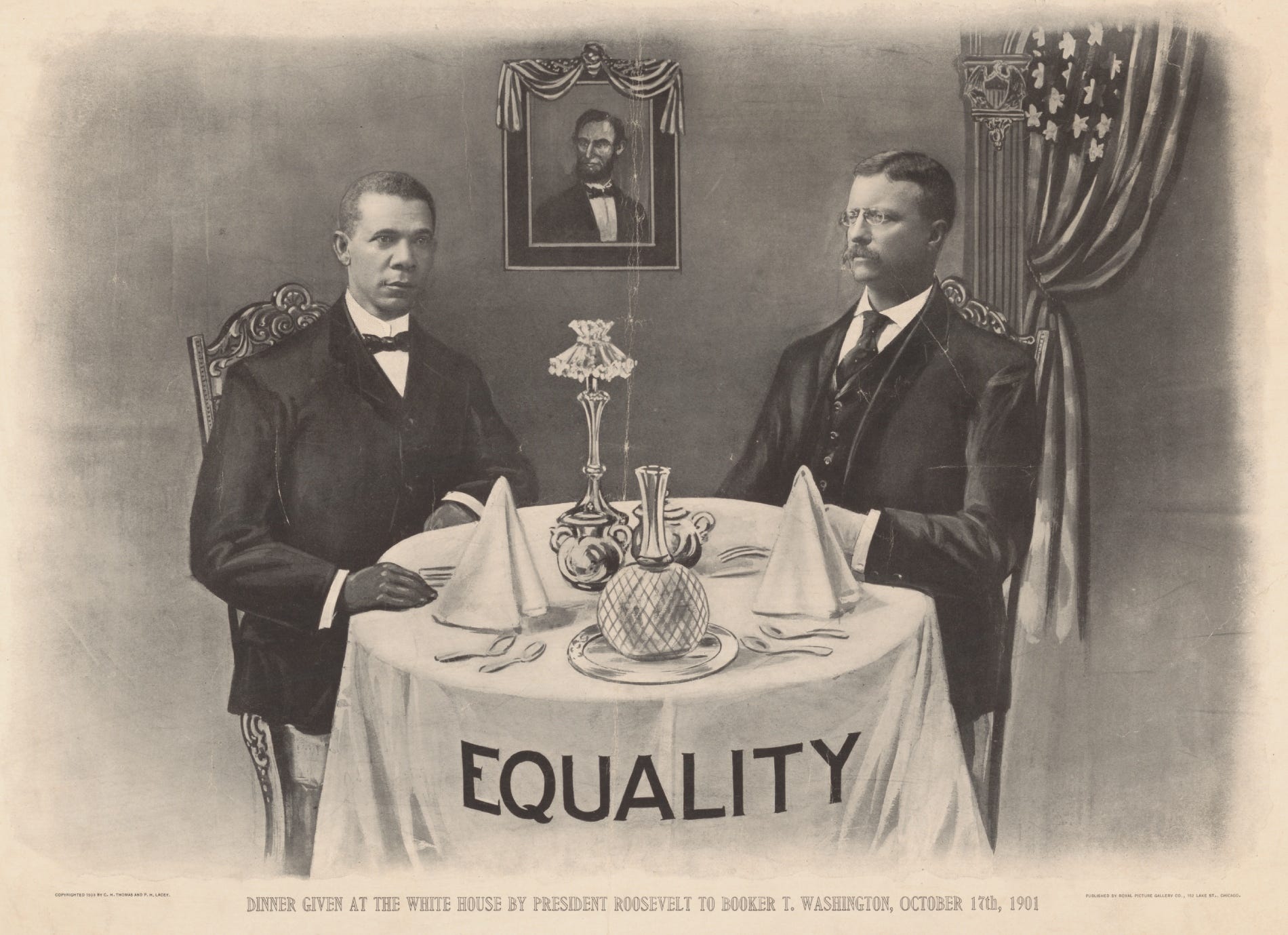
The vitriol spewed at Theodore Roosevelt was laced with suggestions from the Southern elite that he was willing to let his daughters have sex with black men. As South Carolina Governor Miles McSweeney said of the dinner, “No white man who has eaten with a negro can be respected; it is simply a question of whether those who are invited to dine are fit to marry the sisters and daughters of their hosts.” The fear of miscegenation lay at the heart of Southern white supremacist views. In the minds of Southerners, there could be no greater crime than a black man raping a white woman, and most lynchings were sparked by rumors, often unsubstantiated, that the victim had sexually abused a white woman. The true fear had little to do with the trauma and effects of rape on women. Rather, it was about the violation of a white woman’s purity and the insult to white men’s masculinity. “Pitchfork” Ben Tillman gave voice to this anxiety when he said, “I have three daughters, but so help me God, I had rather find either one of them killed by a tiger or a bear […] conscious that she had died in the purity of her maidenhood, than to have her crawl to me and tell me the horrid story that she had been robbed of the jewel of her maidenhood by a black fiend.”
Of course, the histrionic fear of miscegenation was all projection, for no group in America committed the act of miscegenation more than Southern white men.
When slavery was legal, it was common for enslavers, their family members, and other white men who worked on the plantation to rape female slaves, many of whom were just girls. These repeated rapes resulted in an untold number of enslaved women being forced to give birth to their rapist’s child (and property). In 1834, abolitionist George Bourne noted in his book Picture of Slavery in the United States of America that many of the lighter-skinned slaves bore a striking resemblance to their enslaver on the plantations he observed. He also wrote that several plantation owners’ wives privately complained that they were only wives in the legal sense while in reality merely serving as overseers to their husbands’ harems of slaves. It is impossible to determine how many slaves were conceived through rape, but the fact that the average African-American’s genome today is 20–25 percent European paints a rather grim picture.
Even after slavery was outlawed, white men still continued to force themselves on black women. One of the most famous examples is that of Strom Thurmond, who served as a US senator from South Carolina from 1956-2003. An ardent segregationist, Thurmond’s 24-hour filibuster against the Civil Rights Bill of 1957 held the record for longest filibuster for almost 70 years. Yet six months after his death at the age of 100 in 2003, Essie Mae Washington-Williams revealed that Thurmond was her father, having impregnated her mother, Carrie Butler, one of the Thurmond family’s African-American housekeepers, when he was 22 and she was 15 or 16.
With the primary system overhauled, James K. Vardaman was able to win the Democratic Party’s nomination for governor with ease in 1904. And as stated, to win the nomination was to win the general election, which he effortlessly did. During his campaign speeches, he openly announced that “a vote for Vardaman is a vote for white supremacy, a vote for the quelling of the arrogant spirit that has been aroused in the blacks by Roosevelt and his henchmen [...] a vote for the safety of the home and the protection of our women and children.”
Vardaman may have been one of the South’s most controversial politicians, but he was also one of the most charismatic. Standing over six feet tall in an era in which the average man was five foot seven inches, and with shoulder-length hair slicked back at a time when such hairstyles were rare, he cut a striking image. Vardaman wore black suits in the winter and all-white suits in the summer, like a plantation owner. His white supremacist rhetoric and his distinctive appearance led him to be dubbed “The White Chief” or “The Great White Chief.”
During Vardaman’s tenure as governor, he oversaw the opening of the State Insane Asylum in Jackson and the Deaf and Dumb Institute. He also successfully pushed for education funding increases for white communities, which rose by 25 percent, along with a 50 percent raise for teachers and the construction of three hundred new schools. On the other hand, Vardaman used every lever of power at his disposal to destroy the already meager educational opportunities available to black Mississippians. He closed black public schools and vetoed funding for the Mississippi Normal Institute, a college for black teachers. “The only effect of negro education is to spoil a good field hand and make an insolent cook,” Vardaman once said.
One month into his governorship in February 1904, Vardaman penned a nationally distributed op-ed titled “A Governor Bitterly Opposes Negro Education”, outlining his positions on public education and voting rights for black Americans and highlighting the paternalistic attitudes the white Southern elite had toward black Southerners:
“The nigger cannot live in the same country with the white man on terms of social or political equality. It is one of the impossible things […] I am opposed to the nigger’s voting, it matters not what his advertised moral and mental qualifications may be. I am just as much opposed to Booker Washington as I am to voting by the cocoanut-headed, chocolate colored typical little coon, Andy Dotson, who blacks my shoes every morning. Neither one is fit to perform the supreme functions of citizenship […] I want to do what is best for both races. I am the nigger’s best friend. But I am friendly to him as a nigger whom I expect to live, act, and die as a nigger.”
Mississippi and the rest of the white South enforced Jim Crow in ways that went beyond their states’ constitutions to maintain white supremacy. As the former United States Attorney General Eric Holder wrote in his book Our Unfinished March (2022), “Jim Crow was never policed just by laws written out on paper. It was enforced with broken bones and crushed skulls, with rope wrapped around trees and knots tied around necks, with bodies displayed in town squares or made to disappear at the bottom of rivers.” And from 1882-1968, no state had more lynchings than Mississippi, many of which occurred during James K. Vardaman’s governorship.
One such case was the lynching of Luther Holbert. On February 3, 1904, James Eastland, a white plantation owner, confronted Holbert to evict him from his property for reasons that are not known. Some historians have theorized that Eastland may have been upset that Holbert was encouraging other black workers, who were forced to work on the plantation because they were indebted to Eastland, to leave. A gunfight followed that left Eastland himself, along with two black workers, John Carr and John Winters, dead. It was alleged that Holbert killed Eastland during the fight, though this was never proven.
When news of Eastland’s death reached Doddsville, Mississippi, the white citizens formed a posse led by Eastland’s brothers, Woods Caperton Eastland and C.C. Eastland, and went to the Eastland plantation where they killed one of the black workers. But by this time, Luther Holbert and an unknown black woman were already on the run. The following day, two more black men were killed by the mob. On February 7, the posse caught Holbert and the black woman, took them to a black church in Doddsville, and tied them to a tree where a mob of 1,000 people gathered. Like many lynchings, it was a picnic-like atmosphere where deviled eggs, lemonade, and whiskey were served while Holbert and the black woman’s fingers and ears were cut off and given to the spectators. Holbert’s head was bludgeoned so severely that his eye hung from its socket, then the mob took corkscrews and tore the flesh from his thighs and chest. Holbert and the woman were then thrown into a fire pit while they were still alive.
C.C. Eastland was arrested for the murders, but a judge dismissed the charges, much to the delight of the crowd gathered at the courthouse in September 1904. That November, Woods Caperton Eastland welcomed a son whom he named James in honor of his late brother. James Eastland would be elected to the United States Senate in 1943 where he would serve until 1978. Eastland was one of the Southern Senate delegation’s most vociferous segregationists and stifled Civil Rights legislation throughout the 1950s and 1960s. President Lyndon Johnson said, “Eastland could be standing right in the middle of the worst Mississippi flood ever known, and he’d say the niggers caused it, helped out by the Communists.”
After his term as Governor was over, James K. Vardaman was elected to the United States Senate in 1912 on the platform of repealing the Fourteenth and Fifteenth Amendments, which were passed to give former slaves and all those born in the United States citizenship and the right to vote, as well as decreeing that the right to vote could not be infringed upon due to race. The Amendments had to be ratified by the former Confederate states as a condition for them to be readmitted into the United States during Reconstruction. But Vardaman was no longer in Mississippi, and his white supremacist radicalism rendered him largely irrelevant in the US Senate. These Amendments were never going to be repealed due to opposition from Northern politicians. One of the few pieces of legislation Vardaman played a significant part in was the passing of laws barring child labor.
When the US Senate voted to declare war on Germany and enter World War I, Vardaman was one of only six Senators to vote against the resolution. His opposition to the war was largely due to his white supremacist views, as he believed that black Americans were inferior and lacked the temperament to serve in the military. Vardaman was also concerned about the prospect of teaching black soldiers how to use guns and training them to fight. He feared that life in the military would lead black soldiers to conclude that a more equal world was possible, and that the skills and tactics they learned could be employed when they returned to the South to make this a reality.
Vardaman’s refusal to vote for the United States’ entry into World War I effectively ended his political career — and his former popularity could not save him. Congressman Pat Harrison, who had previously been one of Vardaman’s biggest allies, ran against him and relentlessly criticized his opposition to the war on the campaign trail. During his four terms in the House, Harrison had also built a following that rivaled Vardaman’s. President Woodrow Wilson, whose policies Harrison championed, endorsed his Senate candidacy and helped him edge Vardaman in the 1918 primary. Pat Harrison would later become one of the most powerful men in Washington when he was elected to chair the Senate Finance Committee and proved pivotal to passing and implementing President Franklin Roosevelt’s New Deal programs such as the National Industrial Recovery Act and the 1935 Social Security Act. Harrison also helped the United States’ allies defend themselves against fascism before the country entered World War II with his support of the Lend-Lease Act.
Vardaman went back to working in the newspaper industry after losing his Senate seat and waited for an opportunity to mount a comeback. When Senator John Sharp Williams announced his retirement in 1922, Vardaman threw his hat into the Democratic Primary race. However, he had aged considerably during his time away from politics. Vardaman, once one of the South’s most charismatic orators, had lost most of his teeth and could barely speak. Everyone around him also acknowledged that he was no longer there mentally. Despite this, Vardaman’s popularity had recovered since the end of World War I. He narrowly won the first primary against Congressman Hubert D. Stephens, but triggered a run-off in which Vardaman’s opponents rallied around Stephens and defeated Vardaman by 9,000 votes.
James K. Vardaman retired from politics for good after his primary loss, and despite being the most powerful man in Mississippi, he managed his finances as terribly as his father had and found himself virtually penniless. Vardaman and his wife moved in with their daughter and son-in-law in Alabama. According to his obituary, which was published in Alabama newspapers and later reprinted in The New York Times, Vardaman suffered a nervous breakdown shortly after moving to Alabama and his health never recovered. He died on June 25, 1930, at the age of 68. That same obituary said that “Negroes who knew him admired him.” Of course, the African-Americans who knew him could never fully and safely express how they may have truly felt about The Great White Chief, and Vardaman worked his entire life to make sure of that.
James K. Vardaman’s legacy still lives on in Mississippi. The lynchings of Emmett Till and Civil Rights workers James Chaney, Andrew Goodman, and Michael Schwerner were all the result of the policies and social norms implemented by Vardaman and white Southerners in the years after Reconstruction. And the Republican states that have redrawn districts to eliminate black congressmen are taking a page right from Vardaman’s playbook — only they have acted more swiftly to marginalize black voters than the post-Reconstruction generation of white Southern politicians ever did. The New South is, in some respects, not so different from the Old South. Black Southerners always knew this. The Republican Party started Reconstruction and white Southern Democrats resisted until they were able to finally kill it. In the 1960s, Northern and Western Democrats, led by a Southern Democratic President and a black Baptist minister, revived Reconstruction, causing a political realignment that led to white Republicans in every state working diligently to kill it. That is the arc of American politics since the end of the Civil War.
There will be more legal challenges to the Civil Rights and Voting Rights Acts from Republican states in the coming years. The Supreme Court will not repeal these laws all at once. Instead, provisions will be whittled away until the laws are rendered all but meaningless. It took half a century to beat Jim Crow. It took 50 years for a quasi-Jim Crow to make a comeback. It will take another half century or more to beat Jim Crow again. Hopefully, this time, it will be for good.
See also: “The Hebrew Hammer: The Hank Greenberg Story”
Subscribe now and never miss a new post. You can also support the work on Patreon. Please consider sharing this article on your social networks, and hit the like button so more people can discover it. You can reach me at @AmericnDreaming on Twitter, @jamie-paul.bsky.social on Bluesky, or at AmericanDreaming08@Gmail.com.
Throughout Vardaman’s life, it was rumored that his father had died at a young age and that Vardaman had to care for his widowed mother and siblings. However, as his biographer A.S. Cody noted in Biographical sketches of James Kimble Vardaman (1922), William Sylvester Vardaman died after his son was married.
Mississippi Governors were limited to one term at the time.
Comments
Nothing yet. Say the first thing.
Sign in to join the conversation.