
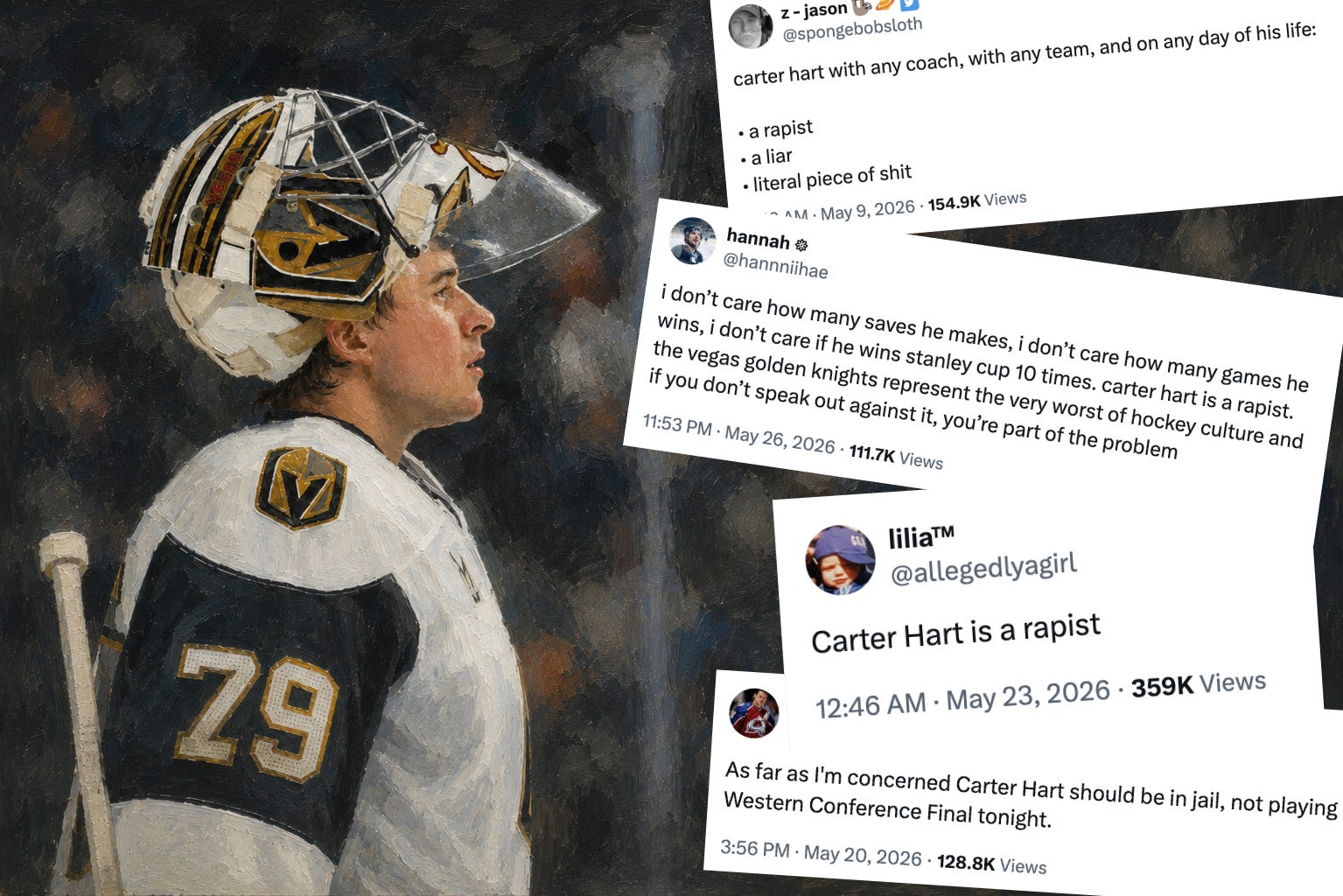
The Vegas Golden Knights are the most successful ice hockey team in NHL history, relative to their short existence. In the nine seasons since the Golden Knights were founded as an expansion team in 2017, the club has qualified for the playoffs eight times, reached the conference finals four times, the Stanley Cup Finals three times, and won the Stanley Cup in 2023, just six seasons after entering the league. Now the upstart “misfits” of the Nevada desert are headed to the Finals once again after completing a stunning sweep of the heavily favored and top-ranked Colorado Avalanche. The National Hockey League couldn’t ask for a more picture-perfect expansion success story. But outside of Greater Las Vegas, few seem to be celebrating. In fact, much of the hockey world seems downright pissed off.
In May, the fantasy sports company RotoWire conducted a study of hockey fanbases across the US and found that the Golden Knights were the most hated hockey team in America. Some of this comes down to simple envy, but that’s not the only reason. There’s also the club’s infamously rule-bending and cutthroat pursuit of winning at all costs, even if it means engaging in unscrupulous business practices or treading over the norm of Canadian courtesy that suffuses the sport’s culture. Yet these have been features of the Golden Knights’ modus operandi since their inception, and the team has only now become the foremost villains of the hockey world. The difference lies in who the VGK have playing between the pipes. Goaltender Carter Hart’s outstanding playoff run has carried the Golden Knights to their third Stanley Cup Final, but his role in one of Canada’s most high-profile sexual assault trials has made him, in the eyes of many hockey fans, a monster. The fact that he was acquitted, and that the evidence uncovered during the trial supports that verdict, hasn’t stemmed the tide of vitriol. If anything, it’s only gotten worse.
Across every hockey-related section of social media, the Hart discourse is overwhelmingly scathing, defamatory, and toxic. It is an ecosystem awash in an ocean of posts calling Carter Hart a “sexual predator”, a “sex pest”, a “rapist”, and a “literal rapist” who “should be in jail”, among other epithets. Others have extended their hatred outward, posting that anyone willing to defend Hart is an “incel chud”, who “hates women”, is “cool with rape”, and deserves to be gang raped. The independent journalist Rachel Gilmore went further to include all Golden Knights fans, writing, “If you’re cheering for a team that signed Carter Hart, you’re a fucking loser anyway.” This is just a small sampling of what 10 minutes spent on a single social media platform turns up.
To understand the Carter Hart saga, we need to begin in 2018.
It happened after the 2018 World Junior Ice Hockey Championships, the highest level of competition among elite 16-to-20-year-old prospects. In Canada, this tournament receives enormous attention, the equivalent of Division I NCAA football in the US. Carter Hart, then a 19-year-old second-round draft pick of the Philadelphia Flyers, backstopped Team Canada to a gold medal victory. Following a gala hosted by Hockey Canada in London, Ontario that June and attended by the Canadian junior team, one of the players, Michael McLeod, had drinks at a nearby bar with a young woman identified only as “E.M.” due to Canadian privacy laws. The two returned to his hotel room and had consensual sex. That much is agreed upon by all parties. Then a number of other Team Canada players were invited in for group sex, with eight or more men being in the room at various points, one of whom was Hart. E.M. claimed this was all non-consensual. The men claimed it was consensual.
Five players were ultimately brought up on charges of sexual assault in early 2024: Michael McLeod, Dillon Dubé, Alex Formenton, Cal Foote, and Carter Hart. All five were playing professional hockey, four in the NHL (including Hart, who was the starting goaltender for the Philadelphia Flyers), when they were indefinitely suspended from playing and required to take leaves of absence.
The trial, which took place from April to July of 2025, became a media circus — and also a procedural one. With five defendants, each with their own legal defense teams, the proceedings were always going to take a while. The case was further delayed by two separate juries being discharged. Just two days into the trial, the jury was dismissed after an interaction between one of the defense attorneys and a juror during a lunch break. Three weeks later, the replacement jury was discharged after the judge was sent a note from a female juror complaining that two lawyers representing Formenton appeared to be whispering to one another and laughing each day as the jury entered the courtroom, “as if they are discussing our [jurors’] appearance”, which the note described as “unprofessional and unacceptable.” Justice Maria Carroccia determined that the jury could not be impartial and decided that she would preside over the remainder of the trial without a jury and deliver the ruling herself. If that weren’t enough, the courtroom experienced frequent technical difficulties.
Despite its hitches, however, a great deal of clarity and light has been shed on what happened that night through various investigations, pretrial disclosure (akin to discovery in US courts), and trial cross-examination.
E.M. claimed that the amount of alcohol she had consumed at the bar prior to leaving with McLeod had made her too drunk to consent to group sex, though she agreed that she was somehow able to and did consent to sex with McLeod. But in a statement to London police in 2018, E.M. said she’d only purchased a couple drinks for herself, and security footage from the bar did not corroborate her claim that players were buying her drinks throughout the evening. A London police detective who reviewed the security footage also said she did not appear to be very inebriated. During cross-examination, the defense brought in glasses from the same bar and demonstrated that E.M.’s account of how much she drank was not physically possible, causing her to revise her recollection to reflect only having drunk half as much as she initially claimed.
E.M. also claimed that the other players who were brought in for group sex were not invited by her or with her consent, and that the group sex that followed was non-consensual. This was disputed by multiple lines of evidence. First, eyewitnesses who were in the room for a time but did not engage in sexual activity testified that it was E.M. who wanted the group sex, and that she aggressively instigated the activities, masturbating in front of the men, demanding they have sex with her, and amid their hesitation, calling them “pussies.”
Then there were the consent videos — plural. These were, after all, college-aged Canadians in 2018. As the CBC reported:
“In the first video, a voice off-camera asks whether E.M. is ‘OK with this.’ She smiles and says: ‘I’m OK with this.’
The second video was taken an hour after the first.
‘Are you recording me? OK, good, it was all consensual,’ E.M. says, holding a hotel towel in front of her naked body. ‘You are so paranoid, holy. I enjoyed it. It was fine. It was all consensual. I am so sober, that’s why I can’t do this right now.’”
At one point, she was being spanked and asked the men to stop, which they did. That was the only time E.M. had asked for anything to stop. Carter Hart’s role in the night’s events was asking E.M. for oral sex and receiving it.
E.M.’s story changed both over the years and also during the course of the trial. In 2018, she did not want to press charges. It was her mother who filed the first complaint with the London police, triggering an investigation that concluded in 2019 with no charges. Direct message screenshots from that time showed E.M. apologizing to McLeod for her mother making a big deal and saying that it was all a “misunderstanding.” Later, E.M.’s. view of that night changed, and the investigation was reopened in 2022, leading to formal charges and the trial.
The verdict that came in — acquitting all defendants of all charges — was the only legally justifiable judgment based on the facts of the case. As I posted on July 24, 2025, shortly after the news broke: “No one who actually read the testimony and evidence should find this surprising.”
In her 91-page verdict, Justice Maria Carroccia expounded on her ruling, stating that “In this case, I have found actual consent not vitiated by fear. I do not find the evidence of E.M. to be either credible or reliable.” She continued, “On several occasions the complainant referred to her evidence as ‘her truth’ rather than ‘the truth’, which seemingly blurs the line between what she believes to be true and what is objectively true.”
Carroccia went on to write:
“The complainant also gave a vague answer when it was suggested to her in cross-examination that it was easier for her to deny the deliberate choices she made on June 18 and 19, 2018, than to acknowledge the shame, guilt, and embarrassment about those choices. She did not deny the suggestion, she said: ‘I don’t know. I’m kind of struggling to understand that’ and went on to explain that she blames herself and that other people should be held accountable, but it was ‘a combination of things.’”
Carroccia also pushed back on the illiberal political climate surrounding the case:
“Although the slogan, ‘Believe the victim,’ has become popularized as of late, it has no place in a criminal trial. To approach a trial with the assumption that the complainant is telling the truth is the equivalent of imposing a presumption of guilt on the person accused of sexual assault and then placing the burden on him to prove his innocence. That is antithetical to the fundamental principles of justice enshrined in our constitution and the values underlying our free and democratic society.”
So what actually happened that night? Literary scholar Marilyn Simon provided perhaps the most incisive summary in her perceptive July 2025 essay exploring the psychological aspects of the case:
“I find the defendants’ account of E.M.’s behavior that night eminently believable. The hockey players and E.M. herself both described the ‘porn-star personality’ she adopted throughout the night, and she behaved exactly as someone enacting her own porn-star fantasy would behave. But her retrospective confusion and humiliation also strike me as authentic. It may be that she encouraged and wanted wild sex on one level but felt ashamed of her desires on another; that she wanted and didn’t want dangerous sex; that she wanted and didn’t want an exciting night; that she wanted and didn’t want to push her limits. I am sympathetic to this confusion, even though I reject entirely her attempt to make five young men pay for her own poor judgement.”
After investigations by the police (twice), Hockey Canada, the NHL, and a criminal trial (which the Crown has elected not to appeal), the accused men were exonerated and allowed to play again. This shifted the focus from the defendants as a group to Carter Hart in particular, as far and away the best player of the bunch, and thus the most likely to make a return to the National Hockey League. He was also the only defendant to testify during the trial. Hart’s contract in Philadelphia, having expired during his leave of absence, left him a free agent who signed with the Vegas Golden Knights in the fall of 2025. After shaking off a lot of rust and battling through an injury, Hart, now 27, is playing like the franchise goaltender he showed promise of becoming in his first few years.
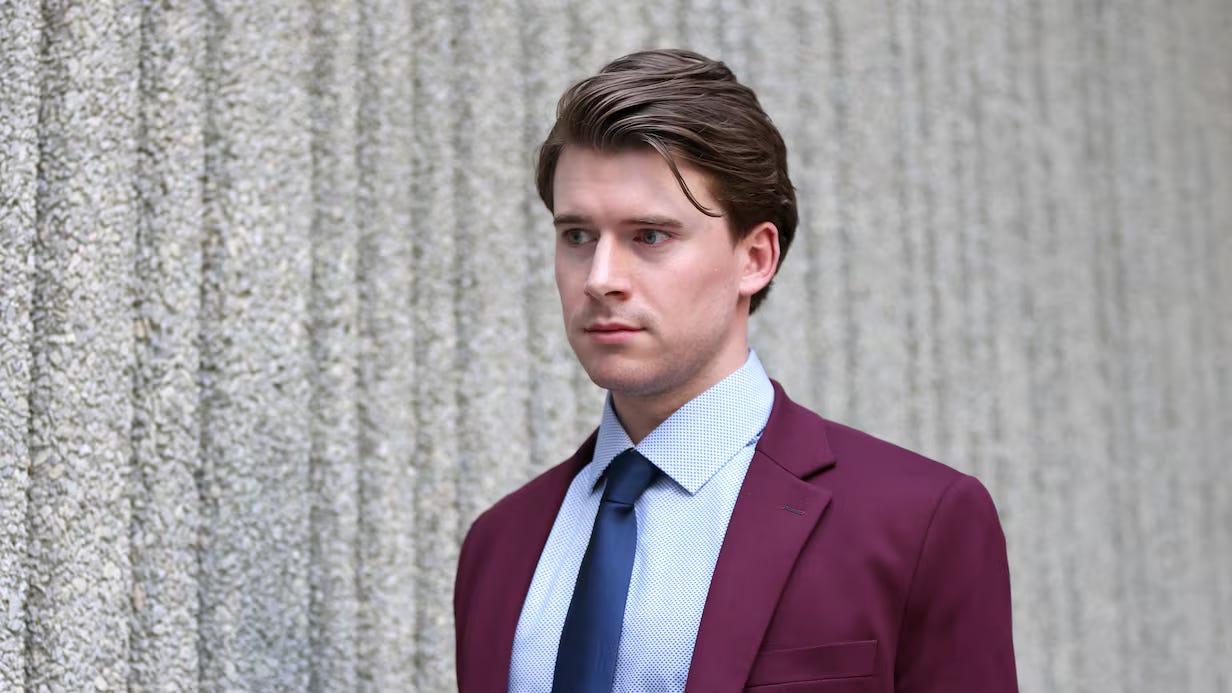
But while he’s allowed to play, and seems by all accounts to be embraced by his teammates and coaches in Vegas, the hockey world and members of the press, who appear not to share Justice Maria Carroccia’s liberal ideals and respect for evidence, have made their displeasure abundantly known.
One frequently encountered sentiment, often heard from men in hockey spaces who are not full-blown male feminists but still endeavor to be seen as “one of the good ones”, is an attempt to split the baby by saying that Hart and his teammates in that hotel room were creeps but not actual rapists — immoral, but not criminal. This, too, deserves pushback. There is nothing wrong with having a consensual one-night stand. There is nothing wrong with having consensual group sex. There is nothing wrong with asking a woman for oral sex and then receiving it. Maybe that’s not your cup of tea, and that’s fine. But one’s distaste for a sex act — again, between consenting adults — does not render it criminal, professionally excommunicable, or even immoral. Based on the facts as laid out in the trial, not only isn’t Carter Hart a rapist or sexual assailant — he did nothing wrong. One can say that he committed an error in judgement. As a soon-to-be professional hockey player at the highest level, it doesn’t take a genius to know that orgies are the sorts of things that can easily become a PR nightmare if details get out. But nothing about this case suggests a lapse in moral judgement.
It has become a cultural victim-blaming trope emblematic of neanderthal misogynists to dismiss incidents of sexual assault by claiming that the woman “was asking for it”, and for good reason. But what happens when events actually unfold in this manner? What happens when the woman in question literally asks for and even demands sex, going so far as to roar emasculating invective at her male partners for showing hesitation? What happens when she gives convincing consent in not one but two videos? Does the woman’s post-coital or morning-after regret retroactively transform the night’s festivities from a “wild” but consensual evening into a horrifying gang rape that all males involved must be imprisoned for? As Simon wrote, “If consent can, as the prosecution contended, be ‘withdrawn at any time,’ does that ‘anytime’ include seven years after the fact?” Modern mainstream feminism — which has become less a cogent political philosophy these days and more a sociocultural labor union that unconditionally advocates for the female side of every gendered issue — unsurprisingly says yes, but its representatives in the Hart discourse can offer no compelling reasons why. What’s more, it appears that many, if not most, are unfamiliar with the facts uncovered in the trial.
The closest thing to an argument one finds for why Carter Hart is indeed a rapist is the mantra that “being found ‘not guilty’ doesn’t equal ‘innocent.’” This is one of those inane and endlessly repeated statements on par with declarations that the United States is a republic, not a democracy. But “not guilty ≠ innocent” isn’t just a stupid person’s idea of a smart thing to say; it betrays a deeply illiberal attitude toward civil liberties and due process that anyone who values a free society should find troubling. The line of reasoning that this refrain and its underlying belief are expressing is that for a certain type of person to be accused of a certain type of crime, the allegation itself is proof of guilt, and no evidence, counter-evidence, defense, or legal adjudication can override that. The sense one gets from observing these attitudes in the wild is that such people apparently see little use for courts or liberal justice systems at all. Rather, they would seem to prefer a society in which any man accused of sexual assault was thereupon swiftly taken out back behind City Hall to receive an unceremonious penectomy administered with a shotgun.
These are, not coincidentally, often the same people eager to lecture us on the virtues of rehabilitation and leniency when it comes to murderers — especially those from marginalized communities. But alas, Carter Hart, whose name and face seem lifted straight out of central casting for “a spoiled, college-movie antagonist who says ‘My father will hear about this!’”, has no melanin forcefield to protect him. All he has are the facts. Those are usually enough, with the aid of competent defense attorneys, to win the day in a court of law. But the court of public opinion has no use for facts, especially when they’re politically inconvenient. Carter Hart may never be able to silence his critics, but he can keep winning.
See also: “Memory-Hole Archive: MeToo and Feminist Culture Wars”
Subscribe now and never miss a new post. You can also support the work on Patreon. Please consider sharing this article on your social networks, and hit the like button so more people can discover it. You can reach me at @AmericnDreaming on Twitter, @jamie-paul.bsky.social on Bluesky, or at AmericanDreaming08@Gmail.com. Cover imaged edited by ChatGPT and American Dreaming.
Comments
Nothing yet. Say the first thing.
Sign in to join the conversation.