
I was recently on the Agree to Disagree About Gender podcast to discuss what has gone wrong with trans activism and how to push for trans rights and acceptance without abandoning liberal values. You can watch here or listen here or here.
In his 2008 stand-up special Why Do I Do This?, Bill Burr’s hilarious routine about population management laments the spawning of so many useless people clogging up the highways, getting in the way, and polluting the planet. Looking at old folks’ large family photos, he quips, “Yeah, and none of you did shit. I don’t recognize anyone in that photo. You just made 30 people who are all taking a shit every day that ends up in a river. That’s not a photo — it’s an environmental disaster, and you framed it!” His tongue-in-cheek solution? Make having babies illegal to get the population down to his ideal size: 30,000 people (that way everyone can attend the Super Bowl in person). “Out of all the bullshit I’m talkin’ up here, I think I’m onto something with this, you know? It’s like, I’m eliminating people but no one has to die.”
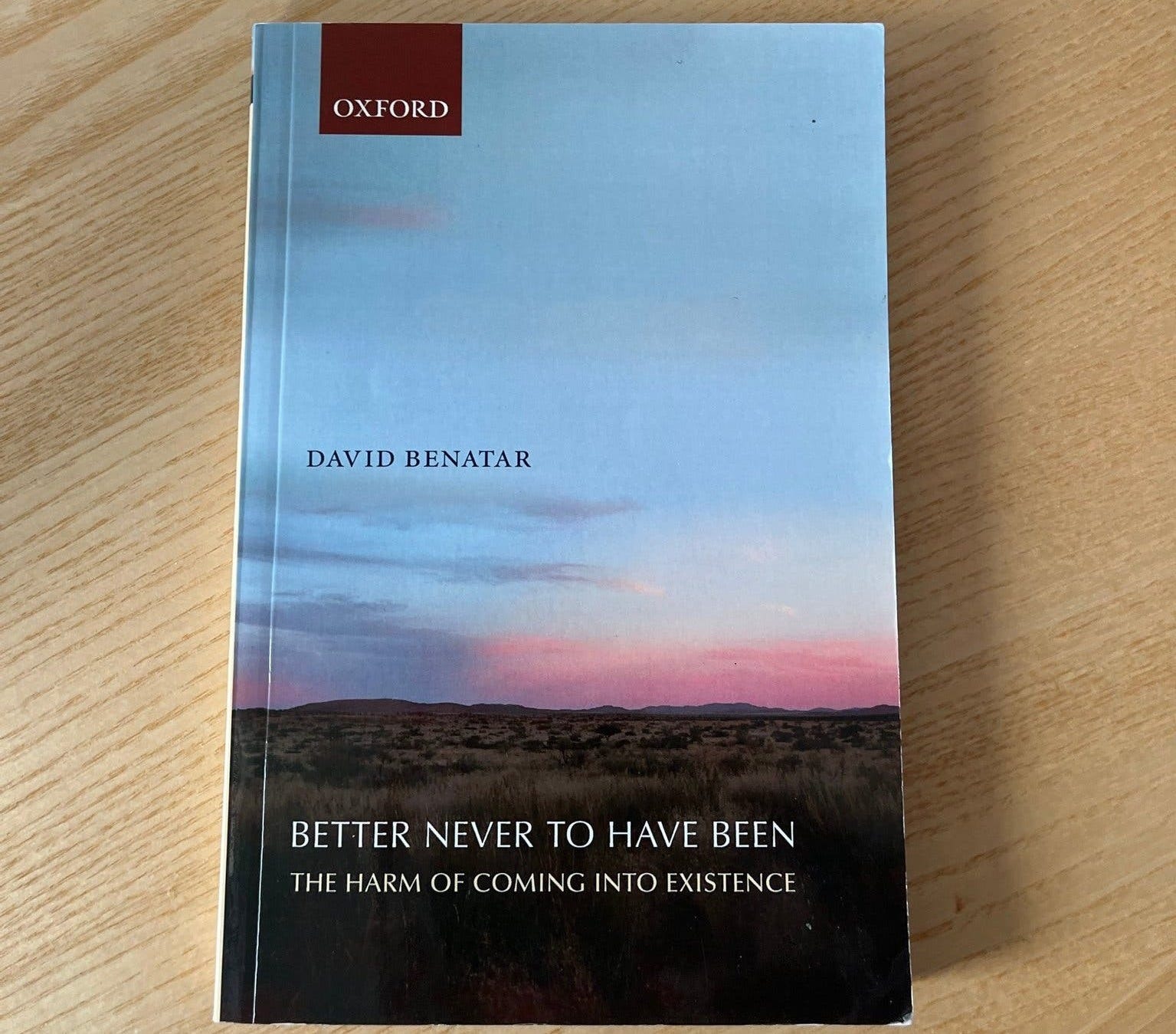
Burr’s colorful ramblings were intended as comedy, but the subject matter is no joke. What he stumbled onto was a philosophical school of thought known as anti-natalism — the position that procreation is unethical. Just two years prior, the philosopher David Benatar published the influential and extremely provocative anti-natalist treatise, Better Never to Have Been: The Harm of Coming into Existence (2006), which remains the seminal text on the matter two decades later.
Benatar’s thesis stakes out the most hard-line version of anti-natalism, arguing not only that procreation is immoral, but that existence itself is a harm and that it would therefore be better if no humans (or any sentient life) existed at all. Most people will find this idea absurd or even monstrous on its face and simply dismiss it out of hand. To be sure, the notion that existence is a harm and that the only way to save the world is to end it does sound an awful lot like the sort of thing you’d hear from a deranged supervillain or an apocalyptic artificial intelligence. But a line of reasoning cannot be discarded just because we find its conclusions uncomfortable. Benatar’s arguments deserve a fair hearing, and have been taken seriously in many quarters. So, is coming into existence a harm? And if it is, are we wrong to bring new lives into the world?
Of course, there are scenarios in which most reasonable people would agree that bringing a new life into the world is unethical. For instance, if that life is the product of incest, or has been determined to have a severe medical condition that would cause immense suffering and death shortly after birth. All but the most uncompromising religious zealots will concede that in certain circumstances, bringing to term or even conceiving a new life can be immoral. If both parents know they are carriers for a recessive disease that has a high likelihood of passing to their offspring and leading to agonizing pain and early death, choosing to conceive — or neglecting to use birth control — seems reckless at best and grotesque at worst. This is an important baseline to establish: most people agree that coming into existence can be a harm, at least sometimes. Benatar’s argument — that coming into existence is always a harm — may seem different in kind, but it is in fact different in degree: perhaps the most glaring difference in degree in all of moral philosophy.
Benatar’s thesis follows from his premise, which he calls “the asymmetry of pain and pleasure”, and has since come to be known as “Benatar’s asymmetry argument.” It goes as follows:
The presence of pain is bad.
The presence of pleasure is good.
However,
The absence of pain is good, even if that good is not enjoyed by anyone,
Whereas the absence of pleasure is not bad unless there is somebody for whom this absence is a deprivation.1
This premise, Benatar notes, leverages widely shared human intuitions implicitly evident in attitudes toward procreation, happiness, suffering, regret, and obligation. For example, suppose someone has two dogs, a male and a female, but cannot afford to care for any more animals. If they have their dogs spayed/neutered to prevent the suffering of puppies likely to be neglected, we recognize that this outcome (the absence of suffering) is good even if those puppies never come into existence to experience it. On the flip side, we recognize that never playing with your dog is bad only if you actually have a dog — not playing with a nonexistent dog you don’t have cannot be bad.
Benatar extrapolates from this asymmetry argument that the absence of suffering is so much more morally salient than the absence of pleasure, joy, and flourishing that no amount of positive experiences could ever outweigh the smallest of harms. After all, if a given individual never comes into existence, all of the joys they never experienced would be irrelevant, but the pain they would avoid would be a moral good. As Benatar puts it:
“One of the implications of my argument is that a life filled with good and containing only the most minute quantity of bad — a life of utter bliss adulterated only by the pain of a single pin-prick — is worse than no life at all.”
In other words, unless one can be assured with certainty that a given life will be absolutely free from any trace of suffering — a virtual impossibility — coming into existence is a harm in itself. Thus, it would be better not only if no one procreated, but if no one had ever been born in the first place. This is the crux of Benatar’s anti-natalist argument.2 Better Never to Have Been goes on from there to explore the feasibility and desirability of banning procreation, enacting “pro-death” abortion policies, and the prospect of a deliberate “phased extinction” of humanity, though he is under no illusions that such ideas will ever be broadly popular.3
Benatar’s conclusion logically follows from his premise, and yet the primary objection (beyond a simple moral disgust response) makes itself. Since the dawn of modern humans, an estimated 117 billion people have been born. All available evidence indicates that the overwhelming majority of these people have regarded their lives as worth living and as worth having been brought into existence. Surely this is a counterpoint worth seriously considering? Apparently not. Benatar ascribes these attitudes to mere optimism bias, artifacts of evolution, and “mass self-deception.” “Armed with a strong argument for the harmfulness of slavery,” he writes, “we would not take slaves’ endorsement of their enslavement as a justification for their enslavement, particularly if we could point to some rationally questionable psychological phenomenon that explained the slaves’ contentment.”
On more than one occasion, Benatar reiterates that just because an argument has a seemingly ugly or mind-boggling conclusion does not make the argument wrong. He rightly points out that many ideas now taken as self-evident truths were once widely seen as counterintuitive or even offensive and that his thesis cannot be dismissed on those grounds alone and should be evaluated on its merits. In this, as in much else, Benatar is technically correct. At the same time, it’s not every day that a serious person, or at least a person with a pretty good case to be considered one, lays out a formal argument in book length for why it would be morally better if the universe were devoid of all complex life. When it comes to the sorts of ideas people will be least able to give a fair hearing to, the notion that they themselves and indeed their children should never have been born is hard to top. Asking even a philosophically minded “high-decoupling” reader, much less the general public, to sincerely consider whether it would be better had they and everyone they’ve ever cared about never existed, really is asking quite a lot. Benatar’s maximally anti-natalist thesis occupies such an outer limit of moral reasoning that no one could or should be begrudged for finding it too preposterous or unthinkable to engage with.
Benatar is not unaware of this. He preempts the charge that his argument is a reductio ad absurdum of asymmetry, noting that the logic is valid and generally accepted in most other cases (you know, when people’s extinction isn’t being argued for). He also notes that few would be prepared to accept the logical conclusion of his asymmetry argument being false — that if existence is not a harm but an inherent good, we should therefore singularly dedicate all human effort to maximum procreation. But the unspoken premise that Benatar treats as self-evident — and that very much remains to be demonstrated — is that the fate of everyone in the universe should hinge on a simple syllogism. He also appears to accept as self-evident the notion that logical arguments must or should be taken to the absolute limits of their applicability and then be accepted as binding. This is a stiflingly rigid and autistic approach to logic, which exists as a tool to help make sense of the world but can and often does go off the rails at a certain level of hypothetical application. Exploring those extremes through thought experiments is a useful exercise. But accepting all of their implications as fully prescriptive rather than accepting the limitations of logic to weave together a grand unified moral theory of everything is the kind of mistake that ill-fated thinking machines make in science fiction doomsday stories.
More fatally, Benatar’s thesis endeavors to bloodlessly sidestep human emotion, intuition, and irrationality, yet the asymmetry principle he grounds his argument in is itself based on flawed human intuitions which he treats as an almost mathematical truth that can be cleanly extrapolated outward. On the one hand, we are told that human extinction can be justified as a positive moral good because it follows logically from the fact that humans intuitively regard the absence of pain, regardless of existence, as more morally salient than the absence of pleasure — and yet on the other hand, the human intuition that our lives and the lives of our children are worth bringing into existence is hand-waved away as emotional bias. Benatar makes no move to dissect or pick apart the reasons why the intuitions behind his asymmetry argument could be artifacts of evolved risk aversion, conventions of linguistic habit, or context-dependent quirks of our primate psychology. One intuition is meaningless, the other is gospel. This is not a reasonable basis on which to call for the end of humanity.
Better Never to Have Been also discounts the role that the mind plays in suffering: how oftentimes suffering results not from circumstances that are objectively harmful, but ones which become interpreted as such because of the stories we tell ourselves. In this, Benatar’s thesis reveals itself, as is common in Western philosophical thought, to be ignorant of Eastern philosophy — which is acutely concerned with the suffering of existence — and the wisdom it has to offer. Likewise, from the inception of the cosmos, nonexistence has been the default state (or non-state). None of us existed for the long eons prior to our conception. The opportunity to come into existence, for a time, brings with it the certainty of some amount of suffering, but that suffering can be inextricably bound to one’s sense of worth, accomplishment, satisfaction, and meaning. Our joys can seem all the sweeter because of the struggle it took to achieve them. That hypothetical single pinprick of pain that Benatar argues renders a life not worth bringing into existence might be the culmination of an intensely meaningful rite of passage, without which an individual may indeed find their life bereft of meaning, perhaps even to the point of wanting to end it.
Though his core argument is flawed, Benatar raises a number of strong ancillary points. It is uncontroversial and entirely defensible to contend, for instance, that bringing new lives into existence is not an automatic and unqualified good, and that we should not devote ourselves to pumping out the most possible lives like an assembly line, as the people from Bill Burr’s population bit. We can see a prime example of this with animal agriculture and factory farming. Whatever else can be said of bringing billions of lives into existence only to be confined in appalling conditions, subjected to all manner of torture and abuse, and then ultimately killed, often very painfully, for our own use — there is no morally defensible argument that this industrial-scale slaughter is good for the animals involved or makes their lives worth living. They would, in fact, be better off never existing.
Similarly, Benatar’s argument that procreation is a fundamentally selfish act and that “there can never be a moral reason to have a child — or, at least, no all-things-considered moral reason” is compelling. Being a good or even halfway decent parent requires tremendous sacrifice and selflessness, a fact that tends to be retroactively applied to the decision to conceive itself, though this is irrational post-hoc justification (and often gets inverted, as when childless people are thought to be selfish). People decide to have children, when indeed they actually decide, because they want children. The motivation behind those wants could be multifactorial, involving biological instincts, love of one’s partner, social or cultural pressures, the desire to continue one’s lineage, pass on one’s legacy, experience parenthood, and so on. I part ways with Benatar in seeing something wrong with that, but it is perfectly valid to note that such decisions cannot possibly be motivated purely or even primarily by an altruistic or loving concern for a person one does not yet know and who does not even exist.
Better Never to Have Been can, at times, veer into rather dry philosophical minutiae of little interest to non-philosophers (which Benatar suggests some readers may want to skip over), but the majority of its pages will provoke some combination of reflection, fascination, and disconcertion, depending on one’s own psychological makeup. There is a reason why this short book from a previously little-known academic has made waves in philosophical circles for two decades. There is genuine value in having thinkers willing to explore the extremities of human thought, to stress test ideas and take them to — or past — their breaking point, and to step outside the Overton window and force confrontations with premises and conclusions that would otherwise go unquestioned.
It is a good thing to have cogent reasons for why we believe what we do. But sometimes those beliefs are so ingrained, foundational, and axiomatic that we are bewildered when we see them challenged. In so doing, however, we come out the other side tempered with a stronger understanding of ourselves. The true worth of Better Never to Have Been doesn’t hinge on whether the book’s central argument is correct, but in the ways in which it makes us grapple with our most bedrock assumptions about life. For that reason, we should all be thankful that David Benatar came into existence.
See also: “The Depopulation Bomb Isn’t Ticking, It’s Overblown”
Subscribe now and never miss a new post. You can also support the work on Patreon. Please consider sharing this article on your social networks, and hit the like button so more people can discover it. You can reach me at @AmericnDreaming on Twitter, @jamie-paul.bsky.social on Bluesky, or at AmericanDreaming08@Gmail.com. Cover imaged generated by ChatGPT.
This is a slightly streamlined version of how Benatar phrased the asymmetry argument in Better Never to Have Been.
Benatar's argument is premised on a world with no gods. Of course, religious people can easily point to scriptural teachings or the broader paradigm of divine will as a labor-saving rebuttal to radical anti-natalism, but appeals to magic or other faith-based claims, however well subscribed, are unsupported assertions, not real arguments.
To be clear, Benatar does not call for mass murder or suicide, and differentiates existing lives from prospective future lives, arguing for a dwindling of the human population and eventual extinction by way of reducing procreation over time.
Comments
Nothing yet. Say the first thing.
Sign in to join the conversation.