
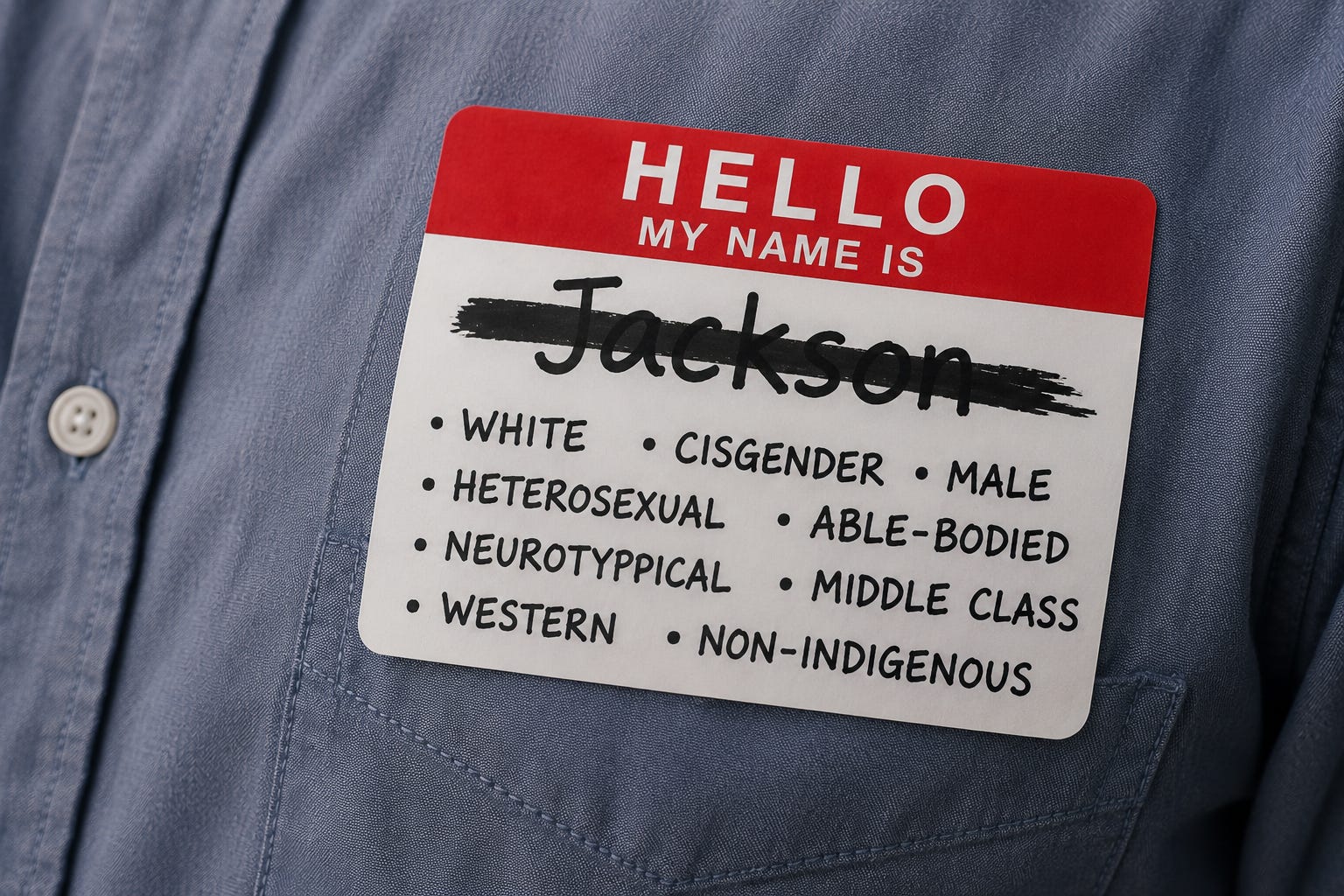
This is the eleventh essay of a multi-part series. Read part one here, or see all of the currently published articles here.
The American left’s shift from liberalism to social justice progressivism over the course of the 2010s manifested in nearly every institutional and cultural overstep of the era. Liberal tolerance became a stifling environment of censoriousness. Liberal pluralism became intersectional racial hierarchies. Liberal arts education gave way to increasingly radical pedagogies. Due process became trial by mob. Liberal gender norms that embraced gender-nonconformity became regressive and rigid gender stereotypes under which the nonconforming were encouraged to change genders altogether. The pursuit of self-expression in the face of authority became a cult of safety enforced by authority. Perhaps more than anything, the period from 2014 to 2023 saw the systematic flattening of the individual into mere identity characteristics and group affiliations, which were elevated above all else. It was this primacy and worship of identity that charted, justified, and gave permission to everything that was carried out in its name.
Central to the attitudes of the era was the paradigm of “lived experience.” The concept, which originated in 19th-century German philosophy and took shape in 20th-century French feminist scholarship, migrated during the early 2010s from academic literature into cultural thought, political discourse, and even policymaking. In its new political orientation, lived experience functioned as a challenge to expert consensus, the scientific method, and inconvenient data, positioning the personal experiences of people — and specifically people from marginalized groups — as holding equal or even more weight than traditionally authoritative sources of information. With populism surging across the political spectrum, the public desire to tear down experts, or elevate everyday people as the true experts, provided a potent wellspring from which cultural leftists drew time and again in service of their identitarian crusades.
Lived experience became the trump card leftists pulled whenever their demands were too unreasonable, the objections too effective, or the data too uncooperative. In the spaces, organizations, and institutions dominated by progressives, claims of lived experience were an unassailable way of knowing. Feelings could override facts, and a ubiquitous refrain from the era was some variation of you don’t get to tell me how I feel. It was a pretty neat deal, used by activists to push for everything from defunding the police to abolishing prisons to paying reparations.
In universities, students cited their lived experience in order to bulldoze speakers, conversations, coursework, or ideas they found discomforting. In a 2018 article in Inside Higher Ed, a pair of Cornell psychologists observed that “Meaningful debate on uncomfortable important topics is replaced by proclamations based on ‘lived experiences’ and ‘emotional knowledge.’ But it is impossible to refute a person’s claim of a lived experience that caused her suffering. If this rubric is how we define permissible speech, very soon nothing worthwhile qualifies. The heckler’s veto reigns supreme.”
Indeed, in the wake of the 2017 riot at Middlebury College that shut down a talk by conservative political scientist Charles Murray and injured a faculty member, 150 students signed an open letter rejecting the notion of open debate and the free exchange of ideas, insisting:
“To state that these protests are the product of mere ‘opinion’ is to dismiss the real, felt experiences of the students who chose to dissent in various forms. We contend that experiences and emotions are valid ways to see the world, and that the hegemony of rational thought-based perspective often found in a university setting limit our collective creativity, health, and potential.”
This ethos made the project of education itself needlessly fraught. As a University of Denver professor noted in 2021, “By citing ‘lived experience’, some students make claims of expertise about their own lives that are not subject to dispute. [...] ‘Lived experience’ can be a claim that what the person is aware of is all there is, with no allowance for the way the narrative may be self-serving or just plain wrong.”
Within academic journals, the fixation with lived experience and identity led to the rise of “positionality statements”, sometimes also called “reflexivity statements” (not to be confused with “diversity statements”), in which authors listed their identity characteristics, privileges, and intersectional credentials — or their “position” with relation to social power dynamics, as defined by the cultural left. As a 2023 article in Perspectives on Psychological Science described, these statements “are meant to address genuine concerns about the limits of knowledge production” and are predicated on the assumption that “reducing bias” in research “hinge[s] on the biographical details of individual scholars.” In the late 2010s and early 2020s, statements of positionality started appearing across the academic landscape, in fields including anthropology, biology, chemistry, engineering, medicine, psychiatry, psychology, public health, social work, and even animal agriculture.
At first glance, such statements might not seem that out of place. After all, conflict of interest disclosures have long been the norm in academic publishing. In practice, however, they became bizarre social justice catechisms that contributed little of relevance or value to the scholarship at hand. Take, for example, this excerpt from the positionality statement of a 2020 article in Physical Review Physics Education Research:
“I identify as a White, cisgender, heterosexual, continuing-generation (CG) man with a color vision deficiency. I was raised in a pair of lower-income households but I now earn an upper-middle class income. I am an assistant professor and director of the LA program at the Hispanic serving institution where the study was performed. My experiences working with marginalized students, particularly those whom I have had the honor to mentor as LAs and as researchers, have motivated my attempts to use my position and privilege to dismantle oppressive power structures.”
It’s worth sampling a few more. From a 2019 article in American Sociological Review:
“Both authors are middle-to upper-middle-class white women — one is a mother, the other is not. A commitment to antiracist, intersectional, and feminist principles guides our research efforts, and we conducted this work with an awareness of the politics, dangers, and limitations of affluent white academics writing about the lives of low-income Black Americans.”
From a 2022 article in the Journal of Social Issues:
“I (first author) was raised as a Muslim immigrant-origin girl in a small Iowa town and constantly aware that my family was ‘different.’ Having been an educator in PK-12 contexts, my goal in studying developmental psychology was to make the process easier for other youth who, like myself, were intersectionally minoritized and privileged because of religious, racial, ethnic, linguistic, and/or other identities or experiences. I was unprepared for the microaggressions embedded in developmental scholarship rooted in non-inclusive modes of knowledge production.”
From a 2022 article in BioScience:
“[Author name] is a disabled (ADHD) cis white queer woman who grew up in a supportive and economically stable household with two university-educated parents.”
From a 2023 article in Paleobiology:
“[Author name] (she/her) is a White, cisgender, heteroromantic woman and professor in the Department of Geoscience at Hobart & William Smith Colleges (HWS). She was a first-generation college student with a learning disability that significantly slows her parsing and processing written language. [...] [Author’s name]’s advocacy for greater inclusion of historically marginalized people in STEMM arises both from her experience as a woman in geology and paleontology and as the mother of two cisgender women who are just beginning to confront the inequities of the world.”
In some journals, statements of this kind were optional but encouraged. In others, they became a requirement, such as the Adultspan Journal, BMJ Global Health, the Journal of Adolescent Research, the Journal of Advanced Academics, the Journal of Student Affairs Research and Practice, the Journal of STEM Leadership and Broadening Participation, the Journal of Women and Minorities in Science and Engineering, Libraries: Culture, History, and Society, Music Therapy Perspectives, Personality and Social Psychology Review, and Tobacco Control.
Yet for all of the theatrical efforts to sniff out and uproot all forms of bias, conspicuously scarce was any concern over the fact that broad swaths of academia were in effect politically far-left monocultures — a fact that surely contributed more to bias than one’s skin color, gender, or sexuality ever could. Any academics who openly criticized these echo chamber effects could expect to be stonewalled at every turn.
In 2023, a paper titled “In Defense of Merit in Science”, penned by 29 academics including two Nobel laureates, offered a substantive critique on the ways in which academia had become too politicized, identitarian, and hostile to the concept of merit. It was an argument expressing the small-l liberal values and ideals shared by most Americans. Yet within the academy, such views were (and are) considered heterodox, contrarian, outlandish, racist, and reactionary. As such, the paper was rejected by every prestigious journal it was submitted to. As a piece in the New York Times explained, “The Proceedings of the National Academy of Sciences took issue with the word ‘merit’ in the title, writing that ‘the problem is that this concept of merit, as the authors surely know, has been widely and legitimately attacked as hollow.’” An editor from another journal wrote that the manuscript was “downright hurtful.” The paper had to be published in the Journal of Controversial Ideas, a legitimate journal that nevertheless serves as a kind of scholarly leper colony where authors can explore ideas, sometimes anonymously, that mainstream academia won’t touch — apparently including a defense of merit.
Like most phenomena that originated in the ivory tower, lived experience soon graduated into the real world. But unlike the abstract and often imaginary “harms” that so animated progressives during these years, the populist anti-intellectualism inherent to the concept of lived experience produced actual, tangible, material harms. This occurred most notably in the considerable inroads it made into public policy and the federal government.
In the early 2020s, the US Department of Health and Human Services (HHS) made significant efforts to integrate lived experience into their work. In particular, from 2021 to 2024, the Substance Abuse and Mental Health Services Administration (SAMHSA) actively sought the input, guidance, and participation of people with lived experience related to drug use — a cohort once known as drug addicts or drug users, now identity-rebranded to “people who use drugs” (PWUD). Under the progressive drug policy approach known as “harm reduction”, which essentially concedes rampant drug use as unavoidable and seeks instead to make illicit drug use as safe as possible, SAMHSA welcomed the “expertise” of people with both lived and “living” experience with substance use — a cohort once known as current drug addicts or drug users.
Did these policies help? According to the CDC, between 2021 and 2024, the number of drug overdose deaths declined from 106,699 in 2021 to 79,384 in 2024. Good news, though researchers attribute this trend less to harm reduction policies and more to the declining potency of the fentanyl supply and greater access to medications for opioid use disorder that had already been increasing since the late 2010s. Meanwhile, SAMHSA’s own data showed that illicit drug use rose from 22.2 percent of Americans in 2021 to 25.5 percent in 2024, and drug use disorder rose from 8.7 percent in 2021 to 9.8 percent in 2024. When the expertise of your new drug policy “experts” is in doing drugs, a rise in drug use seems, if not predictable, at least not terribly surprising. Thankfully, the Biden administration resisted the urge to appoint Keith Richards as Drug Czar.
In all seriousness, lived experience was not wholly without benefit in policymaking. For example, soliciting input from young people with firsthand experience in the child welfare system about how the system could be improved, as HHS’s Child & Family Services Reviews began doing in the early 2020s, has a high plausible upside. Oftentimes, however, people with lived experience were not merely looked to for useful perspectives — they were regarded as subject matter experts on par with actual experts who have devoted their careers to studying and working in their field. Indeed, lived experience was literally transformed into “lived expertise” throughout various sectors of government.
In 2022, New York City Mayor Eric Adams hosted a national convening on the White House Conference on Hunger, Nutrition, and Health. The conference assembled a broad range of experts including “people with lived experience” to “discuss strategies for ending hunger, improving nutrition, [and] reducing the prevalence of diet-related diseases.” Evidently, having experienced hunger made one an expert on nutrition. Similarly, the Social Security Administration, in its 2023 Equity Action Plan, commemorated the “milestone” of conducting research in which people with disabilities, referred to as “lived experience experts”, were paid for their participation.
In many cases, government bodies were not using “expert” and “expertise” in a euphemistic way to describe glorified survey respondents or focus groups; these people were being put into positions of consequential authority and responsibility. A 2023 grant application for the Administration on Children, Youth, and Families’ Children’s Bureau required applicants to craft an “equity impact statement” that was “data-driven.” The first example given was “including qualitative input from experts, such as those with lived experience.” The program, the application went on to detail, would be “co-designed and co-led by youth and families with lived expertise.” That same year, the Department of Justice’s Bureau of Justice Assistance put out a call for grant application peer reviewers who had “expertise and/or lived experience across a wide range of justice-related and community safety areas [emphasis added].”
Homelessness, too, became a type of expertise. Carrying out President Biden’s February 2023 Executive Order 14091 to further advance racial equity, the Department of Housing and Urban Development (HUD) crafted homeless policies “In partnership with Black and Brown people as well as people with lived expertise of homelessness.” As a HUD Notice of Funding Opportunity from that same year declared, without evidence:
“The people who know best what solutions will effectively end homelessness are those who are experiencing homelessness. HUD expects CoCs to include people with lived homeless expertise and experience in their local planning and decision-making process. People with lived experience should determine how local policies may need to be revised and updated [...] including participating in planning and oversight activities, and developing local competition processes.”
This framing appeared over and over in homeless policy documents, including at the state, county, and city levels during these years. Alas, the best efforts of those with lived expertise in homelessness proved unable to reverse the tide of the US homeless crisis, which soared from over 582,000 people in 2022 to more than 771,000 people in 2024. Who could have foreseen this?
Perhaps the most visible facet of the progressive left’s worship of identity and lived experience was its impact on the culture. In the press, the old-school ideals of objectivity and generalism, which entailed that journalists not cover stories they had a personal connection to in order to minimize bias, underwent an evolution during this era. Increasingly, topics related to specific minority communities were covered by journalists from those groups. Part of this shift occurred in direct response to the paroxysms of 2020. Part had already been underway for years, the product of activists, special interests, and other journalists proactively pushing for it. As New York Times publisher A.G. Sulzberger noted in a somewhat self-serving 2023 piece in the Columbia Journalism Review:
“Journalistic decisions are continually being criticized in public by leaders, activists, journalists, celebrities, and influencers speaking for themselves or, just as often, for a broader community. These communities are often tied to personal identity, whether it’s derived from race, religion, gender, ethnicity, nationality, or partisan affiliation. [...] Sometimes they will assert that their community can only be fairly covered by a member of it.”
By the early 2020s, it had become the de facto norm to see stories about minority communities covered by journalists from those groups. In fact, by mid-decade, resource guides for news managers admonished editors to make sure minority staffers weren’t being completely pigeonholed into covering their own identities:
“Audit assignment patterns for minority staff: Review the last three months of story assignments. Are minority journalists consistently assigned only to community-specific stories [...]? If so, diversify their briefs and create a plan for broader career development.”
I’ve also seen this trend firsthand (dare I say, lived experience?). As a magazine editor, I have been in scores of production meetings and group chats in which my colleagues and I made concerted efforts to find identity-matched writers for articles about specific communities. I have had writers turn down paid commissions to write, citing discomfort about not belonging to the communities they were being asked to cover. Having worked in LGBT media since 2021 as a straight cis man, this has also hit me closer to home. Audiences had so taken these new norms in stride that they seemed to have forgotten that things had ever been different. As a result, most people who have encountered me or my work assume that I am either bisexual, gay, trans, or otherwise queer-identified simply because of the publications I’ve worked for and the subjects I’ve covered. At a certain point, I grew tired of having to correct the record (lest I be accused of a kind of identity-based stolen valor) and penned a rather surreal Queer Majority essay in 2023 essentially coming out as straight.
From the outside, journalism’s shift toward identity-credentialism might initially seem a useful and labor-saving move. For one thing, having journalists cover their own communities can save time and legwork that outsiders would have to spend getting up to speed on a lot of the basics. Having intimate and personal experience of something can also add a layer of depth lacking from a more generalist perspective, and in some cases can catch nuances that might otherwise be lost. These benefits are real, but they came at a steep cost.
The implementation of lived experience into the press’s inner workings correlated perfectly with the rise of activist journalism and the concomitant collapse of public trust in the media — in no small part over widespread concerns of bias. Gallup and the Knight Foundation found in 2020 that fully 83 percent of Americans thought there was “at least a fair amount of bias in news coverage.” In 2022, they found that just 25 percent could agree with the statement “In general, most national news organizations do not intend to mislead, misinform, or persuade the public.” This wasn’t merely a problem of perception. One study analyzing 1.8 million articles from major US press outlets from 2014 to 2022 found that media bias in headlines had grown. Other research found biases in the selection of which stories media organizations chose to cover, and that the press’s use of social justice rhetoric and the various isms and phobias rose sharply during the 2010s and especially after 2015.
This trend was by no means confined to the media. During the second half of the 2010s, left-identitarianism mowed through popular culture and mulched everything in its path, beginning in the young adult fiction (YA) and children’s book publishing industry. In 2015, the YA author Corinne Duyvis coined the hashtag “#OwnVoices” in a tweet designed to help people share recommendations for children’s books about “diverse characters written by authors from that same diverse group.” The hashtag took off and rapidly mutated into a years-long industry-wide witch hunt to police who was allowed to write characters or stories related to particular identity groups. Within the span of a year, #OwnVoices had claimed its first victim: a Mexican-American author. As the novelist and culture writer Kat Rosenfield, who underwent her own YA cancellation ordeal, covered in 2017:
“In August 2016, E.E. Charlton-Trujillo’s When We Was Fierce was yanked from shelves on the eve of its release amid accusations that it stereotyped its black characters; several months later, Harlequin Teen delayed YA fantasy The Continent after author Justina Ireland lambasted the book for employing white-savior tropes.”
In 2017, Kirkus Reviews, which occupies a similar place in the publishing world as the Michelin Guide does for restaurants, gave a glowing review to the YA novel American Heart, including a coveted star rating for exceptional merit. Then the book, along with Kirkus itself, was slammed for its “white savior” narratives (the novel, written by a white author, has a white protagonist who rescues a Middle Eastern Muslim character). Within days, Kirkus revised the review to parrot the online criticism, stripped the book of its star, and affixed a note from the Kirkus editor in chief apologizing to the mob. In other cases, authors caved to public pressure and self-cancelled, such as when Amélie Wen Zhao yanked her 2019 YA book Blood Heir from publication after an outrage campaign over the novel’s problematic depictions of slavery and black characters. Part of the problem, of course, was that Zhao wasn’t black herself.
Like every other “woke” movement of the era, #OwnVoices gleefully cannibalized its own. In 2018, YA author, sensitivity reader, and vocal online enforcer Kosoko Jackson tweeted, “Stories about the civil rights movement should be written by black people. Stories of suffrage should be written by women. Ergo, stories about boys during horrific and life changing times, like the AIDS EPIDEMIC, should be written by gay men. Why is this so hard to get?” A year later, his debut novel, A Place For Wolves, came under fire for being set in war-torn 1990s Kosovo, a setting unrelated to Jackson’s identity as a black American. Hoisted by his own petard, Jackson took it like a man: he pulled the book from publication, vowing to “do better” and prompting his publisher to shred the 55,000 copies already printed.
“When a gay Black man writes about his own experience falling in love, he better choose the right backdrop for it or else — only there is no right backdrop,” one author told Kat Rosenfield in 2019, “They tantalize us with the possibility that if we just do enough research, if we hire enough sensitivity readers, if we go to enough diversity classes, it’ll be enough. But it’ll never be enough.” The game was rigged, and playing it became increasingly invasive and suffocating. As Rosenfield wrote:
“It’s also become the source of awkward and inappropriate conversations between young writers and their editors and agents. ‘I had an agent actually ask whether I had a history of mental illness,’ says another YA author, who recently sold her debut novel to one of the big-five traditional publishers. With #ownvoices extending to everything from medical conditions to sexual orientations, authors describe feeling compelled to either reveal private information in order to assert their right to tell a given story, or abandon the material entirely.
[...]
“Additionally, gatekeepers who consider themselves anti-racist allies can have troubling preconceptions of what marginalized people’s stories should look like, and will pressure writers with different backgrounds to stick with ‘issue books’ centered on oppression or injustice. ‘Issues are important for sure, but damn! Can a bitch be entertained? Can I be Black and be entertained?’ says Francina Simone, a YA author [...]. “Sometimes my Blackness is a struggle, but that doesn’t mean my whole life is. Imprints want those kinds of books, but it’s feeding the crowd who wants…I don’t want to call it trauma porn, but it kind of is.”
Over a period of about seven years, #OwnVoices chewed up the youth literature industry and spit out an unrecognizable self-parody of social justice grotesquery in which manuscripts were well-nigh unpublishable unless they conformed to the movement’s dogmas. By 2022, the University of Wisconsin-Madison’s Cooperative Children’s Book Center found that 80.5 percent of all newly published YA or children’s books were by and/or about BIPOC (black, indigenous, and people of color).
This wasn’t only happening in the YA world. In 2020, American Dirt, a New York Times best seller and Oprah’s Book Club selection about a Mexican migrant who flees to the United States, was embroiled in a nationally covered controversy. The novel’s white author, Jeanine Cummins, was pilloried by “Latinx critics” over her lack of lived experience to write such a story. The fury turned vicious and ultimately violent, causing the publisher to cancel the book tour, citing “specific threats to booksellers and the author.” In 2022, the book Bad and Boujee, about black feminism, was pulled from circulation by its publisher after a social media outcry over its author being white.
Hollywood had its own version of #OwnVoices in which the act of performers playing characters different from themselves — a craft once known as acting — was dramatically narrowed in scope to help ensure that actors kept to portraying characters of their own identity group.
In 2015, actress Scarlett Johansson was cast as the lead in the live-action adaptation of the manga/anime series Ghost in the Shell (2017), sparking heavy criticism for “whitewashing” a non-white character.1 A similar furor erupted over the casting of white actor Ed Skrein as a character that was originally Asian in the 2019 Hellboy reboot, causing Skrein to quit the production and perform the requisite obeisance to leftist identity politics. In 2018, Johansson caused an even greater controversy after she was cast to play the trans protagonist in the film Rub and Tug. The backlash grew so vociferous that she withdrew from the project. Johansson had not yet internalized the new definition of acting. When she told an interviewer the following year, “You know, as an actor I should be allowed to play any person, or any tree, or any animal because that is my job and the requirements of my job,” she became a running joke and an object of ridicule among cultural leftists, who saw her as an entitled bigot for believing that actors should be able to play characters who are not facsimiles of themselves.
In several cases, #OwnVoices-inspired hysteria forced LGBT artists out of the closet in ways they didn’t feel comfortable with. The acclaimed YA author Becky Albertalli was subjected to an extended online smear campaign in which she was accused of profiting off of the LGBT community. Albertalli had penned a number of popular novels featuring LGBT characters, including Simon vs. the Homo Sapiens Agenda (2015), which was adapted into the film Love, Simon (2018) and the Hulu spinoff series Love, Victor (2020–2022). She had done this all as a presumed straight woman, a well-established no-no among the social justice Red Guard. Only, she wasn’t straight, and came out as bisexual in a 2020 Medium post in which she wrote:
“Let me be perfectly clear: this isn’t how I wanted to come out. This doesn’t feel good or empowering, or even particularly safe. Honestly, I’m doing this because I’ve been scrutinized, subtweeted, mocked, lectured, and invalidated just about every single day for years, and I’m exhausted. And if you think I’m the only closeted or semi-closeted queer author feeling this pressure, you haven’t been paying attention.”
Two years later, actor Kit Connor, whose breakout role playing the bisexual main character in the series Heartstopper (2022–2024) made him an overnight sensation, infuriated his legions of progressive superfans when he avoided discussing his sexuality on a podcast appearance when asked. Then he was filmed holding hands with his female co-star in August 2022, and things went off the rails. Connor found himself in the eye of an outrage hurricane in which countless former fans called him out for “queerbaiting”, trying to dupe people into thinking he was LGBT, and playing an LGBT character while straight. In September, he deleted his Twitter account, only to briefly reactivate it a month later to post, “Back for a minute. I’m bi. Congrats for forcing an 18 year old to out himself. I think some of you missed the point of the show. Bye.” The whole affair became one of the vanishingly rare instances during the years covered in these archives in which the woke mob appeared genuinely contrite and ashamed of their behavior.
The “racial reckoning” of 2020 functioned as a massive accelerant for these trends, sending a shockwave through the voice acting industry in particular. White actor Mike Henry stepped down as the voice of the black Family Guy character Cleveland Brown, stating that “persons of color should play characters of color”, and was recast by a black actor. White actress Kristen Bell apologized for voicing the mixed-race character Molly on the show Central Park, saying “I am so very sorry” and vacating the role so the show could recast a person of color, which it did. Similar stories played out with the animated series Bob’s Burgers, Big Mouth, and the 2023 revival of Futurama.
Most notably, The Simpsons announced in 2020 that they would no longer have white actors voice characters of other racial or ethnic groups, after years of social justice hectoring. This put an end to the 30-year run of white actor Hank Azaria’s roles as Apu Nahasapeemapetilon, Carl Carlson, Lou, and the Bumblebee Man, as well as white actor Harry Shearer’s role as Dr. Hibbert. The characters were recast by POC actors, with the exception of Apu, who was instead demoted to a background extra with no speaking parts. Azaria voluntarily stepped down, apologizing for “passing along structural racism.” Shearer, for his part, relinquished his role under protest, saying, “The job of the actor is to play someone who they’re not. That’s the gig. That’s the job description. I’m not a rich nuclear plant owner. I’m not a Bible-believing Christian that lives next to Homer (Simpson) [referring to other characters he voiced]. I’m not any of those people.” As Simpsons creator Matt Groening said in 2018, “People love to pretend they’re offended.”2
Groening was more right than he knew. A 2020 New Yorker piece touched on why black voice actors like Cree Summer or Phil LaMarr voicing non-black characters was not also a problem, arguing, “It would be folly [...] to ask that the categories of creator and creation — cartoonists and actors, writers and characters — align neatly,” as though that sentence did anything to explain the asymmetry.
In their frenzied attempts to signal virtue, destroy rivals, and stay on the right side of history (and the mob), cultural leftists appeared to have spared little thought for the broader implications of their identitarian crusades. The columnist Pamela Paul put it well in a 2022 New York Times op-ed when she wrote:
“Taken to its logical conclusion, the belief that ‘lived experience’ trumps all other considerations would lead to a world in which we would create stories only about people like ourselves, in stories to be illustrated by people who looked like ourselves, to be reviewed and read only by people who resembled ourselves. If we all wrote only from our personal experience, our films, performances and literature would be reduced to memoir and transcription.
“What an impoverished culture that would be.”
Of course, lived experience, like every other tenet of cultural leftism, was an entirely selective affair. One’s lived experience mattered little if they belonged to the wrong group, held the wrong views, or identified as something that was verboten. In a 2012 paper, White Fragility (2018) author Robin DiAngelo almost got it when examining the “problematic” nature of white people’s “personal experience”:
“In our own work examining the dynamics of cross-racial discussions, we have shown how the guideline of ‘personal experience’ can in fact be co-opted by White students. [...] This co-option functions to protect and inoculate White students’ claims from further exploration. Our research illustrates that the ‘speak from personal experience’ guideline rests on two problematic assumptions: first, that only the individual herself has access to her own mind; and second, because she is presumed to have sole access, her experiences cannot be challenged. In this way, claims of experience are closed off from interrogation, for how can one question the ‘personal’ experience of others? Thus, the discourse of personal experience [...] functions to make experience itself a kind of ‘sacred text.’ While the guideline to speak for oneself may be intended to prevent White participants from negating the perspectives of students of Color, in effect, it often protects White perspectives from critical analysis.”
But rather than acknowledging this flaw in the framework of lived experience as fundamental, DiAngelo chose the unprincipled path of cognitive dissonance: embracing lived experience for marginalized groups, and problematizing it for “privileged” groups. Over the course of the decade, left-leaning cultural norms followed suit. Over and over, the message sent loud and clear was that members of privileged groups had had their time in the spotlight and now their duty was to step aside, sit down, and shut up. More than that, privileged groups were told they lacked the moral standing to speak about issues related to race, sexuality, and gender.3
This trend hit LGBT activist circles earlier than most. In his 2022 Queer Majority essay, “My ‘Lived Experience’ With the Cult of ‘Social Justice’”, the author, editor, and longtime bisexual activist and organizer Rio Veradonir recalled the atmosphere at some of the biggest activist events:
“In 2016, I attended an LGBT event in Washington, DC, hosted by the Obama administration as an invited bi activist. I didn’t know what to expect. I was hoping for something productive. What I witnessed was anything but. There was virtually no discussion of policy ideas that might make a real material difference in the lives of bi people. It was nothing but grandstanding. Panelists were competing in the oppression Olympics, obnoxiously vying to portray themselves as both the most virtuous and beleaguered. Every speech began with a recitation of the speaker’s intersecting oppressed identities. The more intersectionality points, the more street cred. Poor chaps who had the misfortune of being born white, male, and/or heterosexual (and who weren’t trans) were admonished to ‘check their privilege’, which meant that their opinions were worthless. The quality of one’s ideas didn’t matter, not that anything concrete was being discussed anyway. Instead, the political strategy amounted to nothing but endless shouting about how American society was irredeemably awful and needed to be torn down.
[...]
“Over the following years, we attended many more progressive conferences, including Netroots Nation (attended every year by Democratic lawmakers). They all had the same toxic culture — and it got worse by the year. Eventually, almost every discussion group, presentation, or speech seemed narrowly focused on this emerging, illiberal ideology. With it came more obnoxious behavior. Attendees who spoke up in defense of traditional liberal values were protested, shouted down, and disinvited. I witnessed outright racism against white people, sexism against men, and cisheterophobia — all coming from the movement that was supposed to be standing for equality and human rights.”4
As social justice activism spread throughout educated progressive circles more broadly, male perspectives became suspect. The mere act of men speaking freely was seen as though every word came at women’s expense and therefore had to be stigmatized and derisively recast as “mansplaining”, “manologues,” “manterrupting”, and “hepeating.” This attitude became especially strident in the discourse surrounding anything related to abortion or sexual misconduct. In 2018, the confirmation hearings of Supreme Court Justice Brett Kavanaugh became a referendum over sexual assault allegations dating back to his teenage years, which he and his accuser recalled very differently. Commenting on the controversy, which had become a topic of discussion across society, Democratic Senator Mazie Hirono said, “I just want to say to the men in this country: Just shut up and step up!” Similarly, when guest hosting Jimmy Kimmel Live! in 2022, the actress and comedian Chelsea Handler distilled the company line on reproductive rights when she told men to “shut up, do the work for once and don’t open your mouth unless you’re chanting, ‘Her body, her choice,’” to the roar of approving clapter.
White folks were sent the same message. Everyday Feminism’s 2015 “7 Essential Steps to Being a Good Ally” led off with “Check your privilege” and “Listen, AKA, shut up,” while their racial guide for white feminists, published that same year, advised “Shut up, sit down, and listen.” Covering Netflix’s 10-part progressive race polemic Dear White People in 2017, the entertainment outlet The Wrap suggested the ideal mindset for white viewers going in: “All you have to do is shut up and listen.” 2020 headlines in major newspapers read “Stop talking and start listening, white people” and “The best white statement to make right now may be to shut up and listen.” Still, some messaging was more tactful, such as a piece in the lifestyle magazine The Good Trade urging white people to “decenter” themselves in conversations.
A senior at Dickinson College summed up the sentiment of the era, as students often do in their unguarded, blunt way, in a 2019 Dickinsonian op-ed titled “Should White Boys Still Be Allowed to Talk?”
At the same time, white people not speaking was also seen as problematic. In another 2012 paper, Robin DiAngelo argued that white silence often “functions to maintain white power and privilege.” However, she noted, “too much white participation simply reinscribes” “white dominance.” By 2020, white people were being publicly shamed for not speaking up and told that their silence was violence while also being scolded to “pass the mic”, “get in the backseat”, and “shut the fuck up.”
Whereas the attitudes of white people were often treated as wrong, oppressive, or at least suspect simply because of their whiteness, cultural leftists afforded the opinions of black people the presumption of virtue. But that privilege was subject to revocation. According to the gospel of social justice — which redefined racism to mean “prejudice plus power”, as they defined each — black people may have been categorically precluded from charges of racism, but they could certainly be stripped of their intersectional deference: they simply needed to be conservative.
As the writer and academic Tyler Austin Harper observed in 2023, “Though White liberals generally trip over themselves to defer to the ‘lived experience’ of Black Americans, it often seems that this same courtesy is rarely extended to Black people who understand their own racial experience in ways that don’t accord with progressive pieties.”
This dynamic played out time and time again. The black conservative commentator and 2021 Republican gubernatorial candidate Larry Elder was decried as the “black face of white supremacy” in the pages of the Los Angeles Times. The black neurosurgeon and 2016 GOP presidential candidate Ben Carson was called “coon of the year” by a tenured University of Pennsylvania professor. Similar racist attacks were hurled at black commentators who ran afoul of cultural leftism including Van Jones, Kmele Foster, and Coleman Hughes. On one level, this was nothing new. Black conservatives such as the Supreme Court Justice Clarence Thomas, the economist Thomas Sowell, the economist Glenn Loury, or moderates like the linguist John McWhorter had been on the receiving end of slurs and racial calumnies from the left-wing black intelligentsia for decades. By the 2010s, however, these were no longer intra-community squabbles, but widespread and highly visible attacks coming from every direction.
The black Republican Senator Tim Scott, for example, was subjected to years of left-wing derision and racial abuse beginning almost as soon as he entered national politics in 2013. Scott was likened to a right-wing ventriloquist’s dummy by an NAACP leader, called an “Oreo” (black on the outside, white on the inside) by a white Texas Democratic Party county chair, and had his Wikipedia page vandalized to describe him as an “uncle tom [[house negro]] coon.” In 2020, one enraged progressive left Scott a voicemail referring to him as “Uncle Tim” and dubbing him the “lowest piece of shit this country ever produced.” Another threatened to gut him “like a fish”, vowing, “Tim Scott, my crosshairs on my rifle are going to be pointed right at your forehead and blow your black (inaudible) dumbass away.” In 2021, Scott’s GOP rebuttal to President Biden’s State of the Union, in which he noted, “I get called Uncle Tom, and the N-word by progressives”, prompted “Uncle Tim” to trend across Twitter for hours until the platform stepped in to block it.
White progressives in particular were given a pass to lecture black conservatives on matters of race in ways that would be reputational (and often career) suicide in any other context. When Scott, born and raised in South Carolina, emphasized the social progress in the United States and expressed a message of racial positivity in 2023, The View’s Joy Behar, a white woman with 30 times Scott’s net worth, felt perfectly comfortable proclaiming that Scott “doesn’t get it [racism].”
This incongruity between the left’s stated love of diversity and its demonstrated hatred of the diversity within these “diverse” communities caused some to lament the state of the diversity project as a whole. For what was the point of diversity if not to make the country more left-wing? As the Washington Post columnist and deputy editorial page editor Colbert I. King wrote in 2021, “[Black and female Republicans] are living proof that neither racial nor gender diversity is a guarantor of progressive, inclusive, and broad-minded thinking. Diversity, much in vogue, has its limits.” Or, as the decorated New York Times journalist and racial justice activist Nikole Hannah-Jones put it in a since-deleted 2020 tweet, “There is a difference between being politically black and being racially black [...] we all know this and should stop pretending that we don’t.” This notion that there was a “correct” way to be black in the world — progressive in politics, Democratic in voting, pessimistic on race relations, exasperated in disposition — permeated every area of left-of-center thought. In one of his most memorable 2020 campaign gaffes, Joe Biden encapsulated this attitude when he told black Americans, “If you have a problem figuring out whether you’re for me or Trump, then you ain’t black.”
Indeed, cultural leftists could not reconcile how a growing cohort of non-white voters were being alienated by the normalization and implementation of radical social justice ideas such as dismantling merit-based academic criteria and gifted programs, defunding the police, and an open-door border policy. People of color were supposed to think, act, and vote in a certain way — except many weren’t. They wanted their neighborhoods policed, their children evaluated on grades and test scores rather than skin color, and their country’s border enforced. Were leftists so out of touch? No, it was these minorities who were wrong! Thus, a new explanation emerged: the rise of “multiracial whiteness” and non-white… white supremacy. Evidently, if a person of color wasn’t acting right, they were acting white. Their lived experience wasn’t just disregarded; they were essentially accused of being race traitors and Clayton Bigsbys.
If holding the wrong opinions invalidated one’s lived experience, it was nothing next to claiming a forbidden identity. In June 2015, Rachel Dolezal, the president of the NAACP chapter in Spokane, Washington, who presented and was widely accepted as a light-skinned black woman, was outed by an Idaho newspaper as being white. The story went stratospheric, sweeping the country and beyond. Dolezal was accused of racism and perpetrating a kind of racial fraud, though she remained adamant that, while she was born white, she “identified as black.” As it happens, she hadn’t merely been posing as a black woman in the workplace; she’d been living as though she were black, publicly and privately, for eight or nine years prior to the scandal. By all appearances, Rachel Dolezal either sincerely believed, or came to believe, that she was, in fact, black. But her adopted racial identity and lived experience protected her no more than a cocktail umbrella before the devastating rockslide of progressive condemnation and ridicule. Within days, Dolezal became an internationally infamous pariah, losing her job, her friends, and her reputation, even changing her name the following year.
Dolezal became the first prominent example of “transracialism” — the notion that someone can have a racial identity different from the one they were born into — but by no means the last. In 2017, a transracial and transgender woman in Florida (sometimes also reported as being a man) calling herself Ja Du made headlines for identifying as Filipino despite being born white, stating that she felt Filipino in her heart: “Whenever I’m around the music, around the food, I feel like I’m in my own skin.” Nevertheless, Du was slammed for enacting “cartoon stereotypes”, accused of “cultural appropriation”, and lambasted by Filipino-Americans.
In 2021, Natasha Lycia Ora Bannan, a human rights lawyer billed as the National Lawyers Guild’s first Latina president in 2015, was revealed to be white. Under heavy criticism, she acknowledged that she is “racially white”, but stood firm that she felt “culturally” Latina: “my cultural identity was formed as a result of my family, both chosen and chosen for me, and that has always been Latinx.” She, too, lost her job. Similarly in 2023, the truth about Raquel Evita Saraswati, the Chief Equity, Inclusion, and Culture Officer at a Philadelphia-based nonprofit, was exposed. Saraswati, who identified as multiethnic despite being, in her mother’s words, “white as the driven snow”, remained resolute about her racial identity, even as she resigned in disgrace.
In some cases, such as Jessica Krug, Satchuel Cole, and CV Vitolo-Haddad (all in 2020), when the truth came out (in Krug’s case, she outed herself before someone else could), these white women confessed to knowingly misrepresenting themselves as people of color. Others were disputed, such as the writer and Black Lives Matter activist Shaun King, who always presented as a biracial black man but was dogged since 2015 by allegations that he is fully white and mocked across the political spectrum as “Talcum X.” Perhaps the most unhinged transracial story involved the internet personality Oli London, who, despite being a white British male, came out as both nonbinary and Korean in June 2021, claiming that he was “born in the wrong body.” London then proceeded to undergo 32 surgeries to look more Korean. So committed to the identity was he that London even discussed plans to have penis reduction surgery in order to, in his mind, be “100 percent Korean.” Needless to say, Koreans were none too pleased, the outrage and backlash flowed freely, and accusations of racism abounded.5
Transracialism became so radioactive on the left that even offering a philosophical defense of it made one a monster. The vehement hostility toward transracialism was born, in no small part, from the contradictions it exposed in social justice ideology. Race, the left had long maintained, is made up — a human-created fiction. And yet the cultural left’s identitarian and often essentialist focus on race portrayed it as perhaps the most important and immutable aspect of a person. The idea that one could change races dragged these two incompatible beliefs inconveniently into the light. Likewise, the fact that transracial people were credibly accused of using POC identities to get ahead and further their careers clashed with the progressive dogma that people of color were an oppressed underclass.
More troubling still, the concept of transracialism raised a deeply uncomfortable comparison with trans issues. If gender and race are both social constructs, identity is deeply personal, and lived experience is supposedly sacrosanct, on what grounds can changing one’s gender be celebrated while changing one’s race be rejected as a fraudulent act of bigotry? There are compelling and well-reasoned arguments for why these concepts are substantively different, but rather than “doing the work”, progressives opted, by and large, to shut down debate and smear anyone who seriously engaged transracialism.6
When the philosopher Rebecca Tuvel published “In Defense of Transracialism” in the prestigious feminist journal Hypatia in the spring of 2017, arguing that transgender and transracial people should both be accepted, the uproar was so ferocious that it made national news headlines. Tuvel was hit with a wave of online abuse, condemnations from fellow philosophers, and an open letter with more than 800 signatories that was sent to the Hypatia editor calling for a retraction and alleging grave but unspecified “harms” perpetrated by the paper. Meanwhile, another letter was posted on the journal’s Facebook page, signed by Hypatia’s Board of Associate Editors, denouncing Tuvel’s paper, apologizing for having published it, and suggesting a possible retraction. Commenting on the moral panic surrounding the affair, the philosopher and legal scholar Brian Leiter wrote:
“I confess I’ve never seen anything like this in academic philosophy [...] A tenure-track assistant professor submits her article to a journal, it passes peer review, it is published, others take offense, and the Associate Editors of the journal declare that ‘Clearly, the article should not have been published’ and that the abuse to which the author is being subjected is ‘both predictable and justifiable.’”
Ultimately, Tuvel’s paper — and career — survived, but the ordeal chilled the academic discourse on transracialism ever after.
Lived experience, as a framework for viewing the world and justifying one’s beliefs and actions within it, flourished for self-serving and ideological reasons. But its effects were corrosive not because of who was employing it — lived experience was corrosive to higher education, knowledge production, public policy, political attitudes, and the broader culture because it is a fundamentally unfalsifiable, provincial, impoverished, and, in practice, unprincipled way to view the world. A 2023 article in Our World in Data beautifully articulates the limits of personal experience:
“It’s tempting to believe that we can simply rely on personal experience to develop our understanding of the world. But that’s a mistake. The world is large, and we can experience only very little of it personally. [...] Let’s assume [...] you know 800 people. In a world of 8 billion, this means that you know 0.00001% of the population. A 100,000th of a percent. [...]
“Perhaps you think restricting the people you learn from to the number of people you know by name is too narrow. After all, you also learn from strangers you meet, even if you don’t get to know their names. Let’s assume you are exceptionally good at this, and you have a conversation with three new people every single day of your life. If you can keep this up for 73 years, you will get to know 80,000 people. [...] After a lifetime of speaking with people, you will have spoken to 0.001% of the world’s population. For every person you’ve had a conversation with, there are still 100,000 people you’ve never spoken to.”
The fever pitch of identity worship — its theatrical performativity, vicious outrage campaigns, and embarrassing anti-intellectualism — became less shrill after the era of cultural progressivism waned, but significant portions of the trends and patterns documented above have quietly calcified into a new normal. And normalizing abject identitarianism on the left has also given the political right permission to indulge in the ugliest forms of their own identity politics. Moreover, as we’ll see, the logic of identity worship could not be contained even within the left.
Subscribe now and never miss a new post. You can also support the work on Patreon. Please consider sharing this article on your social networks, and hit the like button so more people can discover it. You can reach me at @AmericnDreaming on Twitter, @jamie-paul.bsky.social on Bluesky, or at AmericanDreaming08@Gmail.com. Cover imaged generated by ChatGPT.
In manga and anime, as Japanese genres, characters are generally assumed to be Japanese as a default, despite the fact that the animation style often depicts them with more European features.
Groening went on to say in 2021, “I actually didn’t have a problem with the way we were doing it [referring to Azaria playing Apu]. All of our actors play dozens of characters each.”
This kind of speech policing via group ranking is part of a broader concept known as “standpoint theory” or “standpoint epistemology.” Originating from far-left feminist thought, standpoint theory asserts that knowledge comes from one’s social position and thus one’s group status dictates whether they can have anything of value to contribute to conversations concerning particular identities.
For transparency, I edited this essay, and Rio Veradonir was my boss at the magazine Queer Majority. He’s also a friend.
The philosopher Cressida J. Heyes, for example, pointed out in 2006 that transsexuality is about changing only oneself, whereas transracialism entails a rewriting of one’s ancestry, which makes the two concepts disanalogous.
Comments
Nothing yet. Say the first thing.
Sign in to join the conversation.