
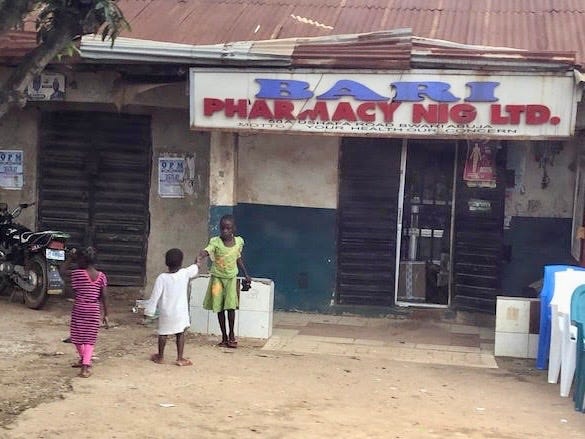
Stubborn Thing: Under its recently finalized health compact with the US, Nigeria will receive $2.1 billion in assistance over 5 years. At the same time, Nigeria’s bilateral debt with China stands at approximately $5.2 billion and its debt with the World Bank is $18.7 billion.
America has traditionally provided foreign assistance for a range of reasons.
National security. Done right, foreign assistance can advance our national security interests by, among other things, strengthening stability in fragile states and at-risk regions.
Economic security. Assistance can be used to improve the enabling environment for US trade and investment, and expand overseas markets for US goods and services.
Reaffirming American values. Assistance —especially our humanitarian assistance— also serves as the embodiment of our values and generosity. Michael Gerson, the late presidential speech writer and columnist, liked to say that helping others in need overseas was “good for our soul.”
But there has always been another reason for providing assistance…one we rarely talk about, but which is clearly on the ascendancy these days. We also provide assistance because it expands our influence with other countries and in international organizations.
When the Millennium Challenge Corporation (MCC) enters into compacts with qualifying nations, it provides conditional assistance that not only funds identified programs and projects, but incentivizes partner countries to undertake important reforms. Countries have to meet objectively identified benchmarks of good governance in order to qualify for compacts. Projects at the heart of each compact are identified and shaped by objective “constraints to growth” analyses and, when complete, they help to improve the enabling environment for both economic growth and US trade and investment. The manner in which funded projects are carried out also strengthens the capacity of partners to fund and implement their own future programs and projects. In other words, each step of the way, our assistance shapes the policies and practices of our partners.
The Trump Administration’s “America First Global Health Strategy” (AFGHS) uses a compact approach as well. AFGHS bilateral agreements condition assistance upon greater investments in public health systems and infrastructure, increased utilization of innovative technologies, and stronger diagnostics and infectious disease response capacity. While the completion of a compact doesn’t necessarily mean a country has achieved the ability to fully fund and be solely responsible for its public health, it does bring partners closer to that goal.
But it isn’t just policy reforms that our international assistance can influence. Sometimes our assistance works to polish our “brand” and remind audiences of America’s role as a global force for good. One of my political inspirations, Jack Kemp, liked to say, “People need to know that you care before they care what you know.” Sometimes our assistance works to show that we care —and our leadership is worth listening to. Put another way, many nations want to work with us because we are powerful. They are even more likely to work with us when they see that we apply our power to causes beyond our immediate self-interest…challenges like international food insecurity and forced human displacement.
But in a time when foreign assistance represents a smaller and smaller part of the broad economic forces shaping the developing world, is our assistance still “influential?” It’s a question worth asking.
Consider the case of Nigeria, an increasingly important player in world affairs. It’s the most populous country in Africa, one of its most diverse (over 500 indigenous languages), its largest oil producer, holds vast reserves of several critical minerals, and is Africa’s second largest economy. Analysts believe Nigeria will become one of the world’s twenty largest economies by the end of the decade and one of its ten largest in two and a half decades. We want to be close to, and influential with, Nigeria.
Under its recently signed health compact with the US, Nigeria is set to receive $2.1 billion in assistance over five years. That assistance is conditioned upon Nigeria dedicating greater amounts of its own resources to public health and taking steps to strengthen key aspects of its public health infrastructure.
While $2.1 billion is a lot of money, there are much larger numbers at play in Nigeria as well—numbers that its leaders need to keep in mind as they make policy decisions. As of 2023, Nigeria owed more than $5.16 billion to China for its past deals with Beijing. The US has increased foreign direct investment in Nigeria to $7.9 billion (as of 2024), and US-Nigeria bilateral trade recently surpassed $13 billion. Nigeria’s debt with the World Bank stands at $18.7 billion (one of the world’s highest amounts). Its annual trade with China is estimated at $22.3 billion (Note: on May 1, Nigeria’s exports to China will become tariff and duty free). Each year, Nigerians receive more than $23 billion in remittances from their diaspora abroad, and Nigeria recently struck a $24.6 billion infrastructure deal with China for projects in Nigeria’s Delta State.
We’re living in a time when foreign assistance (often referred to as official development assistance or “ODA”) represents a smaller and smaller portion of the financial landscape impacting African nations. These days, we’re rightly insisting that our assistance helps to make America stronger and more prosperous, but we shouldn’t lose sight of our goal to make America more influential too. Can we target our assistance to maximize its impact—including the “influence” impact? Can we redesign our assistance tools to include other parts of American life that are the envy of the world—the research capabilities of our universities and entrepreneurial spirit that drives innovation everywhere from Silicon Valley to the launchpads in our space program?
How much we spend does matter when it comes to diplomacy, commerce, and development. But in a time when lots of money is moving through lots of channels, how and where we spend it has never mattered more.
No posts
Comments
Nothing yet. Say the first thing.
Sign in to join the conversation.