
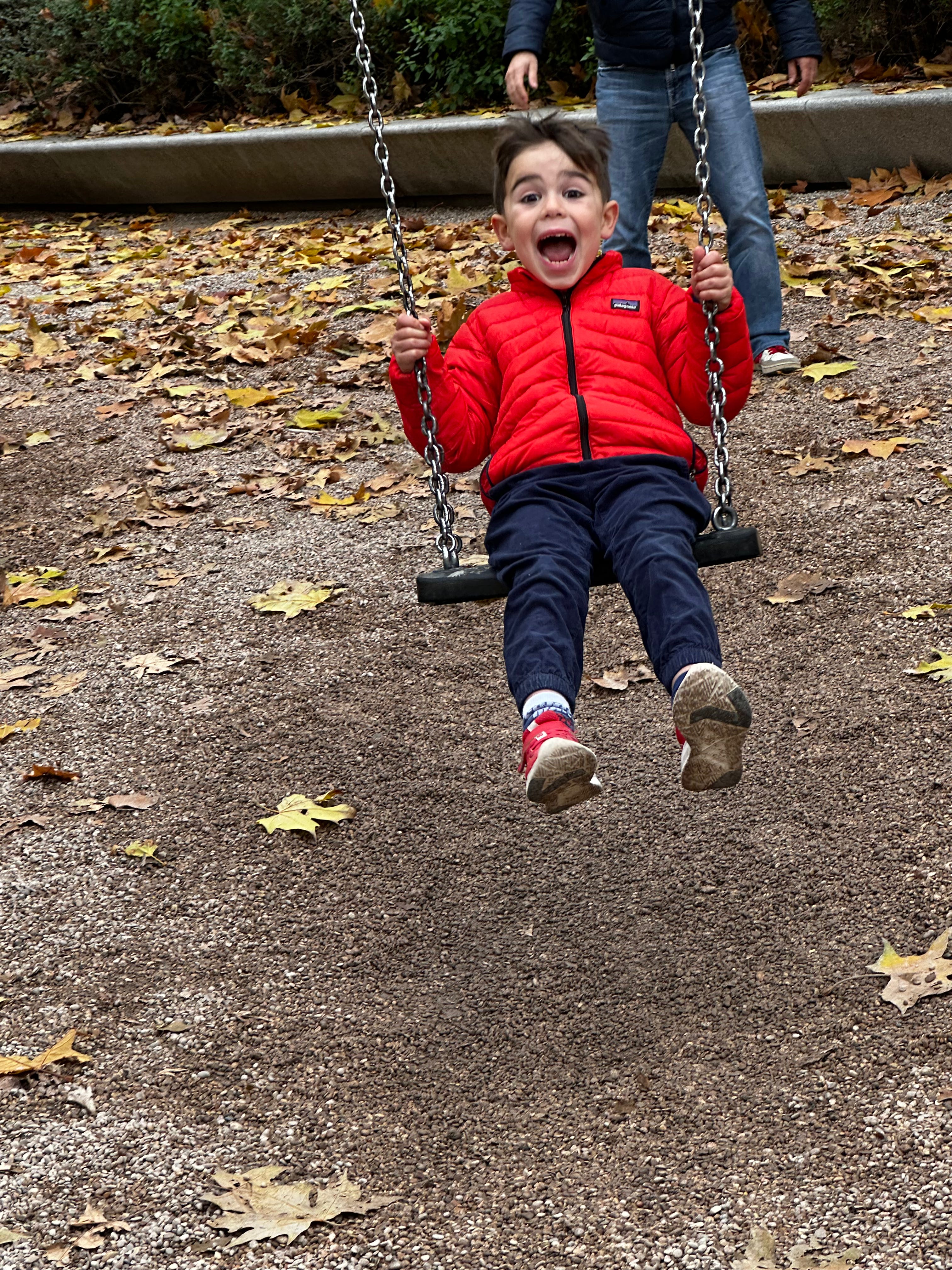
January 13, 2026: New Year’s has had me in a reflective dad mood, realizing how much my boys have grown in the last year. I’d also been listening to a chorus of podcasts warning about the skills kids will need to thrive in a world that’s changing by the second. So I started sketching a 2026 development plan for my children. And in the process, I realized something inconvenient: their growth is probably 90% dependent on mine. That’s when my fatherly dorkiness really kicked in…
Last week I told my 8-year-old I wanted him to try a “real” sport this year. (I was an elite gymnast for 15 years, so I’m opinionated on what’s ‘real.’) But I was open to anything that involved more than sprinting ten feet, tackling his brother, and declaring himself a gold medalist.
He looked at me like I’d taken away TV for the week. Then came the meltdown. A full-body, red-faced, tear-inducing “absolutely not” storm.
So I did what I’ve been trying to do more of lately: I sat with him, as patient as I could be, and tried to get to the root of his agita. It took 20 minutes – and far too many exaggerated tears - until finally, the truth surfaced. (And spoiler: it wasn’t deep. It was that he was eight.)
He gets tired quickly when he runs. That’s it. He doesn’t understand endurance yet. He doesn’t know that physical discomfort is sometimes the price of entry. That your lungs can burn and your legs can ache and nothing is “wrong.” It’s just your body learning.
At eight, he translated “tired” into: “I’m bad at this.” And if I’m bad at this, I don’t want to do it.
This got me thinking about goals. Because my first instinct was to build him a plan: More movement. More resilience. More “try hard things.”
But I quickly realized that if I’ve learned anything in researching fatherhood, it’s that it’s not setting goals for my kids that will help them blossom, but setting goals for me as the dad.
A kid’s development plan is really a parent development plan wearing a tiny hoodie.
When most of us say “I want my kid to grow,” what we accidentally mean is:
“I want my kid to act like the version of themself I imagine in my mind.”
And we start listing the skills they should practice, the habits they should build, the ways they should improve. But we all know our kids rarely work this way. They live inside systems (our household, school, community, etc.) and absorb the defaults.
The uncomfortable truth is that most “kid goals” fail not because the goal is wrong, but because it requires parent behaviors we haven’t designed yet: consistency, calm, accountability, repair, and an environment that encourages movement even when no one is around. Or we are, but not emotionally. One Ambitious Dad I interviewed put it best: “Trust is consistency × time.”
Kids don’t follow plans. They follow defaults. So instead of writing a plan to turn my kids into a project, I have been tinkering with something else.
A simple family development plan… Just a way to be intentional about the parts of childhood that happen outside school and can shape the adult more than the child.
Here’s the model I’m using:
Child skills
What we want them practicing. Simple, visible, repeatable. For example, growth mindset language (never saying “I can’t” – or more realistically: catching it and trying again).Parent skills
What we have to embody for that practice to be possible. Less “control,” more nervous system. For example for growth mindset, not rewarding outcome, not saying ‘you’re so smart,’ but instead celebrating focus, effort and learning. (“I saw how you stayed with that even when it was hard”).Home defaults
The environment that trains the skill automatically. Routines, language, expectations. For example in our dining room, we put up a wallpaper stencil of a gratitude tree and each night at dinner we write out what we’re grateful for on a sticky note and put it on the tree. (The key isn’t the tree. It’s the default: reflection happens here).
If your child goal is emotional regulation but your home default is sprinting for the bus, yelling to get everyone to the dinner table, and “stop crying,” when they’re frustrated, you’re home default will sabotage the goal.
If your child goal is confidence but your instinct is to rescue the moment things get hard, you’re training avoidance and teaching them that discomfort is dangerous.
So the question becomes less: “What should my kid work on?”
And more: “What should our home train without us having to force it?”
This is the process I’m using. You can do it in 30 minutes with a pen.
Pick 3 outcomes per child.
Not academic. Capacity-based. Things like “handles frustration,” “tries new things,” “repairs conflict,” “builds physical confidence,” “leans into creativity.” For example, I want my oldest to build endurance without panicking when it feels hard.Translate each outcome into a skill.
Example: “tries new things” isn’t a trait. It’s skills: practicing courage, tolerating being bad at something, recovering after discomfort. For my son: endurance = pacing + self-talk + knowing ‘tired’ isn’t ‘danger.’Choose the smallest action that train the skill.
Something tiny, boring and repeatable. Ten minutes is enough. For example, for my son, 8 minutes of running plus 2 minutes of walking, twice a week.Attach activities to existing routines.
After they get out of the bath. Before dinner. Just before your bedtime ritual. The goal is automatic, not heroic.Add the parent parallel.
Every child outcome gets one parent habit and one parent script.
Because the plan won’t run if I don’t. My example: I’ll practice saying “your body is learning. Let’s do one more together.”Create a home default that supports it.
What do we do in this house when someone gets frustrated? When someone fails? When someone is tired? When someone is rude? Should we hang some quotes about celebrating failure in the house? A behavior chart? For my oldest, I realized I go to the gym when he’s at school. He doesn’t see daddy workout. So I’m adding jogging (which I hate!) to my repertoire once a week when he’s home from school. I expect he and his brother will quickly ask to join.Review weekly. Adjust quarterly.
Short reviews and tweaks. For example as I’m putting them to bed, I’ll ask a few reflective questions about what felt hard (and I’ll put a sticky note or small photo on their wall to remember to do this).
That’s it. No dashboard required.
Here’s one development example I’ve sketched out for my 5- and 8-year-old boys:
Remi (5)
Emotional: growth mindset language (no “I can’ts”), identify feelings when frustrated, don’t distract away the emotion.
The parent plan hidden underneath:
If I want Remi to name emotions instead of melting down, I have to stop trying to fix the emotion as quickly as possible. I have to validate first. Not talk him out of it. I need to buy some books that highlight these feelings and how to express them. We can watch the movie Inside Out again. Also, I will practice saying less. Validation is short.
Riv (8)
Physical: morning training + one new sport.
Emotional: try an arts activity this year to practice his courage (an instrument, theater, singing, something that makes him feel a little exposed).
The parent plan hidden underneath:
If I want Riv to tolerate the discomfort of a new sport, I have to stop treating discomfort like a problem. I have to coach it. Normalize it. And I have to take on something new, too, so he can watch me struggle as well.
In the past I’ve used the dinner table as a prop for reflection. But any additional wall decals and my wife will divorce me. My compromise is a cool poster of two Olympians wrestling which I’ll hang in their room. That’ll be a perfect reminder of both struggle, brotherly fighting, and most importantly, the reflection questions I’ll ask them each night:
“What felt hard today?”
“What language did you try to use when you were struggling?”
“Where did daddy miss supporting you?”
Then I’ll also answer “What am I practicing next week as your dad?”
Bonus points if I ask another dad to do this entire process with me so we can hold one-another accountable.
I’m not doing this because I don’t trust school. I’m doing it because no school, no matter how strong, loves or engages with my child like I do. And it doesn’t adjust to the micro-seasons of my kids’ development the way a home can.
The real focus here, though, is about building a home where growth is normal. Where repair is normal. Where trying again is normal. My podcast guest Joshua Gillow told me, “There’s always room to start again… when you mess up.” Where “hard” isn’t a stop sign. It’s information. Where emotions don’t get punished, but they also don’t run the whole house. Where effort is celebrated. And where the defaults do most of the teaching.
If I can build that kind of home, my kids don’t need a perfect plan. They’ll grow inside the environment we practice together. And I’ll grow too, whether I like it or not.
If you want to try this, here’s the simplest version:
Pick one outcome for your child this year.
Pick one parent upgrade that would make it possible.
Pick one home default to train it.
Run it for two weeks. Review once. Adjust.
That’s the whole thing. Small steps. Clean repair. Try again.
No posts
Comments
Nothing yet. Say the first thing.
Sign in to join the conversation.