
This will be one of my longer letters (which means you may need to read this on Substack, rather than on your phone), because I wanted to give a piece of my heart around this topic.
What we are really talking about here is not a minor block or a cute question about whether one is “creative.” It is something many of us have suffered under for years.
And if we really want a creative life, I think we have to give the subject the gravity it deserves.
It asks us to go down into the roots and reconsider what creativity is, why it matters, and what kind of life becomes possible when we stop treating it as decoration and begin treating it as a way of being alive.
We have to go deeper than the surface-level answers and inherited clichés, because creativity is not just a hobby or temperament.
It is a mode of participation, a philosophy of attention, a way of being in relationship with life that many of us have been taught to mistrust.
I think a great deal of creative life gets lost in the distance between that phrase and the image many of us carry of what art is supposed to be.
I know it did for me.
For a long time, I was trying to make my way toward a definition of art I had never consciously chosen. I had simply absorbed it. Bits of school. Bits of the internet. Bits of biography and film and cultural atmosphere. The long afterimage of Art (yes, with a capital A).
It all gathered into a sort of invisible atmosphere around me. I absorbed it before I examined it, and by the time I started looking directly at it, it had already organized a great deal of my shame.
What it implied, very quietly and very effectively, was that art was a special kind of event. It needed the right setup, the right materials, the right posture, the right conceptual seriousness, the right degree of visible devotion. It needed to be justifiable. It needed to be worth the trouble. And if what emerged did not look sufficiently refined or moving or important, then perhaps it had never really been art in the first place.
Before I knew how to question it, it had already trained my body. The page felt watched. The brush felt watched. The whole enterprise felt a little overlit and interrogative, and a little punitive, as if anything I made would immediately be brought before some imagined panel and asked to justify itself.
That kind of thing works on us more deeply than we admit.
It is not only an idea in the mind. It enters the muscles. It changes the breath. It narrows the hand. It can make the act itself feel unpleasant before we have even begun.
The body knows when something has turned into a tribunal. It knows when a page is no longer a page but a tiny courtroom.
I think many of us are carrying around some half-formed but tyrannical image of what counts as creativity, what counts as art, what counts as seriousness, what counts as a real artist. We carry it into the room without realizing we are carrying it. And then we wonder why the room feels hostile.
At some point I realized I could not get free by trying harder inside the same definition. I had to back up and ask more primitive questions.
What is art, actually?
What is creativity?
And why do I care about this so much in the first place?
The words themselves ended up helping me.
One ancestral root associated with art points toward joining. Bringing into relation. Linking things. Arranging them in contact. I love that. It feels much older and truer than the modern image many of us inherit. A hand joins with a brush. Pigment joins with water. Water joins with paper. A body joins with a room. A cook joins with heat and salt and herbs and timing. A dancer joins with gravity, momentum, floor, music, breath. A writer joins with language, rhythm, memory, the pressure of a sentence trying to arrive. A person joins with an idea, or perhaps rather is joined by one.
And the old root behind create goes back toward growth. To grow. To bring forth. The Latin creare still carries that older biological feeling in it: produce, bring forth, make grow. (This is the root of words like Ceres, goddess of agriculture, or Crescent Moon, the growing moon phase.) Crops. Birth. Increase. Emergence. A kind of nurturing.
Art as joining.
Create as bringing forth.
When I hold those together, creativity starts to feel much less like talent and much more like a quality of participation. A kind of nurturing attention. An attuned way of entering relationship with what is in front of us so that something can begin to emerge.
That is the cleanest definition I have found for myself:
Creativity is the nurturing attention and participation we bring to our relationship with life.
Art is what emerges from that joining.
That may sound abstract when put so compactly, but I do not mean it abstractly at all. I mean it in the most ordinary, tactile, nearby way possible.
Tea ceremony helps me understand this.
A tea master is not making “art” simply because the gestures look graceful from the outside, though they often do. The art is in the relationship. With the leaf. With the water. With the temperature. With timing, vessel, atmosphere, hand, sequence, guest. Even the cup matters, as every surface can change the quality of the tea. Clay is not porcelain. Porcelain is not wood. The thickness of the lip matters. The way the vessel holds heat matters. The weight in the hand matters. The tea itself changes according to all of these things. The moment changes.
And if the tea is bad, no amount of elegant performance saves it.
It makes visible something I think we often forget: artfulness is not a decorative layer laid over the top of life. It is the quality of the relationship brought to the thing itself.
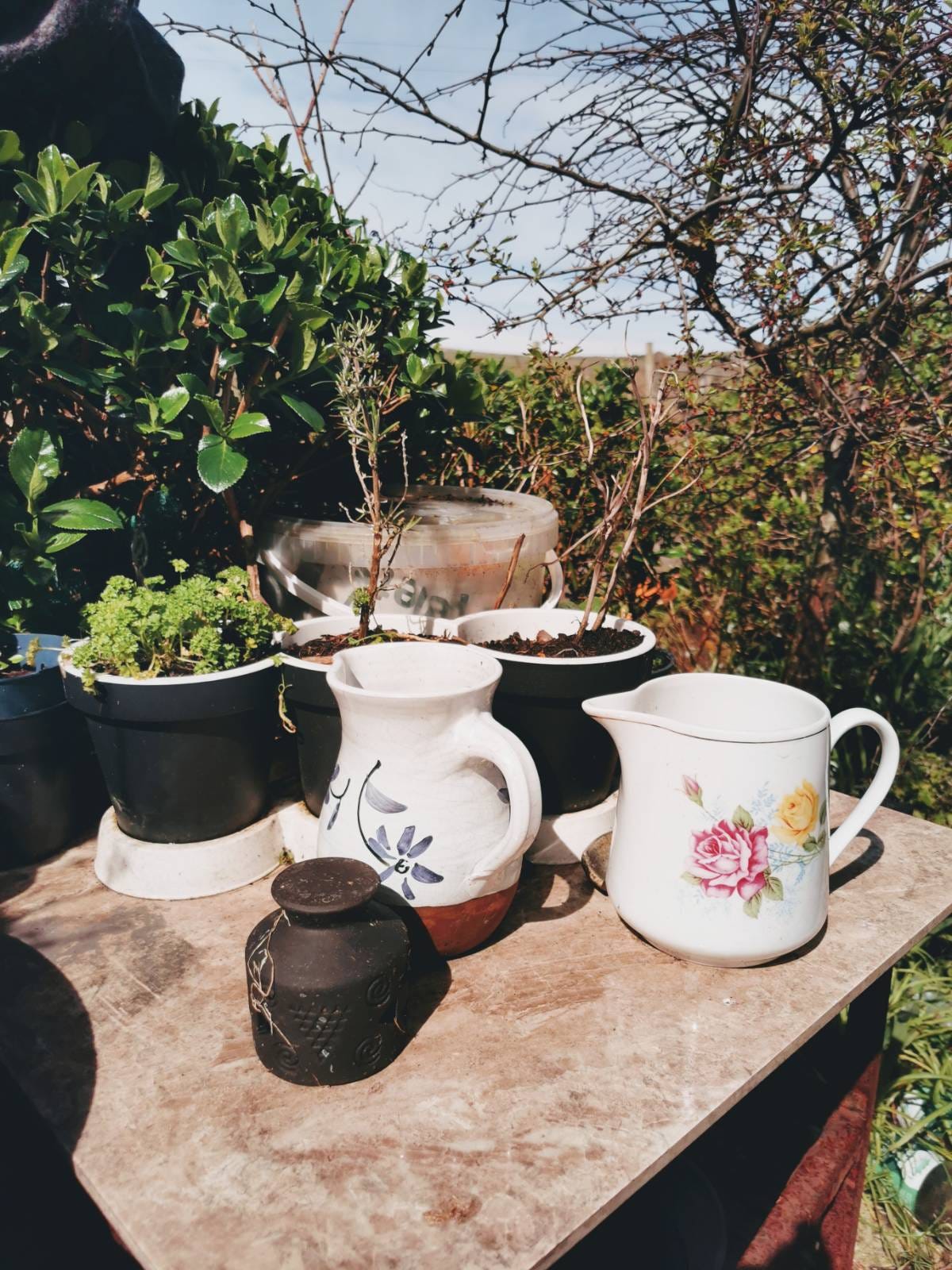
Leaf + water + heat + hand + vessel + time.
Joined with enough patience, care, and attunement that a third thing emerges.
Not merely tea, but this tea. This small atmosphere. This moment that would not have existed in the same way had the relation been different. Something ordinary has been met so fully that it becomes vivid.
I am truly not interested in arguing about whether every such thing should be granted the official category of Art. I do not care much for policing the border.
What interests me is how much artfulness is available in ordinary life when we meet it with enough attention and care.
A meal can be artful. A room can be artful. Gardening can be artful. Mending can be artful. The way someone braids bread, folds cloth, arranges flowers in an old jar, pours tea, chops herbs, lays out three objects on a table so the whole room suddenly feels more alive… all of that matters to me.
Not because I want to dissolve all distinctions into a sweet soup of “everything is art,” but because I think many of us have accepted definitions so narrow and so overprofessionalized that we have exiled ourselves from one of the most direct forms of participation we have.
And participation, more and more, feels like the important word.
We are always already in relationship with something. With weather. With materials. With rooms. With our bodies. With the time of day. With the life we have and the one we imagine we ought to have.
Creativity begins to become palpable when that relationship is met with attuned, nurturing participation; when we do not merely pass by, consume, evaluate, or force, but enter. Stay. Listen. Respond. Help something come into form.
That attunement does not fall from the sky fully formed. It deepens through return.
And that, I think, is where a lot of us get caught.
We talk about practice as if the hard part were discipline in the moral sense. But I have come to suspect the harder and more honest question is much closer to the body: will I want to come back?
Because attunement grows through repeated contact. Through returning to the material, the gesture, the rhythm, the medium, the process. Through staying close long enough for responsiveness to sharpen. What looks like talent from the outside is so often a kind of intimacy. The hand has come back enough times that it begins to know. The eye has looked long enough that it begins to notice more. The body has repeated the movement enough that it no longer has to panic its way through the action.
Practice matters because return matters.
And return matters because that is how attunement is built.
I learned this in a very backward way.
When I first tried to get back into painting as an adult, after many years away from it, I immediately made the whole thing unbearable. I felt I had lost time. I felt embarrassed by how much skill had gone dormant. I felt ashamed that I had not had formal atelier-style training and decided, with the kind of severity that often masquerades as seriousness, that I would correct this by becoming ruthlessly disciplined.
It was, in retrospect, a terrible idea.
I went into it with a clenched body and a very small window of tolerance for uncertainty, failure, or even perceived failure. I wanted to prove that I was serious. I wanted to become excellent quickly. I wanted to live up to my former self, my admired artists, my ambitions, all at once.
I had not yet distinguished between admiring someone and whether I truly wanted and enjoyed doing the same thing myself. I deeply admired hyper-representational painters, specifically botanical painters. People who could render a leaf or a petal with astonishing accuracy and refinement. So I decided, with the strangely strong confidence present in people about to make themselves miserable, that I would train myself toward that.
What it felt like, in the body, was one giant grimace.
That is the truest phrase I have for it.
I sat down tense. I painted tense. I evaluated tense. I was trying so hard to represent what was in front of me correctly that I never once stopped to ask whether I liked the experience of doing it.
I was obsessed with the outcome. I cared only about whether the finished thing measured up to the ideal in my head. The process itself was full of anxiety, frustration, anticipation of failure, and a running current of self-criticism so relentless that it was often physically painful because I found myself bracing for impact.
Of course I started to avoid it.
We usually call this procrastination, but I have come to think that what we are often avoiding is anticipated bad feeling.
If the body expects dread, humiliation, frustration, self-judgment, futility, or the sharp sting of not measuring up, it becomes much harder to approach the thing… even if the thing is, in some deeper sense, genuinely beloved.
That was absolutely true for me.
The strange thing is that what saved me came from what, on the surface, looked like procrastination. I became obsessed with understanding my materials.
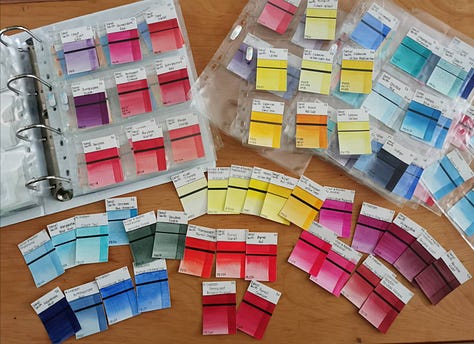


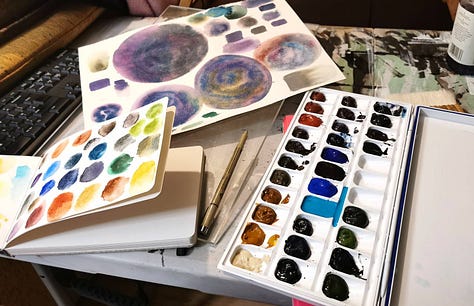
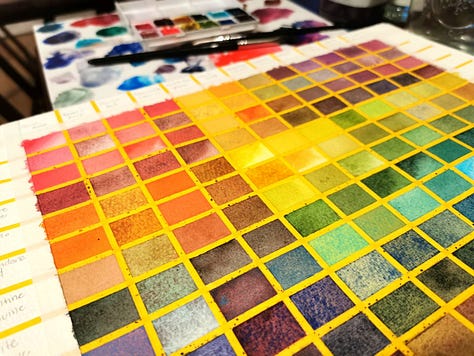
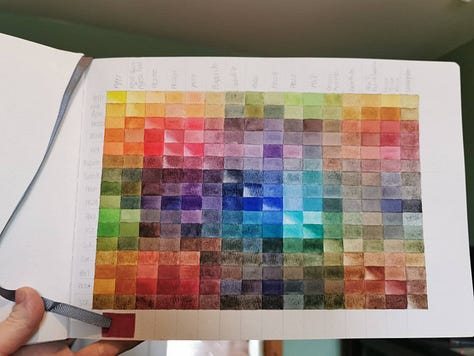
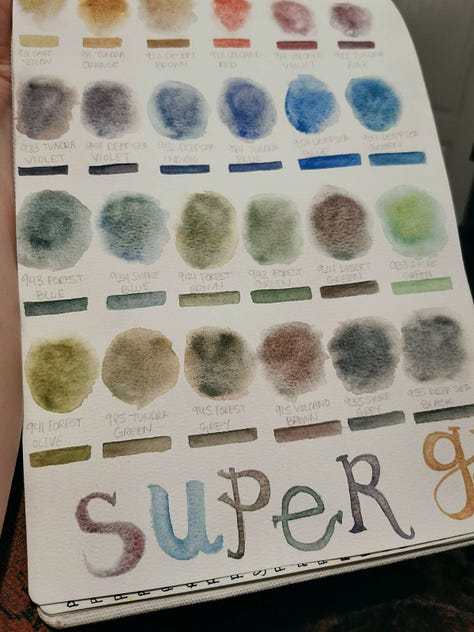
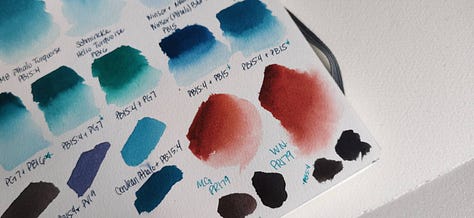

I started painting endless swatches of watercolor. Thousands of them, honestly. I wanted to know what each pigment would do. Why this PR101 from one paint maker behaved so differently from the same pigment number in another brand. Why one color granulated and another stained. How water changed everything. How different papers interacted with water and paint. How paint settled and bloomed into texture. How one wash dried lighter, another darker. How colors separated. How the chemistry of it all changed the result.
I loved it.
I loved the fascination of it. I loved the low stakes. I loved the way it felt to put paint to paper without also demanding that the paper prove my worth as an artist. I loved watching water move pigment around like weather. I loved seeing what would bloom, what would settle, what would edge, what would granulate, what would surprise me.
And because I loved it, I came back.
Again and again and again.
By the accidental grace of that return, I started acquiring the very skills I had been trying to bully myself into earlier. My brush handling and water control got better. My understanding of density, layering, paper, timing, and pigment behavior deepened. I was learning the mechanics and science of painting, but from inside fascination and play, rather than fear.
It taught me something I have had to learn over and over ever since: if I enjoy the process enough to return, attunement begins to grow.
If attunement grows, skill grows with it.
If skill grows, the work becomes more fluid, more instinctive, more intimate.
But none of that happens if the whole experience has been loaded with so much pressure that I dread the first step.
In the same vein of thought, another of the most crucial keys to unlocking me from my own self-imposed creative prison was, in a way, a bit of an accident.
Like many creative people trying to figure out how to get back to engaging the creative muscle, I thought that if I could find the perfect routine, everything would be fixed. Enter Mason Currey’s Daily Rituals books.
Yet rather than revealing the perfect pattern of habit I was hoping to find mirrored by several artists and makers as the one true way of creative living, what I discovered was much stranger, more individual, and often much less glamorous. Every time I read those books, I feel something in me unhook. Again and again, I met people whose methods were peculiar, body-led, highly specific to the individual, and often delightfully unreasonable.
What was important is that their lives were not organized around looking like creators. They were organized around making return possible.
Patricia Highsmith is one of the examples I think about most often. Not just because she was odd, though she absolutely was, and I mean that with real admiration. What struck me was the coherence of her oddness.
She hated the deadened moralism, the sterile puritanical virtuousness, around discipline. If writing began to feel like office work, duty, or some grim performance of virtue, the current broke. So she made different conditions. She would stay in bed with her manual typewriter beside her, surrounded by cigarettes, ashtrays, matches, coffee, and a pastry or sweet roll, and she would let herself drift into the work from inside that atmosphere of pleasure, of decadent permission.
She did not want the work to feel punitive. She wanted it to feel inviting enough to enter.
And then, famously, there were the snails. When she had to attend literary parties she loathed, she sometimes brought a handbag filled with lettuce and dozens of pet snails, simply to have something living to tend while enduring the ritual of public literary life. It is bizarre. It is funny. But beneath the comedy is a kind of seriousness I admire very much.
She was willing to shape the conditions under which she could remain herself and continue returning to the work.
That is the lesson I take from her.
Not that we should all imitate her rituals, or turn decadence into another performance standard. The point is much smaller and more useful than that.
If attunement depends on return, and return depends on whether the body can bear the process, then the conditions matter.
Atmosphere matters. Pleasure matters. Permission matters. Weirdness matters.
If something helps us come back honestly and repeatedly to the work, it is not frivolous.
This is a lesson that keeps unfolding for me.
There was a period not long after that where I started doing loose intuitive paintings in a sketchbook, often on paper not meant for that kind of painting at all. (Tomoe River paper! My love!) The paper buckled the moment it got wet. It crinkled, then the paint would pool and misbehave.

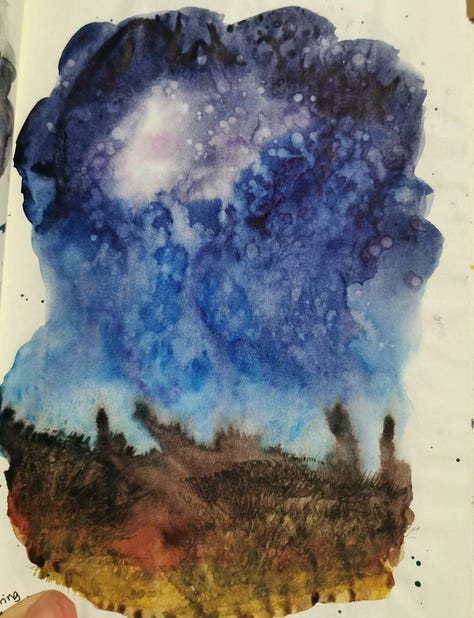
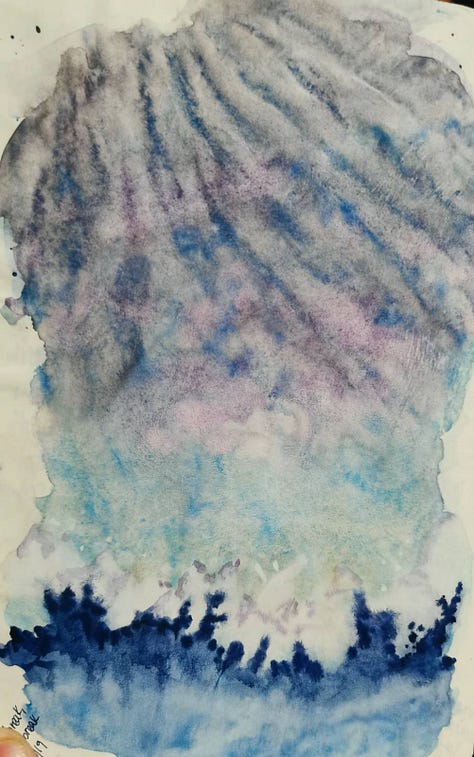
It made any attempt at tight realism immediately impossible, which turned out to be a gift. The paint made its own textures, its own blooms, its own atmospheric accidents. I had to work with what was happening instead of forcing the material to submit to some preconceived image.
That freedom was revelatory.
It felt less like shouldering my way into a painting and more like collaborating with something very much alive in front of me.
That distinction has become one of the defining ones in my creative life.
The way the brush feels in my hand matters enormously to me. It feels almost like an extension of my body. Not in some grand mystical sense, just in a direct, sensory way that is right, pleasurable, and true. I love the soft drag of it.
I love the way water media bloom and settle. I love how pigment can move like fog or sea mist or storm weather over a page. Looking back, that makes perfect sense, because I am a landscape painter. I am obsessed with atmosphere and light, distance and horizon. The way water moves. The way clouds gather. The quality of a place more than the individual objects inside it. My family jokes that I am always trying to get people to look up at the sky, at fog, at a distance horizon, at waves in a constant liquid movement of symphony.
Of course I paint the way I see things.
And when painting is going well (really going well) what I love most has almost nothing to do with the finished painting.
It is difficult to describe without sounding slippery, because I still don’t have precise language for it. It is almost like a trance. An out-of-body feeling, but in the most grounding way. Sometimes cooking gives me this. Occasionally a very good run. Often writing a song or a poem can take me here.
But painting is the clearest and most direct doorway to this state, for me. I settle in. The brush touches water. The sound changes. The breathing slows without me deciding to slow it. The jaw releases. The ordinary hard edges of my self-consciousness begin to dissolve. I am no longer standing over myself, monitoring, correcting, narrating. I disappear and come back completely whole.
That is the best language I have.
I disappear and come back completely whole.
That is what I am after every single time.
Which is why I have become so stubborn about process.
A finished painting can be lovely, sometimes, when it works out. (Most painters will tell you that’s not as common as it appears to be on Instagram.) I am glad when one works. I am glad when something comes together in a way that feels true.
But the outcome is not what makes me return. The outcome is a kind of… a stopping point.
The process is where life happens. The process is where aliveness is actually felt. It is where the body joins the world closely enough to forget itself for a little while and then remember itself more deeply than before.
Jeff Buckley once said:
“Everybody knows what it’s like to create an artistic moment, a so-called artistic moment, because it’s really just heightened humanism, it’s a heightened human language. If you’ve spent a night making love, you know exactly what it means to strip your ego down, where you are there expressing yourself wordlessly, collaborating on a moment that has an energy about it that is replenishing or completely inspirational in a way you could never imagine. That’s the way art really is.”
I love this quote because it catches something so many definitions miss. The stripping down of ego. The wordless collaboration. The replenishment. The way something emerges through a meeting rather than through a monologue of control. That, to me, is much closer to the truth of art than the solemn images we inherit about correctness and prestige and legitimacy.
Children know this long before they know how to explain it.
A child draws because drawing is delicious. Because color is irresistible. Because mud, glue, crayons, scissors, paint, song, movement, rhythm, piling, shaping, pouring, and pretending are all ways of falling in love with being here.
They are not standing over themselves with a clipboard asking whether the result is sophisticated enough to count. They are absorbed. They are participating. They are in direct contact with the world and with their own response to it.
I think often about my grandmother in this context. She made me a little studio corner in her garage and set up a chalkboard there for me. She would draw something simple on it and I would imitate her, utterly enthralled. It is one of my most precious memories.
There was love in it from every direction. My love for her. Her love in teaching me. My love of looking and trying and making.
Later, when I inherited her oil paints, I would sit for hours in a room smelling of linseed oil and turpentine, convinced it was the most romantic thing in the world. I lost myself in it.
That was the whole reason I ever got any “good” at it at all.
We return to what we love.
That should not be controversial, and yet somehow adulthood makes it easy to forget.
When I follow this (very long) train of thought, this is where everything starts to bend toward love.
The more I sit with creativity, the more I find it impossible to separate from devotion. To give nurturing attention to something is already a kind of care. To stay with it, to study it, to respond to it, to shape conditions in which it can grow… this is love in action, even when it looks very ordinary from the outside.
It helps me, when I feel myself drifting back toward old habits of judgment, to look outside the human world too. We have such a talent for narrating ourselves as exceptional that we sometimes forget how old all this is.
The male benthic pufferfish spends days shaping an immense mandala in the sand on the seafloor. His whole small body is involved. He swims, shivers, carves, adjusts. Ridges and valleys appear and shell fragments are gathered. Current and body and desire work together until this brief, astonishing architecture exists, only to be erased again by the sea after it has served its purpose. He does not seem paralyzed by whether anyone in a graduate seminar would consider it conceptually rigorous enough.
He is busy making a world fit for encounter. He arranges a world to call another being close.
These creatures help me remember that creativity is older than our categories and far more widespread than our prestige systems would suggest.
Life has always been joining with life, bringing forth forms through participatory relations(hips).
And often, it does so lavishly.
The more I look at this in life, the more it coyly reveals itself as love.
Not love as thin surface-level sentiment. Love as active devotion. Love as enacted care.
Love as the force that moves a being toward participation, toward offering.
Toward making a moment or a form in which another being might arrive and recognize something there.
The pufferfish gives his future mate a visible trace of his devotion. She recognizes it and responds to it, moves toward it.
We do this too.
We are moved by care all the time. A lovingly cooked meal lands differently in the body. A room arranged with attention changes the nervous system. Music changes us. Paintings change us. A small bunch of flowers in a chipped jar can alter the air in a kitchen.
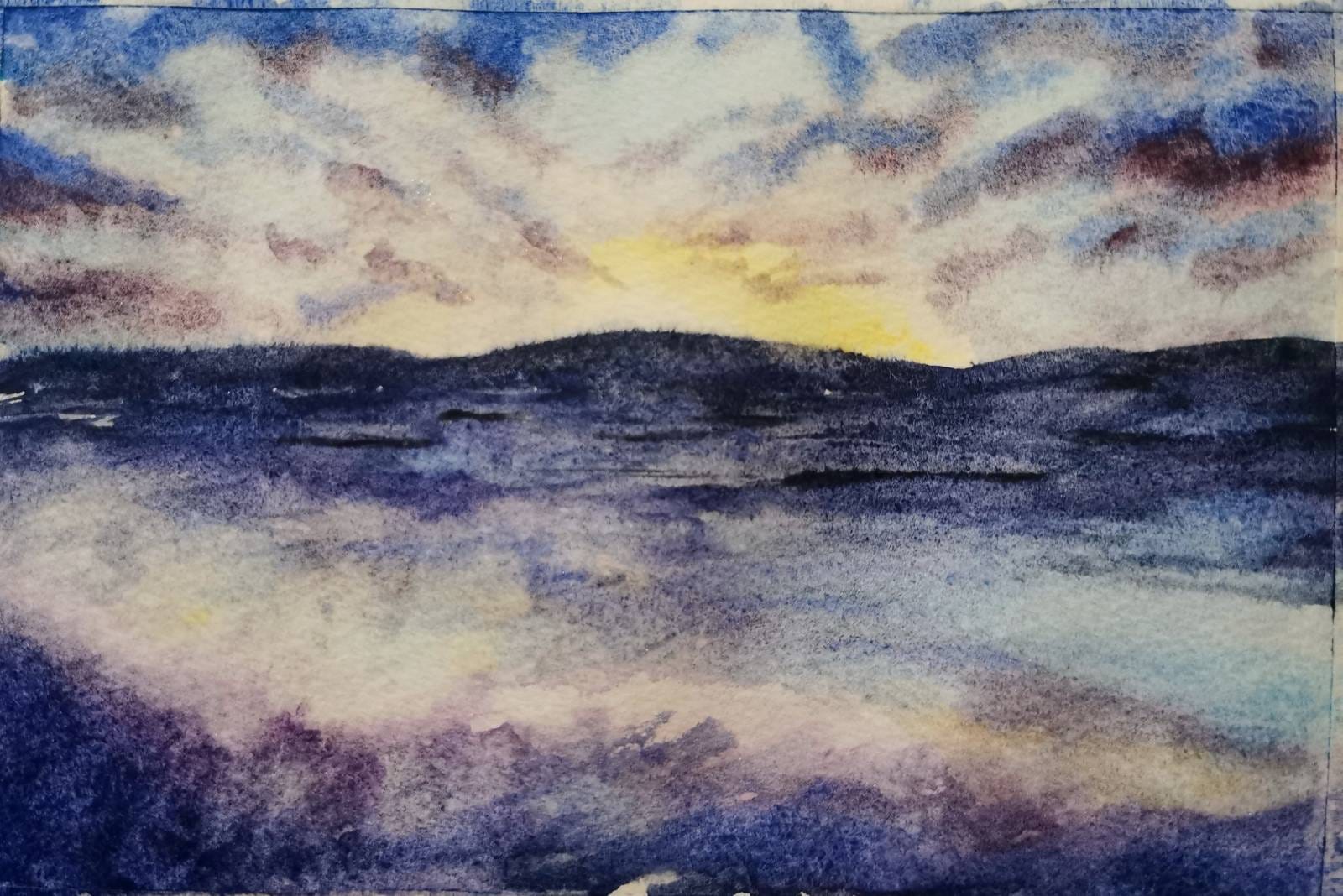
We respond to the traces of devotion because some part of us recognizes them immediately.
This is one of the reasons I think art matters so much: art is one of the ways love becomes visible.
And perhaps that is why the whole thing can feel so painful when blocked. We are not merely missing a hobby! We are missing a mode of relationship. A directness. An intimacy. A way of participating in life that makes us feel more fully here.
Which brings me back to the thing I keep circling:
We do any of this because we want to feel alive.
Not accomplished in the abstract. Not arrived. Not merely admired.
Alive.
And aliveness, at least the kind I trust, does not seem to happen at the end of things. It happens in participation, in process, in the doing… In the joining. In those moments when the self-conscious mind grows quiet enough for a more direct conversation with life to take place.
Why, then, do we judge what brings us alive?
I mean that sincerely.
Why do we take one of the deepest forms of participation available to us and bury it under standards so brittle that ordinary life cannot get near it? Why do we measure our moments of vividness against arbitrary definitions of seriousness? Why do we assume that what feels playful, pleasurable, strange, or local cannot also be profound?
What is more serious than what we give our attention and care to with demonstrable acts of devotion?
What is more serious than nurturing the conditions from which aliveness arises?
I think many of us have made creativity inaccessible not because it was ever truly inaccessible, but because we attached too much pain, too much image, too much self-surveillance, too many inherited rules to it. We turned one of the oldest ways of joining life into another arena in which to evaluate ourselves.
No wonder the body hesitates.
No wonder the small painting of something you love (and that’s the plain simple truth of it) gets pushed aside.
No wonder the ten available minutes seem too small to count.
But what if they do count?
What if the fox painting counts because a real encounter took place there?
What if the point is not whether it looked official from the outside, but whether hand and ink and curiosity and time joined closely enough for something to emerge?
What if a creative life is not primarily a life of impressive outputs, but a life in which more and more of our ordinary encounters become places of artful, nurturing participation?
That is the definition I am trying to live inside now.
It gives me somewhere real to stand. It lets me work with the time and energy actually available. It lets me trust the twelve-minute pocket. The swatch. The weird setup. The materials that misbehave.
The process that feels like home. The little acts that do not look important until one notices that they are the very acts that bring a life back online.
No posts
Comments
Nothing yet. Say the first thing.
Sign in to join the conversation.