
Lately I have been painting in bed.
This is not, as far as I can tell, one of the sanctioned images of artistic seriousness.
No one makes a gorgeous black-and-white documentary about the painter tucked under a temperature-controlled blanket with a tray balanced over her knees, trying not to hyperextend her wrists while rinsing a brush in a chipped water jar set precariously on the nightstand.
It does not carry the romance of the upright easel in the beautiful studio with northern light slanting over exposed wood floors.
It does not look disciplined. It does not look iconic.
It does not look like the version of being an Artist (yes, with a capital A, so regal, so important) I seem to have absorbed by osmosis over the years—through art school adjacent air, through biographies, through movies, through the internet, through that strange invisible tribunal of imagined onlookers who are always, somehow, watching from just over one’s shoulder.
And yet.
It is how I have been painting.
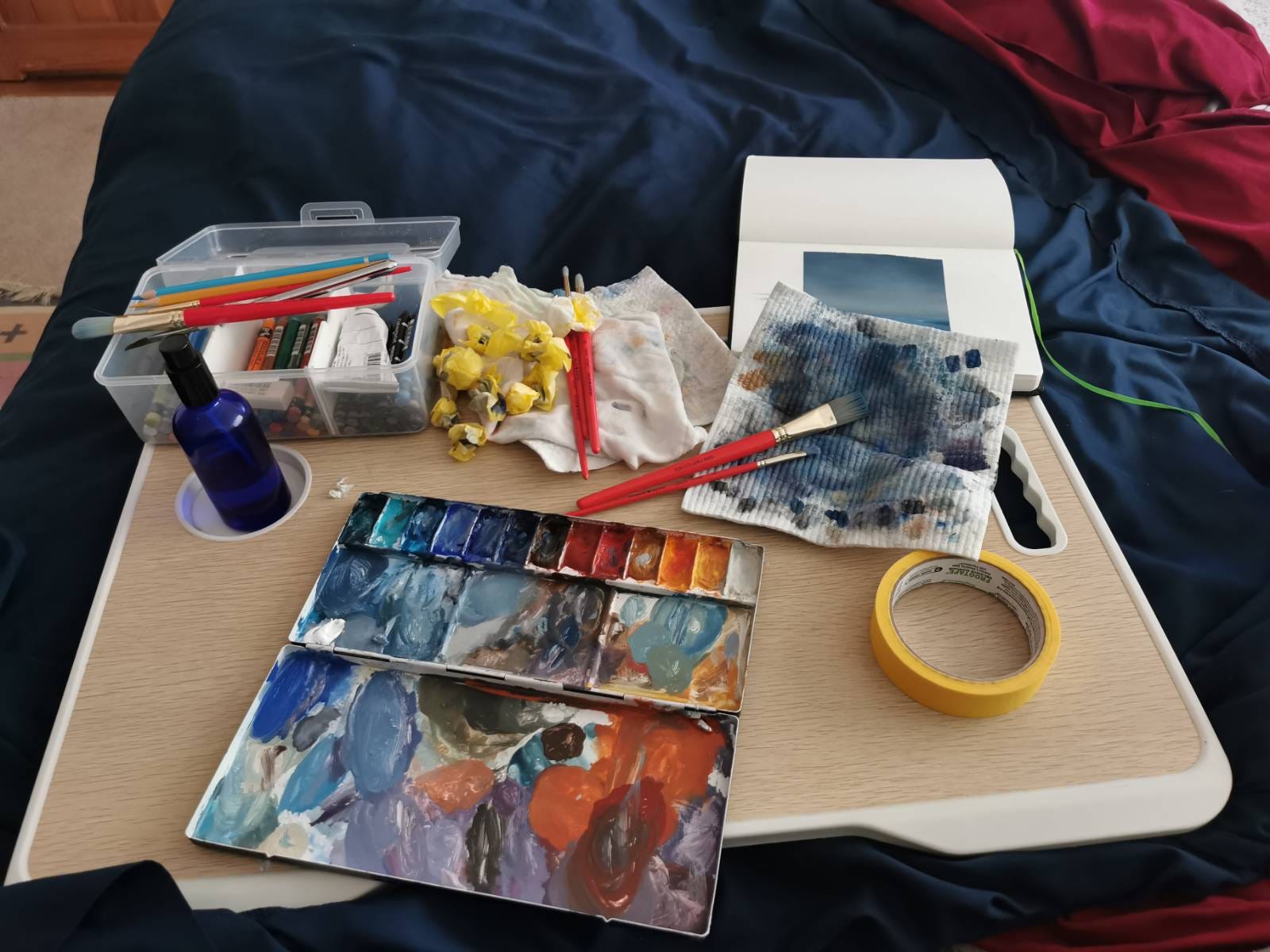
Because my body has been in a pretty rough flare, and sitting at my drafting table right now asks things of me that my body simply is not interested in giving. Sitting rigidly upright for too long can tip from fine to punishing with very little warning. There is a narrow strip of physical comfort available some days, and I am getting less sentimental about pretending that strip does not exist.
So the painting has moved to the bed.
Not because it *looks* right, but because it lets the work happen.
And, to my annoyance and eventual delight, it has its own kind of beauty. The lamp throws a low pool of gold over the page. The blanket keeps a little cave of warmth around my knees while the Atlantic goes on being theatrical beyond the window (the wind the last 2 days has been biblically intense). A brush handle knocks softly against a mug with a soft clink almost like an instrument. My collection of beach ephemera are within reach, containing a dusty haze from drying out, and the patina makes me stare long at the texture and try to imitate it with brush and medium.
It is not the romance I was sold about creative life, but it is a romance nonetheless—stranger, homelier; more intimate, less performative… a more sincere devotion.
I have been thinking, with a kind of low-grade embarrassment and increasing fascination, about how much of creative life gets organized around image. Not the image we make, though certainly that too, but the image of the life itself. The posture and staging of it. The visible proof of seriousness.
The writer at the desk before dawn.
The painter at the easel.
The ceramicist in the immaculate apron.
The tidy morning pages beside the handmade mug and the morally superior lemon water.
The studio that looks like a studio, correctly unmade in an aesthetically pleasing kind of way.
The rhythm that can be photographed. The practice that can be narrated.
I know I am not the only one who has taken in some version of this and quietly mistaken it for proof of legitimacy.
It is strange what begins to harden in us without our consent. Strange what starts as admiration and calcifies into obedience.
Somewhere along the line, I picked up the idea that there are ways a real creative person works, and then there are ways a person is merely fooling herself. That seriousness has a posture. That legitimacy has a silhouette. That if someone saw me making work in a way that looked too comfortable, too improvised, too odd, too stitched into the actual conditions of my life, it would somehow count less.
This is absurd, of course.
A creative life is made out of many kinds of making.
An artist is someone who makes art.
A creative person is someone who lives/acts within life, creatively.
And still… I have found myself negotiating with an unseen specter. Some invisible witness in the room who seems deeply invested in whether I am doing it properly enough. Elegantly enough. In a way that would read “correctly” from the outside.
For the last 4 years, that question has been rearranging me, bit by bit.
I think part of what has been especially punctuated for me in the last year or two—through radically accepting my chronic illness and limitations, through deepening adulthood, through the plain old attrition of trying to keep a life together while also wanting very much to make beautiful things—is that I have become less interested in the appearance of a creative life and much more interested in whether it can be lived here.
Here, in this body.
Here, in this season.
Here, in a life that includes laundry and invoices and weather and fatigue and joy and dishes and sudden pockets of energy and equally sudden collapses and a brain that is not always willing to proceed in a neat little line from intention to execution.
I have often mistakenly thought that I would live creatively and make art after my life looked more like the life of an Artist.
For the last 4 years, I have started to suspect that the more important question is whether I am willing to live creatively inside the life I actually have.
I keep circling back to a sentence that feels embarrassingly obvious and simple: my life is the studio.
And I mean studio in the widest possible sense. Not the fantasy of it. Not the clean little stage set I once imagined I would eventually earn.
This life. This body. This weather. This interruption-prone, laundry-filled, tea-stained, occasionally beautiful, occasionally absurd arrangement of things.
If I want a creative life, it has to be one that can happen here—not somewhere else, not later, not in the imaginary version of adulthood where all the conditions finally line up and the desk is always clear and the body is always compliant.
My life is the studio. Which means the work has to meet me where I am, and I have to be willing to meet it there too.
That feels both smaller and much more radical.
Because the image is always tidy. The image is always finished. The image has no mud on its boots and no heating blanket and no interrupted afternoon and no weird little workaround that would never make it into the tasteful biography.
But real creative life, at least as I am meeting it these days, is full of unphotogenic adaptations.
Maybe that is one of the least glamorous and most important truths about making anything at all: life does not sit politely outside the studio door. It is *the* studio. The work happens inside the weather of a real existence.
It is balancing the palette where it fits. It is painting while on a call because, strangely, the conversation steadies the hand and keeps the inner critic occupied elsewhere. It is scribbling a line while the kettle boils. It is noticing that one chair in the house allows the body to soften and another one turns the whole body into a tightly clenched ball.
It is learning that some days the work arrives through a side door, and if I insist on the front entrance, I will only end up standing outside in the rain, sulking.
But it is not only painting.
It is also gardening with pads, long-handled tools, irrigation hacks, or raised beds because kneeling in the dirt the “normal” way would make the whole thing inaccessible.
It is also cooking with scissors instead of the big beautiful chef’s knife because your hands and nerves have their own opinion about what is possible. It is finding a way to make a meal feel delicious and tender in a kitchen so tiny and stubborn that the oven barely qualifies as a rumor.
It is arranging shells on a windowsill, stitching slowly, humming into a phone recorder, moving furniture until the room breathes better, finding some odd little adaptation that would never make it onto social media and yet quietly gives your life back to you.
And the uncanny and beautiful thing is that once I stop fighting those adaptations, they stop feeling like humiliations and start feeling more like collaborations. The life I actually have begins to answer back.
The bed, the weather, the strange hour, the conversation drifting through the room, the ten-minute pocket before dinner, the way my body wants one chair and refuses another: all of it starts to become material. Texture, rather than interruption. Not the enemy of the work, but part of how the work arrives.
And once I stop treating my actual life as the thing standing in the way of creativity, it begins, quietly, stubbornly, to reveal itself as part of the beauty of it.
None of this is particularly grand. I think that is part of why it has taken me so long to trust it.
We are so used to associating creativity with intensity, with particular high minded ideas and deft skills, with visible aesthetically-pleasing devotion.
But a great deal of real and sustainable making seems to depend on something much humbler than that.
Less performance, more access; less image, more contact.
Less forcing the self into the correct shape, more finding the conditions under which the work can pass through without too much unnecessary friction.
I keep coming back to the body here, not in a grand theory sort of way, but in the stubbornly practical sense. If something hurts badly enough, or asks too much effort before the first mark has even been made, I am simply less likely to return to it. If a setup makes me feel braced, watched, overextended, or subtly ashamed, then some part of me begins to avoid the whole enterprise. Not because I do not love painting. Because the terms of engagement have quietly become hostile.
This is what I mean when I say I am no longer interested in what merely looks like a creative life.
A life can look exquisite from the outside and still be almost impossible to inhabit.
And I think many of us know this, even if we do not say it plainly. We know how much energy can be spent maintaining the appearance of the thing instead of entering it. We know how easy it is to become devoted to a picture of ourselves rather than to the actual, vulnerable, often faintly ridiculous experience that is our continually unfolding becoming.
There is something deeply relieving, if also a little mortifying, about admitting that the real goal is not to look like an artist.
The real goal is to make art. Or, rather, the goal is to live creatively so that we can make art.
The real goal is to have a practice that can be returned to, no matter how photogenic (or not) it is.
The real goal is not to impress the invisible witness, silently waiting to judge and score whatever you put on display.
The real goal is to let the hands touch the materials again… or the ingredients… or the soil… or the thread… or the keys… or the objects on the table… and feel that shiver of anticipation and pleasure and the overwhelming impetus to do…
The goal is to let life become shapeable from the inside.
What I have been building for the last 4 years (and will probably be building for the rest of my life)—very imperfectly, very much in the middle of it, with all the usual human backsliding and melodrama—is a creative life I can actually live. One that does not depend on ideal conditions, or the right posture, or a fantasy version of who I might become if only I could finally get my act together and become beautifully, pristinely, photogenically performative of the role we call Artist.
The kind that can happen in bed, in fragments, in a life that is constantly in motion, in a body with opinions. The kind that is willing to be a little strange if strange is what makes the work possible. The kind that stops asking whether it looks legitimate and starts asking whether it lets a life feel inhabited from the inside.
That feels closer to truth. Closer to the prayer mat always beneath our feet, the sacred ground we already occupy.
Closer, honestly, to love.
And maybe that is one of the quiet rebellions available to us now: refusing to build our creative lives for the gaze of an imaginary audience. Refusing the polished image in favor of the awkward, functioning, tender arrangement that actually allows us to begin.
Letting the thing be weird. Letting it be local. Letting it belong to the body we have, the room we have, the hour we have, the materials at hand.
Rather than lowering the standard, I think it is moving the standard back to where it belongs.
Not: does it look right?
But: does it let the work live? Does it let me come back to a experience of, a participation in aliveness?
I have been carrying these questions around with me for months.
Maybe it is worth carrying a little longer.
No posts
Comments
Nothing yet. Say the first thing.
Sign in to join the conversation.