
Hello Starlings,
I suppose it’s fitting that the first eclipse visible to Ireland since 1999 we are facing an unprecedented heat wave and drought (you read that right). My own area is coated in intermittent fog and a heavy pressure system, but continues to receive very little rain.
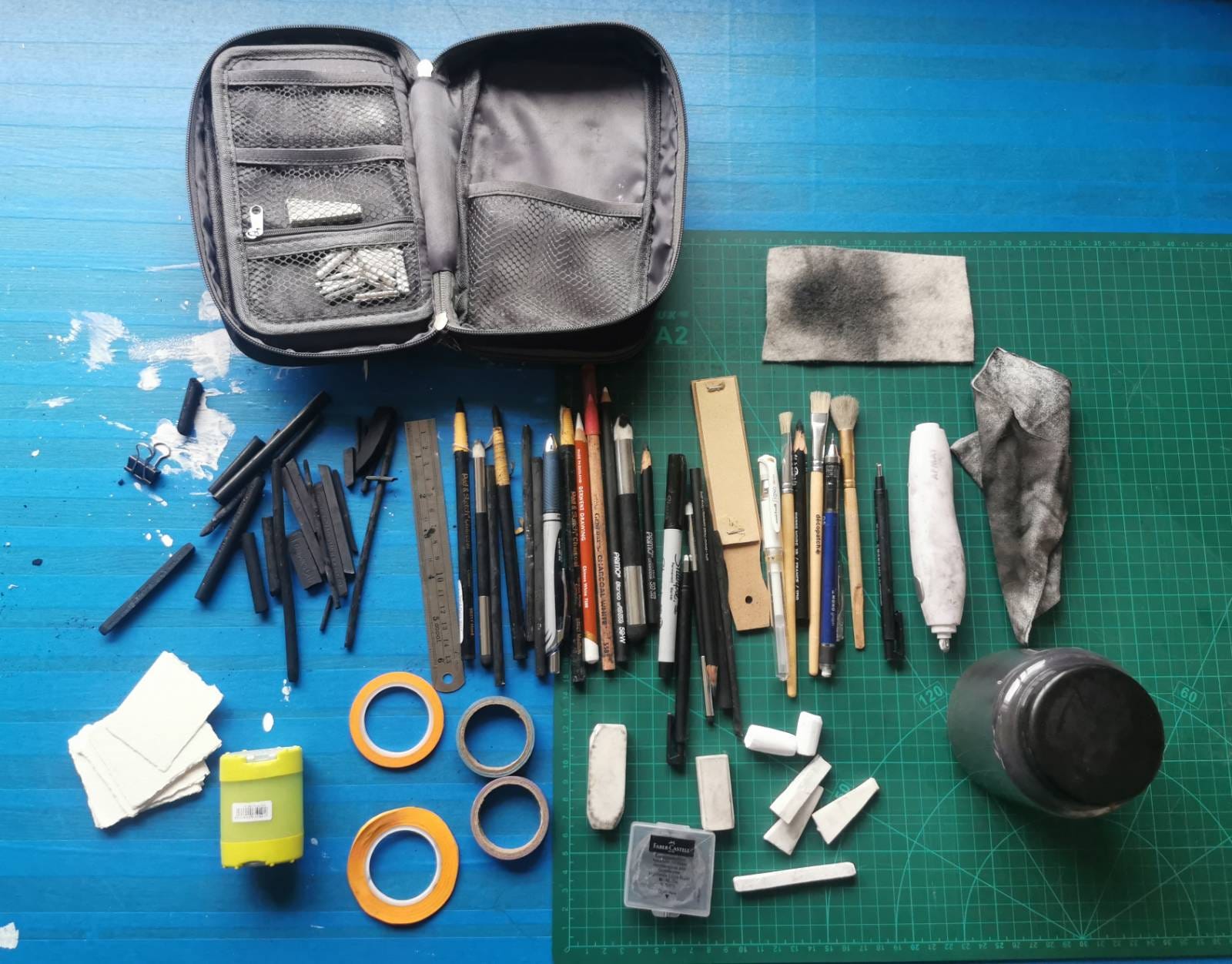
I sit here, writing this email, watching the undulating cloud and light forms from my window and pulling apart my charcoal kit.
I wanted to look honestly at what I use, what I do not use, and what I remain curious about trying. I have also begun cleaning and rearranging my studio so that it better serves the practice I actually have now.
As I turn over every tool, I begin asking questions:
Are you here because I still reach for you?
Are you here because you contain some spark of inspired possibility?
Do you pique my curiosity?
Or are you here because I once imagined becoming the kind of artist who would (one day, maybe) use you?
I find that I often sort my thoughts while organizing something physical. Today that has meant also sorting my thoughts about the larger decisions of my work moving forward.
There are now only 9 Creative Court Reports remaining.
Once they are claimed, I will be closing the reports for the foreseeable future.
I had previously believed that I would eventually replace this enormous report with a smaller version. I have spent countless hours trying to imagine what that version might look like.
What I realized is that I do not want to make this work smaller. I want to go deeper. What an eclipse revelation! We’re going to dive into it at the end of today’s email.
But if you’ve felt the clarion call of learning more about the Creative Court…
These are the final 9 spots to commission the original, fully expanded Creative Court Report. Each one is a bespoke exploration of Venus, Mercury, Mars, the Moon, and the agreements they require in order to support your physical creative practice. These custom reports are generally between 21 and 30 pages.
They are $247, with a current delivery window of 4–6 weeks after I receive your completed creative questionnaire.
Commission Your Creative Court Report
Today’s eclipse has helped me think more carefully about what it means for any maker to release an old creative identity without destroying the living knowledge held inside it.
Reading the Eclipse Through Two Traditions
Today, August 12, we have a total solar eclipse at 20° Leo. (Considering how slow I’m editing this email, it is probably happening just as it hits your inbox.)
As an eclipse in tropical Leo, it also touches creative identity.
Leo is the home of the Sun: the place where something singular emerges from the heart and gathers enough authority to place its name upon what it has made. Within the Creative Court, Leo speaks to the identity of the maker, the courage to create from one’s fiery heart-center, and the willingness to let that creation be seen.
Eclipses are interruptions in light.
A solar eclipse temporarily obscures the Sun, and with it our ordinary access to vitality, authority, purpose, and a coherent sense of self. The Sun has not ceased to exist, and its light has not been destroyed! Yet for a brief interval, we can no longer receive its normally reliable light.
That makes eclipse periods complicated times for making sweeping judgments about who we are.
I should explain that although most of my astrological work is grounded in traditional Western astrology, lunar astrology (the Moon, nodes, eclipses, nakshatras) is one place where I deliberately draw from Vedic astrology as well.
I have been privately studying the Vedic treatment of the Moon, the lunar nodes, and the nakshatras for several years. The nakshatras are the 27 lunar mansions through which the Moon travels (with Abhijit sometimes counted as a 28th lunar mansion). Each has its own presiding intelligence, power, mythology, and particular way of shaping experience.
In my studies, I have found the Western treatment of eclipses useful but… incomplete. What can I say? I’m a bit of a meaning and detail junkie.
Jyotish has preserved an extraordinarily deep and continuous body of knowledge around the Moon and the nodes in particular. I have also found its descriptions startlingly precise in lived experience, especially when we are trying to understand the strange inner mechanics of a creative life.
So I am reading today’s eclipse with an overlay of the Vedic lens of interpretation on top of the basic Tropical Leo significations.
Using the Vedic sidereal zodiac, the eclipsed Sun and Moon fall in the nakshatra Ashlesha. Ketu, the South Node involved in this eclipse, occupies the nakshatra Magha.
These two lunar mansions give us a considerably more textured story than the familiar instruction to “release what no longer serves.”
Ashlesha and the power that binds
The name Ashlesha comes from a Sanskrit root that carries the meanings of embracing, adhering, joining, clinging, and entwining.
Ashlesha is the nakshatra of the wise serpent deities, the Nagas.
Its power concerns binding: the force through which one thing attaches itself to another and becomes difficult to separate.
We could say that a great deal of physical art-making falls under this same concept.
Making depends upon binding. Pigment adheres to a surface. Fibers are twisted, crossed, and tightened until they become thread, and then joined again to become a knitted or crocheted object. Clay particles gather into a body under pressure and are transformed by fire. Repeated gestures gradually come together into one cohesive skill. A hundred scattered encounters with a material slowly cohere into something we can finally call a practice.
Creative identity is also a binding agent.
It gathers years of incomplete experiments, private desires, technical knowledge, disappointments, habits, and moments of revelation into the conviction:
This is what I do. This is the kind of artist I am.
Some form of binding is necessary. Without it, nothing coheres long enough to acquire form, let alone depth or roots that endure through time.
The trouble begins when the bond can no longer discern devotion from captivity.
An unfinished project remains in the studio because allowing it to remain unfinished might say something subtle (and dangerous, possibly hurtful) about our discipline, seriousness, or worth. Supplies are kept because they belonged to an earlier dream, and quitting is rarely seen as a virtue.
A book continues exerting authority long after its instructions stopped bringing pleasure to the hand. A particular medium becomes so entangled with the identity of being an artist that changing materials feels like betrayal. A former teacher’s judgment (or perhaps that of a peer) may continue speaking every time we approach the page.
A successful piece of work may become its own kind of trap, demanding that everything afterward resemble it closely enough to preserve the recognition it once received.
A creative identity that originally protected the work can eventually begin constricting it.
Ashlesha asks us to look closely at the bond.
The serpent imagery also introduces poison, but there is an important distinction here: the snake carries its venom in a particular pouch. Its entire body is not poisonous. (And if you have been around for my earlier work, I’m a big advocate of Paracelsus’s wise idiom “the dose makes the poison”; we use poison as medicine all the time.)
A humiliating experience may have poisoned our relationship with a material, but the skill we developed through that material remains real!
An abandoned project may have become saturated with guilt while still containing one image or idea that simply will not leave you alone. A teacher may have harmed our confidence while also passing down legitimate knowledge that is now an intertwined part of our creative practice.
We do not have to condemn the whole body to remove the venom! We can ask where the poison is actually stored:
What has become bitter because it has been held past its living time?
Where has creative intelligence become trapped inside shame, resentment, comparison, or obligation?
Which old attachment is protecting something precious, and which one has begun slowly squeezing the life from it?
The wisdom of this eclipse is to resist the urge to dispose of our entire creative history and instead discern what remains alive inside the coil.
Who sits upon the creative throne?
Ketu, meanwhile, occupies Magha.
Magha is connected with the Pitris, the ancestral intelligences who carry memory, merit, obligation, and inheritance between generations and states of being. Its symbol is the throne.
Magha concerns the authority we inherit, the position we occupy, and the accumulated conditions that allowed us to arrive where we are.
Ketu… complicates these things.
In the Vedic framework I use, Ketu is the headless body: the force that moves backward toward the source, removing the familiar identity through which we ordinarily understand ourselves.
Freedom Cole teaches that Ketu is met through surrender.
We cannot satisfy him by offering more.
Something must be relinquished.
That does not mean throwing away every object or abandoning material life! That is not so much surrender as it is abandonment.
The deeper surrender concerns attachment.
When we abandon something, we may be trying to outrun an attachment that continues haunting us. Ironically, the more hellbent we become on escaping it, the more deeply we can sink into its tar pit.
For the maker, Ketu in Magha asks:
Who or what is sitting upon the throne in the studio?
It may be an old teacher whose definition of mastery still governs the hand.
It may be the audience (real, imagined, or conspicuously absent) whose recognition has become the measure of whether the work is “real”.
It may be a former success, an inherited tradition, or the artist we once believed we were destined to become.
It may be the long shadow of someone we both admire and envy, causing us to abandon our own desires and ambitions so we can obsess over theirs.
Sometimes guilt sits there, issuing commands about everything we must complete before we are permitted to begin anything new.
Because this is a solar eclipse, the recognizable creative “I” may feel less reliable for a while.
This is my style. This is what I am known for. This is what proves I am serious. This is what makes me an artist.
The eclipse darkens the authority of those statements.
This has the potential to reveal an identity that has reached completion. It can also produce wounded pride, depleted confidence, and a sudden urge to reject parts of the creative life that still contain vitality.
Ketu’s knife is not always delicate, nor is it always precise.
I would not use this eclipse to decide that you are no longer an artist, destroy a body of work, abandon a practice you still love, or make a grand announcement about your total reinvention.
The eclipse interrupts the light by which we ordinarily evaluate ourselves. It does not necessarily provide an accurate verdict on our work.
Decrease is not automatically purification.
The South Node can diminish an inflated ambition or release a project that has swollen far beyond its life. It can also diminish confidence, pleasure, energy, recognition, and our felt connection with creative purpose.
Sitting with this tension before taking impulsive action would be wise.
Is this a genuine act of detachment?
Or am I trying to run away, only to find myself sinking deeper into the tar pit of attachment?
A parable quoted by Oliver Burkeman in a recent newsletter feels useful here:
Two monks encounter a woman who cannot cross a raging river. Although they have taken a vow never to touch a woman, they carry her safely across. Miles later, one monk is still fretting over what they have done.
The other finally says, “I set that woman down hours ago. Why are you still carrying her?”
You have not found freedom from something if you remain entirely preoccupied with it.
The monk who responded to what the moment required and then continued walking was freer than the one who obeyed the rule outwardly while remaining trapped by it inwardly.
A deliberate creative surrender
A more useful way to work with this eclipse is through deliberate, reversible reduction.
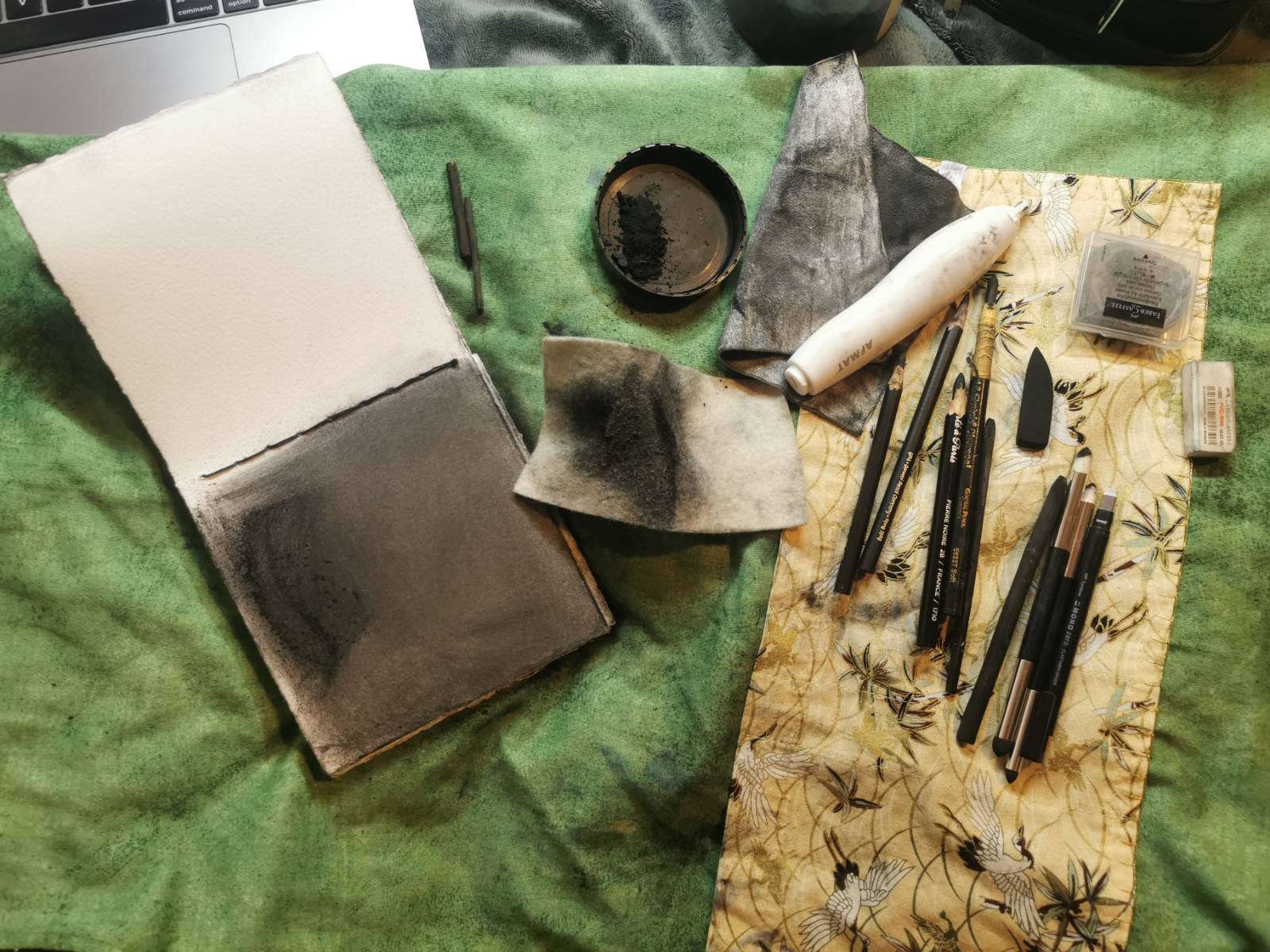
Clean one drawer or sort one box of materials. Look through the books and instructions surrounding your practice. Choose one unfinished project whose claim upon you has become oppressive and allow it to become officially unfinished, rather than eternally pending.
You might ask of each:
Do I actually use this?
Does touching it produce curiosity, pleasure, or some small movement toward the work?
Does it belong to the practice I have now, or only to an artist I once believed I should become?
Am I keeping it because it contains living possibility, or because releasing it would force me to admit that an old creative identity has ended?
And then… sit with it.
Let the answer resound for a while. Allow yourself to feel what arises without immediately turning the feeling into a decision. Wait until the initial urgency has cooled enough that you can tell the difference between clarity and impulsiveness.
An ascetic purge is not necessarily our goal. Simply becoming aware of the attachment may be enough for you right now.
Remember, eclipses are not single earth-shaking events! This is the first eclipse in a longer (Tropical) Leo–Aquarius story that will unfold across roughly 18 months. We are at the beginning of a journey.
There is no rush to make a decision today, or even this week.
The eclipse may provide the first recognition of something that will loosen gradually until you genuinely know it is ready to be released.
Some artists have already made a virtue out of deprivation (which is quite Ketu of them).
So many of us feel guilty purchasing good materials. We distrust pleasure, beauty, ambition, and the desire for a materially supported creative life. Some artists give away what they need, minimize what they know, and call the resulting hunger spiritual “purity”.
But… these are all another way of injuring the tender creaturely heart of your creativity.
If you feel clear and ready, you may release the supplies that have become instruments of your own entrapment, while also keeping what gives you creative sensory pleasure.
In my case, I already have an active practice of using my materials. This clearing is an act of clarity rather than penance or an attempt to run away. It is helping me move forward with greater strength of purpose and momentum.
You may find that you are ready to release a project whose only remaining substance is guilt or obligation. Before doing so, consider what you can keep from it; perhaps a fragment that still contains inspiration or knowledge.
A creative journey rarely travels in a straight line! We may carry an image through many iterations before we discover its final form (if there even is such a thing). If you have made peace with the journey a project has you traveling, even without the finished object you originally imagined, perhaps it is ready to loosen its claim upon you.
Releasing a creative title or identity may be the hardest task of all.
Can you release the title that has become restrictive—or the idealized self-concept that sits on a pedestal you can never realistically reach—without discarding the sovereignty and confidence you earned through the practice? Would moving into another form expand your capacity to create?
Or would it shrink you into something so bound by the illusion of safety that you can no longer find the momentum to move?
We know a release is wise when we can shed the skin without throwing away the body.
Every creative experience has changed the living creature inside it. It’s vital to our creative hearts that we honor those experiences, rather than trying to erase them.
Let the small animal (that’s you!) rest
Once you have decided what you are willing to release (or what you simply need to contemplate releasing) allow the small animal of your body to rest.
Eclipses are poor times for enormous projects that require endurance and discipline. The vital energy of the Sun and the embodiment of the Moon are being disrupted.
Let the small animal of the body lie down somewhere quiet and become accustomed to whatever space has opened within your creative practice.
There is no need to fill it immediately! There is no need to rush another identity onto the empty throne! We have a whole 18-month story through which to let that unfold!
Instead…
Notice what your hands still want when they are no longer being asked to prove who you are.
Notice which skills remain after the title, aspiration, or fantasy has loosened.
Notice what returns (or emerges) after the obligation has been resolved and closed.
Rest gives the knowledge time to incubate into many new and wondrous forms. After all, change is the hallmark of life. Nothing living remains in the same form. Give your creativity permission to live.
If we reinvent ourselves too quickly, we may simply coil the same old hangups around a new medium or idea.
What the Creative Court keeps teaching me
This eclipse falls in my tropical tenth house, co-present with my Midheaven, and I can feel it working through my own public role.
I have loved creating the Creative Court Reports.
They have allowed me to enter another person’s chart and spend time with the planets responsible for their making life: Venus and her sense of value, Mercury and their craft-intelligence, Mars and his force of action, the Moon and her creaturely rhythms.
Every planet opened a long, wondrous conversation. Each had its own needs, desires, resources, frustrations, and relationships with the rest of the chart. Each could be understood from several different angles, all of which changed what practical advice would actually be useful.
The material resisted compression. Every attempt to make the report smaller removed something essential.
What I (re)learned is that I love depth.
I love following one question far enough for the obvious answer to fall apart and something more precise to emerge. I love understanding why a planet behaves as it does, how its condition reverberates through the chart, and what that means in the actual material life of a maker.
Trying to condense each planet into a shorter portrait began to feel like a disservice to the planets and to the people trying to build creative lives with them.
At the same time, the current report is Herculean. Writing four deeply individual planetary portraits and bringing them together through the Craefter’s Concord is not a form I can offer indefinitely while preserving the depth, clarity, usefulness, and sustainability I want my work to possess.
And, if I’m being honest, a couple of very particular planets are pulling at my attention and asking me to enter a deeper initiation with them. (More on that in an email soon!)
So I am letting this form reach its completion.
I do not have to reject what the Creative Court has been in order to finish it! These reports have clarified what kind of artist and astrologer I am, what kind of work I believe genuinely helps artists and makers, and how deeply I want to enter the subjects I choose to explore.
If that knowledge is to keep living and growing in value, it needs a form that allows me to carry it with greater depth and clarity, within what my body can sustainably hold.
So… there are 9 Creative Court Reports remaining.
If you have wanted this complete, deeply detailed study of your making life, these are the final nine opportunities to receive it. Once they have been claimed, I will close the Creative Court Reports for the foreseeable future.
Each report is $247 and is generally between 21 and 30 pages, sometimes longer. The current delivery window is 4–6 weeks after I receive your completed questionnaire.
Commission Your Creative Court Report
For now, I am gently cleaning the studio while I watch the fog drifting between the sea and the cliff-hills.
I am also finishing the work already entrusted to me. I am considering what I use, what I still love, and which forms have completed the work they came here to do.
The old skin does not need to be hated. It preciously held the creature while she grew.
As it loosens, I can honor what it gave me by continuing to change.
May you have a revelatory loosening that deepens your creative wholeheartedness 💙
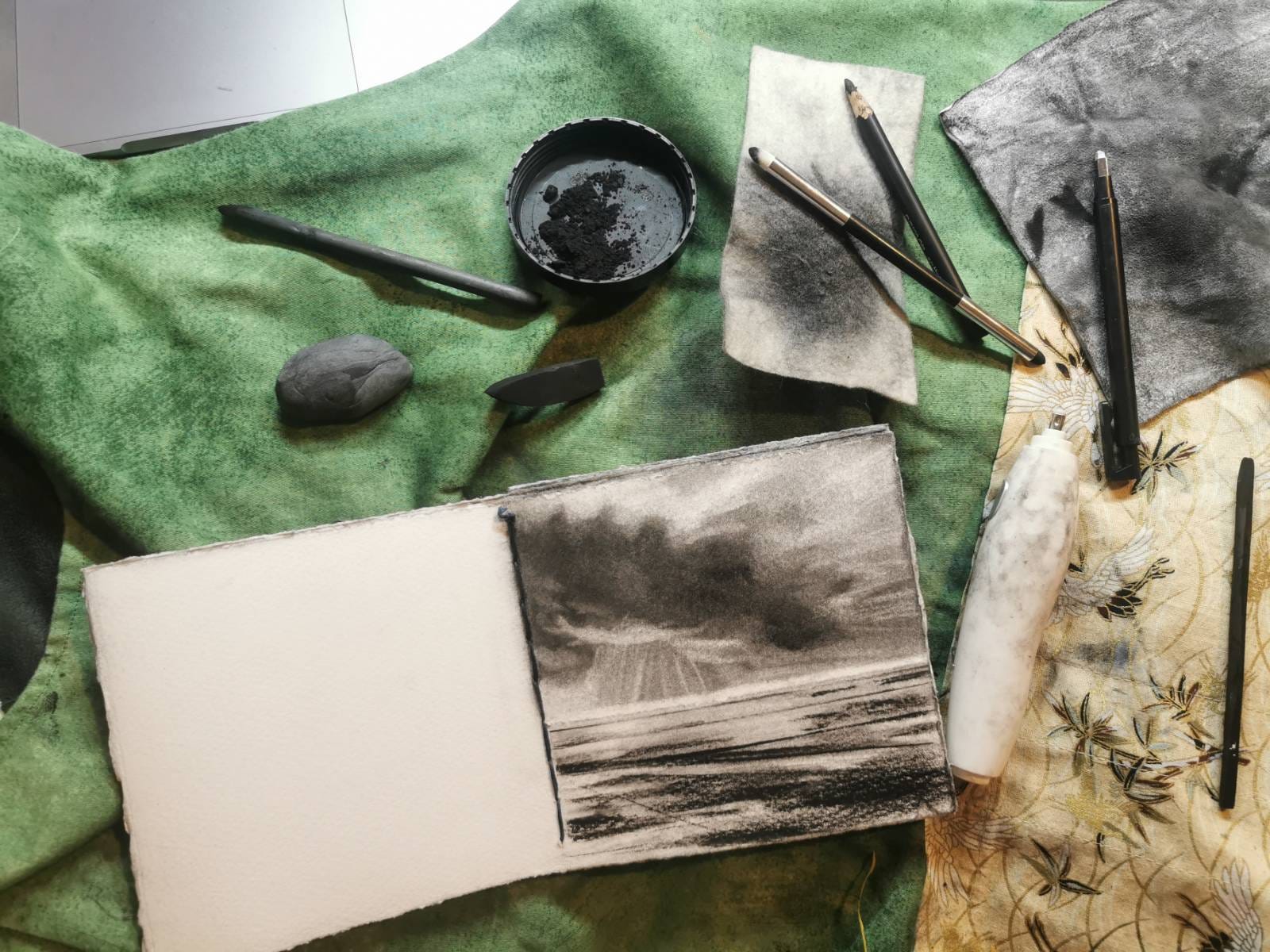
From the charcoal dust gathered in the whorls of my fingers,

P.S. Did you enjoy the exploration of the astrology through the nakshatras? I find them incredibly illuminating and deeply resonant… but I only want to keep pulling these into the work if you also found this to be revelatory and valuable. Let me know!
Comments
Nothing yet. Say the first thing.
Sign in to join the conversation.