
I picked a weird topic. I know. But I promise I’m not just cosplaying as your typical alt-right eugenicist to get some clicks, I think I actually have a unique point of view here. Don’t worry though, I’m not going to try and persuade you incest is good or anything. I have enough self-awareness to avoid supporting the desires of the plethora of Andrew Tate wannabes who now swarm online spaces. Instead, I want to talk about how inbreeding has been used successfully in the animal world to create specialization and its relevance to humans. I wanted to look at it from thought experiment perspective not skewed by social and cultural norms. So for the length of time it takes you to read this I ask you to be open to the idea of inbreeding.
You see us humans, like, we haven’t really evolved in a longtime. There is no selection pressure and modern medicine has kept alive genetics that would be culled in our early ancestors. Bad eyesight runs rampant and our digestive and immune systems fail from river water. I think human and animal genetics are undervalued and underappreciated. The specific genetics of an animal are extremely difficult to recreate and reproduce. Us humans have done well because we are good generalists with above average micromanipulation abilities which has allowed us to make lots of technological progress compared to all other animals up till this point. The problem is that it’s starting to breakdown, generalists can only get a species so far. I probably don’t need to convince you that our shifting technology, society and culture might be pushing humanity beyond what we are capable of handling with our generalist talents. Because we no longer have procreation ability as a genetic selection pressure alot humanity creation is driven by socio-economic and capitalistic driving forces instead of truly finding the best people to create.
Don’t misconstrue me. I think diversity is one of the greatest things we have. Rare genetic variants in an otherwise inbred population are extremely valuable but when inbreeding is rare instead, it becomes the thing that can have outsized value. If we are thinking from “a don’t blow ourselves up and advance technology in an outsized way perspective”, we want people who are extraordinarily good at math to do the math things and people who are good at empathy and governing to do the politics things and people who are creatives to make us amazing art. We want signal instead of noise. Do you really think we can create worlds by terraforming planets and universes much less AGI or cells from scratch using our current systems and expertises? I for one have alot of doubt around that.
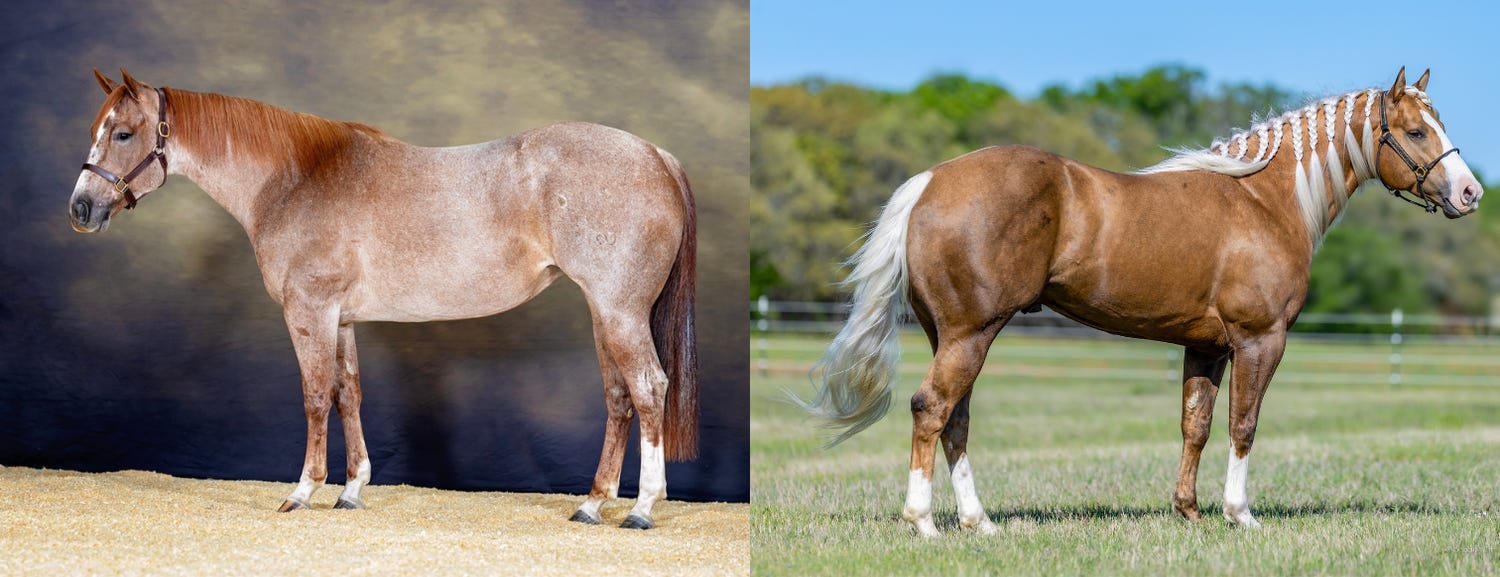
Animal have long been at the forefront of pushing scientific boundaries. We have cured basically every mouse disease and even sometimes give them new diseases they never had and cure them of those. In many ways animals are the best of us and the testing ground for what the future of humanity will look like genetically.
If I told you that one of the horses above was an elite racing horse and one was an elite cutting horse, I bet you could guess which one is which just by looking at them without even knowing what a cutting horse is (if you do though that makes me happy). Both of these horse are Equus caballus and both of these horses have relatively similar ancestry, they are both quarter horses. But their genetics differ at important points and that has allowed one to be bred to optimize for racing and the other the agility and athleticism of cutting. They did this without genetic engineering or even knowing any of the underlying genetics of the animals! Very few horses have been full genome sequenced, surprisingly. They did it through selective breeding which usually requires some amount of inbreeding. Not the silly mating parents with children and brothers and sisters that most people imagine inbreeding to be. But if we think about elite performance genetics, whether for horse racing or creativity, we must understand that these good genetic are not equally distributed in the population. This means that mating random animals will not likely overproduce performance specialization but mating animals from a much smaller pool of probable fast runner genetics might. These smaller pools tend to descend from similar/same ancestors as so even just some small amount of inbreeding becomes a viable way to create specialized outliers.
I know, I know. You’re saying, why inbreed when we have gene editing? You can just take the good traits and put them in the new human/animal. The problem is that while much progress can be made that way we are still limited by the fact that most complex traits are also genetically complex and can’t really be optimized beyond our knowledge. We don’t yet know all the genetic causes of traits and so don’t know all the things to gene edit. Inbreeding helps when we don’t know. We can accumulate good genetics because one starts to overrepresent the genetic background of a good lineage instead of adding in random genetics at each generation. By inbreeding you not only increase the possibility of good traits showing up but you also fix those mutations and variants in a population by creating homozygosity and haplotypes and linkage and which can cause extreme high-end performers.
In animals, inbreeding is generally understood using the measurement ROH, Runs of Homozygosity. We have two copies of every gene. If both parents have the same copies of a gene then the offspring can only get that copy. Out of the millions of genetic mutations/variants in human/animal offspring generally only have around 100 are new unique mutations their parents don't have! So a large driver of significant phenotypes is based on what parts of the parents genomes show up in what combination. If we want to accumulate good mutations we are probably going to do some amount of inbreeding. While not all homozygosity is related to inbreeding, ROH can really only reach higher percentages with inbreeding. ROH is given in a percentage and the average agriculture/companion animal is probably around 5%. Elite animals, including both horses, cattle, dogs and cats start to see ROH 15%-20%+. Despite what people think about the negative effects of inbreeding, a good starting parental genetics background with few or less recessive disease mutations limits the harm. These ranges of inbreeding can be positive because good genes accumulate and with genetic testing one can easily select out the bad. Is inbreeding required for good specialized genetics? No, but it becomes really difficult to do without because specialized rare genetics should by definition be rare and thus limits the breeding pool.
Human inbreeding ROH is around 1%, which is fascinating to me. At this point in human history we are so outbred that our genome structure is more similar to wild animals than anything domesticated and thoughtfully bred. That's not necessarily bad it just means humans are more diverse than specialized. But if we as humans really only utilize maybe 100 distinct phenotypes, which maybe we can generalize from the US Standard Occupational Classification system, it begs the argument that some amount of genome narrowing through inbreeding to create specialization might be extremely useful to the success of the human species without causing much harm.
In practice, I get it, I get it, inbreeding is a big ask, 25 states have bans on first cousin marriage in humans though some major countries don't ban it like UK, Canada, Australia, Germany, and Japan. While major studies consistently show that first cousin breedings are estimated to increases birth defects only 1 to 3% at most. The truth is that the reason humans don't inbreed is more of a social and cultural thing. It’s weird even to me to imagine breeding with anyone I'm related to and you probably couldn’t convince me otherwise despite what I am writing. I imagine ideas like human specialization through inbreeding will take generations to be taken seriously but I think it is an interesting theory that goes beyond the selective breeding eugenics tropes into the weird underpinnings of how human genetics would actually exist especially in limited genetic pool environments like off planet.
Doing breeding and genetics work with my company Embryo corp, I saw how much inbreeding had benefited the specialization of animals and so was deeply curious about this taboo idea. I know I’m stepping into a whole bunch of eugenics stuff and I want to be clear that I am in no way offering support for white supremacy, incest or any other shit I didn't talk about. I’m actively against them in fact and think those things are dum. I just wanted to make this as a scientifically interesting conjecture and leave it at that. I know science doesn't exist in a bubble and so there is always ramifications for saying things like “I support inbreeding” but I think there should be more space in the world in our “freedom of speech” era to offer ideas that might breach taboos.
I think finally this idea lends itself to differential treatment of life. How we think about what is ok for animals but not for us as humans. As those lines thin I imagine we will think of ourselves both in theory and practice as much more willing to subject ourselves to the same things we subject animals to or treat animals more like we treat ourselves.
No posts
Comments
Nothing yet. Say the first thing.
Sign in to join the conversation.