
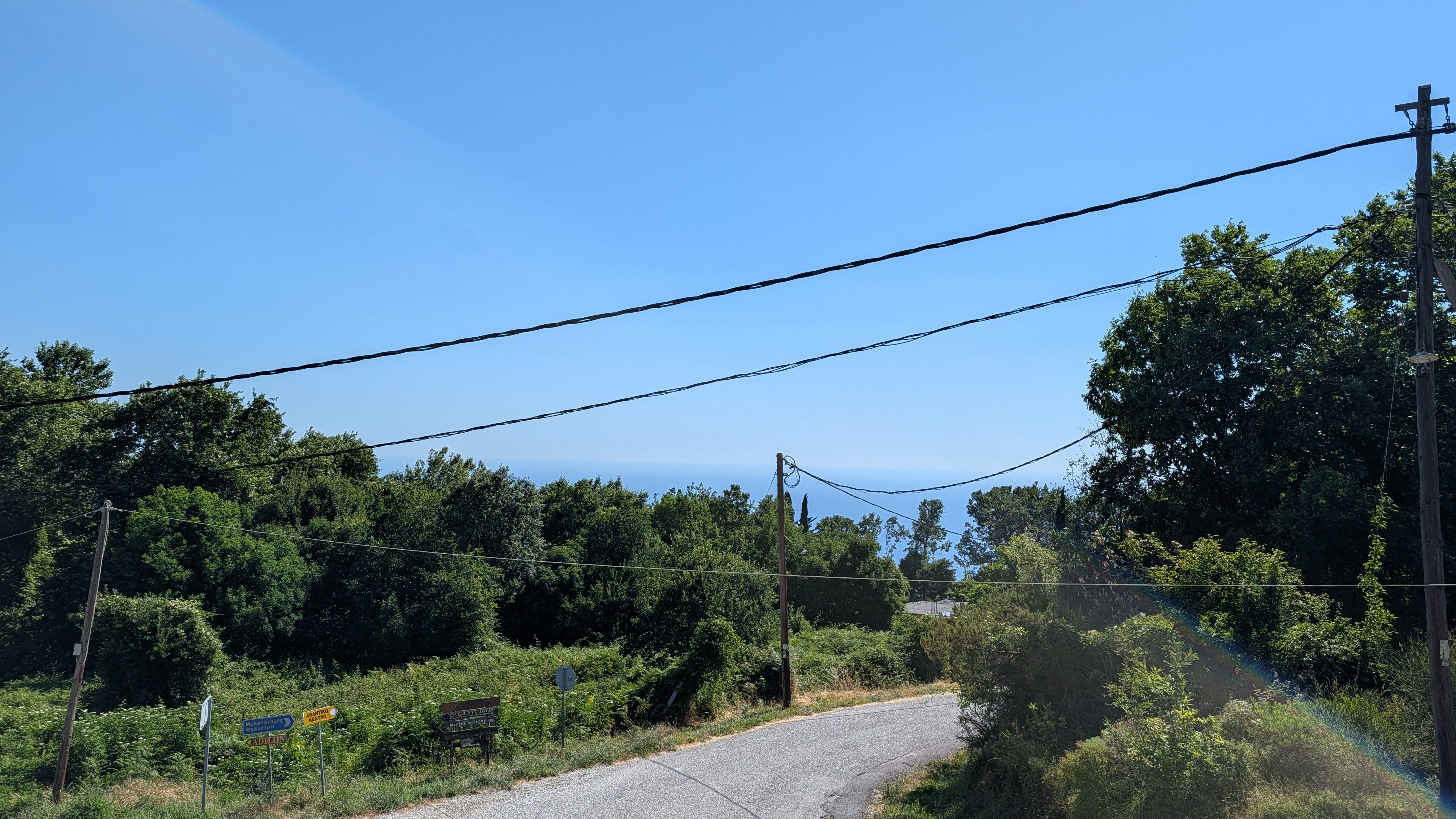
It is Saturday morning in the hills, and the sky is blending into the sea below me, nature’s own impressionist painting with the horizon brushed out. I am on a stone terrace in Tsagarada, a Greek village stitched into the forests of Mount Pelion, where the old stories kept their centaurs, and the Aegean is holding the light loosely, the way a hand holds water. A coffee is going cold at my elbow because I keep forgetting it is there. Tomorrow we will go down to the harbour and sail out from a friend’s house in the cliffs, the opening weekend of a fiftieth birthday generous enough to spread across two weekends. The pines are loud with insects. Somebody’s child, not one of mine, is singing.
My own two are in the house behind me, asleep, and the sea in front of me is not the sea I am thinking about. I am thinking about a different water, six months ago and a continent to the east, the colour of pewter under a low sky, where I stood in a cricket shirt and gave my father back to it. Before the water there had been a fire, and I had lit it, because that is what a son does, following the priest’s Sanskrit half a beat behind, my mouth shaping a language I do not really have, performing with great seriousness a rite whose engineering I did not understand.
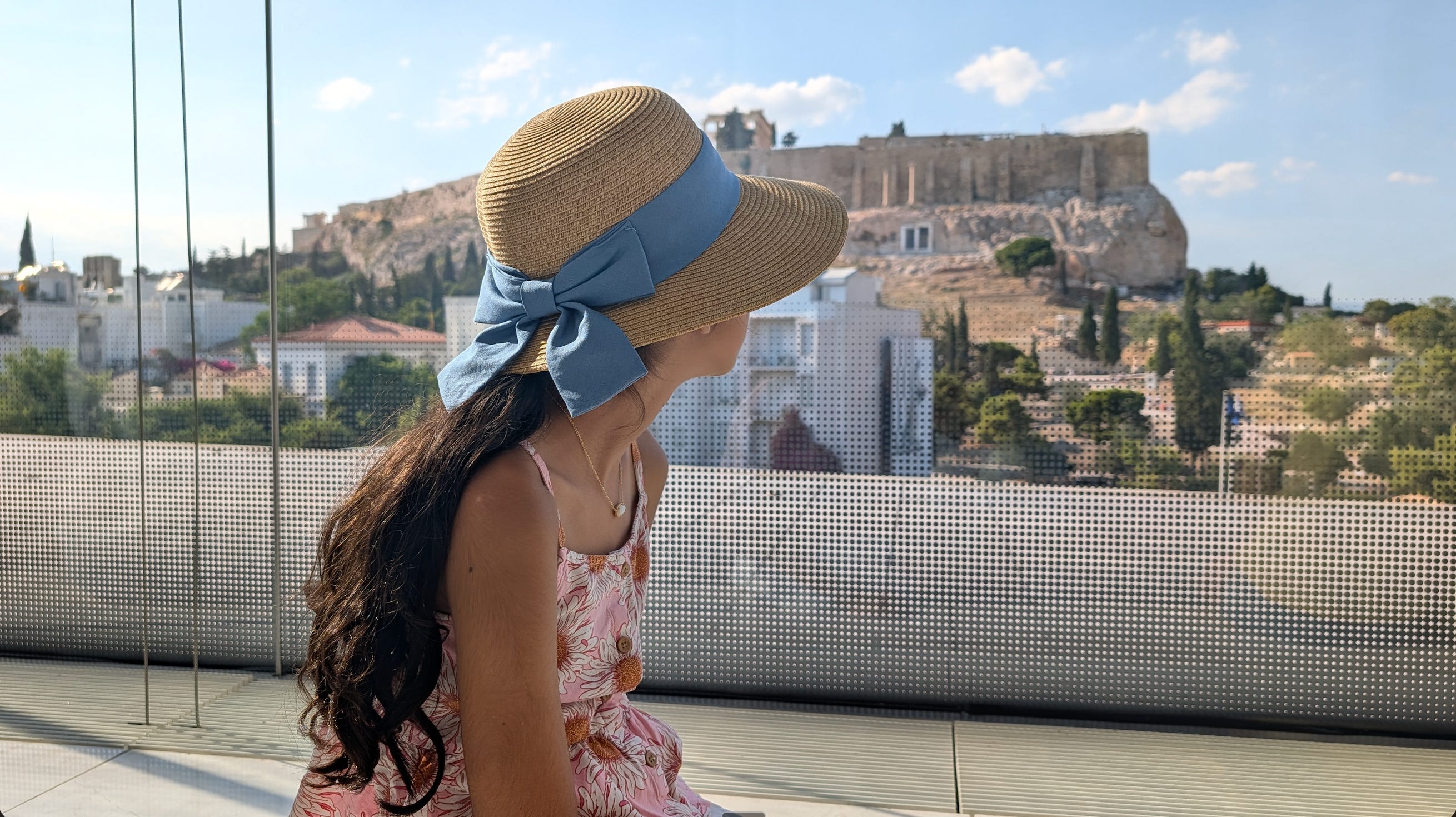
Earlier this week, in Athens, in the cool of the museum beneath the Acropolis, my elder daughter, Nyla, stood in front of a wall of ancient Greek gods and delivered her verdict in the flat voice of a child reporting the weather. They were, she said, basically the Indian ones.
She is right. She is more right than a twelve-year-old could possibly know. The Greek gods are the Indian ones, not by coincidence and not by anyone copying anyone, but by blood; and the story of how two peoples at opposite edges of a continent came to keep the same gods, trade the same cargoes, count with the same numbers, and lay their dead to rest in the same way, turns out to be the story I was living at that fire and did not understand. It begins on a grassland, five thousand years ago.
Last week’s blog, Rules for an (Extra)Ordinary Man, was a tribute to my father, written on the budget flight to Athens that was, as it turned out, carrying us to this exact trip. It was inheritance at its most intimate: what one quiet man hands down to the people around him, in singles rather than sixes. This week the inheritance is older and far larger, the kind a whole civilisation hands down without noticing, though it reached me, as ever, through the most personal door of all: a fire I lit for him, and a sentence my daughter said in a museum.
Begin with the thing my daughter saw, because she was not being vague. The resemblance is not a matter of mood or atmosphere. It is specific, and structural, and once you have seen it you cannot unsee it.
Start at the top. The oldest hymns of India are gathered in a book called the Rigveda, a body of sacred verse already ancient when Homer sang, and its sky father is Dyaus Pita, which means, with nothing lost in translation, Father Sky. The sky father of the Greeks is Zeus Pater. The Romans, further west, called him Jupiter, the same two words worn smooth by another mouth. One god, one name, three languages, the whole width of the ancient world. In India he faded early to a minor figure, a half-remembered grandfather of the pantheon; in Greece he was crowned king and kept the throne. But the name is the same name.
Then the dawn. The Greek goddess of the morning is Eos, who comes with rosy fingers across the sky; the Indian goddess of the morning is Ushas, who comes shining, scattering the dark. They are not merely alike. They are the same goddess, two names for one inheritance, and the Rigveda keeps her most ancient title intact, a fixed phrase the philologists reconstruct for the original dawn from the evidence of both her descendants: Ushas is the Daughter of the Sky. The same dawn, and the same five-thousand-year-old name for her, carried down two family lines that had not exchanged a word in all that time.
Then the weather that could kill you. The central drama of the Rigveda is Indra, the storm god, taking his thunderbolt to a serpent that has coiled around the mountain and trapped the waters inside it, and splitting the creature open so the rivers run and the world lives. That same story, the champion, the bolt, the slain serpent, the freed waters, surfaces all across the family, in Zeus against Typhon and Apollo against the Python, one of the oldest plots our species has ever kept.
And then the clincher, which is a drink. The Indian gods stay deathless on amrita, the Greek gods on ambrosia, and strip both words back to the root and you reach the same ancestor, a negative prefix bolted onto the verb to die. The un-dying. Two peoples on two sides of a continent, separately, keeping the same word for the same impossible thing.
None of this is borrowing. India did not learn these gods from Greece, nor Greece from India. They are both remembering, because Greek and Sanskrit are cousins, two branches of one unrecorded language spoken by herders on the grasslands north of the Black Sea five or six thousand years ago, the grandmother tongue of half the modern world; and when those herders scattered, some east towards the Indus and some west towards the Aegean, they carried the gods the way they carried the grammar, in the mouth, writing none of it down.
The gods came down the family tree along with the grammar.
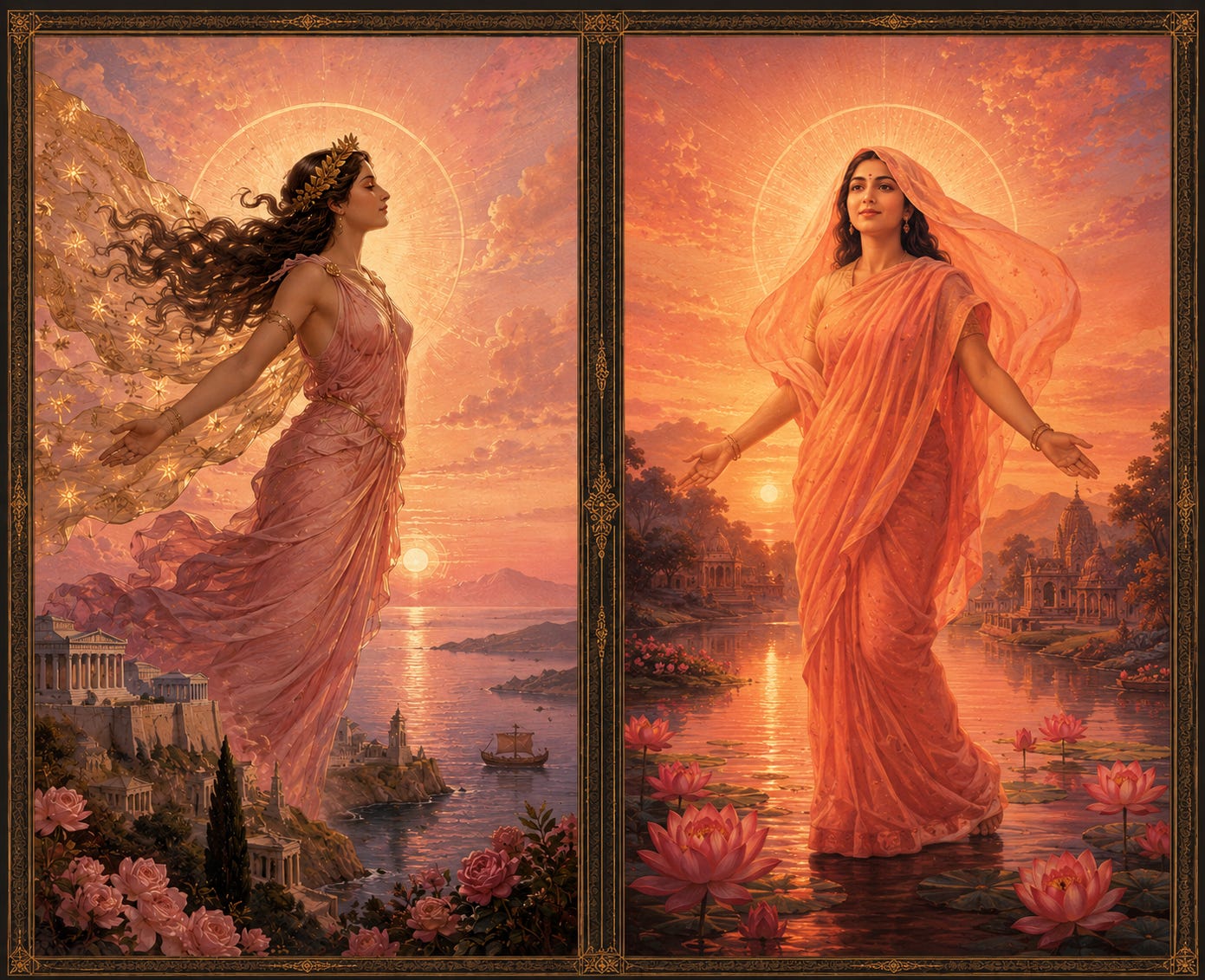
All of that is buried inheritance, five thousand years deep. But the family did not only share a grandmother and lose touch; for long stretches of recorded history the two ends of it were wide awake and trading.
When Alexander marched into the north-west of India in 327 before Christ, the two civilisations met again in the flesh and stayed met. For three centuries afterwards a line of Greek kings ruled in what is now Pakistan and Afghanistan, striking coins with a Greek god on one face and an Indian script on the other, and their sculptors carved the first images of the Buddha in the falling drapery of a Greek statue, which is why the most Indian of teachers can look, in stone, faintly like Apollo. Far to the south, the port of Muziris was, in the words of a Roman merchant’s handbook, packed with Greek ships, and a Tamil poet of the age watched them arrive heavy with gold and leave heavy with pepper.
And they handed each other tools the whole world still uses. Out of India went the most consequential idea in the history of counting: a way to write any number with ten symbols, one of them a small circle standing for nothing, for emptiness, for the void. An astronomer named Brahmagupta set down the rules for that nothing in the year 628, the first person anywhere to treat zero as a number in its own right. It travelled west through Baghdad and reached Europe so late, by so winding a road, that we still miscredit the digits and call them Arabic. They are Indian. A good half of the mathematics on Earth runs on a void first named in Sanskrit. And the traffic ran both ways: Greek star-craft flowed east so completely that the Sanskrit word for an astrological hour, hora, is simply the Greek hora with an Indian coat thrown over it.
They were never two strangers who happened to rhyme. They were cousins who kept meeting, kept trading, and kept handing each other the tools we have never given back.
Of everything the two ends of this family shared, the blood and the gods and the gold and the numbers, the oldest and deepest was the gods. Ask why two peoples a continent apart kept the same gods for five thousand years, and you reach the one thing they had most profoundly in common, which was not their prosperity. It was their fear.
Go back far enough and every god is a weather report. The oldest powers in the oldest pantheons are not moral exemplars or abstractions; they are the forces that could, in a given season, feed you or finish you. Indra is the rain that saves the harvest. Agni is the fire on the hearth and the fire that razes the village. Ushas is the dawn coming back, which in a world without electric light you could not assume. Zeus is the thunderbolt; Poseidon the sea and the earthquake. You did not love these gods. You handled them, made the offering, said the words, and hoped the storm would pass over your own roof and break on somebody else’s.
And underneath every one of those bargains lay the bargain you could never strike. You can propitiate the storm, sacrifice to the river, keep the dawn goddess sweet. There is one element that takes no offering and grants no exception, one direction in which the fire only ever carries you, and that is death. So the oldest religion does the single thing left to it once bargaining is useless: it dreams up the drink that would settle the account for good, the nectar that makes the drinker un-dying, and hands that drink to the gods, because no human being has ever found a drop of it. Amrita is the name of that dream. It is also, as it happens, my mother’s name, but I am getting ahead of the story.
The first prayers were not about how to live. They were about whether you would.
A god who manages the rain is enough for a village. He is not enough for a city. The moment human beings began living in numbers too large to know one another by face, religion was handed a second job it had never been designed for and turned out to be uncannily good at. Not propitiation. Organisation.
You can see it in the record. Small communities keep small gods, local and capricious and indifferent to your conduct; large, crowded, stranger-filled societies grow what the scholars call Big Gods, high moral powers who watch everyone, know what you did, and care. The leading account, from the psychologist Ara Norenzayan, is that such gods are a cooperation technology: when the chief cannot see every cheat, a god who sees everything keeps the strangers honest. The direction of cause is still disputed, but the association is not: scale and a watching god travel together. And the gods themselves change job. In India the elemental powers give way, across a thousand years, to dharma, the moral order, and karma, the ledger that follows you from one life to the next; in Greece, Zeus the thunderer takes a new portfolio as the guardian of justice. Across the old world, in the same few centuries, religion turned from getting the harvest in to getting the conduct right.
And here, after five thousand years of kinship, the cousins finally parted. But notice exactly where the crack runs. It runs through the second job, and only the second job, because they kept their governance in different rooms. Call them the two-room civilisation and the one-room civilisation. Greece built its order outside its religion, in the assembly and the law court and the argument settled aloud in the marketplace; governance lived in the agora, not on the altar, and the gods kept their old elemental work. India built the order into the religion itself, until dharma was your duty and your caste and karma was the court that enforced it, and god and government shared one room. You cannot evict a god who is holding up the ceiling.
Which is why their later histories look so different, and why almost everyone misreads the difference. The West could swap its gods wholesale, by decree, from the top: Constantine made Christianity legal in 313, Theodosius made it compulsory by 392, and inside two generations a thousand years of gods were gone, because Greece had never let its gods run the state. India never swapped at all; its gods could not be evicted, only built around, so the religion of the elements graduated slowly into Hinduism and absorbed every faith that came after.
But all of that is the story of the second job. The first job, the one the gods were invented for, the standing between a frightened human and his own death, they never divided at all. They parted over how to govern the living. They never parted over how to grieve the dead.
You can prove that last claim at a graveside, which is exactly where I found myself this past winter, performing a thing that turned out to have no governance in it at all.
The rite I carried out for my father weighed nothing and judged nothing. No karma, no moral ledger, no reckoning of his next birth. Only fire, water, and the asking. Agni the fire took the body and carried it, in the words of the oldest hymns, to the world of the fathers, a bright meadow of the ancestors the Rigveda imagined long before it had ever dreamed up the wheel of rebirth. Then the ashes went to moving water. Fire, then water. That is the whole architecture, and it is the oldest one we possess.
And the Greeks, our cousins, built the identical thing. They burned their dead on pyres, as Achilles burned Patroclus near the close of the Iliad, an epic that ends, like the Mahabharata, India’s vast poem of a war between cousins, in the smoke of a funeral fire. Then they sent the soul down to a river it had to cross, the Styx, ferried by a boatman paid with a coin laid on the tongue, exactly as the Hindu dead must cross their own river, the Vaitarani, to reach the country of the lord of death. At the far bank the Greeks posted a dog, Kerberos, to guard the gate; the Indian dead had to slip past the two hounds of Yama on the same dark road. And beyond the crossing and the dog, both peoples imagined the same destination: a meadow of the dead, the Greek Elysium, the Vedic world of the fathers. Fire, then water, then the guarded threshold, then the meadow. The same four gestures, in the same order, on opposite edges of the earth, because both were inherited from the same grandmother, in the age before either people had invented anything as elaborate as a soul to be judged.
This is the part the long history hides. Religion grew up. It took on the enormous adult work of organising us, governing us, binding millions of strangers into something that could last, and in that work the two civilisations walked off in opposite directions. But it never stopped doing its first job, and you can see that job most clearly at the one place where all the adult machinery is no use to anybody: at the fire, with someone you love on it. There, nobody needs to be made governable. Somebody needs to be made bearable to lose. And there, stripped of everything they each built on top, the cousins are not cousins any more. They are twins.
Religion grew up to organise the living. It becomes a child again, the same child, in Athens or in India, at the fire.
The oldest Indian story about amrita is not, in the end, about a drink. It is about the sea. In the beginning, the texts say, the gods and the demons wanted the nectar of immortality so badly that they took a mountain for a churning-stick and a serpent for a rope, and churned the ocean itself, for an age, until the amrita rose out of it. Everyone who has told that story understood the bargain folded inside it. The un-dying does not wash up on the shore. You must turn an entire ocean inside out to win a single cup of it, and even then it goes to the gods.
I have been turning that story over all week, in front of this other sea. Six months ago I went down to a river myself, though not to churn immortality out of it. I went to give a death back to it. I poured my father into the water and asked it to be kind, and the river took him, unhurried, the way rivers do; and I came away with no nectar, because there is none, because there never was. The gods keep the amrita precisely because human beings do not. We get the fire, and the water, and the asking. We do not get the un-dying.
And then I look at my own family, and find the gods were never only on the museum wall. They were at my table. My wife’s mother is called Usha, which is Ushas, the dawn, the Daughter of the Sky who gives this essay its title. My own mother, as I have been promising to tell you, carries the name of the nectar itself. And the king of the gods, in the shape the Greeks took from Egypt and folded into their own Zeus, was Amun: the god a desert oracle once named as the true father of Alexander, who first carried Greece into India, and a single slipped vowel from my own name, though mine is merely the Arabic for peace and lays claim to no throne. The family resemblance my daughter spotted behind glass was, without her knowing it, the resemblance of her own family.
That is the thing those two civilisations shared most deeply, deeper than the gods and the gold and the numbers: not immortality, which neither was ever granted, but the refusal to accept the lack of it quietly. Greece and India both looked at death and did the same magnificent, hopeless thing. They churned an entire ocean for a drink that was not in it. And the only amrita any of them ever held is the one in this house: a name, a story, a fire lit by a son who did not have the words. Memory is the nectar. It is the only immortality that was ever real, and the living are the ones who pour it.
The coffee is stone cold now. Behind me a group is gathering for lunch, carb-loading before a day that will fold into a night of celebration for the friend who has turned fifty. It is a number that stares at me now from three weeks off, and it means something different since I lit a fire for a man who spent his life delivering virtue rather than fearing the dark, which is, when you strip everything else away, the one fear all of this mythology was built to manage. Nyla will be on the boat tomorrow, twelve years old, trailing a hand in the water, serenely uninterested in all of it. She caught the resemblance without being told what it had cost to prove. One day the rest will be hers too, the fire and the water and the asking. For now she has the good half, the kinship and not the grief, and there is no hurry to hand her the other.
My mother has been Simbi every day of my life. The name underneath, the one no one uses, is Amrita: the undying. On a morning like this, in front of a sea like this, with a fire six months behind me and a fiftieth birthday a boat-ride ahead, it is exactly the right thing for her to have been called all along, and exactly the right thing, finally, to say out loud.
A Man Who Blogs goes out twice a week. Aman Narain was born in the UK, raised in India, studied in the United States and France, and lives in Singapore, for the better part of two decades. He is the Founder and Principal of A2Z Advisors, a boutique fintech and digital transformation consultancy, and co-hosts the A2Z Fintech podcast with Zubin Vandrevala; his career runs through Google, HSBC, Standard Chartered, and Schroders. He wrote this on a terrace in Greece, having gone on holiday to celebrate a friend and ended up tracing a five-thousand-year-old family tree back to his own father’s funeral, which is, he concedes, not what the brochure promised.
Go Deeper: on the grassland where the family begins, David Anthony’s The Horse, the Wheel, and Language is the thrilling account of the people who scattered the gods; on the shared gods and the inherited poetry, M. L. West’s Indo-European Poetry and Myth is the deep water; and on why the two ends later drifted, Ara Norenzayan’s Big Gods is the readable way in. If you would rather meet the man this essay keeps circling than read around him, the last conversation with my father, and the short films cut from it, live on the Remembering Ajit channel.
No posts
Comments
Nothing yet. Say the first thing.
Sign in to join the conversation.