
Time to write: 70 minutes
For those who have to write as part of our job (i.e. pretty much all computer-based workers), it is very tempting to get sucked into the allure that is AI generated writing.
It is so fast!
It uses words that make me sound important!
(When else would I use words like leverage and delve and underscore)!
I mean, here are just a couple of examples of what is possible:
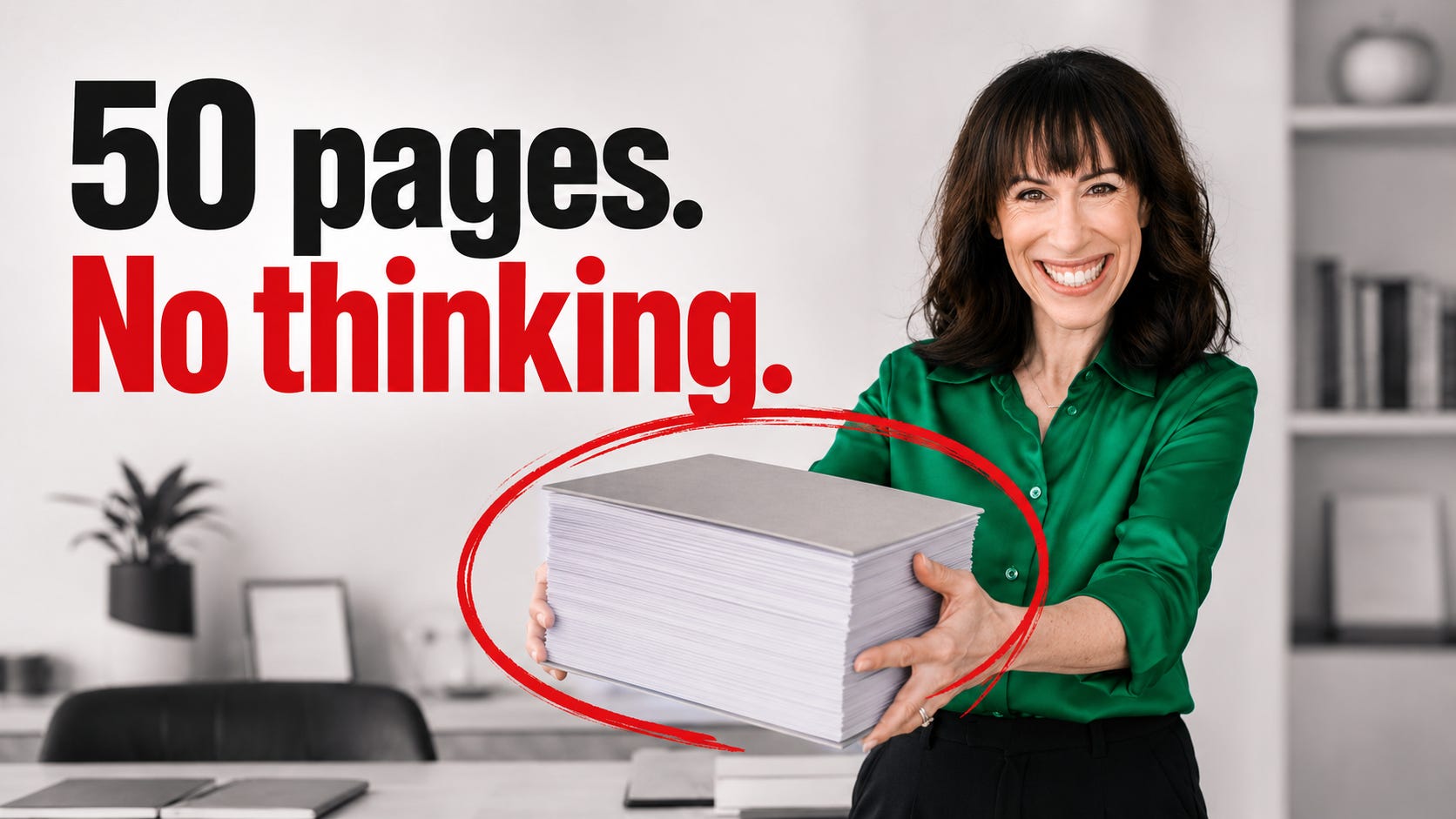
Give it a shitty one-line prompt and it can produce a 50-page report that actually appears (at first glance) to be impressive, complete with random phrases bolded for reasons nobody can explain.
When you feel pressure to post on the socials but have nothing to say, ask AI to “write a post on the government’s stance on AI” and some smart (but empty) words get generated.
If you've been with me on Substack for a while, I know, I know: I'm preaching to the choir.
And if you are a leader who is drowning in AI slop, this matters more than it might look, because crappy work is one of the biggest reasons why AI is not giving us the productivity gains we were promised.
Researchers at BetterUp, working with Stanford’s Social Media Lab, surveyed 1,150 US desk workers and found that 40% had been sent AI slop by a colleague in the past month. (And this research was conducted nearly a year ago, so I daresay that stat would be looking much worse now).
Each AI slop incident took about 2 hours to sort out. Based on these employees’ self-reported salaries, this translated to roughly $186 per employee per month in wasted time. In a 10,000 person company, that’s $9 million a year in productivity down the drain. (But hey, you can do the maths for your team in your organisation.)
So in a nutshell: The work is coming out faster. It’s also coming out emptier, and someone downstream is paying for it in hours.
Earlier this week, I saw one company taking a shot at a solution that piqued my interest.
A few days ago, Varun Anand, co-founder of software company Clay, publicly shared the organisation’s AI Writing Policy (you can also read a more detailed post here). The policy was originally intended just for the engineering function, but has now been expanded organisation-wide.
Here is Varun’s summary:
1. You must stand behind every idea and sentence
It is your responsibility to make sure that the entire document is representative of your own thoughts before you share it.2. Writing is thinking
Spending time on the writing process teaches you more about your topic. If you circumvent this process, you will walk away with a poorer understanding of the subject matter.3. More time should be spent writing a document than consuming it
If you generate a document from a short prompt then ask your readers to go through the longer output, you are disrespecting their time. They can talk to ChatGPT themselves if they want to.4. Longer is not better
AI makes it easy to generate long docs, and it loves padding them with sentences that say nothing. If you're producing docs from a short prompt, consider just sharing the prompt.
Before AI, we didn’t need rules for writing.
Effort used to be visible in the writing itself. If someone handed you five tightly written pages of thinking, you knew roughly what it had cost them to produce.
That signal is gone.
So what can you do?
Adapt these rules to your own team or company.
Add in any rules that you think are missing. Mine is: if AI wrote it or contributed to it, say so. (If you have to declare it, you’ll start noticing how much of your thinking you’ve outsourced).
Tell me in the comments: which rule is your favourite? And what rule do you think is missing?
You use AI every day and it works. The answers are satisfactory, the drafts are usable, nothing feels “broken”.
But when nothing is going wrong, nothing makes you go looking for better.
So you sit at fine, while the top 2% of users are saving tens of hours every month using the same AI tool as you.
Eight habits separate you from those top 2%. Six of those habits take less than a minute to execute.
In this free 60-minute live masterclass, Neo Aplin and I are going to walk through all eight. We will cover tactics that will help you:
Extract significantly better output from your AI, quickly and easily
Get an honest second opinion from AI instead of it being a sycophantic cheerleader
Run research you’d be comfortable to put in front of your board
Know which parts of your job are worth handing over to AI and how to set work up once so it happens while you’re asleep.
It’s free. It’s live. And everyone who registers gets access to the replay.
Thanks for reading One Percent Better! This post is public so feel free to share it.
No posts
Comments
Nothing yet. Say the first thing.
Sign in to join the conversation.