
This (and the remaining newsletters for 2025) will deviate from my usual format to share in-depth essays on my trip to Denmark this summer and the many wonderful textile encounters I had while there. I hope you enjoy this interlude from regular programming! It’s a lot of writing and photographs, so this newsletter may be clipped in your inbox — I encourage you to click on the title (October 2025) to visit this post in your browser so you don’t miss anything.
I’ve also included a few other studio notes at the very end — the usual stuff! Thanks!
In my first few days in Denmark, I visited museums like the Design Museum (see September 2025), and the Louisiana Museum of Modern Art, and walked around to see what I could encounter. I found plenty of great places to eat a bun (Meyers Bageri), have tea (Sing Tehus), and browse a bookstore (Cinnober Bookshop).
One day trip I was excited to make was to Malmö, Sweden, a short trip across the Øresund by train. I was very fortunate to be given some excellent recommendations on what to do there by new friend Steen H Madsen (I’ll introduce Steen properly in another newsletter), and so I’d like to share some of my day in Malmö, much of which is thanks to his excellent suggestions.
My first stop was the Form/Design Center in central Malmö. It’s probably easiest to describe it as an art gallery, but I got the sense it was much more — and more interesting — than that term might imply.
Founded in 1964, the Form/Design Center focuses on exhibiting craft, design, and architectural projects, as well as acting as a resource and meeting place for the public and industry. Beyond exhibitions, they offer public programming for people of all ages, and collaborate with academia, the public sector, and related organizations. Located in an old granary, there were three exhibitions on when I visited: Cotton Candy Wonder Wool, Transformation, Adaptive Reuse, and Circular Construction, and In the Making.
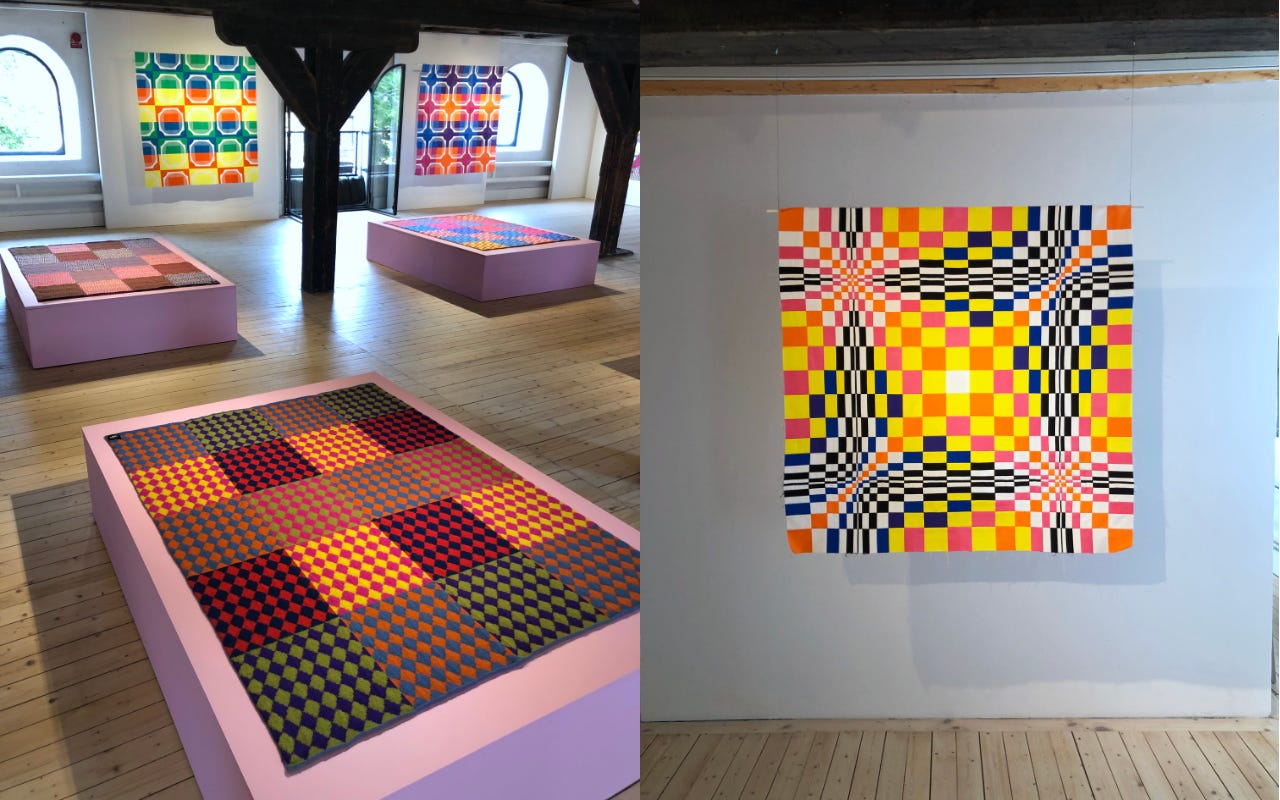
In Cotton Candy Wonder Wool (June 19, 2025 - August 17, 2025) the artist Ida Pettersson Preutz presented colourful, graphic, and illusory textile works created using sewing and knitting. Her process for the sewn and pieced works was especially interesting and labour intensive. They begin with small-scale sketches or material studies based on geometric shapes and patterns. The fabric is then screenprinted with patterns in bright, flat colours and cut into smaller pieces, which are pieced and sewn together to create shifting optical illusions — patterns within patterns within patterns.
Pettersson Preutz notes that while it would be easier to draw the optical illusions than go through the process of draw, print, cut and sew, the translation into a textile medium feels especially essential for the success and outcome of the illusion. The distortion, sway, and movement that cloth provides breaks the smoothness of the surface and its perfection. You know you’re not looking at something printed or flat, but your eye still wants to believe otherwise.
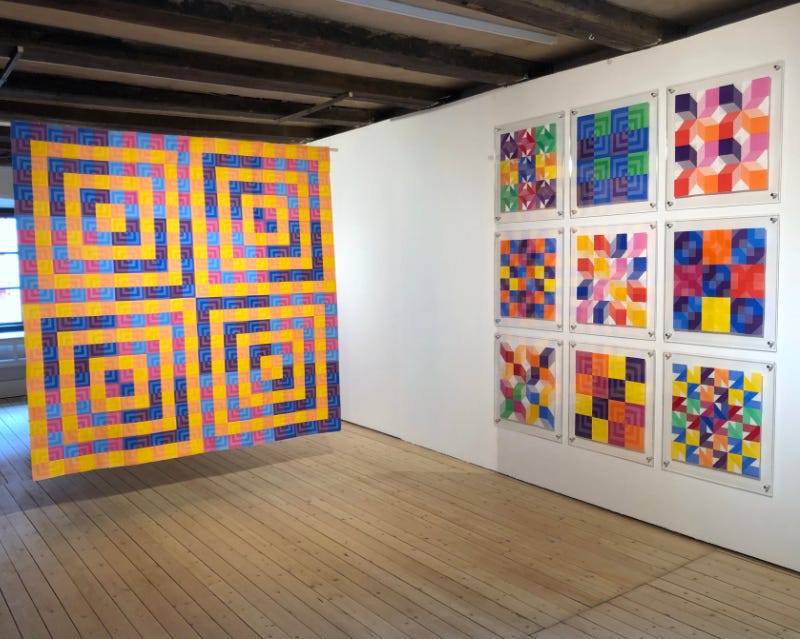
This also results in a really unique experience — up close, you can see the individual blocks and the pattern, but from farther away, the vibrancy of the colours and repetition of pattern work together to appear 3D. All the repeated patterns, motifs, and colours were so energetically charged that they really start to come off the wall — it reminded me of the Magic Eye books that were popular when I was a kid, where you’d stare at a dense image and an unrelated shape or figure would float out towards you.
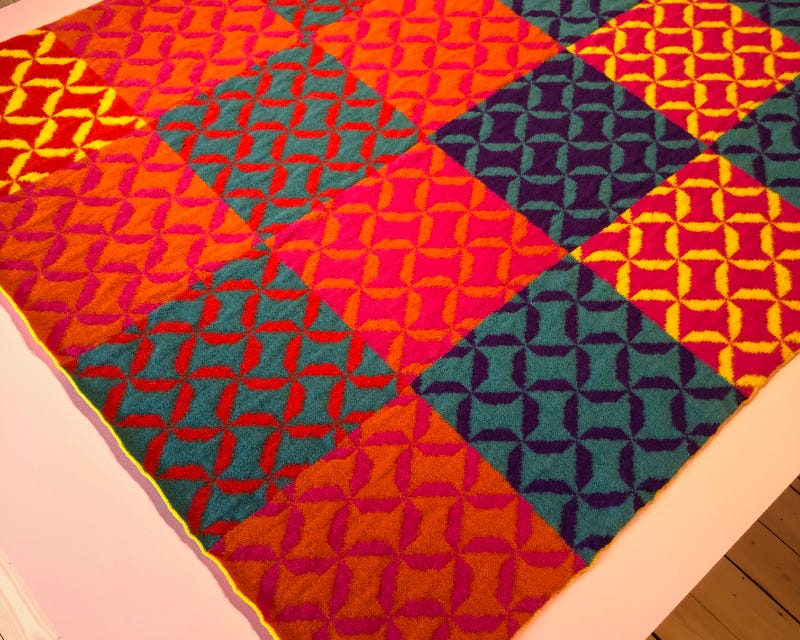
The knitted works, which were displayed on pink plinths in the center of the gallery, play with similar themes of colour, pattern, and illusion. Some of the same motifs were rendered both in knit and patchwork, and it was fun to see how they changed and behaved depending on the medium.
Transformation, Adaptive Reuse, and Circular Construction featured the thesis work of masters students from the School of Architecture at Lund University that explored circular and transformative architectural projects through case studies and site-specific investigations, but I was really interested in to the exhibition alongside it, In the Making: Artistic Methods in Architecture and Design.
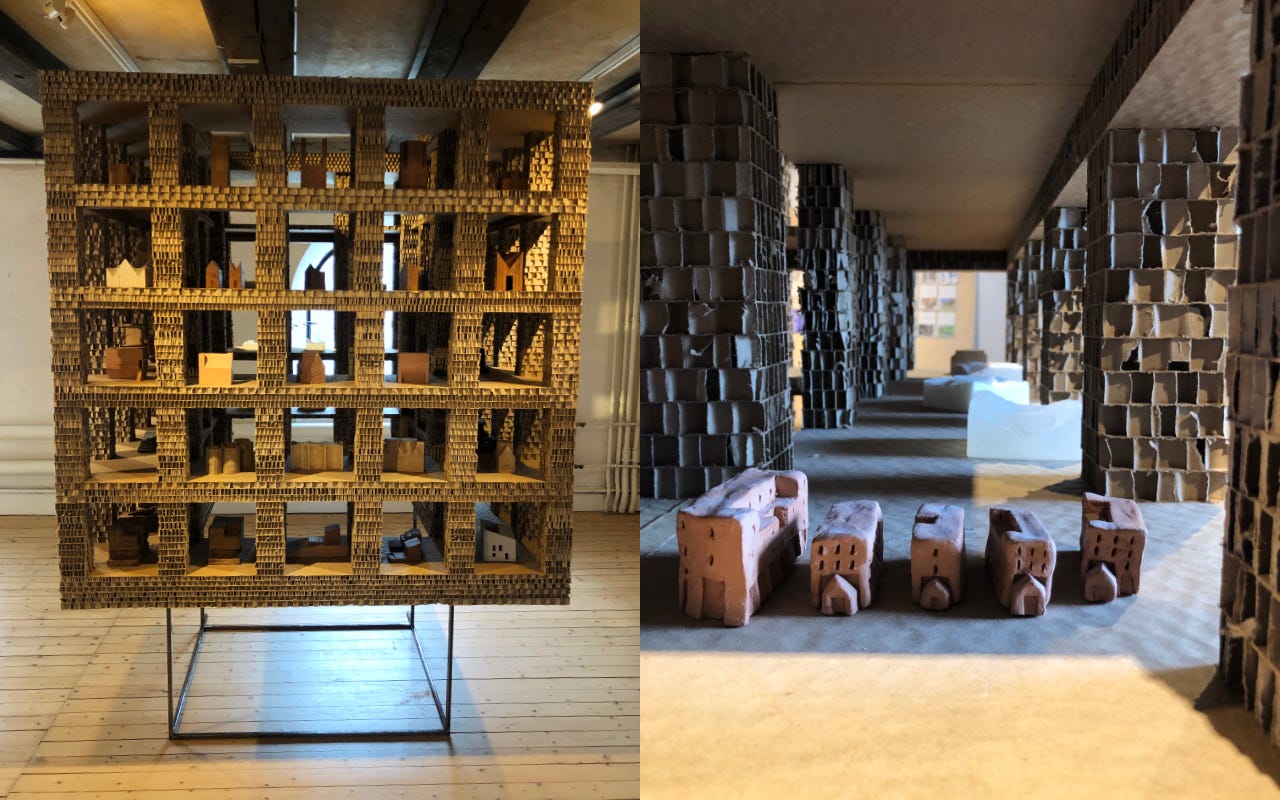
Through 26 projects produced by students and researchers at the Royal Danish Academy, artistic methods were applied to educational activities in architecture, design, and conservation. Not all 26 projects were on display, but several textile-based projects piqued my interest, like The Common Nettle, Comprehending Biogenic Materials, and the Mariebjerg textile. On display was the wonderful Model Architecture; A House of Models, made of cardboard, clay, plastic, wood, and other materials that celebrated the model as an essential and poetic part of architectural practice.
My next stop was the Moderna Museet to see the Kiki Smith exhibition Woven Worlds. Kiki Smith is an American artist who uses drawing, printmaking, and sculpture to explore ideas such as the female body, natural world, folk tales, and regeneration. In Woven Worlds, large scale works on paper were scanned and transformed into Jacquard textiles. Both paper and textile were displayed alongside each other with some of Smith’s sculptural works. I really appreciated seeing the textiles next to their prints; each material picked up different elements, so that varying parts of the dense and multilayered imagery were foregrounded or backgrounded depending on what piece you were looking at. Faces, lines, creatures and textures were sharper or softer, denser or lighter, shimmering or flat.
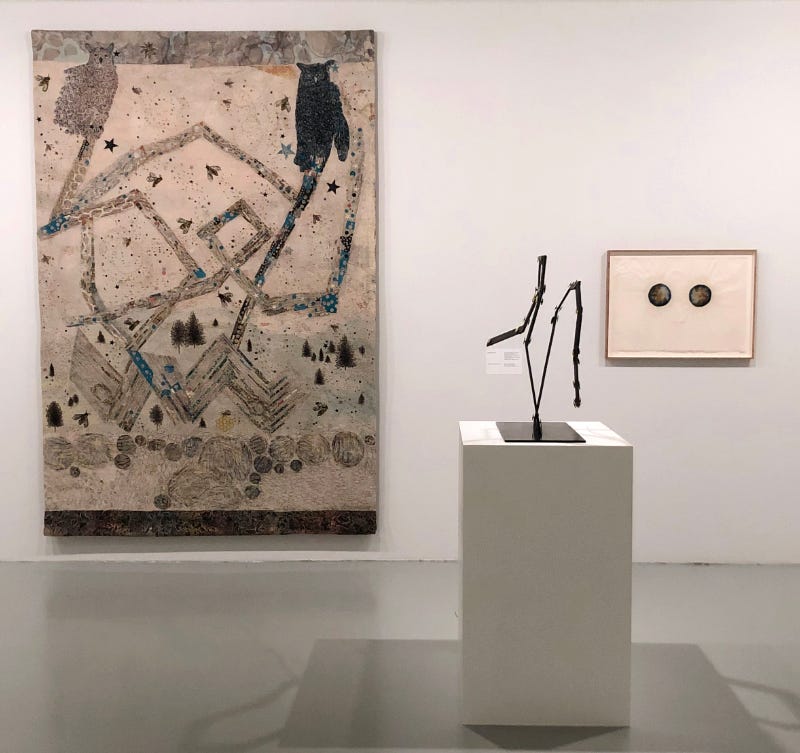
The textile works are woven at Magnolia Editions in California. Smith sends her original collaged prints (which usually begin as etchings or lithographs) for digitization; she then paints on the digitized prints and sends them back to be rescanned and woven. Even though the final works are textiles, she sees the process as an extension of her practice in printmaking, where an original (in this case, the drawing/painting) can be used to make infinite editions.
She very pointedly notes in the exhibition catalogue that while she respects hand crafts and those engaging in this type of skilled labour, she is not at all interested in hand weaving. You can, however, sense that she is thinking very deeply about textiles as a medium — it’s not just a gimmick or new way to print her drawings. She refers to textiles as holy, and says that weaving “is our inheritance as people.” (Wallner/Mattern)
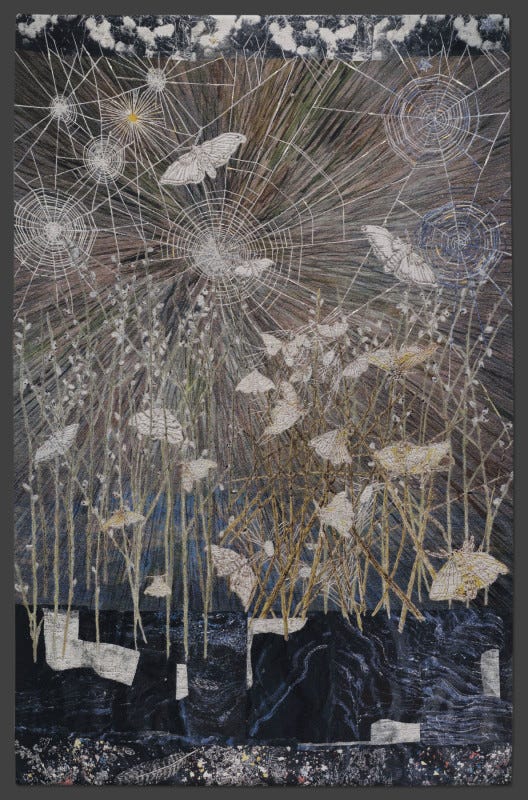
My favourite piece was Spinners (2014) and its digital sketch, in which spiders, moths, water, a feather, and waving willow wands create a vibrant and living world. One of the functions of art is (in my opinion, at least) to allow you to glimpse the way another person sees the world. In practice, however, not every work takes you there; sometimes it’s more about beauty, skill, or meaning.
With Woven Worlds, the dense layering of textures, allusions, animal familiars, and materials tells a enigmatic tale that brings all of those elements together. I keep thinking of C. S. Lewis’s The Lion, the Witch, and the Wardrobe, where the children find the extraordinary world of Narnia in the back of an everyday cupboard; these pieces were the same, presenting everyday creatures interacting in the midst of a rich and compelling story that encouraged imagination over hard answers. Even in the coldness of the white cube, the pieces were warm and alien, familiar and magical. The opening to my notes on this exhibition just says “wow wow wow.”
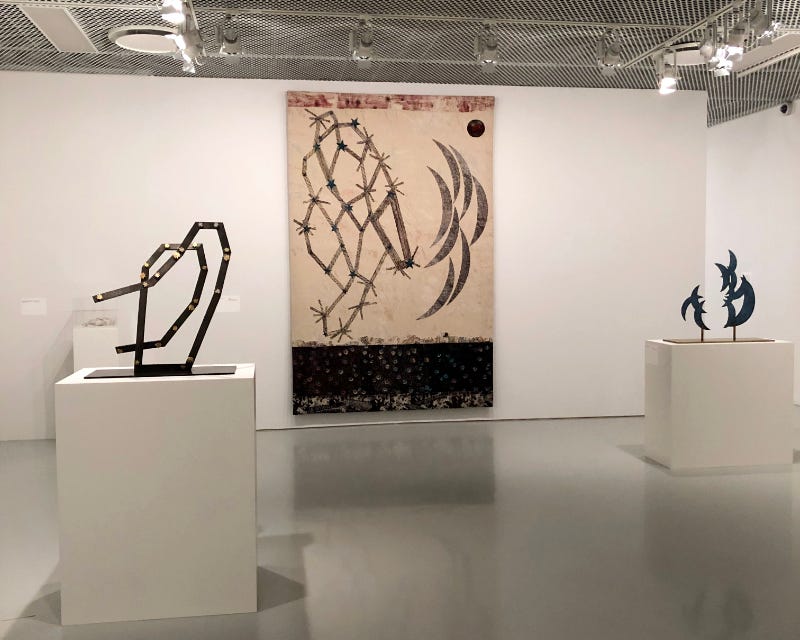
Scattered throughout the gallery were several sculptures and wall-works that pick up the crumbs seeded by the tapestries: eagles, stars, moons and flowers. In the catalogue (Kiki Smith: verwobene Welten), Smith speaks of her admiration for the Middle Ages and its “rich and sophisticated visual narrative and language,” and “connection between images and belief.” (Wallner/Mattern)
With so many talismanic figures appearing through her work, this reference felt very salient to me, but I appreciated her dry resistance to ascribing meaning or interpretation. In the catalogue she says, “My interest is not in the subjects but how a subject can have many different lives through many materializations. Material brings meaning.”
The next time I passed through Malmö I had a bag full of weaving yarn and was eager to get back to Nykøbing, so I didn’t stop. Several places I wanted to visit that I couldn’t make it to are:
The Cloth Lab: A “creative hub dedicated to sustainable textile and garment design” by Birgitta Helmmerson and Sam Grose. Their super cool approach, projects, and patterns can be found in Helmmerson’s two English language books, Zero Waste Patterns and Sewing With Scraps.
MalmöVÄV: A non-profit association and artist’s workplace by and for weavers and other craft workers. (Instagram).
Malmö Konsthall: A free contemporary art museum.
Ribersborgs Kallbadhus: Open air bathing and sauna.
Malmö Saluhall: Steen recommended I have lunch here!
Closer to home, I’ve been busy as usual (perhaps busier than comfortable). Some things I’d like to share:
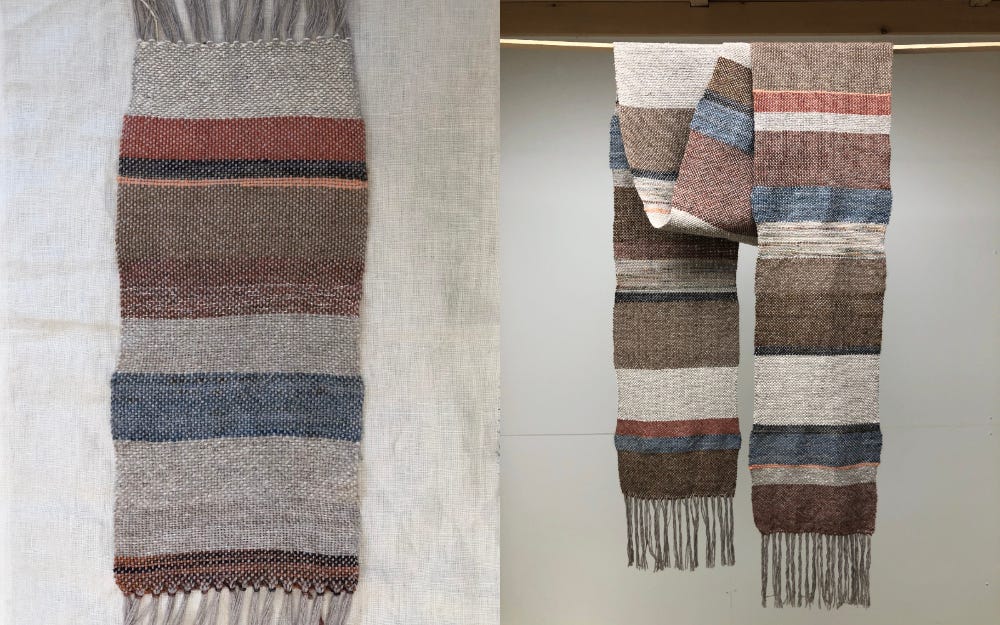
Last September I mentioned that I had worked on a project for a film — and now it’s out! I wove a scarf for Wayward, out from September 25th, 2025 on Netflix. The scarf is worn by Toni Collette’s character during a scene called “the leap” in the final episode of the series. The project brief was for a piece of textile art from the 70s using different weights of yarn in a specific palette. Here is an image of a sample and the finished scarf — you’ll just have to watch the show if you’d like to see it in context.
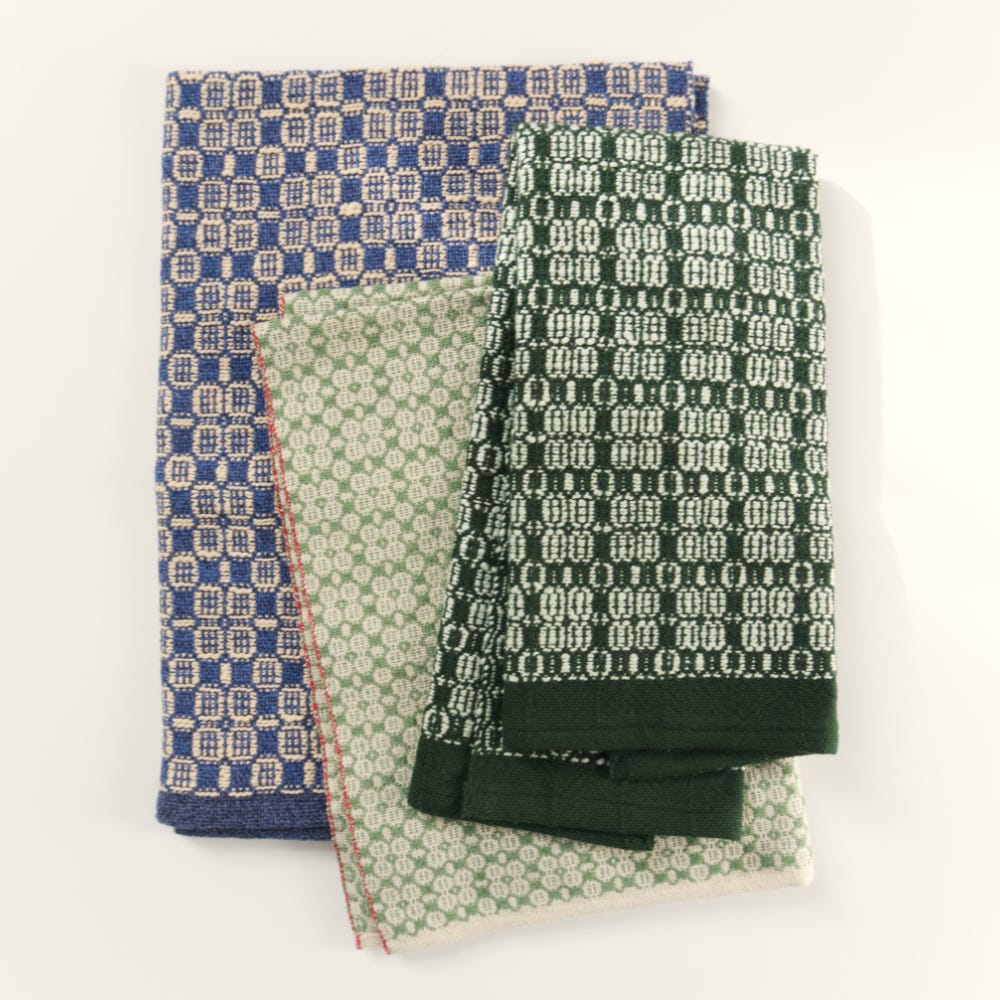
Gist Yarn has recently released an adapted version of the Seed Pod Towels. Christine and I independently decided to re-do this pattern at the same time, and it’s been great fun to see how the same project has diverged and changed. I think of weaving patterns much like I do a recipe: the pattern provides the outline, but each chef chooses their own ingredients. The towels are soft, thick, and completely different from the original as well as the variation available on my website. A small tweak to the draft and different materials can have a big impact!
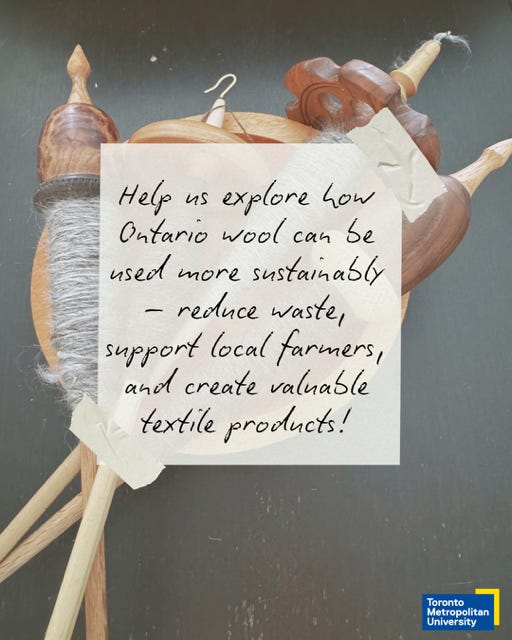
One of the MA candidates at the my university is currently running a research survey collect insights from Ontario sheep farmers, wool processors, and fibre professionals. If you use Ontario wool in your practice and think you may be able to help Wen Shen understand “the current challenges and opportunities within the province’s wool sector and help identify ways to support small-scale, sustainable fibre systems,” your response would be greatly appreciated!
Please visit the survey here: https://forms.gle/FtC5V6cdXXk9JJzf7 It should take ~15 minutes of your time and is open to Ontario-based farmers, processors, and fibre professionals. This research survey is REB Approved: TMU REB #2025-381
And lastly, the Ontario Fibreshed has a new video initiative called the Circular Series. It’s “a storytelling project created in collaboration with TMU interns, sharing the journey of fibre from farm to fashion.” Yours truly has given a typically awkward interview for Series 2, but you can watch the first series of interviews here, with Megan Cleland, artist, Jeanette Lourens of Red Maple Homestead, and Rachel MacHenry, Assistant Professor at TMU.
And lastly, there are still spaces in some workshops I have coming up:
Weave a Scarf at the Art Gallery of Burlington. Session 2 starts November 5th.
Colour for Knitters on Saturday November 8 from 12-4pm, at Unwind Yarn House in Newmarket, Ontario. This is a new workshop that’s about creative process and gaining colour confidence and is especially for knitters (but all yarn folks are welcome!).
More to come in November’s newsletter!
I would like gratefully acknowledge the support of the Canada Council for the Arts for my residency at Det Vilde Spinderi.

References
Mattern, Julia and Julia Wallner. Kiki Smith: verwobene Welten. Wienand, 2024.
Comments
Nothing yet. Say the first thing.
Sign in to join the conversation.