
After a very long week, I don’t really want to talk about Graham Platner anymore.
For the longest version of my takes, I chatted with Vox about how we got to this point — the heartbreak, the frustration, and being honest about what decisions were made with what info when (and what the consequences would have been), so we can avoid making the same mistakes again.
I also highly recommend Rebecca Traister’s essay in NYMag, which speaks to the complicated moral questions in this election and as always, nails the nuance that I’m also grappling with.
But I do want to dig in on one of the sub-plots that has come up out of this scandal: The role of political consultants in politics.
ICYMI: Two of the many villains in the Platner saga are the consultants who recruited him to run and led his campaign. They had been traveling the country recruiting working-class candidates (or at least, people who match their imagined aesthetic of working class) and then throwing them into the deep end without rigorous vetting.
You should watch this video — it’s kind of insane they said this shit on camera.
Moraff and his partner are taking a lot of heat, as are the consultants1 that pushed Platner into the spotlight and kept him there throughout the scandals.
The fact that consultants were running the show on the campaign is emblematic of a structural problem in Democratic politics (and probably the GOP too, but I don’t know the ins and outs of their shit as well so I can’t speak with 100% certainty).
So I want to zoom out and answer one of my favorite (?) cocktail party questions2:
Let’s start by defining our terms: What even is a “political consultant”?
By definition, just a subcontractor — the person or firm you hire when you can’t or won’t build a function in-house.
Consultants do all kinds of things: Direct mail, digital ads, social media, email and major donor fundraising, IT, TV, polling, research, vetting, compliance, press, even volunteer organizing, and of course, general consultants (or GCs) who function as overall strategists.
At this point, there are consulting firms that cover nearly any function in a campaign; many will take on multiple roles (like: one firm will handle both online fundraising and paid digital ads, for an example.)
Some are firms, some are individuals. Some consultants have ideological frameworks for taking on clients; others have regional focuses or “types” of people.
Others do both for-profit and political clients — usually the corporate work underwrites the political work.
Most of the contempt aimed at “consultants” is typically aimed at the paid advertising consultants, since they tend to control the biggest chunk of the campaign budget and therefore have a prominent seat in campaign leadership. Paid ad firms also tend to be the ones driving messaging (although sometimes that also comes from the comms firms.) GCs also get a bad rap as the ones driving campaign.
Consultants don’t typically do candidate recruitment — in part because, as we’ve seen, it tends not to work out well, but also because who pays the consultant if there is no candidate?
Are consultants bad people?
No.
I mean, not any more so than any other group of people. Some of them are bad, in the way that some people writ large are bad.
But even if they are, the problem isn’t really their morality.
It’s that the incentive structure around them rewards the wrong behavior — and no one is ever held accountable.
Explain the incentives…
Most consultants charge with a retainer — a defined scope of work with a flat fee per month. Consultants could be as cheap as $5k a month for a solo operator doing a small specific project or as expensive as $25k+/month or more for big fancy firms with lots of manpower.
Then there’s commission… While most fundraising consultants I’ve heard of don’t take a cut of what they raise, there are certainly a few (both small dollar and big dollar) who do.
Ad consultants — both TV and digital — get a cut of the buy, usually single digits but could be up to 15%. Then there are often production fees for developing the creative.
Notably, TV is the most profitable, least labor-intensive thing a firm can sell — one media-buying shop can service two dozen clients, whereas digital or direct mail needs ten times the staff for the same revenue.
Accordingly, commission-based consultants are financially incentivized to push more of whatever they make money off of, even if that’s not actually what is the best path to win.
That’s not to say they’re always acting in their own best interest and against the campaign, but it’s a tension at hand that needs to be named.
The second thing to note about the money is that the commission doesn’t get paid out until the money is spent.
The timing is important because campaigns are obsessed with “cash on hand,” the number reported to the FEC every quarter that reporters and opponents use as a proxy for how healthy a campaign is.
Raise a lot, spend a lot? No bueno.
Raise a lot, sit on it? Great candidate, ready to win.
Put those two facts together and you get something genuinely absurd: Campaigns can theoretically let a consultant work for a year and a half, driving strategy that personally benefits them, then get the entire commission at the very end, conveniently after the number that matters has already been reported.
And that’s just run-of-the-mill normal conflict of interest shit.
I’m barely scratching the surface of the consultants who start PACs and then raise money into those PACs — money that then goes back into the consultant’s pocket as a commission.
Or the donor advisors (who are also consultants!) who advise their donor to give to projects the donor advisor themselves run.
The grifts are, sadly, limitless.
It’s worth naming: Many (hopefully most?) consultants do not operate unethically. But it’s simply the water they’re swimming in.
Why else do people hate consultants?
Because of the financial nature of their relationship, consultants are not incentivized to take risks.
Let’s say a candidate decides they’re going to rebuff the system and decline to run TV ads, or run fewer TV ads than their opponent. Then they lose.
Maybe it’s because they didn’t run TV ads and all the haters were right — or maybe it’s because the candidate was boring and couldn’t get voters excited to show up, or maybe it was an election year in which the winds were blowing against the candidate’s political party and nothing they could’ve done would’ve made a difference.
Doesn’t matter. Winning campaigns have always done X Y Z — so if you don’t do X Y or Z and then you lose, that’s why.
The same is true for campaign messaging: If you go with the same old framework that has usually won elections in the past and you lose, so be it.
It’s rare a campaign is willing to be the guinea pig for the new approach. The stakes are too high to risk a negative outcome.
This is a system where every individual actor is behaving rationally and the aggregate result is still broken.
What about what happened in Maine? How’d those consultants mess up?
Well for starters, they did a fucked up version of candidate recruitment. I’ll quote Michelle Goldberg from the New York Times here:
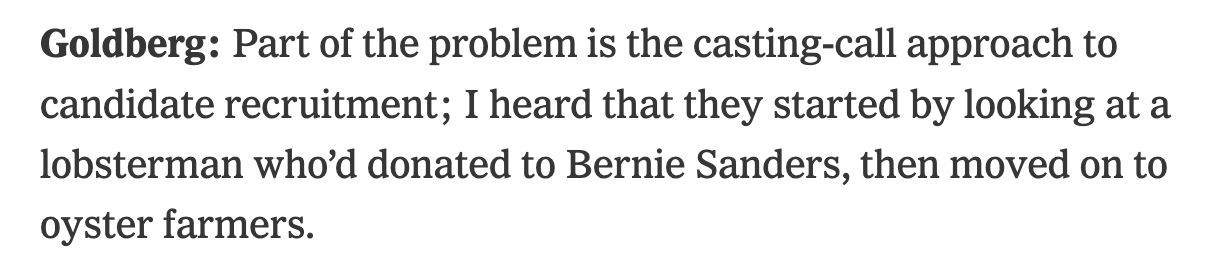
(She goes on to say the Run for Something method is much preferable — I agree!)
Then they of course failed to deeply vet their chosen candidate and per their own retelling, didn’t take the vetting flags that did come up seriously.
But zooming out even further: One of my go-to questions to ask when assessing political strategy is “who is this person accountable to?”
Is it their donors? Their bottom lines? Their constituency?
The consultants who recruited Platner in Maine were not accountable to anyone but themselves. They had a theory of the case on who could win and they set out to prove it, consequences be damned. While I do appreciate people who just do things, this was supremely not the time or place for that kind of careless behavior.
Don’t people face consequences for any of this?
Not really!
There’s no database, no real accountability layer, no consumer reports for hiring a political consultant.
Work gets referred in through networks and friendships — I know so-and-so, I worked with your last campaign — which is a terrible way to hire anyone on merit and a great way to keep the same people in the same rooms.
And since often those referrals come with a finders fee (that then raises costs even further), the whole thing is just donor money moving through a supply chain that’s been marked up more than once before anyone with actual oversight ever sees the number.
Consider that basically every consultant who worked in the 2024 election — one where Democrats spent over a billion dollars and lost — is still working today.
I’m not saying all of them should be out of work.
But no one is ever going to be truly honest about what worked, what didn’t, and what money was wasted because their livelihood depends on it.
Seems like the consultant class is mostly white men. True/not true?
True. Because the barrier to becoming a “known” consultant is money, time, and relationships — which is a nice way of saying it selects hard against everyone but the already-connected.
I have a distinct memory of a senior leadership retreat during the 2014 Florida governor’s race — about thirty people, maybe twenty of them consultants — and not one woman among them, and only one person of color.
I have friends who work as consultants have been brought into rooms specifically so the firm doesn’t look “too white,” or “too male” — and then the firm was not hired anyway.
That’s not just an equity problem. It’s a strategy problem.
If the people building the messaging, the ads, the entire theory of persuasion are disproportionately white men, there’s a real gap between who’s deciding what resonates and who actually needs to be resonated with. (And also, we’re still somehow not winning white men!)
If everyone hates this, why does it keep happening? Why do consultants still exist?
Because working as a consultant is one of the only ways you can keep working on campaigns and also have a life outside of them.
If you want to keep doing electoral politics and also make a good living, stay in one city, have a family, have time with your kids, etc, you literally cannot do that while also jumping from one campaign to the next.
Consulting firms are the infrastructure — campaigns stand up and then get shut down, vendors live forever.
The ecosystem’s failure to fund year-round organizing and state or local parties that build political power means the best, most talented senior people tend to join or start consulting firms because they have no alternative if they want to have health insurance past Thanksgiving.
Every incentive in the system is pointing the same broken direction at once.
Feels like this is a problem that’s been happening forever…
Indeed. (I actually hosted a podcast episode about this back in 2021 if you’re interested.)
It’s been interesting, however, to see how it’s changed especially in the last five years.
For starters, the anti-consultant critique has gone from insider baseball to part of a broader diagnosis (and arguably, a correct one) for our party’s failure to win: We play it safe, spend too much on paid media, and don’t trust in our guts. We look to the same old people to drive the same old strategies.
I’m also fascinated by how “consultant-driven politics” has become part of factional warfare — even though let’s be real: Every side has their own consultants. There are leftist consultants, moderate ones, centrist ones, etc. But whatever, make a villain of whoever you need, I guess.
Outside spending has also made this much worse — more money going into politics means more opportunities to make a buck by spending it on advertising.
So what would actually fix it?
Not “abolish consulting,” which is a fundamentally unserious proposal.
But rather, like most things, consider what we can build to solve the systemic problems:
Ensure (through funding!) that there are sustained staff jobs with benefits that don’t evaporate the day after an election so good people can stay in senior roles in electoral work.
Encourage risk-taking. Acknowledge that so much of elections are out of our control anyway, so campaigns that try new things should be celebrated because the world is changing fast, the old ways aren’t working anymore, and we have to be willing to take a big swing if we’re going to catch up.
Empower candidates to have backbones. Much like with “The Groups,” people put responsibility on the wrong parties. If candidates know what they want to say, consultants can be helpful in guiding them how and where to say it in the way that breaks through. But consultants are just that — consulting — they’re not the final decision-makers. Candidates are in charge.
Take vetting seriously. Some of the stuff that has come up would never have been found out, even in the deepest of vetting reports. But some of the stuff would have! One of the things we tell candidates going into a campaign — even just for school board — is to assume your worst mistakes will end up on the front page of your hometown newspaper and plan accordingly.
Hold people accountable! When consultants fuck up — as we’re seeing in Maine — consider whether they should stay in this line of work. I know this is sticky shit. Everyone makes mistakes and should be given a chance for growth and a redemption story. (And I don’t take suggestions about how to fuck around with people’s livelihoods lightly.) But/and: Actions should have consequences.
The reality is: Most consultants are not evil grifters.3 Many are just doing their best to make a living doing good work for causes they believe in.
Many of my friends are political consultants; I assume that at some point later in my career, I will do consulting — it is not definitionally a bad thing.
However: Consulting shouldn’t be the only option for senior people. Consultants shouldn’t be the driving force behind our campaigns. And maybe this is in my own best interest to say, but: They for sure should not be leading on candidate recruitment.
What other questions do you have? What else can I debunk for you?
When We’re in Charge is my leadership book for millennials and gen Z trying to do things differently. Pick up a copy in any format you’d like — hardcover, e-book, or audio book (narrated by yours truly) anywhere you get books, including Amazon or Bookshop.org or literally anywhere else. If you have Spotify Premium, you can listen to for free right this very minute. It’ll be out in paperback in September.
Full transparency: I’ve worked with at least one of the consultants over the years, albeit not while at their current agency.
Invite me to your parties, I’m really fun.
Worth a reminder: When you see stories or social posts that seem like they’re knives-out for a particular individual, perhaps there is some truth to it! But perhaps it is another consultant trying to affect their business via some good old fashioned ratfucking. Who’s to say?
Comments
Nothing yet. Say the first thing.
Sign in to join the conversation.