
Ben Wikler is low-key famous in the political world. He’s the former chair of the Wisconsin Democratic Party who led the party to true heights, winning elections up and down the ballot (and having a good time while he did it.)
In early 2025, Ben ran for DNC Chair and while he came up short (sadly, sigh), he didn’t let that stop him from putting pen to paper on a plan to save democracy.
His new book, This Is The Plan, comes out on Tuesday — and if you read this Substack or follow me anywhere on the internet, you’re going to like it.
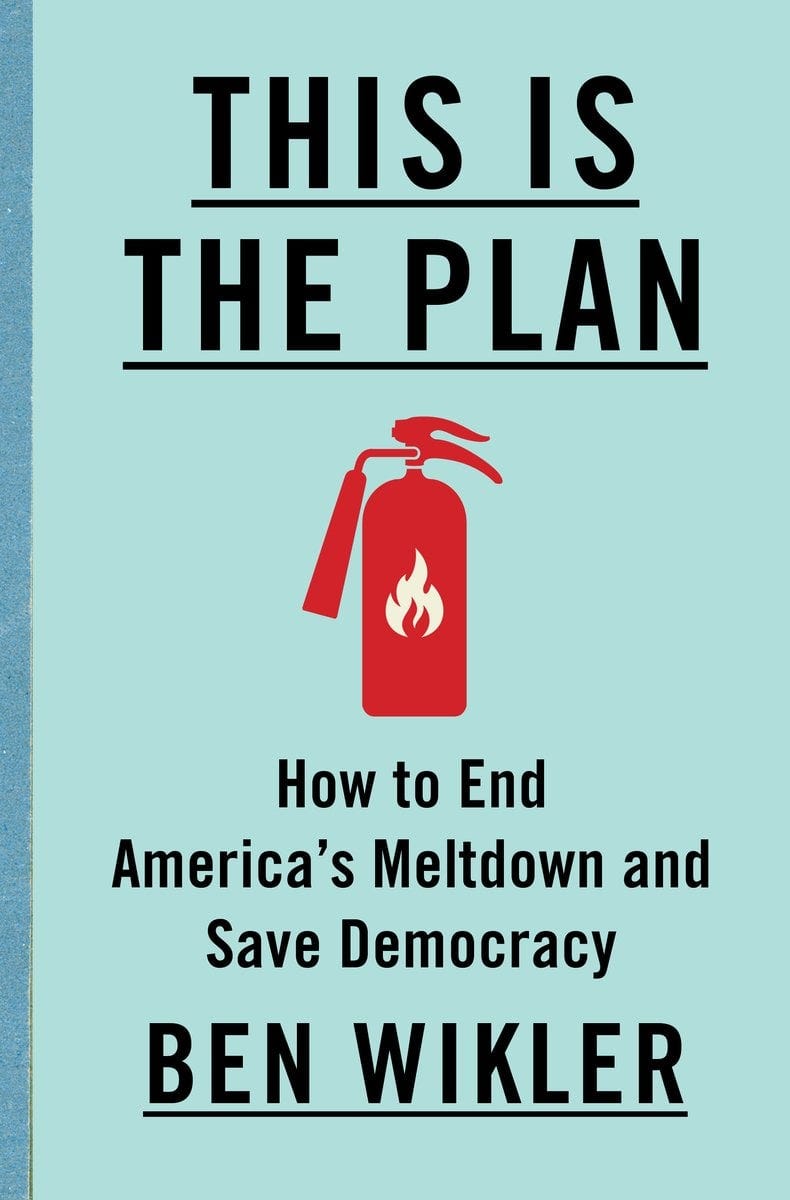
This is not a book about messaging or policy — it’s not a Project 2029.1 Rather, it’s about power in service of making people’s lives better, something I think too many political operatives and pundits forget is the point.
He dives in on what you can do to actually win, how the different levels of government actually function (and why, as I like to say, the way to win the big elections is to win lots of small ones), and what the Democratic Party actually is.
I’ve known Ben for a while now and think he’s just an all-around good guy — his equal parts pragmatic and optimistic approach to politics really hits with me. (I also admittedly love books that tell me I’m right.)
We chatted earlier this week about his book — which is excellent, with lots of Dad Jokes and Princess Bride references — and the broader misconceptions people have about how politics actually works. Pre-order it now.
ME: The thing I really loved about the book is that it’s not particularly ideological. You don’t get into the intra-factional debates inside the Democratic Party — it’s not really about issues (and I mean that as a compliment). How’d you land there?
BEN: The central idea is that all of us who believe in democracy, who believe government should work for regular people and not just the ultra-wealthy and well-connected, have to get together — because we’re up against a trillionaire, a multi-billionaire president, and a cabal with more wealth and power than maybe any group in history. They’re going to use everything they have to divide us and cement control, whether the public likes it or not.
So I’m trying to draw the biggest circle I can.
I call it “the big we” — a group that has to include a ton of people who disagree with each other about a lot of stuff, in order to protect this incredibly sacred, non-guaranteed thing: the idea that the majority of the public gets to decide who controls the most powerful military and biggest budget any government has ever had.
Most people around the world have no say over what their government does. The fact that we still have even a prayer of winning an election and having our choice lead the country is something worth fighting to protect at all costs.
I’m not writing a book arguing that one wing of the Democratic Party should beat another wing.
I’m arguing that everyone who believes we should have the most fundamental freedoms in this country needs to agree on that one thing and fight for it together.
There’s a data point on page 30 that stopped me — you cite data journalist G. Elliott Morris, who asked people an open-ended question in November 2025 about what their ideal political party would argue for.
A quarter of respondents were generally left-leaning, a quarter generally right-leaning, 4% called for centrists specifically, and 38% gave answers that didn’t fit the left-right spectrum at all — things like “helping people,” “treating everyone the same,” kitchen-table stuff. You wrote that most people aren’t mapping a left-right spectrum. For them, politics is over there, and real life is over here.
This gets at one of my pet peeves about a lot of punditry — it misses that most people don’t have ideologies. They have problems, they want solutions, and they’d rather not think about politics at all.
How has that shaped your organizing?
When you knock on doors — talking to voters who might vote one way or the other, or might not vote at all — every elaborate theory about how to position yourself ideologically falls away.
You’re in a conversation with a real human being living their own life, and most of what political professionals think about every day is just noise to them. They don’t know or care who started the redistricting fight in Texas. They want to know if their kid can join the sports team, or if the cost of the uniform is competing with the cost of medicine. That’s true across race, ethnicity, rural areas, cities, suburbs — everywhere.
If you already have strong views on a bunch of political issues and candidates, you already know who you’re voting for.
The people who actually decide close elections — both whether to vote at all, and which party to support — are overwhelmingly people who just don’t put politics at the center of their lives, the same way most political professionals don’t put competitive curling at the center of theirs. It’s something they think about once every four years, maybe get briefly interested in, then it fades into the background while they deal with more urgent things.
That shaped how I thought about my work as chair of the Wisconsin Democratic Party: I saw myself as protecting an immensely valuable thing — our neighbor-to-neighbor, friend-to-friend organizing program. That’s been building for years, some of it dating back to teams that launched under the Obama campaign in 2008 — people who’d meet in a living room or coffee shop and then go talk to their neighbors about city council races, mayoral races, all the way up to president.
There’s a million forces in politics trying to pull everyone away from that focus — the money, what donors want, candidates who don’t want to be on the same doorknocking script as each other. All of it is about the political world’s internal drama, not about voters’ actual lives.
I think of the real work of politics as bumper bowling. If you’re actually listening to what voters care about, you’re not going to wind up in the gutter — you’re going to hit pins, because meeting people where they are is how democracy is supposed to work. Your message works when it gets people nodding who otherwise wouldn’t be paying attention to politics at all. The practice of listening pulls you out of your own head, out of the Twitter wars and cable news fights, and into the real-life question underneath all of it: can my life be a little bit better, a little less hard, in an environment that often feels bleak.
I really appreciated your chapter on the Democratic Party, because you get at something I’ve written about before — the party doesn’t exist the way people think it does. You call it “the blob.” I call it a loosely connected series of group chats. What’s the biggest misconception people have? What myth do you most want to bust?
People think of the Democratic Party as this giant force looming over Democratic politics — calling the shots, choosing candidates, deciding when and how to fight.
The reality is it’s a handful of people, mostly volunteers, desperately trying to keep the lights on and say something anyone will notice. For the people who work inside these institutions, it often feels like yelling into a hurricane while getting blamed for every outcome that happens.
My argument in the book is that functionally, the party works like a civic club — like an Elks Lodge that also happens to have a bank account candidates can raise money into, which the party can then spend to help them. That’s essentially it, in most places, most of the time. But it can be something bigger: a vehicle for people who disagree about a lot of things but share a commitment to doing the year-round organizing work that builds political power at every level of government — a permanent campaign.
That’s what we built in Wisconsin, and I’ve seen the impact of it community by community across the state. There are places doing the same thing around the country. If more places did it, we could create enormous change, because a lot of the outcomes that make us want to pull our hair out today trace back to small local elections nobody was paying attention to five or ten years ago.
There was a state supreme court race in North Carolina in 2020 — the Democratic candidate, Cheri Beasley, lost the race for Chief Justice by 401 votes. Four hundred and one people. If they’d voted for her instead, North Carolina wouldn’t have been re-gerrymandered before 2024. Republicans wouldn’t have won three additional U.S. House seats. Mike Johnson wouldn’t have become Speaker. Donald Trump wouldn’t have had the votes to cut a trillion dollars from health care.
Four hundred and one votes, in a race no one was watching — and those elections happen constantly. What all of us can do is bring our fundamental commitment to a free and fair democracy to the work of building a party that does that organizing on the ground, in the races far from the headlines that end up affecting everything.
I have a theory here, and I’m curious if yours matches: why doesn’t the Democratic Party do this? Why doesn’t every state party, or the DNC, build this kind of infrastructure? It feels so obvious — why doesn’t it exist?
Part of the challenge is that most people live in places where very little actually feels on the line — you already know who’s going to win your governor’s race, your congressional race. Most states, most districts, are solidly blue or solidly red. Most people don’t know many people who vote differently than they do. Non-voters hang out with non-voters; Democrats hang out with Democrats. So the idea that we all have this superpower — that we can change the fate of American democracy by getting some friends together — feels abstract, especially while we’re bombarded with fundraising texts and emails saying the sky is falling, which can’t all be true at once.
There’s a real disillusionment that follows, and often the people who stick around are there because the local party is a place to see friends, or because the national convention is genuinely a blast.
[ED NOTE: I made a face at Ben here - the convention sounds exhausting!]
It is! I talk in the book about the moment Lil Jon kicked off Georgia’s roll call: “Georgia, how do you cast your ten electoral votes?” Genuinely one of the best moments of my life.
But it’s not necessarily a magnet for organizers who want to think strategically and throw themselves into the work — and when they do show up, they sometimes get chewed up by people who’ve always done things a certain way.
Most of these roles are unpaid. Most state party chairs are paid zero dollars. Most executive directors are paid far less than they’d make doing something else. Most people who work at a state party stay less than a year. High turnover, tough conditions — hard to build anything on that foundation.
Part of the reason Wisconsin worked: two chairs before me, an operative told the then-governor he’d only take the job if it was paid. The governor agreed. That chair discovered the party was in debt and about to miss payroll, but got it on firm footing over years. His successor made it her full-time job, and launched the year-round organizing program. I came in standing on their shoulders and built it further. That takes years — and in a moment when a lot of people are furious at “the party” and don’t want to fund a stranger’s salary, it’s hard to make the case that this is a garden worth tending.
But that’s how political power gets built. It’s how the Christian right built theirs, starting with school board races in the 1980s under Ralph Reed and Pat Robertson. They’ve been doing that work for decades, and even though most Americans reject their policies, the infrastructure has paid off enormously.
You plant a tree knowing you won’t taste the apple for years. That’s the work anyone who wants a democracy in the 2030s needs to start now.
You spoke around it, so I’ll say it plainly: there’s no money for this in most places, unless someone like you is at the top raising it. I’ve spent years trying to raise money for long-term infrastructure with a long-term plan, and that’s just not how money moves in Democratic politics — it’s so different from how Republicans fund things.
When I explain to non-political people that the Leadership Institute, which is Run for Something’s closest Republican analog, has a $50 million annual budget and we work off of $8 million, they can’t believe it. Our billionaires are just different.
It’s not just billionaires — it’s millionaires, and it’s “thousanders” too.
Some of the most successful Democratic fundraising happens through giving-circle programs, where working- and middle-class folks each chip in a few dollars a month and it adds up. Part of the imbalance is the systematic destruction of unions — organizations that actually understand long-term infrastructure building, and that have been dismantled by federal and state governments as part of a deliberate effort to defund Democratic politics.
Part of it is a kind of shiny-object syndrome that’s easy to fall into on our side — long-shot candidates who pull in unbelievable money every cycle, and at the end of it there’s nothing left to carry forward, because every dollar went to TV ads that pay the owners of TV stations rather than building political muscle. I’m not saying don’t run TV ads — you should. You just also have to do the other stuff.
My view is all-of-the-above: out-communicate and out-organize in every medium, every channel, every geography, every constituency, every time period. Do that and you win by half a percent in Wisconsin. But you can’t skip the infrastructure.
Something that shocked me every cycle as chair: more than half our budget would come in after Labor Day of the election year — just the last two months before a November election.2 That creates a huge incentive to spend every cent getting through Election Day and come out the other side broke. Which means most campaigns and state parties scale up fast with people who haven’t built trust or ways of working together, and then almost everyone gets laid off, and you start from scratch next time. That’s no way to build a movement, a party, or power. You need staying power.
If people are thinking about where to put their political dollars: invest in something that will be stronger after the election, win or lose — not just something with a two-month impact that disappears the moment the election’s over.
I write a lot in the book about Run for Something, because I think it exemplifies this — building a cohort of leaders who move through the political system and exercise power now, in ways that make their communities better. About a quarter of members of Congress served as local elected officials earlier in their careers; half served as state legislators. And even for the people who never run for higher office, a local elected official right now — protecting democracy, the rule of law, our fundamental freedoms — is essential. They’re the most important line of defense we have.
One of the things I grapple with a lot, especially around current leadership — and I think this shows up across government, politics, and business — is the declining trust in institutions.
People trust individuals now, not institutions. Why should people trust the Democratic Party right now?
I think the key shift is moving from a Democratic Party that’s a them to one that’s an us. If you’re skeptical of the party, the biggest way to build trust in it is to join it and help build it into what you want it to be. It’s much more plastic and open to revitalization than people realize. 3
Go to a school board meeting — nearly everyone sitting on that board got mad about something happening in the district, got mad enough to run themselves, and now they’re shaping local policy. The Democratic Party works the same way. For people who are fed up: it’s time to join and think about how to make it the organizing force you want it to be.
I don’t think trust should be granted — I think it has to be earned. Across thousands of counties in this country, some county parties are a total disaster and others are amazing, undiscovered gems of people organizing together. But the way this changes is if the party becomes an institution embedded in your community’s life — the table outside the high school musical asking people to sign up, a presence beyond the two months before an election.
Trust ultimately comes from seeing that something is on your side over time, in an enduring way — not just trying to get something from you, but actually being for you. That’s how the party earns trust: showing up consistently. And that takes people.
I have the same refrain for people: if you don’t like the party, join it — this is a membership-based institution, so be a member. People tell me, “I went to a meeting and it was six senior citizens sitting in a room not doing anything, it wasn’t even worth my time.” And I think: you couldn’t take that over? Couldn’t bring ten friends next time? That’s a skills issue on your part, my dude.
If it’s so incompetent and you can’t transform it, what are we even talking about?
No shade to those senior citizens — sometimes they’re leading amazing county parties. But I’ve seen it happen over and over: a group of young folks, or old folks, wanting to transform something, do a little organizing, and suddenly they’re running the county party and transforming it.
It’s one of my favorite things to watch — a local party organization suddenly blooming, tripling in size. You can do that between now and November. There are elections in local party organizations constantly — every year in some counties, every two or four in others — and there are very often open leadership spots.
Most people with extremely strong opinions about the Democratic Party will never go to a county party meeting, formally sign up, or attend a state convention — and that’s fine, that’s just how the world is. But it’s mind-blowing how much power you can have if you just show up. If you’re ever at a party where everyone’s complaining about the Democratic Party, that room probably has enough people in it to win an election for your local party chairship and transform the energy there.
Last question: I think about November, and I’m both incredibly optimistic that we’re going to win big, and also genuinely worried it’ll be because of the environment — not because we did enough of the kind of rigorous introspection and infrastructure work our party actually needs, even when that introspection is miserable.
Looking at the next 18 months into 2028, what do you hope are the questions we ask, and the work we do to prepare?
The book is meant to make the case for how to build and organize in a way that creates enduring change.
If people only read a couple chapters, I’d point them to chapter one — “Your Superpower,” about organizing — and chapter four, about the Democratic Party.
The rest is about the individual fights: state and local government, ballot initiatives, state supreme courts, the House, Senate, presidency.
But fundamentally, it’s about moving away from the idea that there’s a magic set of words, or one office, that ends the darkness and begins some glorious new era. It’s a shared commitment to building a democracy, a community, a civic life — work that doesn’t come out of a focus group and doesn’t fit on a bumper sticker.
I write about how the First Amendment isn’t just freedom of speech — it’s freedom of assembly, the freedom of people getting together to do something. Democracy is as much about what we do as human beings in community together as it is about what we say.
My hope is that we win in 2026, whether or not we do everything right — and that the day after, we come back together and talk through what worked and what didn’t. Then we ask: when’s the next local election? Maybe it’s three months out. (It certainly will be in Wisconsin — we’ve got a Supreme Court race in 2027.)
Who are the new people who showed up at the local office? Who did I meet for the first time — let me get everyone together for a drink. What can we actually build coming out of this? And we make that part of a longer story.
Zoom way back: community in America rises and declines. Political engagement rises and declines. Right now we’re in an era of incredibly low trust, toxic politics, and constant shifts in power because there are no enduring coalitions and so many people are tuned out. It won’t be like this forever — we’re perched on a knife’s edge, with more shifts in the House, Senate, and presidency than in any comparable period in U.S. history.
I want the people who believe in a democracy where everyone can thrive, where everyone’s rights are protected, where everyone has a voice — I want that big “we” to win this era, so those things become a shared agreement in this country, and we can go back to arguing about the marginal tax rate as part of the 2032 election instead. Democracy itself, people’s fundamental freedoms — those shouldn’t be on the table.
That work only happens if we find the joy that comes from common cause together. I want us to rebuild an America we can all be proud of. That, to me, is the work.
Pre-order Ben’s book anywhere you get your books — Amazon, Bookshop.org, or anywhere else — and get it first thing on Tuesday. It’s really great. And subscribe to his Substack for more from him!
When We’re in Charge is my leadership book for millennials and gen Z trying to do things differently. Pick up a copy in any format you’d like — hardcover, e-book, or audio book (narrated by yours truly) anywhere you get books, including Amazon or Bookshop.org or literally anywhere else. If you have Spotify Premium, you can listen to for free right this very minute. It’ll be out in paperback in September.
If you’re interested, perhaps I’ll write sometime about why I think that shit is mostly pretty silly.
When I worked in grassroots fundraising, we’d estimate that half our money for the quarter would come in the final month, half of that would come in the final week, half of that would come in the final day, and half of that would come in the final half of the final day. It’s a hockey stick over time — shoots right up at the end. Even now, I’ve had years of fundraising where half our budget comes in the final 3 months of the year. It makes planning IMPOSSIBLE.
Comments
Nothing yet. Say the first thing.
Sign in to join the conversation.