
At dawn, on certain blocks, Buenos Aires looks like London after the Blitz, the day after a terrible bombing.
There are more bodies each morning. I’ve started counting them, lying in near-perfect lines, spaced a few meters apart, skinny outlines beneath thin polyester, graying blankets. Most are hunched, curled figures. Others splay on their backs, the tips of their noses the highest peak of the blanket mountain. Most press themselves against the walls to leave space for passersby. More often, I find myself stepping wide, dodging exposed legs and blackened bare feet.
Today Nina started jardín, meaning I was on the streets in the early morning walking to school as she sat erect in her cochesito, breathing in the city, pointing to pigeons, buses, bikes and the people sleeping on the streets.
“Shhhh shhh mama.” She turns to me and points to the figures, her way of reminding me they’re sleeping.
I copy her gesture, touching my finger to barely parted lips, “Shhhh shhhh.”
She turns and continues watching forward.
On one street, eight forms lay in a line. I could make out male and female shapes. Mostly male. Mostly alone. I noticed a pareja, the greasy, ratted hair of the female using the male’s shoulder as her pillow.
Then, we passed a child, the blanketed outline of a coiled prepubescent figure resting on the mother’s body.
Nina didn’t notice.
***
It was exactly one year ago when we moved to the city. One year since the remodeling of our downtown apartment was finished and ready to inhabit. Nina was about to turn two. Daycare would begin. We were ready to embrace the city and everything it promised: culture, chaos, possibility.
One thing I love about Buenos Aires is the grunge, the adaptability, the way people adjust even when their peso may be worth half as much tomorrow. People here understand economic concepts I struggle to grasp: inflation, devaluation, sovereign debt, capital controls.
Not as theories, but as lived reality.
Before we moved to the downtown investment of all our savings (plus loans), we lived in a fairy-tale dollar-making, peso-living world. Life wasn’t just cheap, it was absurdly affordable. We burrowed into my husband’s family summer house for three years, worked online for dollars, and barely thought about money. Our monthly expenses never exceeded 1,000 US dollars. High-end groceries: 300 a month. Gas and electricity: maybe 50. Going out to eat? Ten dollars a person for three courses with wine. We paid no rent. Had no loans. We remodeled parts of the country house, but even that felt light.
Fast forward two years, and our monthly expenses have tripled with groceries around 1,000 dollars and utilities above 300. Going out to eat now easily costs 30 per person per meal. And it’s not just because we moved to the city or added a member to our family (yes, that does change costs a bit). Everywhere is more expensive.
I am putting the prices in dollars intentionally, because the peso price barely makes sense. But the peso price makes sense to locals, because while my dollars still function, locals earn in pesos. If life feels 3x more expensive to me, for someone paid strictly in pesos, it can feel like 5x or 6x, depending on their sector. For example, if your job is dollar-linked (i.e. pricing your goods or services against the dollar) then yes, costs rise, but you adjust your prices. You are fine. That is, if you still have buyers.
But for those earning fixed peso salaries, roughly 74% of Argentina’s workforce, it’s brutal.
In 2015, my husband chose his government job at the National Archives because it was stable. He was earning around 20,000 pesos a month which, at the time, was roughly 1,300 dollars using the blue, unofficial exchange rate most Argentines operated under.
On that income, life worked. Rent was around 150 dollars. Groceries, 150. Utilities, 50. He owned a car. Went out several nights a week. Took vacations. Saved a little. It wasn’t luxury, but it was enough.
Today, that same position earns about 1 million pesos a month, a fifty-fold increase in pesos. But at today’s unified exchange rate (now that the blue dollar and official rate have mostly converged), that 1 million pesos equals roughly 700 to 750 dollars. So yes, the peso salary exploded from 20,000 to 1 million. But the dollar value shrank.
And the cost of living did the opposite.
Rent that once cost 150 dollars is now easily 300. Food that cost 150 is closer to 400. Utilities that were 50 are now at least 200, especially after Milei’s subsidy cuts.
So when someone earns 700 dollars a month today, there’s nothing left after paying rent, utilities, and discount groceries. What about childcare, transportation, clothing, medicine, a dentist visit, a birthday gift, a coffee, a pair of shoes, a veterinarian bill?
When people tell me inflation is slowing, or the peso has stabilized, or macro indicators look better, maybe they do. But the cost of living, measured in dollars against what salaries can actually buy, has not returned to something sustainable.
Every single Argentine I know has a side hustle. With the new open market, many are importing cheap goods from China with TEMU packages flooding in, and reselling on Mercado Libre. My old housekeeper sells leggings. Chino’s friends sell dishware, carpets, furniture. Our nanny, a 70-year-old retired teacher, earns about 200 dollars equivalent in retirement. She works because she has to.
Every Argentine I know is working two or three jobs to survive.
Because nobody wants to be a cadaver.
***
The only time I interact with the homeless is when Nina waves or smiles at them. They wave and smile back. I wave and smile back.
The man on our street calls us “Veci” (short for vecino/neighbor). He once asked Nina when she would go to “Disnay” to meet her friend “Mickay.” She corrected him, “It’s MickEY Mouse!”
But that was last year.
These days I mostly see him splayed like a chalk outline over a heap of garbage, needles and powders within arm’s reach. The woman four buildings down, thin as bone, folds herself into a daytime hunch, muttering to no one, nibbling moldy bread in slow, deliberate bites.
In the morning, their blanketed outlines look like cadavers, not because they are dead, but because they are so still, so consistently stepped around, that the city moves past them as if they were. By afternoon, they are upright again, talking, passing mate, arguing, laughing, wandering in search of food. Some were recently employed. Some still are. They are people in motion, trying to stretch a peso that shrinks by the week. At night, the volume rises. Metal lids crash. Bins are overturned in search of copper, wire, anything that can be resold. Some look for a hit to dull the edge of the day. By dawn, the bins are gutted, trash strewn in mounds, excrement left among the wreckage. The bodies are back under blankets, slumped in corners, quiet again. Leave a person ignored long enough, and even the living can begin to resemble the gone.
I am not my best friend, the one whose heart seems to grow outside her skin. In Salt Lake City, she seeks out the homeless, approaches them, strokes their matted hair and tells each one, “You are beautiful.” She looks into their faces and finds something alive. In Utah, she founded a nonprofit called the Nomad Alliance.
Because they are nomads. People displaced, in transition, waiting for stability. Waiting for a system that catches them instead of letting them fall.
But systems don’t collapse in isolation. They collapse through policy, currency shocks, debt spirals, global markets, elections, ideology, decisions made far from the sidewalk.
***
In Argentina, President Milei has been clear about the path forward. Shortly after taking office, he warned the country that no hay alternativa al ajuste y no hay alternativa al shock, “there is no alternative to adjustment, no alternative to shock.” He has acknowledged that, for a time, vamos a estar peor, “we are going to be worse off” before things improve.
The economy here is complicated. In layman’s terms (which is all I claim to understand) Argentina has swung for decades between heavy state intervention and attempts at liberalization. Peronist governments favored tariffs, subsidies, strong national production. Many imported brands were scarce or expensive due to protectionism. I remember grocery stores lined with locally made cookies, cereals, peanut butter, electronics. You didn’t see brands like Kirkland, Walmart, or Target flooding shelves. Tariffs kept them out. Subsidies kept utilities and transport artificially low.
Life was cheap at home. But cheap isn’t competitive. Argentineans couldn’t travel easily. Couldn’t accumulate reserves. Couldn’t compete globally. So voters chose the opposite extreme. A libertarian economist with rock-star theatrics and chainsaw metaphors.
But people are suffering.
The peso has now stabilized somewhat against the dollar. Inflation has slowed from its peak. But prices remain high. Salaries lag. Purchasing power has not recovered.
Some say it’s necessary. That people must learn to work harder. That three jobs are the new normal. That “vamos a estar peor” before it gets better. That this is the cost of becoming “normal” like the United States or Europe.
Some say suffering is temporary. Some say give it time. Some turn to the streets. Some lay on the streets.
Becoming cadavers.
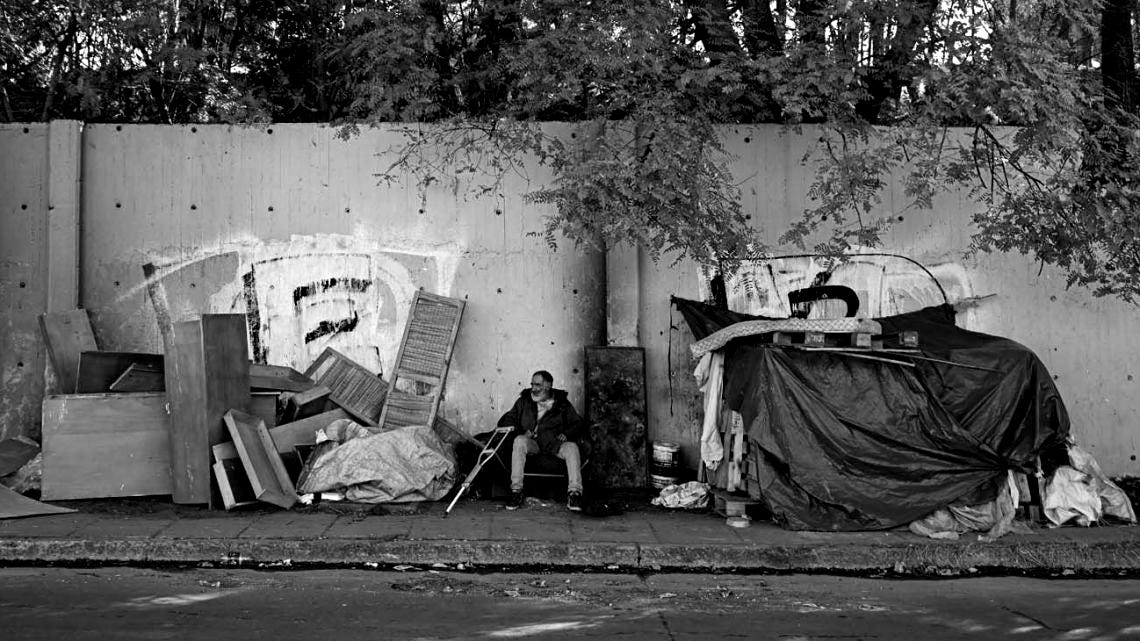
Photo: From AFP, used by the Buenos Aires Times for a story about how the homeless numbers began to rise in 2024
No posts
Comments
Nothing yet. Say the first thing.
Sign in to join the conversation.