
Author’s Note: I’d highly recommend watching (500) Days of Summer before reading this piece because I don’t think my words do it justice. Also, I spoil it heavily, so read at your own discretion.
There’s a film I have forever used as a litmus test for potential boyfriends: (500) Days of Summer. In fact, I can’t remember a time when my answer to “What’s your favorite movie?” wasn’t this 2009 rom-com. Are there objectively better movies? Sure. Are they better than (500) Days of Summer? To me, no, and I think that’s what defines a lifelong favorite movie. It has to be something untouchable by time.
For me, the nostalgia associated with the movie seemed to cement it as my favorite. I’ve watched it on a plane to a different country. I’ve watched it with an ex-boyfriend who hardly paid attention, which felt deeply personal. I’ve watched it while awaiting the reply of someone half-invested, silently crying at every scene—even the ones I should’ve laughed at. (Side note: if your emotional state is currently hinging on whether some guy texts you back, maybe save this watch for later.)
The film has embedded itself into different versions of my life, making a certain question inevitable—one that’s forever associated with this movie. Who’s in the wrong—Summer or Tom? Someone’s answer tells you everything.
(500) Days of Summer breaks the mold of the early 2000s rom-com. It takes the typical boy-meets-girl formula and subverts genre expectations. Spoiler alert: they don’t end up together. As the movie states within its initial minutes, “This is not a love story.” There’s no happily ever after despite the two aligning in classic rom-com fashion. Tom is an idealist; Summer is a cynic. Instead, the film argues that love isn’t as simple as opposites attracting over a shared love of the Smiths. Compatibility may actually be non-negotiable.
They meet at a greeting card company—arguably my dream job—and Tom is instantly smitten. Summer is mythologized from the beginning; even her jaded, agnostic view on love doesn’t crash his crush. Summer clearly states that she’s looking for something casual. Tom agrees, but not really. He pines, yearns, and longs, hoping she’ll change her mind. He constructs a version of her that fits his expectations rather than what she’s actually offering, falling for the Summer he’s romanticized and projected onto. They play the part of a couple: holding hands in Ikea, shower sex, running errands, sharing stories they’ve never spoken aloud before, and yet the most important thing is missing: commitment.
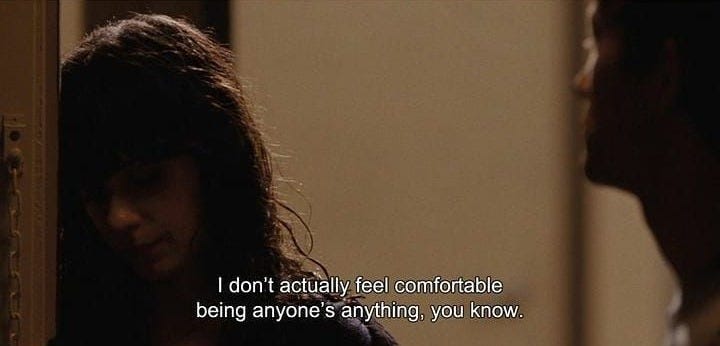
The illusion ultimately shatters when Summer invites Tom to a party. He walks in with the expectation of his hopes finally coming into fruition. He’s served his time in the jail of “what are we?” Instead, he finds out that she’s engaged. Not just dating—engaged. Finally his rose-colored glasses dim to a shade of gray. The very woman who resisted labels has chosen the most permanent one of all. It sends him into a spiral that ultimately pushes him toward his dream career, and eventually, someone new: Autumn. (Get it? It’s the next season after Summer!)
Summer and Tom, near the end of the film, have the closure conversation that all unlabeled relationships seem to have. In this scene, Summer says, “I just woke up one day and I knew.”
“Knew what?” Tom asks.
“What I was never sure of with you.”
It’s a simple yet earnest reply that I believe applies to many Summers of the world. It’s not about something someone did wrong or a box they failed to check. Sometimes, something is just missing, and you don’t realize it until you meet the person who seamlessly fits without force. Someone you don’t have to convince yourself to want.
So who do I ultimately agree with? I hate to be a contrarian and admit my answer has usually been, “I understand both.” Ultimately, though, I have always empathized more with Tom. (Come on, she slow-danced with him at a wedding while in a relationship with her soon-to-be fiancé.) There’s something so human about longing to be chosen; it’s one of the biggest dilemmas I’ve struggled with. Nevertheless, I’ve found myself relating to both Tom and Summer at different points in my life. With every watch, I’m in the midst of a transformative experience which reshapes my interpretation. Even though you could argue (500) Days of Summer is “just a rom-com,” I’d argue many don’t provide the same experience. When watching the film in 2024, I cried, relating to Tom’s desperation to be “the one.” When I watched it in 2023, stuck in a suffocating relationship, I understood Summer’s avoidance. (500) Days of Summer, unlike other rom-coms, evolves with you.
Really, there is no correct “side.” The answer says more about the viewer and how they view relationships than the characters. No one is really at fault. The film depicts two flawed individuals who want fundamentally different things. Ultimately, it’s not about right or wrong, it’s about misalignment—expectations versus reality. Yet both of them served their rightful purpose in each other’s lives, even if it didn’t result in a relationship between the two.

Summer indirectly pushed Tom toward his ambitions and meeting someone new, Autumn (albeit, you could argue whether this alludes to the fact that the cycle will start all over again or if he’s turning a new leaf.) For Summer, the juxtaposition of Tom and her fiancé granted her clarity of her wants and instilled a newfound belief in love entirely. I find it beautiful how many people enter our lives with an initial purpose, yet leave having fulfilled another.
It mirrors real life. A random freshman-year roommate becomes your best friend. A class you took out of convenience changes the trajectory of your career. Someone you almost loved changes you in ways that last longer than the relationship itself.
There is such a phenomenon of almost-love that is articulated so well in this film. When it occurs to us, it feels so singular and isolating. We genuinely believe no one else in the world could possibly understand this feeling. (500) Days of Summer reminds us that it’s universal. It provides hope. There’s always a remedy for your heart. Ultimately, these were the people we had to meet to become who we’re meant to be.
(500) Days of Summer interrogates this very thought of people being a “waste of time,” illustrating how everyone is in our lives for a reason, even we don’t know what it is yet. Not every relationship is meant to last. Some exist to teach lessons we never knew we had to learn. Some redirect our path. Others reveal something new about ourselves.
It could be for a season. Or, if you’re lucky, it could be for life.
If you’d like to support me and my writing, you can consider buying me a coffee :)
No posts
Comments
Nothing yet. Say the first thing.
Sign in to join the conversation.