
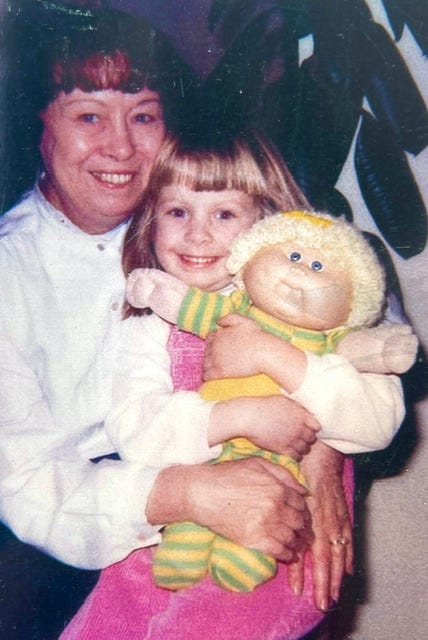
“Is she smoking?” my aunt asked me when I was eleven years old. I was seated nearest the bathroom door, from which my grandma had just exited, trailed by a cloud of cigarette smoke.
“No,” I replied, with a deadpan expression.
“Amanda, I smell smoke.”
“I don’t smell anything,” I said firmly. I was a well-behaved child, with straight A’s on my report cards, and yet, I was lying to an adult without a hint of remorse.
“So, you’re telling me your grandmother wasn’t smoking?”
“She wasn’t.”
“Amanda,” my aunt said in a this is your last chance tone.
“My grandma doesn’t smoke.”
“Unbelievable,” my aunt conceded.
My grandma winked at me, and my little body felt warm with love. I’d take her side any day, regardless of whether she was right or wrong. She was a strong, sassy woman, and I wanted to be just like her.
When I was sixteen, my grandmother told me stories about World War II.
“Most of the pilots died when the planes took off, not during missions,” she said. “Many of them never lived long enough to drop their bombs. The Air Force doesn’t like to admit that, but it’s true.”
She traveled throughout the Pacific, following her bomber pilot husband wherever he was stationed. Many war wives stayed home, but she refused, standing for days on packed trains of soldiers with no assurance that when she arrived, her husband would be alive.
“You should write this down,” I told her. “Your life is an amazing story.”
“One day, I’ll write a book.”
At twenty years old, she showed me a story she’d written. At the end of the story, I discovered that her characters were not humans, but birds. It was a unique twist.
“Grandma, if you can write this, you can write a book. I’ll be your secretary. Just speak your story into this, and I’ll type it for you.” I gave her a small tape recorder with five blank tapes.
“One day,” she said as she placed the recorder in a drawer.
When I was twenty-five, she died from COPD at eighty-four, due to decades of heavy smoking. My grandma doesn’t smoke. Those words clung to me like the smell of smoke on clothing that smokers cannot smell, but everyone else can. Weeks later, I found the tape recorder in the drawer and listened to every tape, hoping I might find a story that I could transcribe. I heard only hours of white static, a cold reminder of the life and the book that were lost.
“Why didn’t she ever write her book?” I asked my aunt when I began writing my first book.
“It was too painful for her.”
“Why?” I asked.
“She had a difficult life. If you want to know, I’ll tell you, but you have to be willing to know her, truly know her. She was more than your grandmother.”
I paused. Did I want to know her? What if knowing her made me love her less?
“I want to know her,” I said, cautiously.
“Her father, your great-grandfather, had a gambling addiction. One day, he called her after losing a great deal of money. He was afraid to face his wife because this wasn’t the first time this had happened. I guess it was easier for him to tell his daughter. He was crying as he said to her, ‘I can’t take it anymore.’ Your grandmother responded, ‘I’m tired of hearing it. Why don’t you go do it?’ Minutes later, he shot himself and died instantly.”
“Did she know he would do that?” I asked.
“No, he’d threatened it before but didn’t follow through. But you couldn’t convince her that she wasn’t to blame for his death. She carried that guilt with her throughout her life. Still want to know her?”
Did I? The idol I had created was melting, being replaced by a real woman. Yet, the more I learned, the deeper my understanding, and the closer I felt to her.
“I want to know her,” I said with confidence.
“Her husband, your grandfather, was on his last mission in the war when his plane crashed, killing his copilot, who was his best friend. The Air Force investigated the crash and found that it was due to a pilot’s error. Just as she believed she killed her father, he believed he killed his friend. He came home from the war a changed man. He became an alcoholic, abused a few of his children, and had a mistress, fathering two sons.”
“That’s why there weren’t any pictures of him at her funeral,” I said.
“Yes, it’s easier for us to pretend like he didn’t exist. She was tied to a difficult man, and in those days, divorce wasn’t an option. She found ways to cope. She struggled with her own drinking, had her own affair, parentified her children, and as you know, smoked like a chimney.”
“Yes,” I admitted. “She smoked.”
The smoke I had seen, smelled, and dismissed was the aftermath of a fire that raged long before I was born. Though it seemed like the blaze had burned itself out, it was never fully extinguished. Yet, the smoke that had clouded my vision lifted, revealing a woman who had fought to survive and had harmed herself and others in the process. Understanding my grandmother’s life didn’t make me love her less, but more, as I understood and accepted her as she was.
My grandmother didn’t write her book, but I did. I wove her life into my book, exploring the weight of my family’s intergenerational trauma and acknowledging her pain and resilience. When my book was published, there was no question who it would be dedicated to.
In memory of my grandmother Dorothy,
Your dream was to write a book, but you never did.
I wrote one for you.
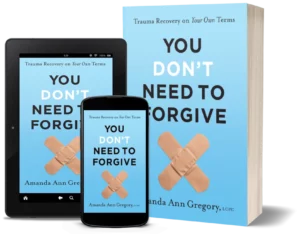
Purchase my book, You Don’t Need to Forgive: Trauma Recovery on Your Own Terms, for $11 HERE
Comments
Nothing yet. Say the first thing.
Sign in to join the conversation.