
Last month a founder sat across from me and told me she was raising an eight-figure Series A. The deck was beautiful. Thirty-two slides. A scientific advisory board with names you would recognise.
Cost curves bending the right way. I asked her three questions.
Contracted revenue: zero.
Signed buyers: none, three non-binding letters of intent, all conditional on a regulatory approval she had not filed for.
Monthly burn: six figures, against nine scientists in a glass-walled lab.
She was not raising a Series A. She did not have a company. She had a research project wearing very expensive venture makeup, on an operating model the 2023 correction had already made fatal. Here is the uncomfortable part. Her cap table said Series A. Her physics said pre-seed. Stage is not what your deck declares.
She is not unusual. She is the median.
This is the relaunch you asked for. Shorter, sharper, back on Tuesdays. You told me the old posts were too long and too technical to enjoy. You were right. So the heavy models and the full receipts now live at foodedge.eu, and this briefing does one job: name the thing that is quietly killing companies at your stage, and hand you something you can use before Friday.
One named problem a week. Tuesday names it. Thursday solves it.
Today’s problem is the one that arrives twice.
Thanks for reading Food Edge! Subscribe for free to receive new posts and support my work.
The Myth.
The myth is your stage is the round you raised. You closed a seed, so you are a seed company. You closed a Series A, so you are a Series A company. The cap table is treated as the diagnosis.
It is not. The cap table is an administrative fact. Stage is a commercial fact, and the two come apart constantly. A company that raised a Series A on a platform narrative, with no contracted revenue and unsolved scale-up physics, is a pre-seed venture that happens to have a Series A bank balance. The balance buys time. It does not buy stage. And it costs you twice: once when you spend the round running the operating model of a company you are not yet, and again eighteen months later when the next round will not close because the evidence never caught up to the story.
Investors underwrite this too. They want the multi-molecule platform exit, so they fund the narrative and call the gap execution risk. It is a mutual cosplay. Founders pretend to run a platform, investors pretend to fund a category leader, and the bill arrives on schedule.
What this costs you, and the one move that fixes it today
The damage is not abstract. It is hiring a VP of Sustainability before you have a repeatable, positive-margin transaction. It is leasing custom bioreactors before downstream recovery yields hold at pilot scale. It is burning the seed running a Series A organisation chart, which is the fastest way to make the actual Series A unraisable.
The fix is one question, and you can run it today: what have your buyers actually committed? Not interest. Not a workshop. Not a logo on a partnership slide. A binding, paid commitment. A non-binding letter of intent is a polite way of saying go away and call me when you have a product. If you strip every stated intention out of your pipeline and keep only the contracts a procurement team has signed and funded, the stage you are left standing in is your real one. Run your hiring and your capital plan from that number, not from the round.
That single discipline, hiring and spending against contracted commitment rather than against the cap table, is most of the difference between the founders who survive the next eighteen months and the ones who do not.
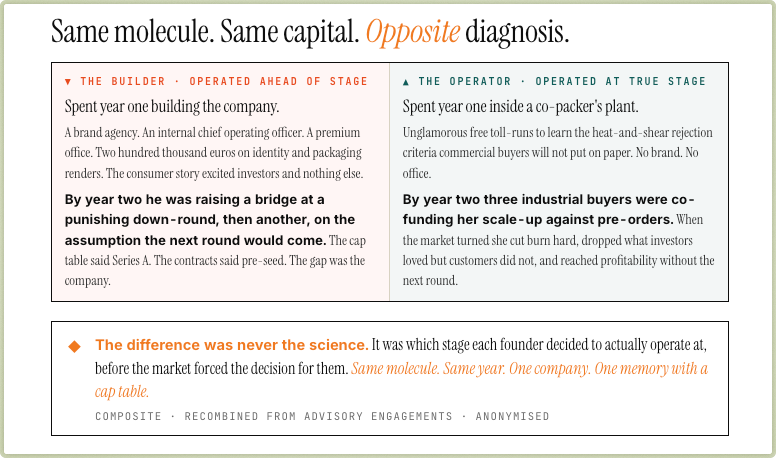
This is Issue 29 of FoodEdge. The five-gate stage diagnostic, the stage-adapted playbook from pre-seed to growth, and the worked example, two founders with the same molecule and opposite outcomes, are below for paid subscribers.
Comments
Nothing yet. Say the first thing.
Sign in to join the conversation.