
Motif FoodWorks raised USD 345 million. The portfolio was genuinely impressive: HEMAMI, a heme analogue designed to replace animal-derived flavour compounds. BoviSAR, a bovine serum albumin replacement expressed in yeast. Dairy proteins produced through licensed Ginkgo Bioworks strains. A formulation platform that could, in theory, serve meat alternatives, dairy alternatives, baked goods, and clinical nutrition.
Seven application categories on one slide. Two facilities under construction. A press narrative that described “a technology platform for next-generation food ingredients.” Investor decks that treated the optionality as a feature.
Then Motif closed in September 2024. Not because the science was wrong. The science was often excellent. The team was capable. The technology genuinely could express multiple proteins.
But not one of the seven application categories had produced a single ingredient at commercial scale. The word “platform” had survived longer than the company. It was doing the work the product could not.
Motif raised three hundred and forty-five million dollars to be a platform. It died as a portfolio of unfunded experiments with a brand.
Food Biotech founders call themselves platforms because the word sounds investable, and the market rewards breadth over depth. A platform pitch produces a larger TAM estimate. It generates more partnership announcements. It creates the appearance of optionality.
Why it persists. Platform claims make investor conversations easier. A founder who says "we are a dairy protein company" is committing to a category. A founder who says "we are a protein platform" is preserving the illusion of choice. The illusion produces press releases, LinkedIn posts, and term sheet discussions. It produces everything except a shipped product with a buyer's name on the purchase order.
In Food Biotech, 'platform' often means 'we have not chosen where we earn the right to exist.'
Investors – when a founder describes themselves as a platform, ask which single SKU ships first, to which buyer, in which category. If the answer names three, the company has not chosen. If the answer names one, ask to see the supplier qualification evidence. The platform conversation can wait until after the first ingredient has revenue.
Founders – the ingredient-first path is not a retreat from ambition. It is the sequencing that produces a fundable, shippable, defensible company. A single SKU forces operational concentration: one COA, one regulatory dossier, one supplier qualification, one buyer relationship. Platforms come later, after the wedge has revenue.
Innovators – your strain may express six proteins. Your buyer is purchasing one. Technical optionality is a scientific asset and a commercial liability until channelled into a single commercial product with a regulatory pathway and a named buyer.
Evidence layer 1: The platform language pattern
The word “platform” appears in the investor materials of a significant majority of Food Biotech companies that raised Series A or later between 2020 and 2024. It appears in their Substack bios, their LinkedIn descriptions, their conference abstracts, and their AgFunder profiles. The word signals ambition. It signals scientific breadth. It signals that the company is not betting on a single molecule or a single application, but on a versatile technology engine that can produce value across multiple categories.
What the word does not signal is commercial readiness.
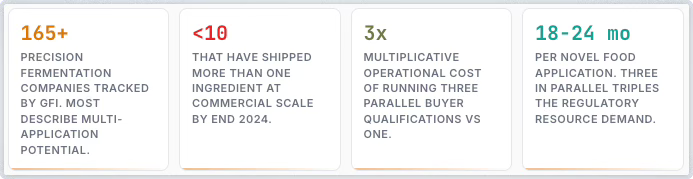
GFI’s State of the Industry reports track over 165 precision fermentation companies and hundreds of plant-based companies worldwide. AgFunder’s annual investment reports document the capital flows that fund them. Across both databases, the pattern is clear: the companies that described themselves as platforms spent longer in pre-revenue than the companies that described themselves as ingredient companies. The platform premium in pitch language was not reflected in commercial velocity. It was reflected in burn rate.
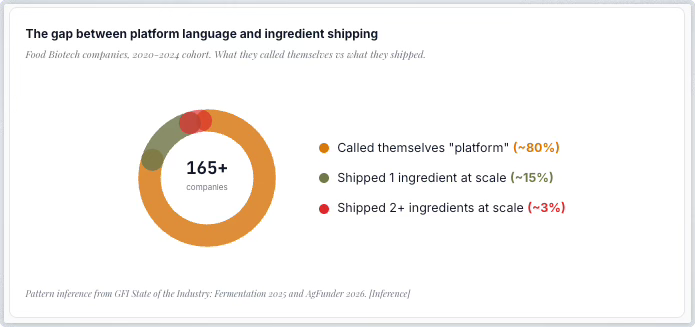
The number of Food Biotech companies that called themselves platforms in 2021 is roughly the number that shipped a single ingredient at scale by 2024. The two sets do not overlap.
The diagnosis is not that platform thinking is wrong. It is that platform language arrives before platform capability. The word is describing an aspiration, not a state. And investors, founders, and innovation teams have collectively agreed to treat the aspiration as if it were evidence. It is not. The evidence is in the purchase order, the supplier qualification, the regulatory clearance, and the repeat shipment. None of those artefacts say “platform” on them. They say the name of a specific ingredient, sold to a specific buyer, in a specific category.
The consequences of this language gap are commercial, not semantic. A company that calls itself a platform allocates its Series A capital across three or four parallel workstreams - regulatory, manufacturing, buyer qualification - for three or four different applications. A company that calls itself an ingredient company allocates the same capital to one workstream. The ingredient company ships first. It generates revenue first. It learns from the buyer’s feedback first. It earns the right to extend first. The platform company is still explaining to its board why none of the three workstreams have completed, and why next quarter will be different.
The word “platform” is not free. It costs runway. Every month that capital is being split across unfocused parallel tracks is a month the company is not shipping the one thing that could generate the operational data, the buyer relationship, and the regulatory precedent that would make the platform conversation real instead of aspirational.
Evidence layer 2: Why ingredient-first wins
Three mechanical forces compound to make ingredient-first the commercially superior path. None of them are about ambition. All of them are about operational arithmetic.
Comments
Nothing yet. Say the first thing.
Sign in to join the conversation.