
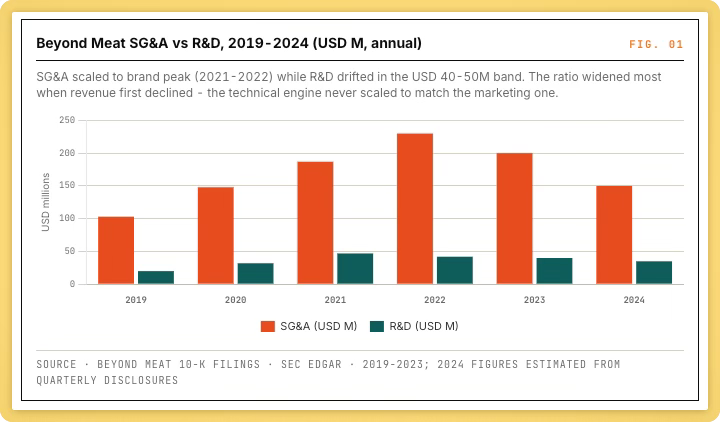
Between its 2019 IPO and the end of its peak commercial year in 2021, Beyond Meat spent roughly USD 300 million on selling, general, and administrative expenses - the line in its SEC filings that includes its marketing investment. It spent roughly USD 75 million on research and development across those same years. The ratio was approximately four dollars on SG&A for every one dollar on R&D, sustained through the most capital-available window the plant-based category has ever seen.
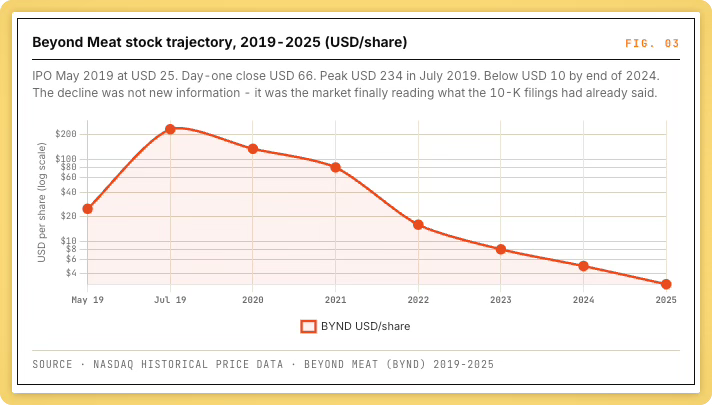
The marketing spend funded a category-defining brand. The 2019 IPO narrative, priced at USD 25 per share, closed its first day at USD 66 and peaked above USD 230 in the months that followed. McDonald’s partnership announcements, Super Bowl-adjacent campaigns, retailer placements, and the specific way the company taught the mainstream press to talk about “plant-based” - all of it came out of the SG&A budget. The R&D spend funded the Beyond Burger and a sequence of reformulation cycles that followed: Beyond Burger 2.0, then 3.0, then 4.0, each positioned as a technical reset, each landing as a cosmetic improvement because the underlying R&D stack never deepened structurally.
By the end of 2024, the stock was under USD 10. Revenue had declined two years in a row. Gross margin went negative in 2023. The decline was not a marketing failure. It was a structural mismatch, revealed when the early-adopter pool was exhausted and the mainstream market started measuring texture at the till.
Beyond Meat spent more on marketing in 2021 than it did on R&D in every year of the company’s history combined. That ratio is not an operational choice. It is an X-ray.
Plant-Based 1.0 stalled because consumers became anti-innovation, because GLP-1 and Ozempic killed demand, because prices were too high, because the media turned against the category.
Why it persists. those explanations externalise the cause. They let sector leadership off the hook. They treat the 1.0 failure as something that happened to the category from outside, not something the category's own architecture guaranteed. They keep the board composition intact, the capital allocation defensible, and the next round fundable on the same narrative the last round closed on.
The honest reading is harder and more useful. Plant-Based 1.0
was a branding experiment dressed as a technology company.
Plant-Based 2.0 will be a technology company dressed as a brand.
Innovators – our technical background is no longer a supporting function inside a plant-based company. It is the foundation the company is built on. 2.0 companies structure headcount, capex, and governance around R&D. Marketing becomes an output of technical wins, not the other way around.
Founders – the choice is not whether to add R&D muscle to your company. It is whether the company you have built can hold the people who would build 2.0. Most 1.0 architectures cannot. Reformulation cycles are cosmetic unless the underlying org structure changes.
Investors – diligence the R&D org chart, not the brand metrics. Ask for PhD count, capex on extrusion and rheology equipment, and named technical leaders with publication or patent records. If the company cannot answer with specifics, the deck is a 1.0 deck in a 2.0 market.
Evidence layer 1: The capital allocation X-ray
The SEC filings tell a story that the press coverage rarely did. Between 2019 and 2022, Beyond Meat’s SG&A line consistently ran three to five times the size of its R&D line. In peak 2021, SG&A was approximately USD 187 million against R&D of approximately USD 47 million. In 2022, as revenue declined for the first time, the ratio widened further: SG&A held near USD 230 million while R&D drifted in the low USD 40 million range. The marketing engine was running at the same speed as the brand peak. The technical engine never scaled to match.
In R&D intensity terms - R&D as a percentage of revenue - Beyond Meat has run in the low-to-mid single digits across most of its public history. Food Biotech companies with real technical defensibility typically run 10 to 20 percent. Deep-tech biotech companies run 20 to 40 percent. Pharma companies run 30 percent or higher. Beyond Meat was operating at R&D intensity levels typical of a consumer packaged goods company, not a technology company. The public filings said so in plain language. The press coverage described a technology company. Those two descriptions cannot both be right.
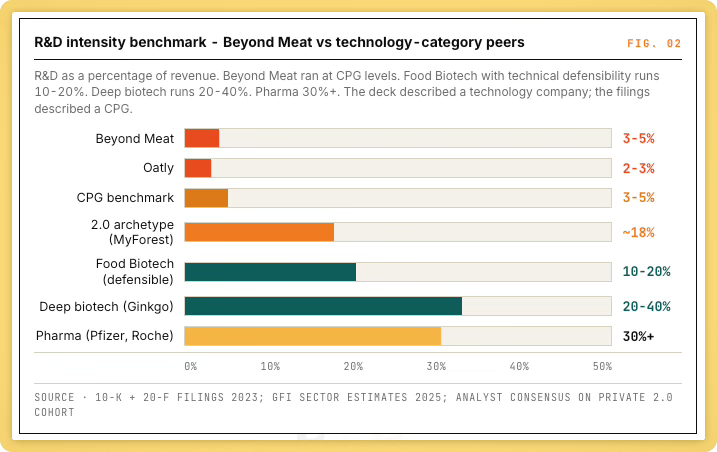
Oatly’s public 20-F shows the same architecture. Marketing and selling expenses dominant, R&D a smaller line. Product development organised around format extension and category launches, not around fundamental texture or fat-system research. The category’s public companies converge on the same pattern.
GFI’s State of the Industry data for 2025 shows the sector-wide picture. Across publicly tracked plant-based companies, R&D investment as a fraction of total category investment consistently runs below what the product challenges would require. The category has been funded like a brand category, not like a technology category. And the 2.0 cohort - MyForest Foods, Juicy Marbles, Meati - is explicitly building the inverse. Extrusion equipment, fermentation bioreactors, sensory analysis tools as core capex. Technical founders with publication and patent records. Marketing as late-stage output of product that works.
The plant-based 1.0 cohort spent three to five dollars on marketing for every dollar on R&D. The plant-based 2.0 cohort is building the inverse. The companies that win the next cycle will be the ones whose P&L looks like a texture lab’s.
Evidence layer 2: Three forces that make downstream the real moat
Three structural forces explain why the 1.0 capital allocation was rational in 2019-2022 and fatal in 2023-2026. None of them are reversible by adding a food scientist or two.
Comments
Nothing yet. Say the first thing.
Sign in to join the conversation.