
Every pilot signature lives inside two rooms. The problem is that founders only ever see one of them.
Room A is the one you know. The Slack channel lights up on a Tuesday morning. A LinkedIn post is being drafted. Investors are being texted. There is a quiet moment when everyone on the founding team allows themselves to believe the thing they have been pretending not to need to believe: that somebody real has said yes.
Room B is on the other side of the world, inside the buyer. Same Tuesday morning. Procurement is sitting at their desk. Somebody searches the vendor master data for your company’s name. No record. Somebody opens the 2026 procurement budget. No line item for your category. Somebody searches the internal Slack for the announcement. The innovation team’s excitement has not yet crossed the corridor into the part of the building where purchase orders are raised. On the day your pilot was announced on LinkedIn, your name did not appear in a single vendor record at the company you had just signed with.
Every pilot signature lives inside two rooms. In one of them, someone is celebrating. In the other, nobody has heard of you.
The distance between those two rooms is the distance between a press release and a business.
Thanks for reading Food Edge! Subscribe for free to receive new posts and support my work.
The Myth. And why it persists.
The myth: the sector treats any pilot signature as commercial traction. Founders cite pilots as proof of demand. Investors read them as strategic validation. Corporate innovation teams file them as pipeline wins.
Why it persists: pilots produce press releases. Press releases produce LinkedIn posts. LinkedIn posts produce investor meetings. The signal travels up the fundraising chain long before the buyer has asked a single diligence question. Nobody inside the fundraising loop is incentivised to slow the signal down, because everybody inside that loop benefits from the signal travelling.
A pilot is not traction. It is branded curiosity. And branded curiosity does not have a purchase order.
One-minute brief
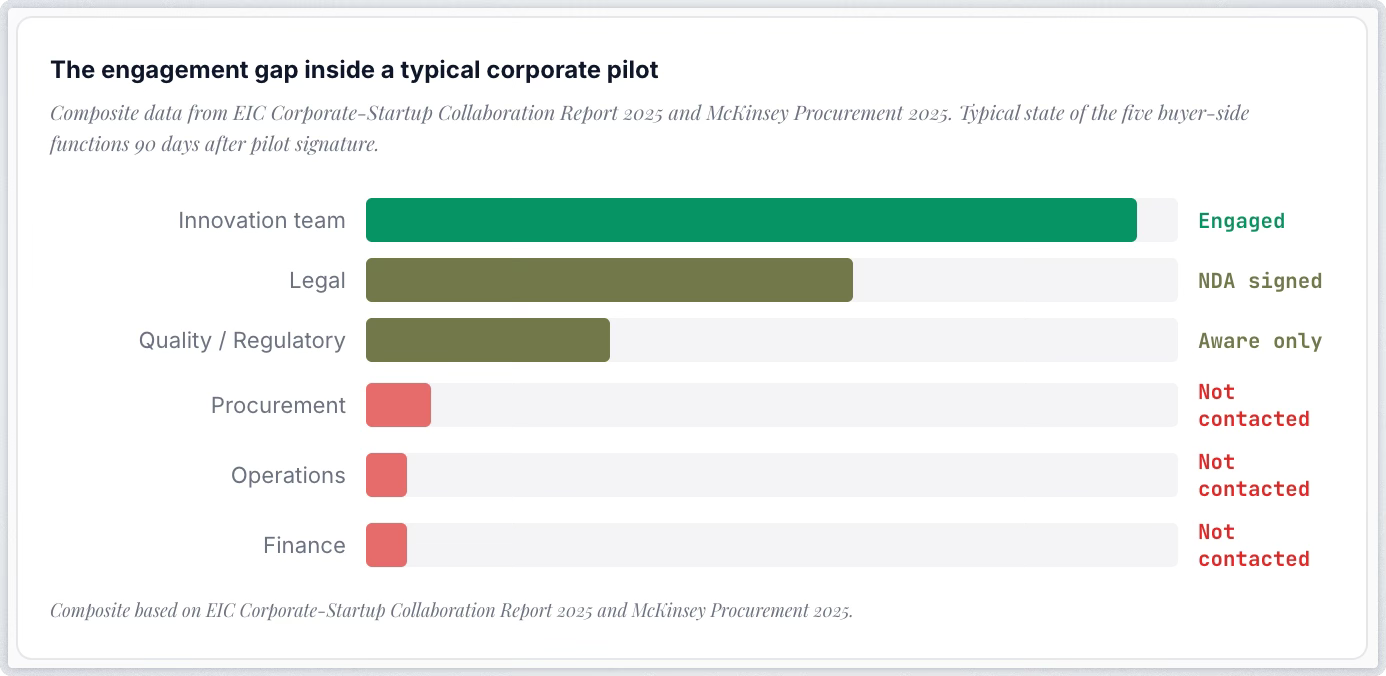
Founders – a pilot only matters when five internal functions at the buyer have seen the product: procurement, quality and regulatory, operations, finance, and legal. If even one of those has not engaged, the pilot is a meeting, not a commitment.
Map the five. Celebrate when you have crossed all of them, not on the day the announcement went out.
Innovators – your scientific excellence is not the pilot’s bottleneck. The product has probably already passed the technical conversation with the innovation team. The question is whether procurement’s vendor qualification process has even started.
No amount of better titer, lower cost, or cleaner label will move that process along unless it is explicitly scheduled.
Investors – when a founder cites a pilot in a deck, ask which of the five internal functions has engaged. If they can only name the innovation team or the corporate venture lead, the pilot is a press release.
The diligence question is not did the pilot happen. It is who else inside the buyer has seen the product.
What I’m seeing that others aren’t
Evidence layer 1: Procurement
A pilot without a vendor code is a conversation, not a commitment.
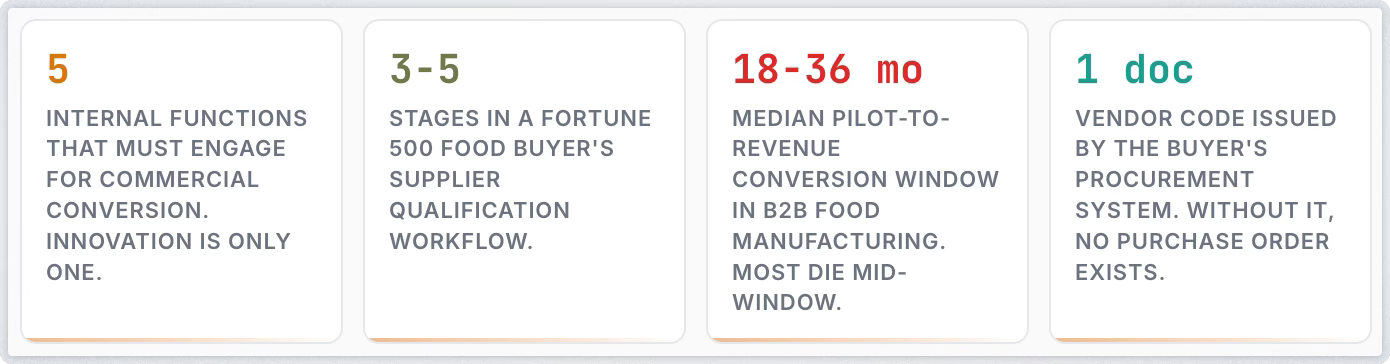
Here is what founders say when asked about procurement after a pilot signature. ”We signed a pilot with [Corporation X]. Procurement will be involved in the next phase.” You have said this, or something very close to it, in at least one pitch meeting. It is the sentence you reach for because it sounds operationally mature. It is also the sentence that tells a procurement professional that nobody has opened your file.
Here is what procurement actually does. Every Fortune 500 food buyer runs a Vendor Master Data system. Before a purchase order can be raised, a supplier must be registered inside that system. Registration requires an intake form.
The intake form triggers an ESG and compliance questionnaire, a responsible sourcing assessment, an insurance-certificate request, and a supplier qualification workflow that typically runs three to five stages. Each stage is owned by a named person inside procurement, and each has a completion milestone. A vendor code is issued only at the end of the workflow. Without a vendor code, no commercial purchase order exists in the buyer’s system. And one more thing: the buyer’s procurement catalog is organised by named categories (raw materials, ingredients, packaging, co-manufacturing).
A Food Biotech startup with no category tag is invisible to the catalog. The category buyer - not the innovation buyer - is the person who will eventually sign the first commercial purchase order. Most founders have never spoken to a category buyer.
Here is what real evidence looks like. A vendor code issued by the buyer’s procurement system. A signed Supplier Master Agreement. A category buyer (not innovation buyer) named as the internal sponsor. An RFP response on file. If you cannot produce at least two of those four documents, procurement has not engaged. The pilot is still a conversation.
Evidence layer 2: Quality and regulatory
If your product has not been through a buyer’s food safety intake form, your pilot is a tasting session with better lighting.
Here is what founders say. ”The innovation team loved the sensory profile. They said it met spec.”
Sensory acceptance by an innovation chef is not quality sign-off.
It is a preference indicator, nothing more.
Here is what Quality and Regulatory actually does. HACCP and food safety hazard analysis. Allergen management. A formal supplier audit, often on-site at your facility or your contract manufacturer’s facility. COA (Certificate of Analysis) template negotiation. Specification sheet negotiation - the document that codifies exactly what the buyer is paying you to produce, and the variance bands they will accept. Microbiological and chemical contaminant thresholds. For Food Biotech specifically, novel-ingredient regulatory status documentation. That means Novel Food authorisation in the EU, GRAS notification in the US, EFSA opinions, and whichever other regimes apply to the markets the buyer intends to sell in. For precision fermentation, it also means host organism safety classification, purification residuals, and regulatory dossier status. The innovation team does not own any of this. Regulatory affairs owns it. Regulatory affairs has almost certainly never heard of your company.
Here is what real evidence looks like. A signed supplier qualification audit on file. A COA template agreed and shared. A product specification document countersigned by both sides. A regulatory pathway confirmed by regulatory affairs - not by an innovation analyst forwarding your pitch deck.
Evidence layer 3: Operations
Plant integration is the line between a pilot and a product. Most pilots never cross it.
Here is what founders say. ”They ran a successful trial in their innovation kitchen.” An innovation kitchen is not a commercial plant. A pilot-scale reactor is not a commercial bioreactor. The trial that worked in their R&D facility has almost nothing to do with what will happen when your ingredient is brought into their production line at commercial throughput.
Here is what Operations actually does. Line integration testing on commercial equipment with production operators present. Equipment compatibility assessment. Changeover time impact analysis - the number of minutes the line has to stop to handle your ingredient, and the production hours lost to that stop. Throughput effects. Sanitation compatibility with the buyer’s existing CIP protocols. Storage and handling integration at the receiving dock. Training for plant operators on how to unload, inspect, and feed your ingredient into the line. Production scheduling implications. Capacity planning effects - how much of the buyer’s annual plant capacity is now committed to running a line with your ingredient in it.
Here is what real evidence looks like. A plant trial run completed on commercial equipment with production operators (not R&D staff). A process deviation report reviewed and accepted. A changeover time analysis completed by the buyer’s operations team. A named plant operations owner with the project in their milestone tracker. Without that operations owner, the pilot will never schedule the plant trial, and without the plant trial, your ingredient will never move from the innovation kitchen into the commercial line.
One more thing worth naming. The operations function is also where the most expensive hidden cost of a failed pilot lives. Every hour of plant time scheduled for a trial run is an hour the line is not producing the buyer’s core products. If a plant operations owner has not been willing to commit that time, it is not because they are too busy. It is because nobody senior enough inside the buyer has asked them to.
That is a signal about the pilot’s actual priority inside the buyer, not a scheduling problem.
Evidence layer 4: Finance
Ask your corporate partner for the budget code. Watch what happens to the silence that follows.
Here is what founders say. ”The pilot is funded by their innovation budget. Commercial conversion will have its own budget.” This is the sentence that tells a finance professional that the founder does not understand how corporate budgets work.
Comments
Nothing yet. Say the first thing.
Sign in to join the conversation.