
Two founders were offered the same cheque last year. I watched both decisions from close enough to see how they were made, and far enough to see how they ended.
The cheque came from a regional dairy conglomerate, the kind of strategic investor that looks, on a Tuesday afternoon when your runway is shortening, like the answer to every question you have. It was a large seed round at a generous valuation. The number on the term sheet was bigger than anything either founder could get from a venture fund. And it came with the usual price, written in the terms rather than the headline: a board seat, exclusive distribution rights, and a veto on any future exit.
The first founder took it. I wrote about where that road leads on Tuesday, so I will only say here that the valuation he was so proud of turned out to be the least important number in the deal.
The second founder did something that looked, in the moment, like turning down free money. She refused the conglomerate’s terms, kept them as a prospective customer rather than an owner, and raised a slightly smaller round from fifteen angels she pooled into a single vehicle, on a standard convertible with no governance attached. Her headline valuation was lower. Her friends thought she had been too cautious. Eighteen months later, when she raised her Series A, the institutional lead issued a term sheet in days rather than weeks, because there was nothing in her cap table to argue about. The conglomerate came back, this time as a paying B2B customer at market rates, with no vote on her company. She kept the asset. He kept the story about a high valuation.
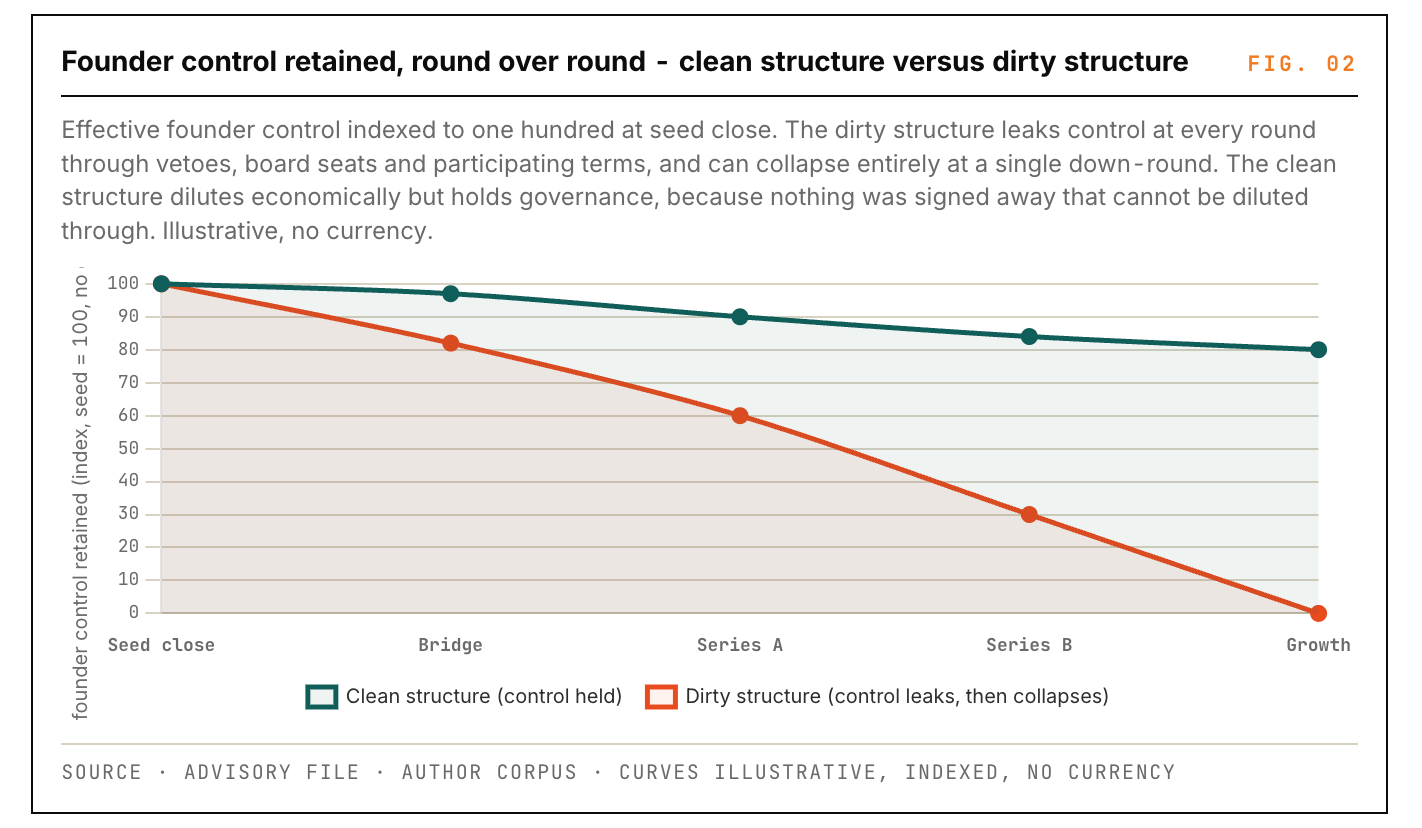
That is the whole of today’s argument, and I want to put it as plainly as I can: a clean cap table beats a high valuation every time. Not sometimes. Not on average. Every time the two are genuinely in tension, the founder who optimised for structure ends up in a stronger position than the one who optimised for the number, because valuation is something you negotiate once and structure is something that governs you for the life of the company.
The good news, and this is genuinely good news, is that a clean cap table is not a matter of luck or of having fancier investors. It is a matter of engineering the seed round deliberately, using four structures that are entirely within your control, that cost you nothing but the discipline to ask for them, and that the right investors will respect you more for insisting on.
The myth we are replacing: a higher valuation is a better deal.
Here is the reframe. Valuation sets how much of the company you give away in this round. Structure sets who controls the company, and on what terms you can raise the next round, and what you walk away with at the end, across every round and every year that follows. A high valuation with dirty terms is a large slice of a company you no longer fully govern. A fair valuation with clean terms is a slightly smaller slice of a company that is still yours to steer, still financeable, still worth building.
The arithmetic of founder wealth runs through structure far more than through any single round’s headline. A lower valuation with a clean, standard preference compounds into more for the founder than a high valuation wrapped in participating preferences, accruing dividends, and individual vetoes that price themselves into every future negotiation.
The investors you actually want understand this better than you do.
When a fund sees a founder hold the line on clean structure under the pressure of a shortening runway, it does not read stubbornness. It reads maturity. A clean cap table is the cheapest, clearest signal of founder judgement that an investor will ever get to read, and it is one you can send entirely on purpose.
Here is the single structural decision that prevents most of the damage, and you can make it on the next term sheet that crosses your desk, free, today.
Before you accept any seed capital, decide two things in advance and hold them as non-negotiable.
First, that all non-institutional money goes into one pooled vehicle with one representative, so that no individual angel, distributor, or local backer holds a personal veto or a personal board seat.
Second, that you raise on a standard, governance-free instrument, a SAFE or its European equivalent, with a clear valuation cap and no control rights attached, so that the valuation is deferred without any governance being handed over.
Those two decisions, made before the cheque rather than renegotiated after it, are most of the difference between a table a fund can read in an hour and a table a fund refuses to lead through. They do not require you to turn down money. They require you to take it in a shape that keeps the company financeable. And they are far easier to ask for at the start, when you have the leverage of an unsigned deal, than to claw back later, when the leverage has moved entirely to the person whose name is already on the cap table.
If you do nothing else with this issue, do that. Pool the small money, defer the valuation without the governance, and you have already closed off the two most common ways a seed round poisons a Series A.
This is Issue 34 of FoodEdge. The full four-part Clean Seed Structuring Protocol, the stage-adapted playbook from pre-seed to growth, and the worked example are below for paid subscribers.
Comments
Nothing yet. Say the first thing.
Sign in to join the conversation.