
The simplest way to get ROI from marketing is to get the job description right.
Sounds obvious. But this is something even well-funded, fast-growing tech companies consistently get wrong — and it quietly determines everything that comes after.
The job post that made this concrete
Snabbit — a fast-growing app that connects users with quick home services — recently posted two senior marketing roles: Director of Digital Marketing and Director of Offline Marketing.
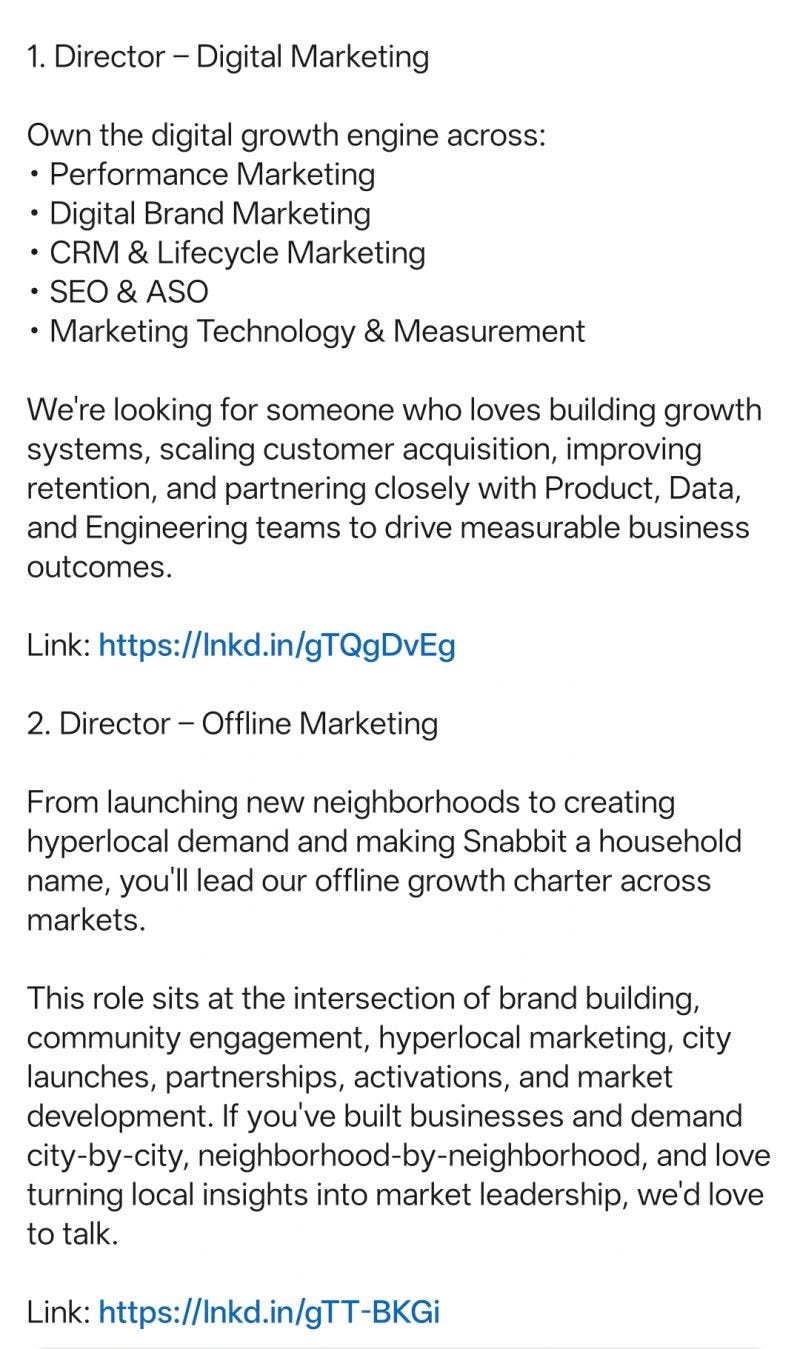
Two separate directors. Two separate mandates. Two separate worlds.
Now here’s what makes this worth examining: Snabbit is an online-offline business. A customer books via a mobile app for a service delivered at their home. The entire product crosses mediums in a single transaction. If any company should intuitively understand that the customer journey doesn’t live in mediums, it’s them.
And yet, the org chart says otherwise.
Consumers don’t think in mediums. Marketers still do.
As I write this, I’m also checking my phone. If someone walked into the room for a meeting, I’d switch to that. Later I’ll log onto Grab or Zomato to order food — depending on which country I’m in that week.
Online and offline isn’t a toggle. It’s fluid, constant, often simultaneous. The customer who sees a Snabbit van in their neighbourhood, gets retargeted on Instagram, and converts via app — that’s one journey. Three “channels.” Zero handoff points in their head.
The differentiation between mediums and platforms is only in our head as marketers. Customers don’t switch between mediums — they float between them. It happens in milliseconds and is subconscious.
But we’re still building org structures as if 2010 never ended.
Medium-based hiring: right at junior level, wrong at senior
To be fair — medium-based hiring makes sense at junior levels. Execution specialists, tighter scope, simpler briefs. Someone who owns performance campaigns. Someone who manages on-ground activations. That’s the right call.
At Director level, the mandate should be business outcomes. Revenue. Retention. ROI.
The moment two senior leaders own two separate mediums, each optimises for their medium. Digital reports ROAS and clicks. Offline reports footfall and activations. Nobody owns the number that actually matters.
And this is precisely how Indian marketing ended up producing more metrics than business growth.
The startup graveyard is full of performance marketers
I’ve consulted with companies that were shut down despite significant funding. In almost every case, the fundamental problem was the same: over-reliance on performance marketing to drive growth, and an obsession with measuring marketing activity rather than business outcomes.
Every CMO talked about scale. But when it was time to deliver, the only tool in the bag was performance spend. Because from day one, the job description had defined scale as a performance metric — not a business strategy.

None of the best brands in the world have had CMOs who were over-reliant on metrics or performance marketing. Not one.
The job post doesn’t just define a role. It defines what the team will optimise for. Define it around mediums, and you’ll get medium-level results.
The invisible cost
This is the hardest part to accept: you can’t A/B test a bad org structure.
By the time you realise that two medium-siloed directors produced medium-sized results, millions in budget have already been allocated the wrong way. Campaigns have run. Hires have been made. The machine has been running — just pointed in the wrong direction.
The missed opportunity is invisible. There’s no control group. No “what if we’d done it differently” report that lands on the founder’s desk.
The unfortunate reality of Indian business is that we’ve become very good at measuring marketing — and not nearly good enough at measuring what marketing actually delivers to the business. And it starts at the hiring stage.
A note on Snabbit specifically
This piece isn’t a criticism of Snabbit. They’re building something real and they’ll likely figure this out. The org design challenge I’m describing is industry-wide — Snabbit’s job post just made it visible.
Get the job description right. Everything downstream depends on it.
So what’s the solution if you need two people?
A few people asked after I posted about this. Some options worth considering:
Hire two people, one reporting to the other — but don’t build a structure that goes against consumer behaviour.
If you still need to segregate, segregate by business goals, not marketing mediums. One person whose goal is customer acquisition and trials. Another whose goal is LTV and basket size. When there’s conflict, the CMO decides — that’s literally the job.
The frame should always be: what does the business need, not which channel do we need to manage.
- Saurabh Parmar linkedin.com/in/saurabhparmar is a Fractional CMO with 18+ years across business strategy, brand, digital, and AI.
Comments
Nothing yet. Say the first thing.
Sign in to join the conversation.