
In 1962, Pakistan beat India to space.
Today, we know India as the nation that landed on the lunar south pole for less than the cost of a Hollywood movie—but, for a brief period, the technological vanguard of South Asia was Karachi, not Delhi or Bangalore.
When Pakistani theoretical physicist Abdus Salam approached President Ayub Khan in 1961 with his vision for a space program, the country had won independence from British colonial rule only fourteen years prior. Pakistan had little industry, only modest universities, and almost no aerospace infrastructure. But Salam, who would later become Pakistan’s first Nobel laureate, understood timing better than anyone.
Just months earlier, President John F. Kennedy had stood before Congress and declared that America would “land a man on the Moon and return him safely to the Earth.”
“We choose to go to the Moon in this decade,” he said, “not because it is easy, but because it is hard.”
That single promise transformed the National Aeronautics and Space Administration (NASA) from an experimental agency into a machine racing the clock. Designing Apollo meant more than building a giant rocket: NASA had to map the upper atmosphere and ionosphere so precisely that they could predict how much drag a spacecraft would feel, how radio signals would bend across the globe, and how tiny navigation errors would accumulate over dozens of orbits.
Over the Indian Ocean, NASA’s maps failed. They had a huge blind spot over a vast region, with almost no measurements of high-altitude winds or ionospheric behavior. To understand the implications, imagine trying to sail across the ocean with parts of your map missing, and no idea how the winds behave. Your compass still works, your sails still catch the wind, but the moment you enter the blind spot, you don’t know whether the breeze is nudging you gently forward or shoving you sideways. Apollo faced the same problem in orbit: a few invisible pushes in the wrong direction could turn into a hundred-kilometre miss when it mattered the most.
To fix that, NASA needed a coastal partner on the western edge of the Indian Ocean where it could launch sounding rockets—small, single-use research rockets that carry instruments up to the edge of space for a few minutes before falling back. These would release glowing sodium clouds, turning that empty column of sky into hard data about winds and the upper atmosphere.
Salam realized that if Pakistan partnered NASA, it could skip a decade of trial-and-error and walk straight into the space age, hand in hand with America. He established the Space and Upper Atmosphere Research Commission (SUPARCO) under the Pakistan Atomic Energy Commission (PAEC) that same year.

A handful of young engineers, including future SUPARCO chairman Salim Mehmud, were packed off to NASA’s Goddard and Wallops Flight Facility to learn atmospheric sounding, rocket assembly, and tracking instrumentation. When they returned to Karachi, they brought back crates of Nike-Cajun rocket hardware, stacks of technical manuals, and a sense of mission far bigger than their years.
In June 1962, Pakistan’s scientists assembled and launched Rehbar-1, a solid-fuel rocket that soared 130 kilometers above the Sonmiani coast, in southern Baluchistan. The name “Rehbar,” meaning “the one who leads the way” in Urdu, was symbolic of the nation’s pioneering status.
This launch made Pakistan the fourth Asian nation to enter the space race after the USSR, Japan, and Israel.
With continuing American support, Pakistan established a rocket manufacturing plant, launched hypersonic rockets, and laid the groundwork for a civilian satellite program. Pakistani scientists trained at the Goddard Space Flight Center while Apollo astronauts visited Karachi and Lahore. Pakistan launched rockets into space 200 times between 1962 and 1972.
India’s first sounding rocket would only launch sixteen months after Rehbar-1, but Pakistan’s early momentum proved short-lived.
As the 1970s dawned, Islamabad’s focus shifted to nuclear ambitions and to countering internal challenges, and the space program lost its privileged status. In 1974, even as India tested its nuclear device, Pakistan amended its constitution to prohibit members of Salam’s religious community, the Ahmadiyya, to refer to themselves as Muslims, and introduced several forms of discrimination against them.
Salam, unwilling to serve a state that had turned on him, resigned from all official posts and left the country. The exile of the founder and principal advocate of the country’s national space agency hollowed out not only its intellectual leadership but also its ability to attract foreign collaboration, training, and funding. Meanwhile, India leaned into Soviet support by accessing tracking stations, launch opportunities, and propulsion expertise.
The space race between India and Pakistan was effectively over.

Alter Magazine’s Issue #2 is the definitive history of how India conquered space. Featuring Abdus Salam & Vikram Sarabhai, fishing villages and rechristened churches, racist cartoons and indefinite sanctions. And, above all, a story of dreamers, believers, and achievers.
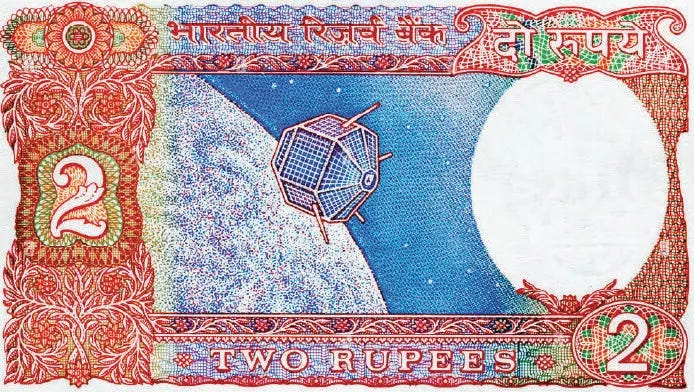
Sparsh and Adithya stumbled upon the ₹2 note during a late-night call. A relic of the past, it was a fascinating piece of paper, and it had to find a place somewhere. Issued in 1976, the ₹2 Aryabhata note commemorates the moment India first touched space. It is a gentle reminder that even the smallest denominations can carry astronomical dreams. We’ve turned this into a printed postcard, which you can pick up when you visit us at Alt HQ.

Our second issue is a walk through the history of India’s rise in space. Written by Khushi Mittal, edited by Prem Panicker, and designed by the Climate Studio team at Alt Carbon.
No posts
Comments
Nothing yet. Say the first thing.
Sign in to join the conversation.