
Issue No. 54

There’s a shop that’s been selling handmade brushes for 200 years. Another that’s been selling handmade knives for 500 years. A friend sent me the names of several such shops and I made the rounds visiting them all during a recent visit to a new city.
It felt comforting stopping at a storefront on a street corner. Glancing down at my phone to make sure I had the right one and then up at the sign above the door. Stepping inside and seeing several generations of family history on display. Some items had been laid bare, some were in wrappers, some were behind glass.
At the first shop, the proprietor and I exchanged plenty of smiles though hardly any words given the language barrier. He wrote down my total with pen and paper and I paid in cash. And for the rest of the morning, I sat with that lovely feeling. Why do we value handmade things? At the very least, why had I?
There’s the perception of uniqueness. The feeling of owning something that is not quite like any other thing in the world. Something that’s not even like any of the other things of the same type made by that same person. A body of work explores the need for uniqueness,1 which I was only able to read summaries of in time for this week’s issue.
[The] need for uniqueness is activated when individuals perceive a threat to their self-concept caused by excessive similarity with others. In response, they engage in behaviors aimed at restoring an optimal level of differentiation, while generally remaining within socially acceptable boundaries … Individuals seek to be different only to the extent that such differentiation does not lead to strong social sanctions. Consumption represents a particularly suitable domain for expressing uniqueness, as products and brands serve as symbolic resources for identity construction.2
There’s the perception of value. Someone, a whole person just like us, took time out of their life to pour their effort, attention, and craft into this one thing. We see their mark in the imperfections they leave and the inefficiencies of their process and, counterintuitively, come to value the result more because of them. This psychological quirk has a name: labor illusion. When we can see evidence of effort, we often perceive the outcome as more valuable.
Conventional wisdom and operations theory suggest that the longer people wait, the less satisfied they become … when websites engage in operational transparency by signaling that they are exerting effort, people can actually prefer websites with longer waits to those that return instantaneous results—even when those results are identical.3
So for many of us, if we’re searching for flights, we’d prefer seeing a message telling us, “Searching hundreds of airlines to find you the best possible flights” and being made to wait instead of being shown instant results.4
There’s the connection to somebody else’s story, and to all the ones leading up to theirs. When we purchase something made by someone, we’re not only buying a product, but also stepping into a narrative. Studies on narrative transportation show that people’s real-world beliefs can be influenced once they’re transported into a story they become immersed in.5 The moment we feel we’re part of a story, we’re more likely to trust its source, remember it, and act on it.
There’s a deep-seated need some of us have to know who created something so that we can then infer their intent. The physical piece becomes a window into someone’s thoughts, the same way a writer reveals themselves through their writing, or a chef through their food.
One body of work refers to this as contagion:6 the degree of physical contact between a creator and, in that case, art they’ve created increases the work’s perceived significance. In one set of studies, participants considered original artwork more significant than identical duplicates precisely because of the artist’s direct connection to the originals.
Aristotle believed there are four causes7 that allow us to fully understand something:
The material cause: what it’s made of
The formal cause: the shape that gives it function
The efficient cause: what brings it into being
The final cause: the reason it exists at all (its purpose)
Applied to our creator-object connection, we can say that knowing the efficient cause gives us a way to relate to the final cause. When we don’t know the efficient cause, or can’t relate to it because it’s concealed or alien, that can impact the degree to which we understand the final cause.
A few months ago, a gym in my neighborhood introduced a robot massager. You would lie on a bed and two giant mandibles for arms gently worked your back while you prayed neither accidentally took out your spine. It did what it promised. But the whole experience felt so utterly vacuous that I left vowing to never return.
I did so because, to use Aristotle’s terms, the robot lacked a relatable efficient cause. I couldn’t attribute to it beliefs, intents, and purposes the way I naturally would with a person.
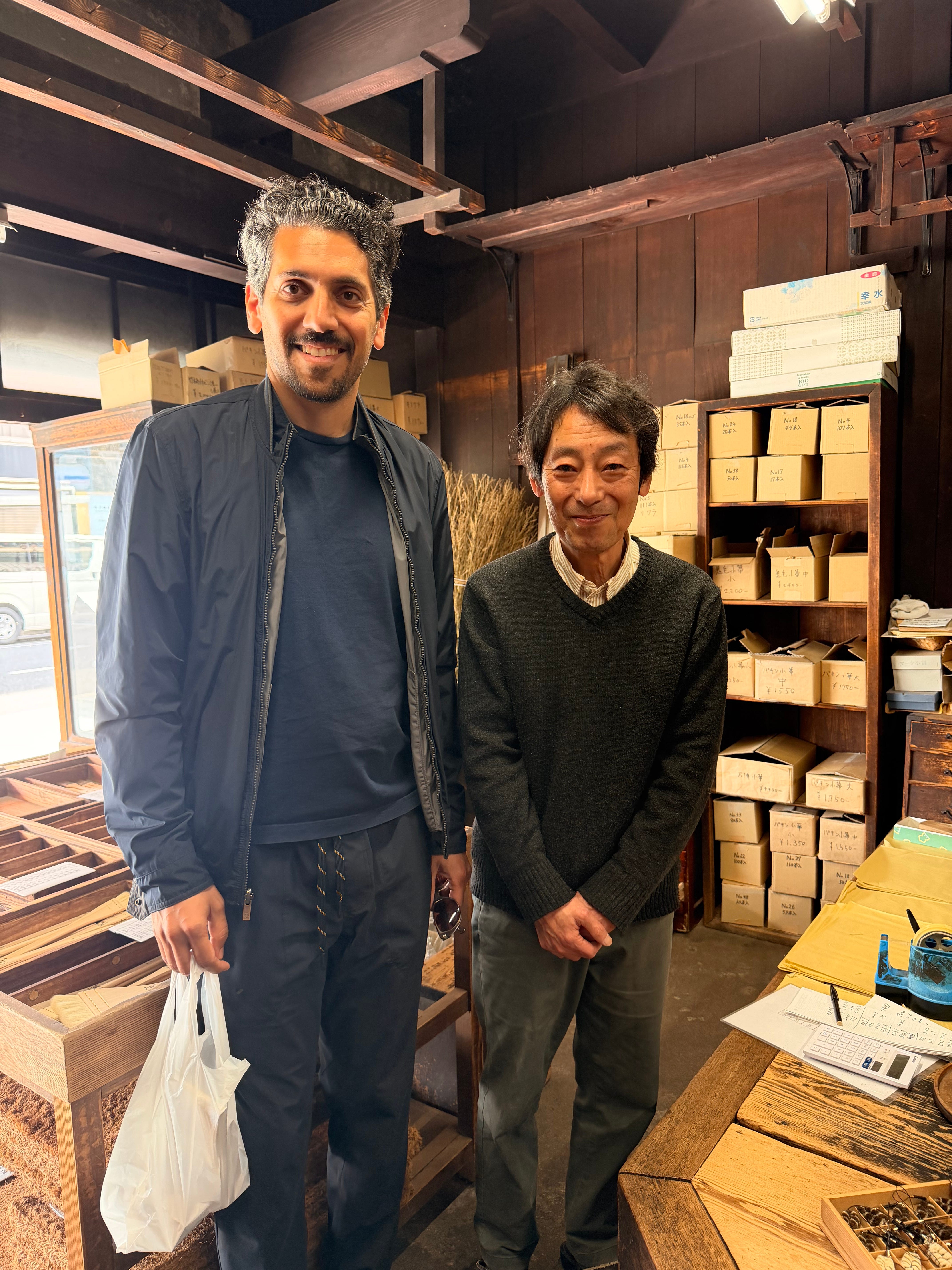
And that was unlike my interaction with the proprietor at that brush shop, where I could look the creator in the eye, then down at the object he’d created, then up at him. The connection couldn’t have been more real.
It looked as though he wanted to tell some story. People who lead a solitary existence always have something in their hearts which they are eager to talk about.
—Anton Chekhov (About Love)
Until next time.
Be well,
Ali
P.S. Some past issues to read through in case you missed them.
Snyder, C.R. & Fromkin, H.L. (1980). Uniqueness: The Human Pursuit of Difference. Plenum.
https://www.jean-pfiffelmann.com/theory-of-uniqueness/
https://www.hbs.edu/ris/Publication%20Files/Norton_Michael_The%20labor%20illusion%20How%20operational_f4269b70-3732-4fc4-8113-72d0c47533e0.pdf
Similarly, would you say a regular old broom does a better job of cleaning your kitchen floor or a Swiffer? (A Swiffer is a stick attached to a rectangle that you attach white pads to.) According to the labor illusion, even if the broom does a better job of cleaning the floor, many people might prefer the Swiffer because they can see its once-white pad now turned grey, and so they perceive its outcome as more valuable than maybe it actually was.
Green, M.C. & Brock, T.C. (2000). The role of transportation in the persuasiveness of public narratives. Journal of Personality and Social Psychology, 79(5), 701–721.
https://www.researchgate.net/publication/51797088_Art_and_Authenticity_The_Importance_of_Originals_in_Judgments_of_Value
https://en.wikipedia.org/wiki/Four_causes
No posts
Comments
Nothing yet. Say the first thing.
Sign in to join the conversation.