
Issue No. 55
We make to ourselves pictures of facts.
—Ludwig Wittgenstein (Tractatus Logico-Philosophicus)
The Rashomon effect1 is a phenomenon named after a movie from 1950 by Akira Kurosawa,2 in which four testimonies of the same event are told by four eye witnesses to a murder. We the viewers are never given objective evidence telling us which of the testimonies is true, and are left to reason through what the truth might be amidst the medley of half-truths, mistruths, embellishments, and omissions.
In short, the Rashomon effect describes
a psychological or storytelling phenomenon where multiple individuals witness the same event, but provide vastly different, contradictory, or self-serving accounts of what happened.
I love how a storytelling device can double as a broader tool for reasoning about narratives. So for this week, I want to briefly share three films that play with narratives in distinct ways and whose approaches also double as a useful tool for thinking about narratives in our everyday lives.

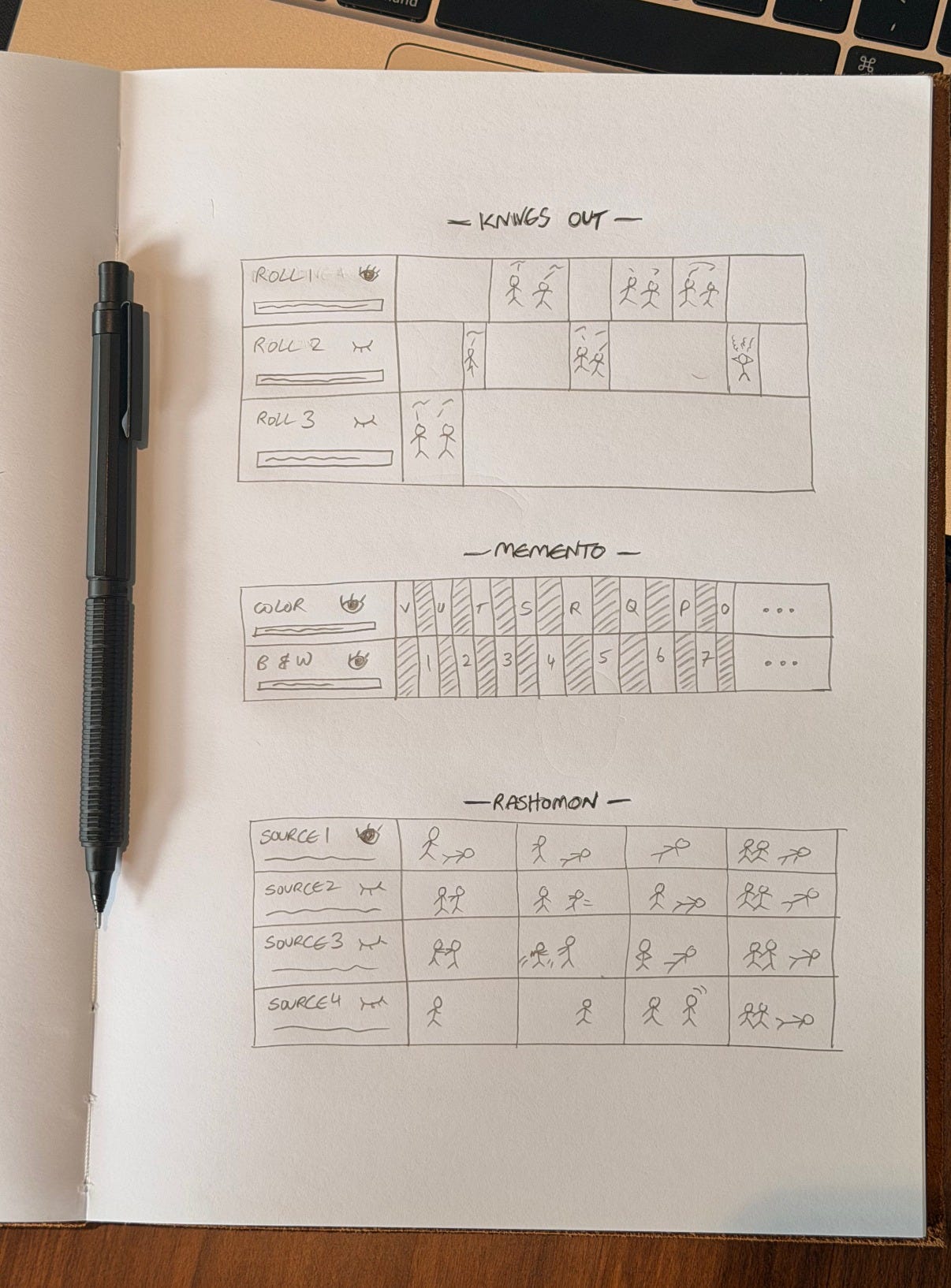
Story 1. Glass Onion opens on a private island. A wealthy founder has gathered his inner circle for a murder-mystery weekend. Among them is a scientist, a model-turned-politician, an influencer, a fashion designer, and a detective who happens to be among the guests. We watch alongside him as the game unfolds, relationships develop, tensions brew, and then someone actually dies. We think we understand what happened and why.
Only in the second half does the director reveal entire scenes we never saw. And suddenly, as the full timeline crystallizes, we realize the founder was actually a fraud, the woman everyone dismissed as an unhinged liability was actually the victim, and what looked like a drunken suicide was actually murder.
So for us as viewers, the story was incomplete because someone deliberately withheld scenes from us.
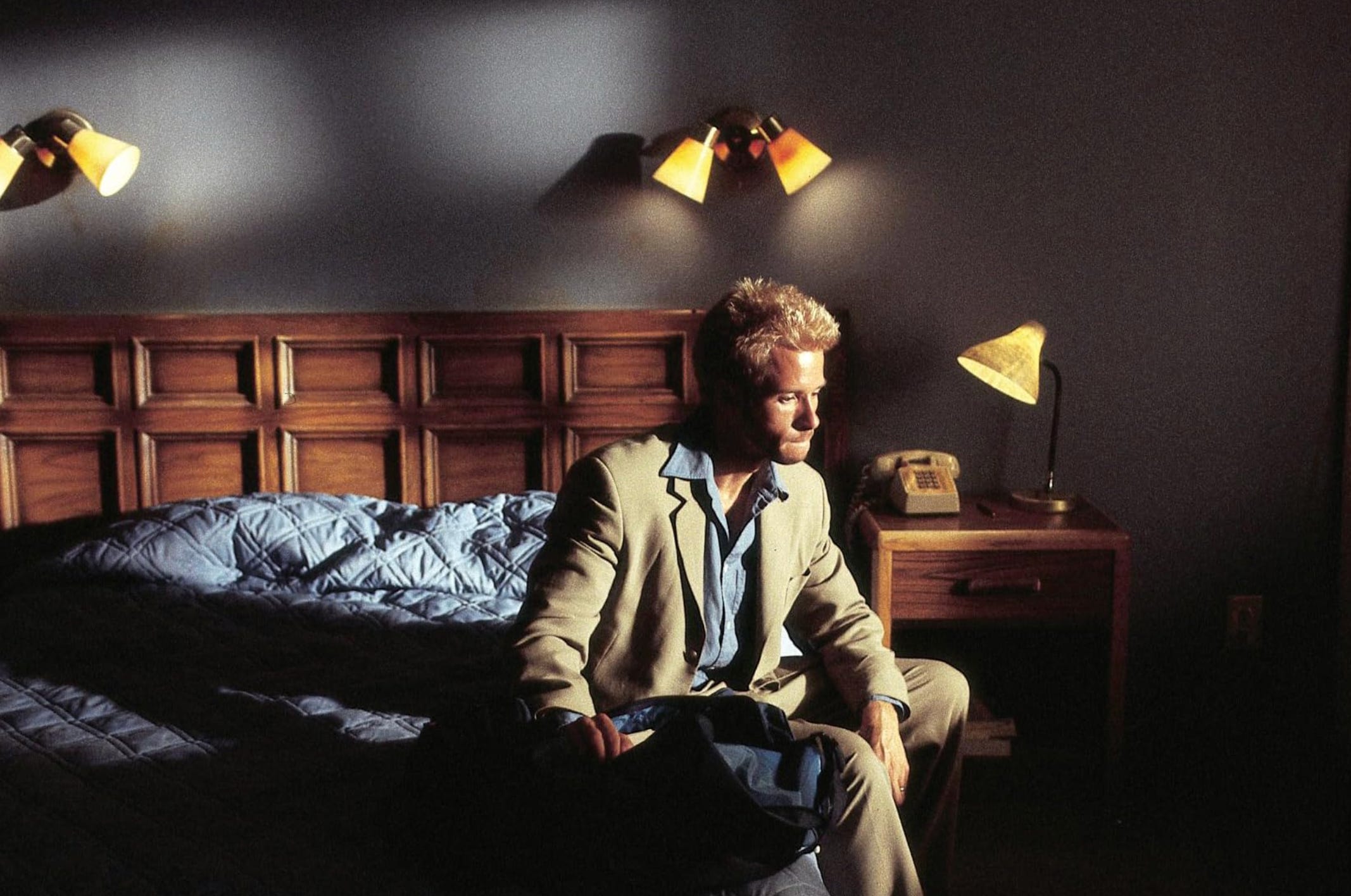
Story 2. Memento opens with a man being shot. Then it cuts to an earlier scene, then apparently to a later one. We can’t quite tell. The story is about a man called Leonard who is unable to form new memories, and in order to cope with his condition he has a whole system for preserving what he already knows, through tattoos, polaroids, and handwritten notes. Every morning he goes through them to remind himself whom he can trust, and how to deal with the world around him.
We take things at face value until the film is about to end when it becomes apparent that the story wasn’t being told to us linearly. And only then do we realize that all the conclusions we made about Leonard and the people around him were wrong. We learn that Leonard was selectively editing his own evidence to preserve a narrative he wanted to believe despite the evidence. He made facts fit his truth and we were intentionally manipulated through the story’s reshuffling of scenes.
So for us as viewers, the story was incomplete because someone handed us a scrambled edit.
Story 3. Rashomon opens at a temple during a downpour. A man has been murdered. A court is trying to establish what happened, and four witnesses are called. The bandit, the wife, the ghost of the dead man speaking through a medium, and a woodcutter who claims to have seen everything.
Each of them gives a coherent account of what went down. Yet each account is irreconcilably different from the others. Each of the four witnesses gets roughly equal screen time. Nothing is withheld or scrambled like in the previous two stories, and we never find out which account is true at the end. We assume each of the narratives was shaped by what the person telling it stood to gain, what they feared to lose, and who they needed to be in the story.
So for us as viewers, the story was incomplete because someone handed us multiple interpretations of the same event and no way to know which was the real one.
To bring those takeaways together, when we’re handed a narrative, it’s possible that one of these three things could be true.
Some things are missing. We’re watching a cut with gaps, and we don’t know what the gaps are.
Some things are reordered. All the clips are there, but the sequence is wrong, and we don’t know what the right one is.
Some things are interpreted. We have inconsistent retellings of the same sequence of events from different sources. This is what we earlier called the Rashomon effect.
All three manipulations can lead us to forming an incorrect conclusion.3 While all three patterns can happen innocently through bias or omission, they can also be deployed deliberately, and the Rashomon effect in particular lends itself to bad-faith use, because flooding a situation with competing accounts can make an otherwise clear-cut issue seem complicated and unresolvable.
Before accepting a narrative, ask which of the three edits might have been applied to it. Are there scenes missing? Has the sequence been curated? Are you being handed multiple versions with no way to verify any of them? You don’t need to necessarily have an answer. Merely knowing which kind of manipulation might be at play is usually enough to stop you from forming a premature conclusion. Because for some of us, once we take a position, we become attached to it and it becomes difficult to then separate it from our identity.
This week’s topic came to mind because of a conversation with my daughter recently. We got talking over dinner one evening about how some people she’d crossed paths with that day had a completely distorted view of reality. Despite the evidence, they were locked into a view of the world where they were making facts fit their personal truths, instead of shaping their truth to fit the facts.
It so happened that the same night she watched Glass Onion with a friend, and the next morning she commented to me, Isn’t it interesting that at the start of the movie, you think you know everything, but it’s only when you find out which scenes were cut that you realize you got it all wrong.
Films manipulate narratives to lead us astray for dramatic effect. The sources of information in real life, such as where we get our news from, manipulate narratives to keep us locked into whatever group we’re told we have to belong to. Patterns, like the ones we covered, are useful to know about to help us stay vigilant any time someone hands us a reel and expects us to take it as read.
If you only read the books that everyone else is reading, you can only think what everyone else is thinking.
—Haruki Murakami (Norwegian Wood)
Until next time.
Be well,
Ali
P.S. Some past issues to read through in case you missed them.
https://en.wikipedia.org/wiki/Rashomon_effect
Available on YouTube for free. The movie is based on the book In a Grove by Ryūnosuke Akutagawa.
The good news is we’ve covered how to protect against each of those things in past issues. Search the archive for anchoring, confirmation bias, availability bias, “It’s complicated”, wishful thinking, and not knowing what we know, for instance.
No posts
Comments
Nothing yet. Say the first thing.
Sign in to join the conversation.