

I’m tempted to start off a post on how to write short stories by saying “damned if I know.” As I mentioned in my previous post, I never thought of myself as a short story writer. I had enough experience to know that they’re different beasts. Novels aren’t simply “more words”.
It’s probably easier to go from writing novels to writing short stories than the other way around. After all, a novel is (generally) more complex, has not only a plot but sub-plots, themes, subtexts. A short story can have these things, too, but will be by nature simpler. That sounds appealing, doesn’t it?
But simpler doesn’t always mean easier.
The challenge with a short story is that it must be a perfect jewel. There are no shadowy corners where you can hide the shaggy bits. Every piece must contribute to the whole and, ideally, do so in an elegant way—and by ‘elegant’, I mean the term as used by mathematicians. As cleanly and concisely as possible.
All this perfection sounds as though it means you must plan your story with unforgiving precision, but oddly enough for me, short stories are where I wing it. I may plot my novels to a fare-thee-well, but I usually go into short stories with nothing more than a premise or a character. That’s my starting point and I go from there, and that’s probably why I find writing them so enjoyable. When it works, it’s magic.
I can hear you now saying, yeah, but what if it doesn’t work? What if you invest all this time and it fails to come together?
Here’s the thing: it almost always does.
How to get from premise to complete story
The secret is asking yourself the right questions.
Let’s use The Familiar’s Assistant as an example. This story first appeared in the anthology Dark Stars and was later reprinted in This Way Lies Madness. It’s one of my favorite things I’ve ever written.
I got the idea of a troubled young man who finds out that there’s a vampire in town, rumored to be totally brutal. To confront him is a veritable death sentence, and the young man decides that he not only must meet him, but he must become his servant, too—or his latest victim.
I wrote the story, scene after scene of action as I saw it in my head. The young man hearing rumors from his friends, that there is a real vampire in town, preying on the junkies and dissolute such as himself. He figures out a way to find the supposed home of the vampire and runs into the vampire’s familiar. This woman takes him to the vampire, who allows him to join them assisting the familiar. The young man’s past catches up to him and he bets his life that the vampire will save him—which it does. Encouraged, the young man kills the familiar and the story ends with him awaiting the vampire’s judgment: the vampire will either kill him for this trespass or elevate him to the dead woman’s position.
Even though I had all the action, it was not yet a complete story. It was like a body—skin, bones, flesh, organs, blood—but with no soul. Something was missing, the magic spark that makes it all come together, and the missing part was why?
This is where learning to ask the right questions comes in. Asking questions is key to analysis, to make sure you’re looking at a problem correctly. Turns out it’s key to storytelling, too. The questions should be specific and not open-ended. In the case of this story, the question is not just why, but:
Why would the narrator want to entrust his life to an entity as blindly violent and unknowable as the monster? (In this story, the vampire was barely seen, only known through what others thought of him. This unknowability heightened our fear of him.)
What in the narrator’s past drew him to monsters—in other words, what made him so self-destructive? Being able to identify your characters’ flaws is key to really understanding them, to seeing their true nature.
Once I understood that these questions were key to understanding the narrator, it all came together.
The narrator was self-destructive because he believed he had done a terrible unforgivable thing. I didn’t know what it was yet but it had to be really, really bad in order for him to sign up for what was a death sentence.
Whatever this bad thing was, up to this point it had driven him to ruin his life. He was a drug addict, homeless, and estranged from his family.
This deeper understanding led me to the pivotal incident in the narrator’s past that fixed in his mind that he was a bad person deserving of punishment.
As a child, the narrator turned his father into the police for sexually abusing him and his sister. Instead of seeing him as their savior, the mother and sister (horrified that everyone knew their shame) banished him from their lives. He subconsciously looks for another monster like this father, abusive and yet also his protector.
Fucked up? Yes. But also: everything the narrator did was fucked up. When your characters do things a normal person wouldn’t do (which is most stories, right? We’re not writing about the ordinary, that’s not why people turn to fiction), it’s because they are not normal. Because something is compelling them to do the wrong thing.
This backstory was the key that made everything fall into place perfectly. You really need to read the story to see how that thread, the backstory, makes the whole piece hang together.
So, in a nutshell, here’s what you need to remember to do when writing a short story: ask yourself why? But not just why; try to be as specific to the circumstances as possible so your solution isn’t just some ho-hum trigger but will be elegantly tailored to the tantalizing puzzle you’ve presented in your story. It’ll take practice and effort. Push yourself until you hit on the exact right motivation for why your unique character.
That’s how you go from a generic to a perfectly shining jewel.
“INCARNATE shines a terrifying light on how scary modern technology is. It’s a shocking thriller that will dial your paranoia to eleven!” - Jonathan Maberry, NY Times bestselling author of Red Empire and NecroTek
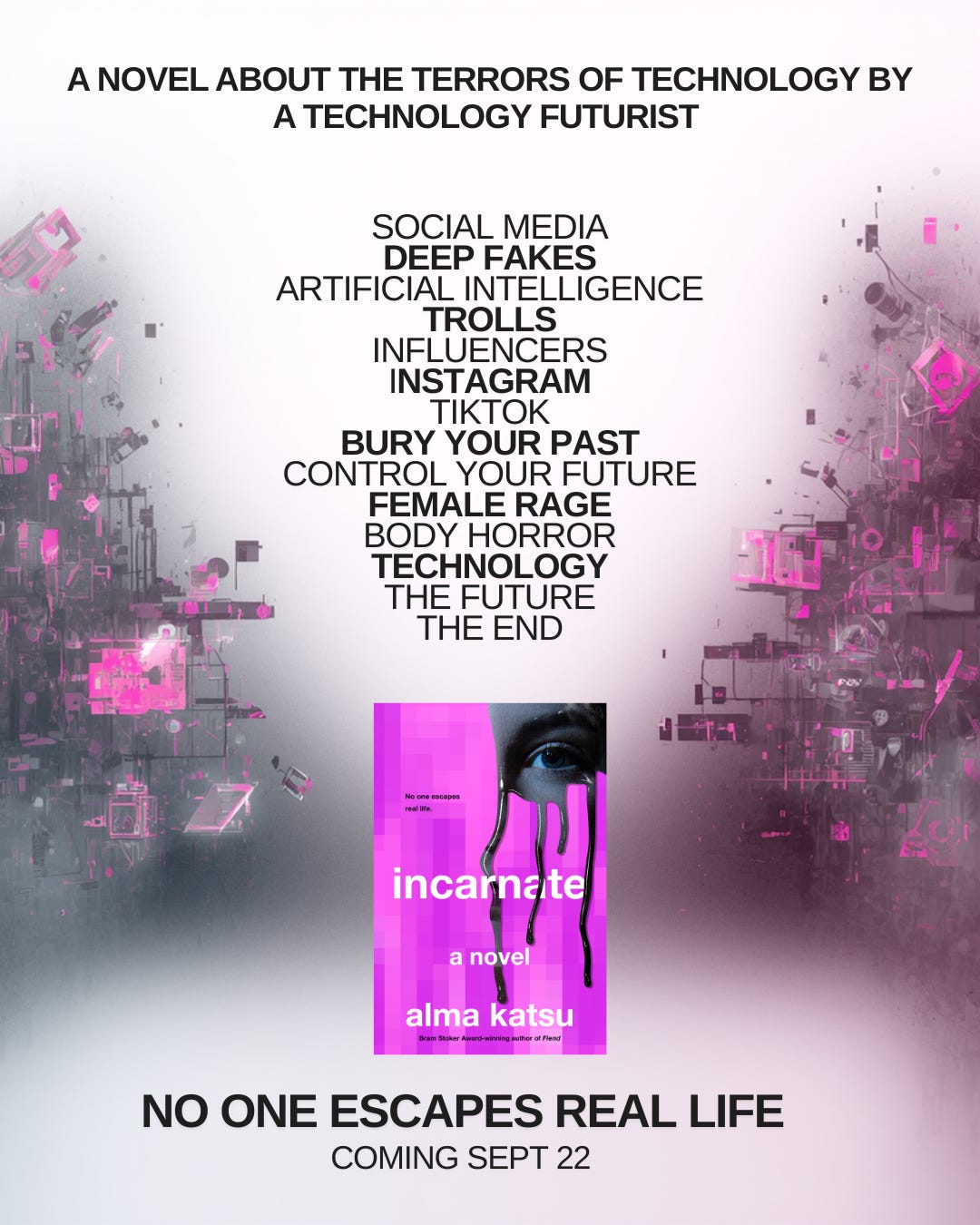
Pre-order your copy today.
Comments
Nothing yet. Say the first thing.
Sign in to join the conversation.