

By the time the 2016 presidential elections were approaching, I’d been a social media researcher for years. That means I was familiar with the various analytic techniques—all of them highly technical—used to figure out if what we saw on social media was authentic or being manipulated.
There was no question that it was manipulated.1 It was, really, the introduction of a new age of mass propaganda.
We started seeing avatars pretending to be real people on social media, coming to a head around 2017 with Lil Miquela, a 19-something year-old Brazilian-American model, musical artist and Instagram sensation with then over one million followers. Eventually, the creator came clean but in the beginning, Lil Miquela was coy about whether she was real or a collection of bytes. Lil Miquela was fake, created with the intention of making money for its creators by becoming an influencer. To me, as an analyst, this development had the potential to be disruptive. Would bad actors create fake characters to try to manipulate politics, the economy? We’d already seen how easily people could be misled on social media by bot armies—what chaos would an attractive avatar aided by bot armies be able to accomplish?
This fear, that avatars would be used for political means, was not unfounded. We’d just seen Jenna Abrams, a right-wing sock puppet, fool the masses. By the time “she’d” amassed 70,000 Twitter followers (quaint by today’s standard) she was being interviewed by the likes of CNN and NYT as a representative of the right. Only she was fake, a creation of Russian actors who were flooding the U.S. political discourse with propaganda. That story got out, eventually, but I bet there are people who, to this day, believe Jenna Abrams was a real American housewife living in Tennessee.

It was cases like this that planted the idea for Incarnate in my brain. Now, the technology behind deep fakes has been perfected and with developments in genAI, it had become dead easy for anyone to make a realistic video out of nothing but ideas and prompts.
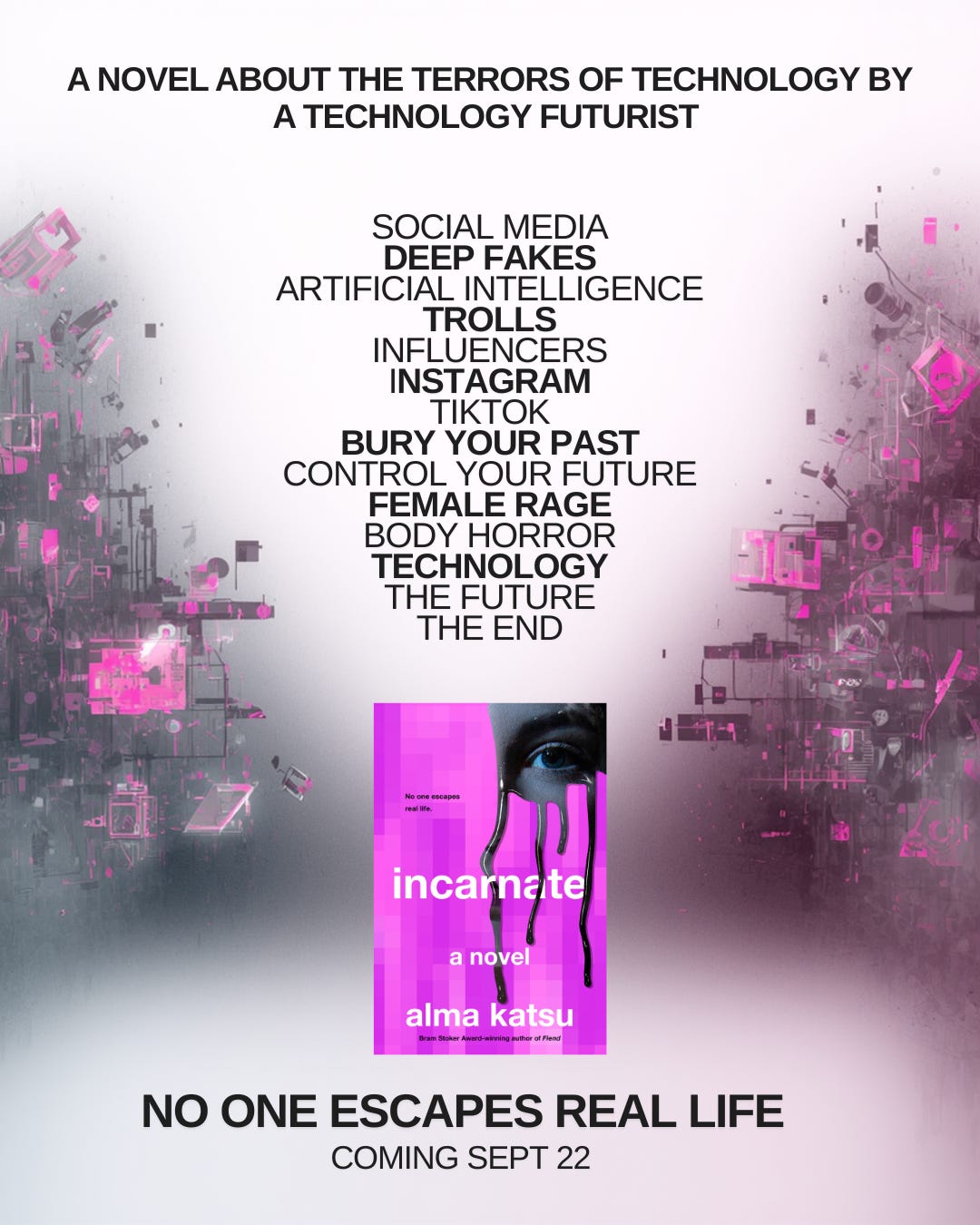
Incarnate doesn’t go into possible political outcomes. I decided instead to focus on how a young woman becomes seduced by technology and lets it lead her morally astray when she creates a beautiful avatar that becomes a social media sensation. The story is about dealing with feelings of inadequacy, insecurity, and powerlessness by projecting a false front through social media—a temptation available to everyone today—and what that kind of power can do to the mind and soul.
Given what we’re seeing in the news about social media’s harm to mental health, particularly in young people, it seems a fitting message for the book.
As for Jenna Abrams, it’s too soon to assign political sock puppets to the trash bin of history. Perhaps you saw the recent story about Emily Hart, a blonde MAGA beauty gaining followers on social media. Only—she’s not real. She’s AI, the creation of a South Asian medical student who is using soft-porn pictures of his creation to fund his tuition. He’s raking in money by fooling legions of men who want to believe there’s a real live pretty girl out there who believes in the same things as them.
Everything old is new again.
Is now a good time to suggest you pre-order INCARNATE? Coming September 22.
I’ll go into more detail on this in future columns, promise.
Comments
Nothing yet. Say the first thing.
Sign in to join the conversation.