
There has never been more professional content available to urbanists.
Every week brings new courses, webinars, reports, toolkits, podcasts, and events covering everything from mobility and climate adaptation to AI, public space, biodiversity, community engagement, and urban policy.
The problem is no longer finding something to learn.
The problem is deciding what deserves your limited time.
Which skills are genuinely relevant to your career? Which subjects should you learn together? Where should you begin? And how can you make sure that what you learn becomes useful in your actual work?
Without a clear direction, professional development can quickly become fragmented.
You register for a course because the topic sounds interesting. You attend a webinar on another subject. You save several reports to read later. But the pieces do not necessarily connect, and the growing list of resources starts to feel more overwhelming than helpful.
For professionals working across urban planning, mobility, climate, design, sustainability, and city-making, this is an especially common challenge.
Cities are interconnected systems. Our professional learning should reflect that.
Every month, All Things Urban publishes a special edition developed in collaboration with UMX by EIT Urban Mobility - an online learning platform bringing together courses across urban mobility, transport, sustainability, climate, and other key topics such as urban development and design.
This month, we are exploring how urban professionals can take a more structured and intentional approach to upskilling.
Together with UMX and EIT Campus, we have helped curate Healthy Streets, Greener Cities, Nature for Tomorrow, a free (!) interdisciplinary learning path (selection of courses) developed around the interests and professional realities of you, our dear All Things Urban community.
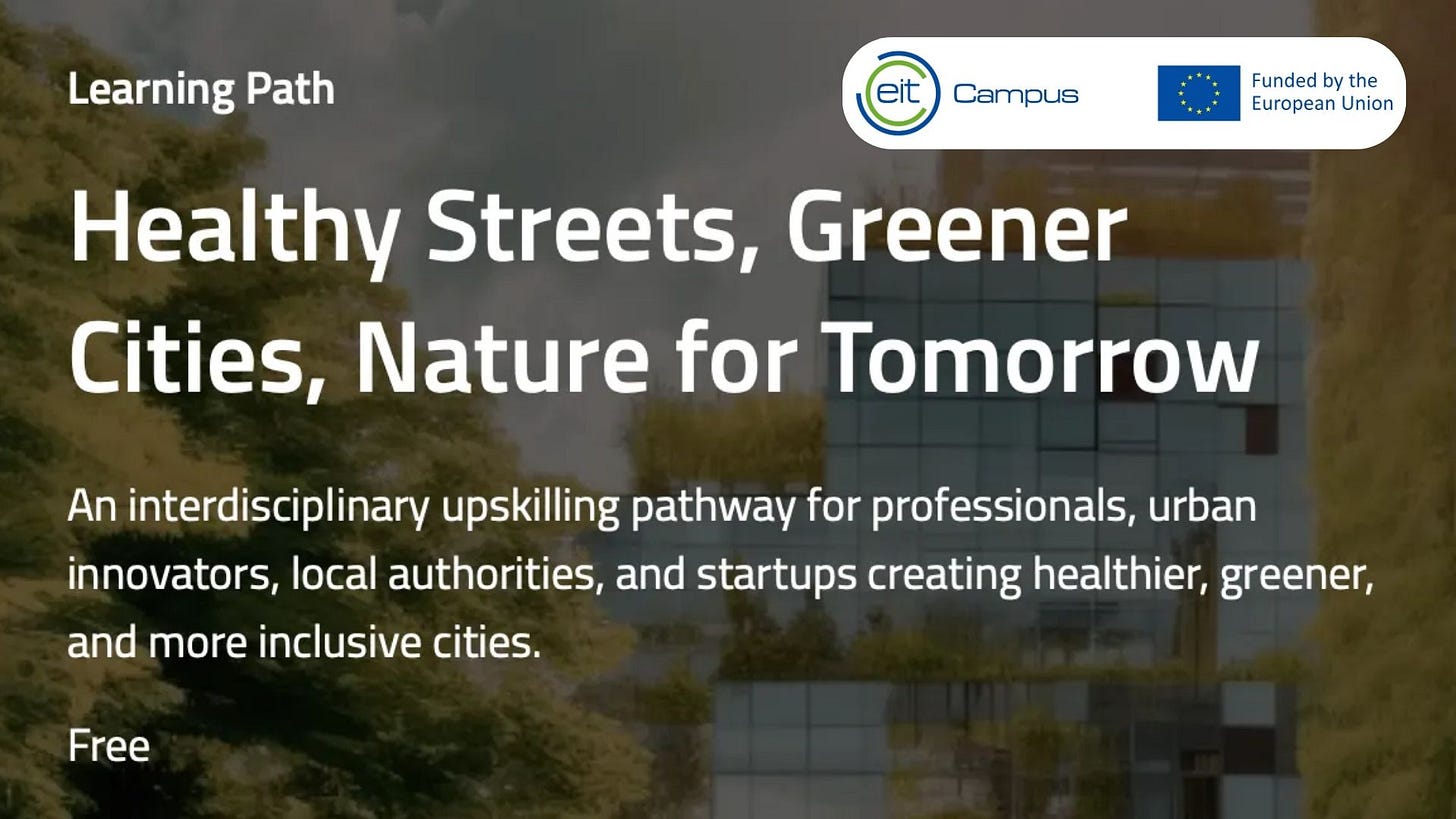
EIT Campus’ path in collaboration with UMX brings together three connected, self-paced courses exploring how people-centred streets, green infrastructure, and nature-based solutions can contribute to healthier, more resilient, and more inclusive cities.
Before introducing the path in more detail, here are three useful questions to ask whenever you begin a new learning process, based on our experience of working with thousands of urban professionals globally.
Start with a practical goal rather than a broad topic.
💡Instead of saying:
I want to learn about green infrastructure.
Try:
I want to understand how green infrastructure could reduce heat and improve liveability in a neighbourhood project.
💡Or instead of:
I want to learn about sustainable mobility.
Try:
I want to assess whether a street is safe and accessible for children, pedestrians, and cyclists.
A clear outcome helps you choose relevant learning and avoid collecting information without knowing how you will use it.
Urban challenges rarely belong to one discipline.
Making streets safer for children involves mobility, accessibility, public-space design, health, and community needs.
Creating a climate-resilient neighbourhood may involve green infrastructure, biodiversity, water management, landscape design, planning, and social inclusion.
💡 Before choosing a course, create a simple skills map. Write your main topic in the centre, then add two or three related subjects that would help you understand the challenge more fully.
For example:
Main topic: Climate-resilient public spaces
Connected subjects: Green infrastructure, heat adaptation, inclusive design
You do not need to become an expert in every related field. The goal is to identify the most useful connections, understand where your own knowledge ends, and recognise when collaboration is needed.
A course is only useful if you can fit it into your life.
💡Before enrolling, consider:
How much time can you realistically dedicate?
Do you need a fixed schedule or a self-paced format?
Can you divide the learning into shorter sessions?
Will you apply the material to a real project or place?
Do the different parts of the learning journey build on one another?
A realistic and structured plan is often more valuable than an ambitious programme you never finish.
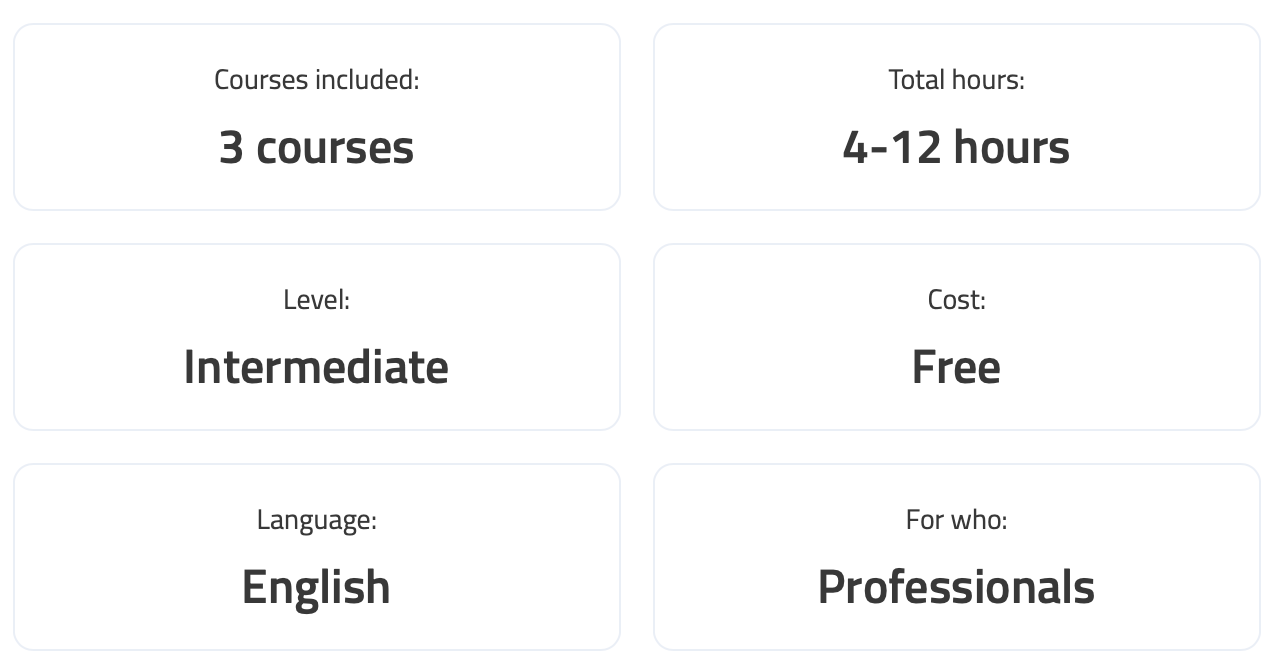
The new learning path Healthy Streets, Greener Cities, Nature for Tomorrow brings together three free, online, self-paced courses.

The courses have been selected to create a clear progression:
Begin with the people using a street
Expand to the green systems supporting a city
Explore how nature can shape future urban development
Together, they provide a broader understanding of how mobility, public space, climate adaptation, biodiversity, and urban planning can work together.
Explore the free learning path
Key skills you can develop through this path:
Improve urban liveability: Design safer, more accessible, and child-friendly public spaces.
Strengthen climate resilience: Apply green infrastructure and nature-based solutions to address heat, flooding, and environmental stress.
Support sustainable mobility: Reclaim streets for people and encourage active travel.
Align with European priorities: Integrate New European Bauhaus principles of sustainability, inclusion, and quality of experience.
The path moves from the experience of people on individual streets to the wider environmental systems shaping neighbourhoods and cities.
Start at street level by exploring how public-space design, mobility, and accessibility can create safer and more inclusive environments for children and other urban residents.
Expand to the city scale and learn how parks, trees, green corridors, and water systems can work together to support biodiversity, wellbeing, and climate resilience.
Explore how nature-based solutions, regenerative design, and New European Bauhaus principles can be integrated into future urban planning and development.
Together, the three courses connect people-centred streets, sustainable mobility, green infrastructure, and urban nature into one practical learning journey.
Choose one street, neighbourhood, or current project before beginning.
Use the same case throughout all three courses.
💡 After the first course, ask:
How safe, accessible, and welcoming is this place for children and other users?
💡 After the second course, ask:
How does it connect to wider green infrastructure, biodiversity, shade, and water management?
💡 After the third course, ask:
Which nature-based solutions could improve it, and how could they be incorporated into planning or design?
At the end, summarise:
The main challenge
Three observations
Three possible interventions
One practical next step
This will help you turn the path into a small applied project rather than simply completing three courses.
Urban planners, public space designers, sustainable mobility specialists, green infrastructure coordinators, climate adaptation officers, landscape and urban designers, community engagement practitioners, and urban innovation entrepreneurs.
And anyone interested in making our cities healthier, greener, and more connected to nature!
The Healthy Streets, Greener Cities, Nature for Tomorrow path offers a structured way to develop multidisciplinary urban skills without having to search for and compare disconnected courses yourself.
💡 You can complete the courses according to your own schedule, follow the suggested order, or begin with the topic most relevant to your work.
Register for free on EIT Campus to track your progress and earn a digital badge after completing the full path:
Enrol for free today or save for later

EIT Campus brings together practical online courses and curated learning pathways for people working on green, digital, and urban transitions. Explore topics including sustainable mobility, climate resilience, innovation, technology, and other key topics such as urban development and design.
Explore EIT Campus and discover your next learning path:

Urban Mobility Explained (UMX) by EIT Urban Mobility offers a variety of free, self-paced courses available for urbanists worldwide. UMX helps professionals like you level up your skills and become urban mobility insiders. Backed by their extensive network of 750+ top European entities and experts, including city planners, academics, and consultants, they offer a diverse array of courses, short videos, and other tailored learning resources to help you stay on track and refine your desired skill set.
Explore this new free learning path, curated by EIT Campus in collaboration with UMX, select the courses most relevant to you, and begin building a more connected urban skill set:
Warm regards,
The All Things Urban Team
Thanks for reading URBAN CAREER BOOST by All Things Urban! This post is public so feel free to share it.
Comments
Nothing yet. Say the first thing.
Sign in to join the conversation.