
Most of us, urban professionals, are trained to design places, develop policy, coordinate projects, work with data and engage communities.
But very few are taught how to lead the teams responsible for delivering this work.
And urban teams are rarely straightforward.
They often span disciplines, departments, organisations, countries and time zones. The person responsible for moving the project forward may be coordinating people who do not formally report to them.
This is where familiar problems start to appear:
Roles remain unclear. Decisions take too long. Meetings multiply. People work in parallel rather than together. One person ends up chasing tasks, resolving misunderstandings and holding everything together.
We often describe these as communication problems. But many of them are actually team design problems.
In our latest article on the All Things Urban blog, we explore why team leadership is becoming an essential skill for urban professionals, especially those working on multidisciplinary and cross-organisational projects.
At All Things Urban, we spend a lot of time looking at how careers in urbanism are changing.
Technical and sector-specific expertise remain essential. But as professionals progress, they are increasingly expected to coordinate people, manage partnerships, facilitate decisions and lead complex projects.
The transition can happen quickly.
You may be hired for your expertise in planning, design, mobility, policy or research, and then find yourself responsible for a multidisciplinary team, an international consortium or a project involving several organisations.
Yet the skills required to do this well are rarely part of formal urban education.
That is why we believe team leadership should be seen as an important urban skill, not simply a general management topic.

Developing these skills can help you:
Move from specialist to project or team lead
Leadership skills make it easier to take on responsibility beyond your own technical work.Lead without formal authority
This is especially valuable for project managers, consultants and consortium coordinators who need to create alignment across organisations.Manage more complex projects
Clear structures, roles and decision-making processes become increasingly important as projects grow.Build confidence in a new leadership role
Practical tools can make the transition into managing or coordinating others feel less improvised.Become more effective across disciplines
Urban work depends on people with different professional backgrounds understanding how to work together.Reduce the pressure of holding everything yourself
A well-designed team has clearer ownership, stronger accountability and less dependence on one person chasing every task.Prepare for more senior roles
As careers develop, the ability to enable other people’s work often becomes as important as the ability to deliver your own.
You do not need to redesign everything at once. A few simple conversations can already show where the biggest gaps are.
At your next meeting, ask each person to complete this sentence:
“This team exists to…”
Compare the answers. Are people working towards the same outcome, or do they understand the project differently?
Choose a few recurring decisions and clarify:
Who makes the final decision?
Who needs to be consulted?
Who needs to be informed?
What happens when there is no agreement?
Many teams discuss responsibilities without clarifying who can actually make decisions.
Choose a meeting that regularly feels too long or unfocused and ask:
What is this meeting actually for?
Which decisions need to happen here?
Who genuinely needs to attend?
What could be shared asynchronously?
What should people prepare in advance?
Sometimes the solution is not fewer meetings, but meetings with a clearer purpose.
We explore these ideas further in our latest article on the blog:
These three exercises are a useful starting point. But creating a team that works well over time requires more than fixing individual meetings or clarifying one decision.
It means looking at the team as a system: why it exists, how responsibilities are shared, how decisions are made, what behaviours are expected and whether the way people work together actually supports the project.
This is also why we decided not only to write about the topic, but to create a practical learning space where urban professionals can apply these ideas to their own teams.
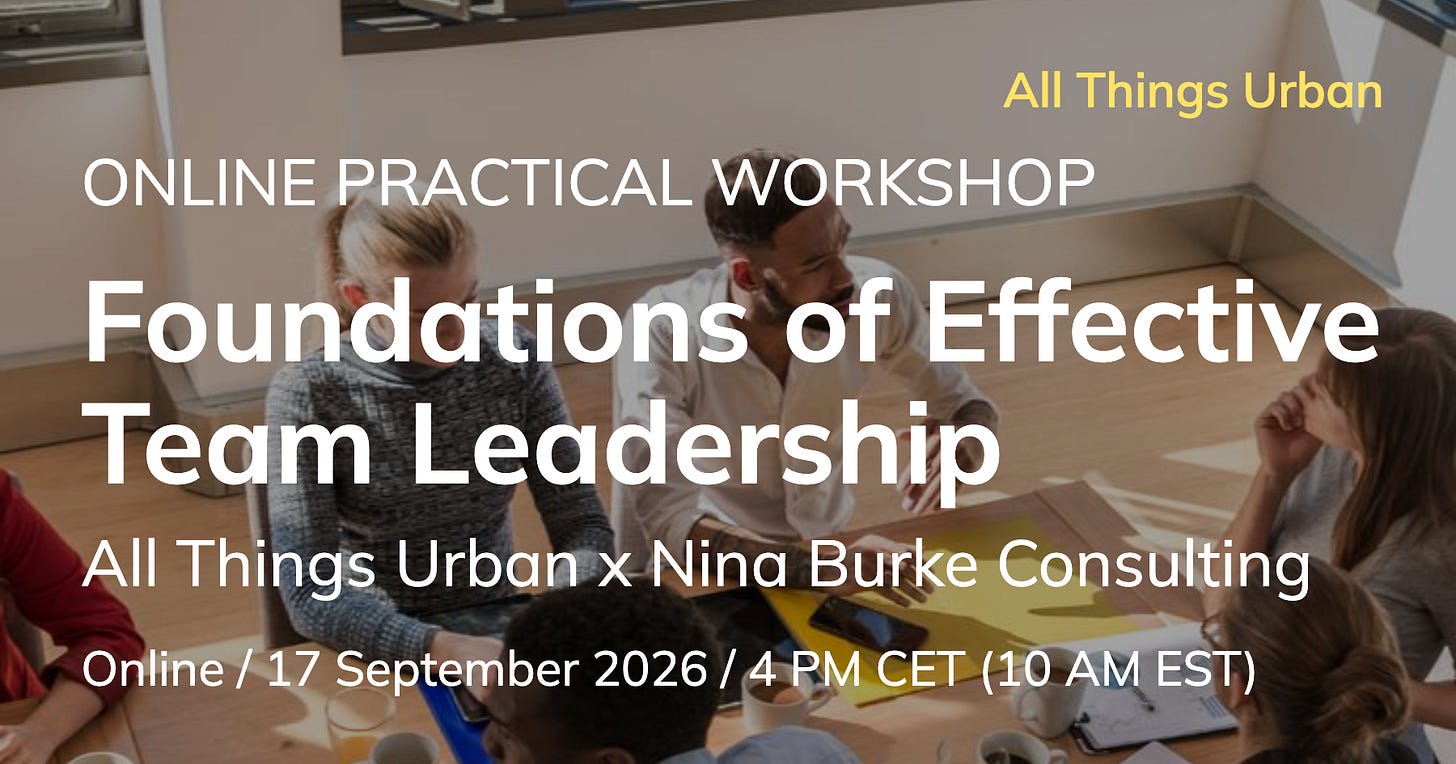
On Thursday, 17 September, we are hosting a two-hour interactive online workshop facilitated by Nina Burke, an experienced consultant and facilitator who supports teams working across urbanism, health, and the built environment, and co-leads the All Things Urban Brussels Chapter.
Together, we will explore and learn how to:
create the conditions for an effective team;
clarify roles, norms and decision-making;
launch or relaunch a team intentionally;
organise meetings that move the work forward.
The workshop is particularly relevant for new team leads, project and consortium coordinators, professionals leading without formal authority, and experienced leaders who want to reset how their team works.
Thursday, 17 September 2026
16:00–18:00 CEST / 10:00–12:00 EDT
Live online
The group will be kept small so everyone can contribute, work with their own real team context, meet fellow urbanists meaningfully, and build valuable connections.
Explore the workshop and save your seat
Can’t make the September date? You can also join the waitlist for a future session.
Hope to see you there!
All Things Urban team
Thanks for reading URBAN CAREER BOOST by All Things Urban! This post is public so feel free to share it.
Comments
Nothing yet. Say the first thing.
Sign in to join the conversation.