
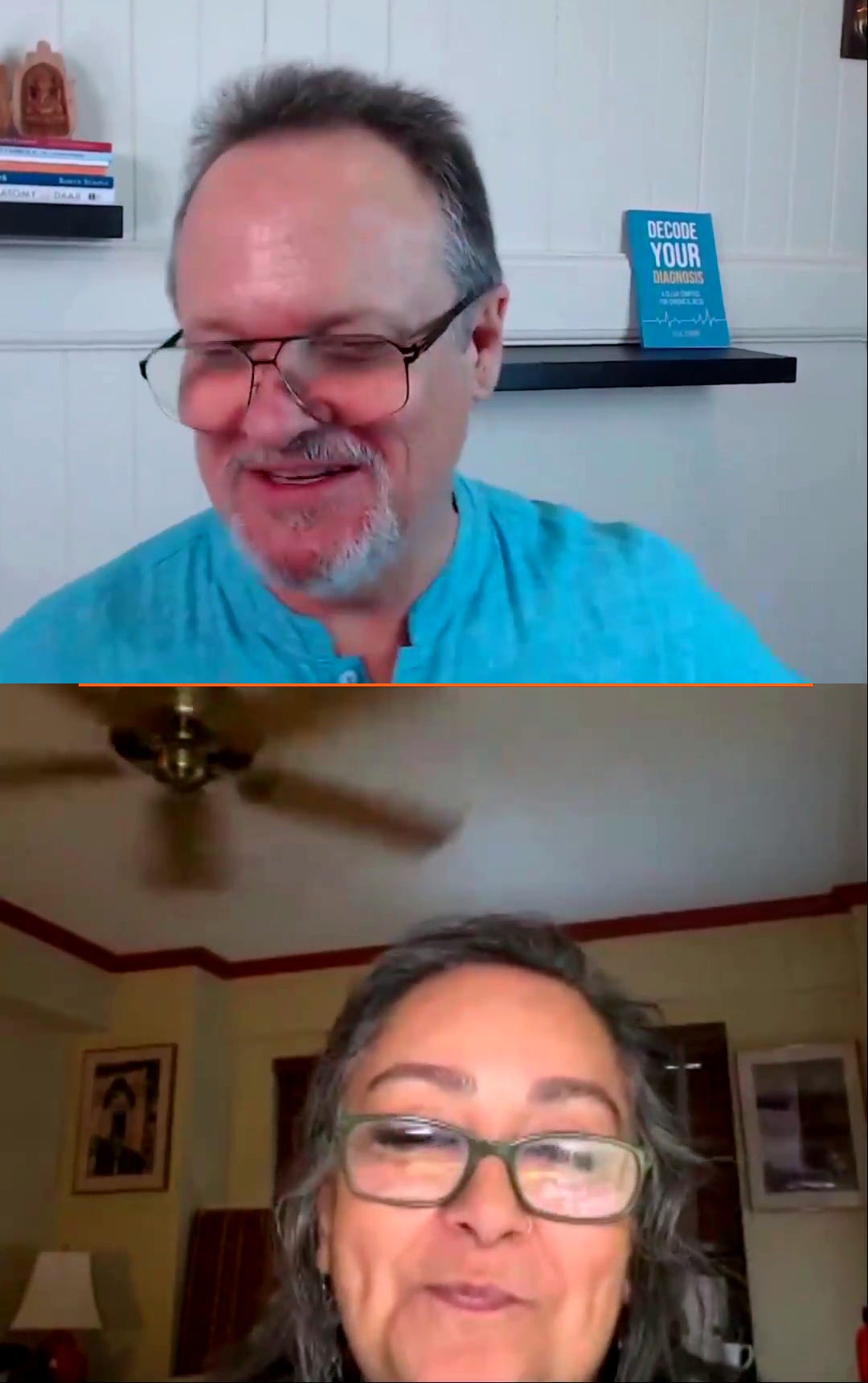
A couple of weeks ago I sat down with Paul Cobbin — a former international CEO now devoted to helping people navigate chronic illness — for a wide-ranging podcast conversation. He wanted to hear about Ayurveda from my perspective, as a chef as much as a student of it, and somewhere in that hour and a half, we found more in common than either of us expected: his story of a diagnosis serious enough to rearrange his whole life, mine of a couple of decades spent chasing every strange dish and ignoring every rhythm my body was asking for.
𑁍𑁍𑁍
That conversation turned into an invitation. Paul asked me to write for his readers this week, people navigating something far more serious than most wellness advice is written for. Here’s what I wrote for them, and I think it holds just as true for anyone whose days are full and whose rest keeps getting pushed to tomorrow.
Thank you, Paul, for inviting me to share my interpretation of Ayurveda with your readers. Your work speaks to people living with a serious, life-altering diagnosis, and I wanted this piece to speak to that same room.
If you’ve never heard of Ayurveda before, here’s the short version. The word itself means the science of life, ayur meaning life, veda meaning knowledge, and it comes from India and is thousands of years old.
Ayurveda was built on a foundational idea -- each of us is a unique expression of nature, and true health comes from living in harmony with that nature rather than working against it.
In Ayurveda, a racing mind and a struggling gut aren’t treated as two different problems, they’re two expressions of the same imbalance. Health isn’t a collection of isolated symptoms to chase down one by one. It’s a single interconnected system, and the body is already working, every hour of every day, to bring the whole thing back into balance. What it needs is fewer obstacles standing in the way.
Ayurveda isn’t just herbs or rituals.
At its core it’s a way of paying attention to rhythm, to rest, to what a particular body needs. It doesn’t promise miracle results. What it’s good at is narrower and more useful -- giving you a daily, practical way to support a body that’s already under strain.
That’s why I think it belongs in a conversation about chronic illness. A serious diagnosis puts the body under a long, unpredictable kind of pressure that doesn’t resolve in a week or a month. Most wellness advice is written for people who are basically healthy and looking to optimize. Ayurveda was built for something closer to what you’re dealing with -- a body working overtime, with no clear end date.
Here’s an idea I think helps everyone: we are part of nature, not separate from it, and nature runs on rhythm.
The rhythm is engrained into our DNA.
The sun rises and sets on a schedule.
The tides move in and out.
Ayurveda holds that our bodies are built on that same principle — we have an internal clock, and it responds to timing the same way the tides respond to the moon. There’s an ideal window for sleep, for instance, because that’s when the body gets the uninterrupted stretch it needs to digest fully and repair itself.
Food follows the same logic. Eating something close to its natural state, cooked and warm, gives the body what it can most easily draw nutrients from, without working harder than it has to. And eating around the same time every day matters nearly as much as what’s on the plate. Miss these windows repeatedly, and the body struggles to catch up on either job.
𑁍𑁍𑁍
For someone managing a serious diagnosis, I don’t think the answer is more information about symptoms or systems. It’s permission to treat rhythm and rest as legitimate priorities, not luxuries.
Simple breathing practices. A few minutes of slow, conscious breath can shift the body out of a stress state faster than almost anything else available to you, free, anywhere, anytime.
Protecting your peace as seriously as you’d protect any medical instruction: saying no to what drains you, guarding a consistent bedtime, treating a quiet few minutes as non-negotiable. These aren’t indulgences, they’re the conditions your body needs to do its own repair work.
None of this replaces medical care, and it was never meant to. Think of it as what’s available to you in the hours medicine doesn’t cover, the evenings, the long stretches between appointments where you’re the one making the calls. For a lot of people living with a chronic diagnosis, those unmonitored hours are where powerlessness might set in, and where a little rhythm can start to hand some of it back.
𑁍𑁍𑁍
You don’t need to overhaul your life to work with this. Start tonight, with one small act of rhythm such as going to bed at roughly the same time, undisturbed, and letting your body do the work it already knows how to do. It has been trying to help you the entire time. Ayurveda is just a way of finally listening.
You can read the complete piece — including Paul’s introduction and a bit more from his world — over on his Substack, Formula For Life. He’s also publishing the full recording of our conversation this Friday. I will share that with you when it goes live.
Thanks for reading,

Comments
Nothing yet. Say the first thing.
Sign in to join the conversation.