
The global secondhand market is now a $393 billion powerhouse, representing roughly 10% of total apparel spend – but the brands that originally made the pieces being sold through secondhand markets typically see very little to none of that cash flow. Startups in the fashion and retail tech space have been attempting to solve this problem for decades, with little success. In fact, branded resale is somewhat of a dirty word in the fashion industry.
Relist is hoping to change that stigma by meeting brands where their resellers already sell through a novel approach: rewards. They’ve recently partnered with WHP Global, home to brands like Anne Klein and Rag & Bone, to put their thesis to the test.
In my conversation with Relist co-founder and CEO Maneesh Karnati, we discuss how he ended up in this space and why what he’s offering to brands could flip the concept of branded resale on its head.
Emma: At a high level, what does Relist do?
Maneesh: For consumers, we have a digital closet that enables instant relisting across multiple sites, including Mercari, Depop, and eBay.
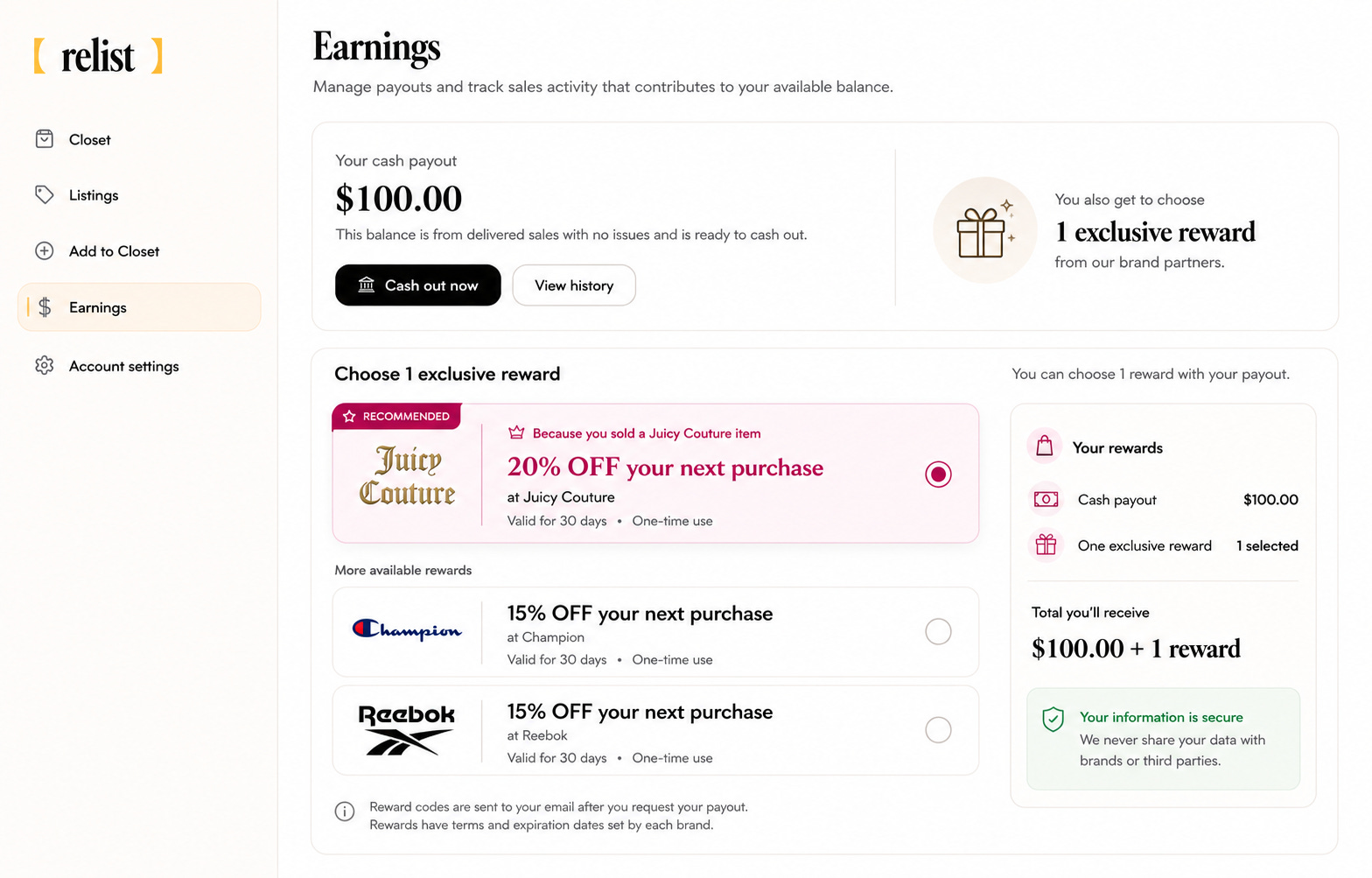
We also let brands reward their resellers where they resell. For example, if you sell a pair of Nike shoes on Depop tomorrow for $50, normally, you only get paid in cash. Now, with Relist, you’ll get that $50, plus a personalized discount code from Nike.
For the brands we work with, it boils down to a customer acquisition and retention play. They usually spend $100+ to acquire a new customer. That customer buys once, then resells on Poshmark, Depop, or eBay to fund their next purchase. That means there’s billions in resale GMV flowing through those marketplaces every year. Brands see it as a leak, but we see growth. Relist turns resale into the brand’s cheapest acquisition and retention channel, without forcing the brand to run a second business.
Emma Rayder: How did you come up with the idea for Relist?
Maneesh Karnati: While I was traveling in Southeast Asia about two and a half years ago, I came across a bunch of suit suppliers whose inventory sold for $200 or $300, versus the $3,000 standard here in New York City. I was working in AI product at the time, and came across a model that measured the body holistically. I thought suits would make a really cool use case, so I asked to license that technology, trained it with suit suppliers in Bangkok, and started shipping suits to new grads in the city.
This led me to realize how broken post-purchase and retail tech was. I got my first return, and I wasn’t sure how to handle it given the margin loss. There was no tech-enabled solution to handle this in even a 1% more seamless way. Eventually, I got a team together two years ago to work in the return space. We called the company Skip Returns.
The premise was, what if we can intercept an item mid-return and push it to the next buyer at an open box discount. Brands were incredibly interested, but once tariffs took effect, decision-makers didn’t know how to think about returns because they wanted to keep stock in America. So about eight months ago now, we pivoted to Relist.
We said, let’s just take branded resale for mid-market, flip it on its head, and bring brands to where items are actually selling, because the end goal is retention and acquisition, right?
Emma: Is there anything unique or particularly interesting to you about the retail and fashion tech space that surprised you?
Maneesh: It’s interesting how the tech world has kind of shunned retail, but it’s one of the biggest markets by GDP, exceeding almost everyone, nationally and worldwide. And the growth rate in resale specifically is crazy.
Even with those tailwinds, brands and investors continually say, “Oh no, we’re never looking at branded resale again.” People have been burned in the last decade trying to break into the space. In fintech or healthcare tech, a solution comes out, and you get a hundred iterations with a different logo and UI. Spray-and-pray is fine there, but not in retail.
That surprised me. Even talking to investors, there’s a real “hurt” mentality. And I get it. When one of the biggest funds in the world says “we’re done with this space,” that sticks. But it’s also pretty cool. Everyone feels like a first mover.
Emma: How have you pitched your value prop to brands, given that pushback?
Maneesh: In the beginning, it was very hard to get in front of a brand because, when you’re pitching resale, they immediately think branded resale and they’re jaded. So we focused our pitch on rewards and fintech, to help with retention and customer acquisition.
When we can show that you’re targeting people who already know your brand and that just made money, it’s pretty compelling. Rewards are something that almost every brand implements, but always when a consumer is losing money. We flipped that idea on its head.
We realized that leaning into the fact that we’re a Shopify plugin with no operations or engineering required was very attractive to brands.
At the end of the day, we want brands to reward their resellers, because that’s what drives loyalty.
Emma: And what about your pitch to investors?
Maneesh: My first page — the cover page of the deck — literally has our logo, but right alongside it, just as prominent, is the fact that we’re not brand resale. We wanted investors to know that right away. Moving the pitch away from “re-commerce” and into “rewards” has really helped, because that’s the end goal. When you hear “commerce,” you think operations-heavy, warehousing, manual — can it scale to the 100x that investors want to see? Repositioning it that way has helped a lot.
Warm intros have helped too. We’ve been in the space for two and a half years now, so it’s been a lot easier getting in front of the investors we actually want to reach, seeing what they want to hear, and knowing what we need to come back with or who’s ready to go.
I think we’re in a privileged spot now, getting that feedback immediately. But in the beginning, it was not that. We raised a pre-seed round a little over a year and a half ago. I wouldn’t call it easy, but it happened quickly – in maybe six to eight weeks. We found a champion that wanted to lead our round, so we’re properly venture-backed and also had three or four strategic angels come in.
Emma: How do you navigate the ever-changing nature of startups? What have your biggest learnings been along the way?
Maneesh: Honestly, trial by fire. This industry [retail and fashion], compared to others, especially, is still up-and-coming in the tech world.
We didn’t run a single line of code until we spoke with every vendor to understand how they actually implement and sell, and understood why some people are so much better at selling than others, and what it is that brands need to hear.
Emma Rayder: What’s next for Relist?
Maneesh: With all these players already moving in the luxury direction, I’d rather see how that plays out than compete head-on where no one’s tackling what we’re doing. And honestly, we don’t see them as competitors, but as complementary. If you want to do brand resale, do it. But you’re never going to capture 100% of people willing to come and sell on your own website. If both markets exist, you probably need both solutions. That’s my mentality.
But really, I want to focus on proving our value prop and building the network effect on both the brand and consumer sides. That alone is a brutal problem to solve, but we’re trying.
Comments
Nothing yet. Say the first thing.
Sign in to join the conversation.