
The Harvard Study of Adult Development has placed “close and deep social ties” at the top of the list when it comes to predicting a long, healthy, and happy life. Relationship satisfaction at 50 predicted health at 80 better than cholesterol levels and other popular metrics. It is now up to us to reshape our daily digital environment so that it helps weave these social ties back into everyday life.
The urgency is quite real. Our social fabric has already been eroded by a combination of socio-economic structures biased towards isolation and the current crop of digital applications designed to capture attention rather than deepen connection. And the trends are not slowing down.
Over the many years I’ve devoted to developing, studying, and deploying a variety of digital twins, there are three principles that I find critical if we are to foster a more humane digital landscape:
1. Create technologies with the capacity and breathing room for unplanned interactions.
2. Focus less on optimization and automation; focus more on meaning and shared human action.
3. Redefine spaces so that digital and physical layers can evolve together, creating shared activity, local meaning, and diverse participation.
The last principle is admittedly a mouthful, but it carries a great deal of potential that I’ll unpack soon. For now, let’s start with the first principle.
“Create technologies with the capacity and breathing room for unplanned interactions.”
One of the best deals we got on a rental apartment was a well-lit second-floor unit between Harvard and MIT. The rent was reasonable because the unit sat in a crossfire of construction: across the bedroom window was a view of the Swiss Embassy renovation, and from the living room we watched the growth of the Cambridge Public Library. A few months later, our patience was amply rewarded as the public library turned out to be a great hub of local activity.
Here are some of my random recollections from my visits to the library:
I recall a toddler running around with a high-end SLR camera setup, the parents surprisingly nonchalant about it. It seemed I was more worried about the impressive lens.
I remember borrowing something from the library called a “Kill-a-Watt” to measure the electricity usage of my laptop. Leaving devices on stand-by? Not a problem at all.
There was the time I tried to bet with the librarians on the number of RFID tags that could be scanned at once. I think I lost the bet. I can’t remember the details, but an uneasy feeling lingers.
Definitely the presentation on caterpillars rejecting foreign trees. That was an eye-opener for me regarding biodiversity. I shamelessly showed off that knowledge quite a few times over the years.
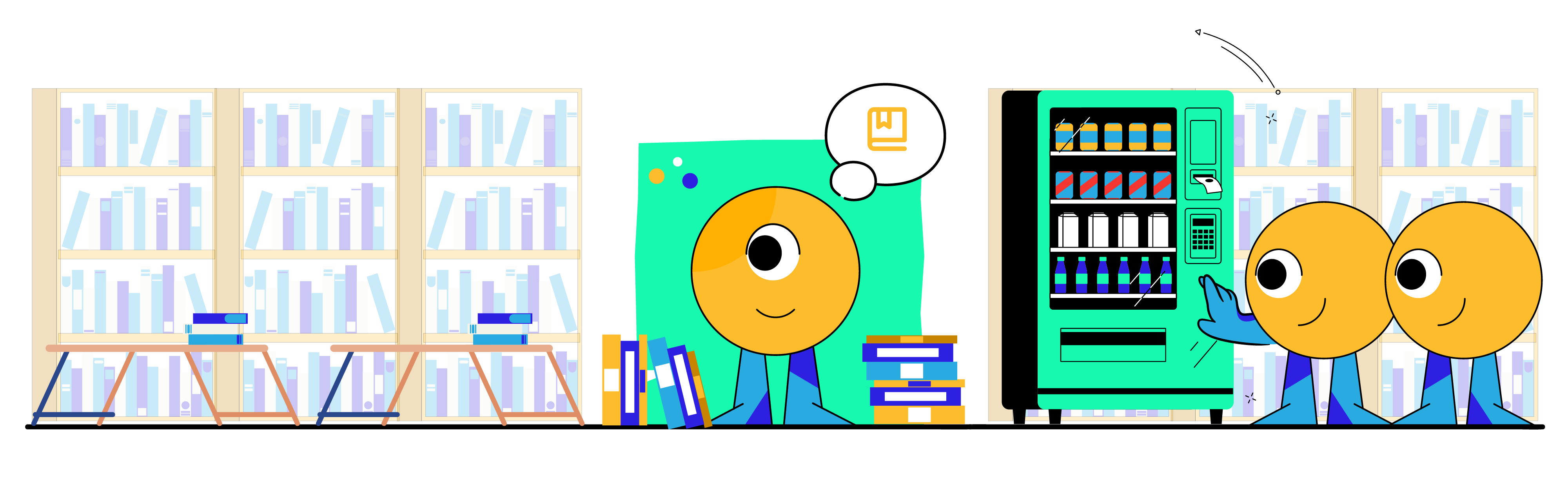
There was also the time when the gentleman restocking the vending machine told me he would be done in five minutes. After a moment of reflection, he added that he would not mind me looking over his shoulder to preselect an item. Quite a subtle touch there.
If by these fragments you get the impression that I’m illiterate, I’d object to that. I definitely borrowed and read quite a few books from the library. But it is the less predictable experiences and social interactions offered by rich physical spaces that left a greater impression on me.
Well-designed shared physical spaces allow visitors to create experiences beyond the primary role of that space. The Cambridge Public Library offered more than just the capacity to browse and borrow books. Its children’s section contained a play area for desperate parents, while one floor down there were soundproof work areas for professionals. The activities within its conference hall brought in experts and interest groups. The creative play area right outside the building drew in a much younger crowd of toddlers and preschoolers, along with an older crowd of grandparents and caregivers. And because the library allowed people to spend time freely, its diverse users had more chances to cross paths and interact in unpredictable ways.
Inherently, digital spaces behave differently. Websites try to keep visitors within their boundaries, guiding them toward relevant content or services. I’m not trying to pass judgment. Even on a nonprofit website such as Oxfam’s, an international charity, leaving room for unrelated interactions seems counterintuitive. Imagine Oxfam’s website offering a digital area where visitors discuss football instead of contributing to global causes. Similar arguments can be made for social media and XR environments, where interactions may be more varied, but are still usually shaped by the goals of the platform owners.
Yet the digital twin has the potential to buck this trend, as its foundations are based on real-world spaces. Therefore, a digital twin supporting unexpected types of interactions among its users would still keep those visitors within striking distance of its more explicit goals.
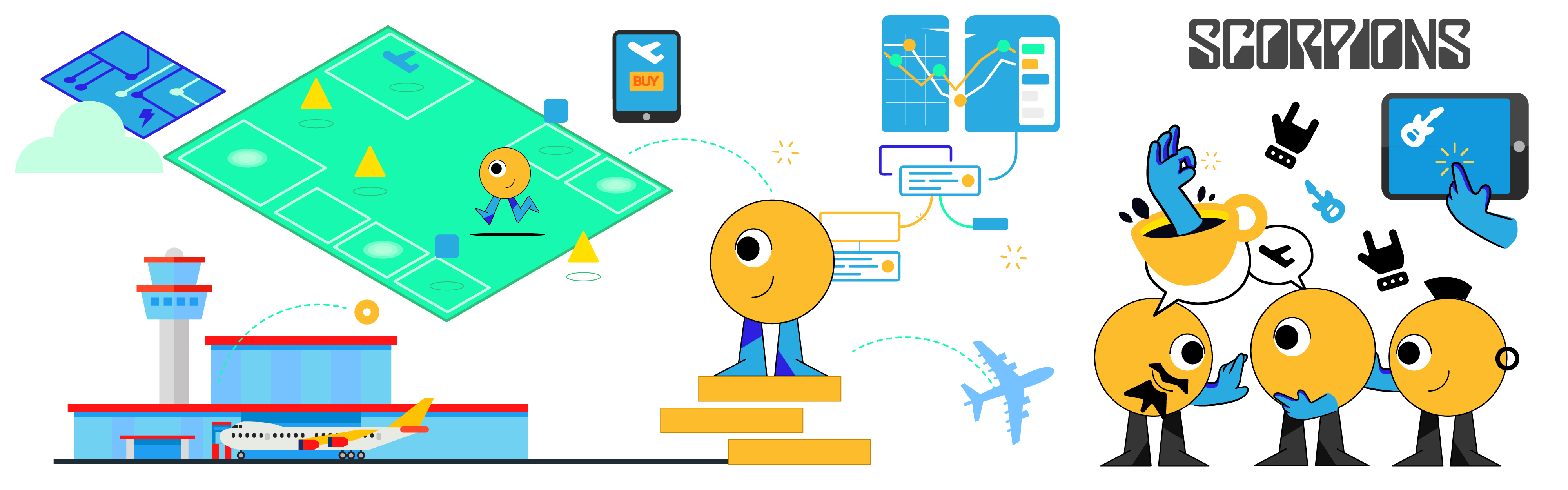
Imagine the digital twins of major airports such as LAX, Los Angeles International Airport, or Istanbul Airport, as well as smaller airports such as Hannover Airport. Their digital twins would allow access to live flight information, luggage tracking, guided navigation to gates, full layout of safety equipment, and much more.
Yet a discussion of finding a decent cup of coffee at LAX (am I the only one having trouble with this?), recommendations on footwear for the irrational distances to gates at Istanbul Airport, and a full-fledged fan area for the rock band Scorpions at Hannover Airport would definitely be warranted. In fact, these would enrich the level of participation, feed useful information back to the administration, and enhance the experience overall. That is the magic of the digital twin: straying off the beaten path does not make the system weaker; it makes it more interesting, robust, and capable of perpetual growth.
Although digital twin technology inherently supports the flexibility and serendipitous experiences of the physical world, most digital twins that I’ve studied lack these elements. Most examples I’ve seen, such as digital twins of cities, hospitals, or factories, are focused on addressing specific problems or enhancing the physical operations within those spaces. This somewhat narrow and stubborn focus seems to have spilled over from more restricted digital domains.
I believe that this is a trend we have to reverse if we want to create digital twins that weave new patterns into physical spaces with health and happiness as explicit design goals. The changes do not need to be drastic. In one of our recent projects, a relatively simple design choice ended up altering the benefit of the digital twin almost instantly.
The project in question had the goal of analyzing occupancy in shared spaces on a university campus in the Netherlands using IoT sensors and a digital twin. A streamlined engineering approach would have pushed us toward focused devices that measured only occupancy. Less risky. To the point. Instead, we chose to add some low-cost environmental sensors that could also capture temperature, light, and humidity.
When the first analysis reports from the university researchers arrived, we were happily surprised. What began as an occupancy study had also produced a full breakdown of comfort levels in the selected area. Better yet, the analysis pointed towards quick fixes that could improve the working environment in one of the best departments in the world. We don’t always have to place flashing neon signs at leverage points; sometimes you leave the tools in the open and trust in the capacity of others to improve their spaces.
Providing additional tools for designers and experts is one way to give the twin breathing room and surprising capabilities. Another is to model the virtual space with more richness than the immediate purpose requires.
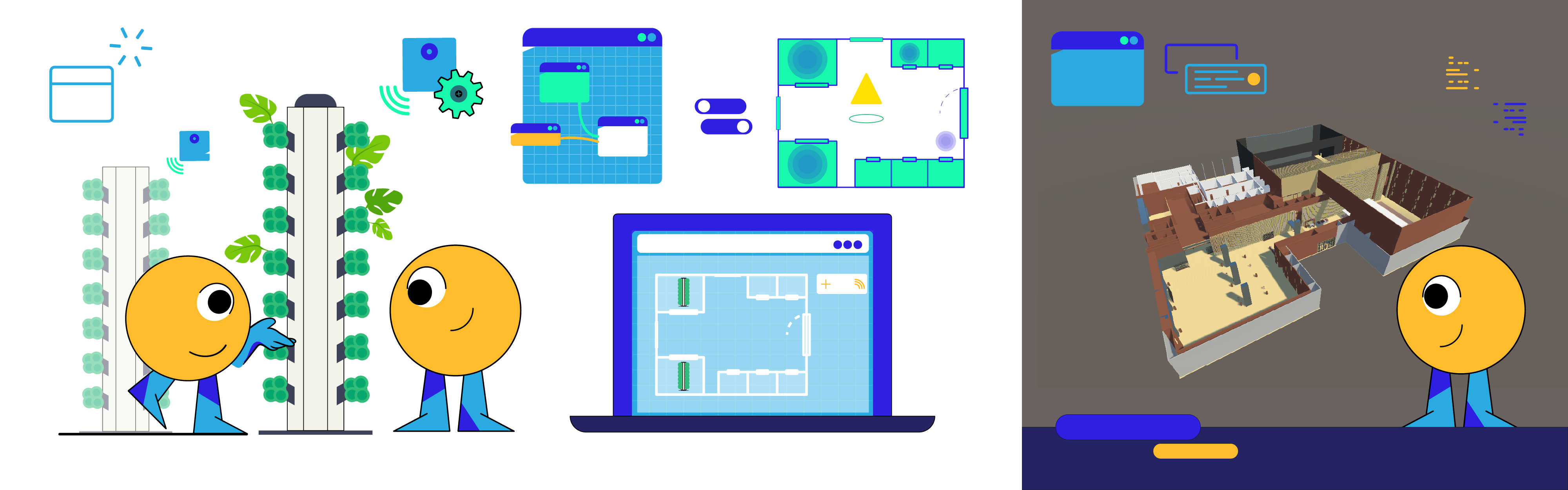
For the last five years or so, we have had a digital twin of our offices. The virtual space includes IoT devices for room monitoring, coffee freshness tracking (don’t ask), electricity usage, and asset tracking. Since our commercial applications in manufacturing sites and laboratories often involve sensitive data, we frequently use our office twin to demonstrate the capabilities of our technology.
During one such demonstration for a university preparing an IoT showcase for COP28, I was walking through the environmental monitoring features of our virtual office when something unusual caught a professor’s eye.
As I was walking down the virtual corridor to show the sensors in my office, the professor noticed something in the corner of the digital twin: a 3D model that looked like three white cylinders with large leaves sticking out. He asked me to go back a few steps and look at the setup.
I started to explain that this was the aeroponic plant system in our office, which used artificial light and smart watering to grow lettuce and arugula. But before I could finish my sentence, he said, “Yeah, I know what it is. We are actually looking for something similar.”
One conversation led to another. We did end up creating the COP28 digital twin for the university, but we were also invited to provide a quote for an aeroponic system like the one in our office. To me, this is a good example of why digital spaces should contain interesting details and side paths, even when they do not directly fit the theme of the moment. Physical spaces have this capacity for discovery. We may visit the same place over and over, only to notice something interesting that had been there all along. Sometimes chance exposes it. Sometimes we are simply more receptive during that particular visit.
It is these surprising interactions. It is the interesting plant we notice from the corner of our eye. It is the message carved into a tree. It is the way kids turn a fence into a castle wall, or the half-hidden workshop pushing half-finished items to the curb.
I still make it a design choice in my digital twin projects to inject a variety of “hooks” into the deliverables. Sometimes it is a passage to an additional virtual space; at other times, it is a tool waiting to be discovered. Needless to say, this does not always lead to something interesting. But the times it does more than make up for the extra effort.
And just as we understand that the success of a public library is not measured by the speed with which a book is delivered and a visitor sent on their way, in time we will realize that a well-designed digital twin embodies the potential for unplanned shared experiences. These are usually the best kind. If you find yourself in a position to create a twin, may I ask that you plant a little surprise in there? Or if you are a user, may I ask that you kindly demand to be surprised by your twin?
No posts
Comments
Nothing yet. Say the first thing.
Sign in to join the conversation.