

Unique and cleverly crafted experiments provide the ultimate one-two punch for curious minds. Not only are we drawn to the knowledge revealed by the results, we are also left with the itchy question: “How on earth did they come up with this setup?”
In 1964 John Bell was able to devise a theoretical experiment to test whether Einstein’s explanation for Quantum Entanglement, which he famously criticized as “spooky action at a distance”, was indeed correct. When the experiment was finally carried out some eight years later, it showed one of the few times that Einstein was off. Reality itself appeared to behave in ways far stranger than even he was willing to accept.
While not as reality altering, I love how Watts and Salganik were able to create artificial music markets to show that in popular culture the cream does not always rise to the top. Luck and momentum often seem to have the last word.
The list goes on and on, but for me there is one experiment that stands above the rest.
“The Harvard Study of Adult Development” is the longest in-depth study of human well-being ever conducted. What is not to love about a study that began nearly nine decades ago with the goal of identifying the primary drivers of health and happiness? Even more fascinating for me is how naturally the digital twin can cultivate the primary insight of this study.
The Harvard Study of Adult Development began in 1938. The initial selection of 268 Harvard sophomores already presented an ambitious task, but they represented a narrow and somewhat privileged slice of society. So 456 boys and young men from some of Boston’s poorest neighborhoods were added, giving the study a broader social and economic range.
Every few years the participants filled out detailed questionnaires about their health, relationships, work, and mental well-being. Researchers conducted interviews, gathered medical records from doctors, performed physical examinations, and later added blood tests, brain scans, and discussions with spouses and children.
While the norm is for a researcher to conduct multiple studies over their career, The Harvard Study of Adult Development flipped this script. It was carried forward across generations of Harvard researchers. Not only did the project survive, it expanded to include spouses, children, and descendants of the original participants, turning it from a study of a few hundred young men into a much larger, multi-generational record of how lives actually unfold. Harvard reported in 2025 that the study had grown from its original 724 participants to roughly 2,500 people.
What is most surprising to me about the results is that the top driver of a healthy, long, and happy life would likely not even make the top ten answers if you were to ask people on the street. After all, we are bombarded with announcements of miracle diets, quirky treatments, along with the sensible advice to not smoke and to exercise. I’m sure that most of us would fill our top ten with some combination of these while completely missing the primary finding of this study.
The biggest driver of a long, healthy, and happy life is actually the quality of our social networks.
Perhaps a modern response to this revelation is a touch of disappointment. It cannot be packaged into a trendy pill that leaves our current flow untouched. It also seems to lack the dramatic kick of quitting or starting a new set of habits.
But as I dug deeper into the study and its implications, I found that acting on this result requires something more fundamentally stimulating than a simple alteration of habits. But first, let’s dig a bit deeper. Too much is at stake to rush this.
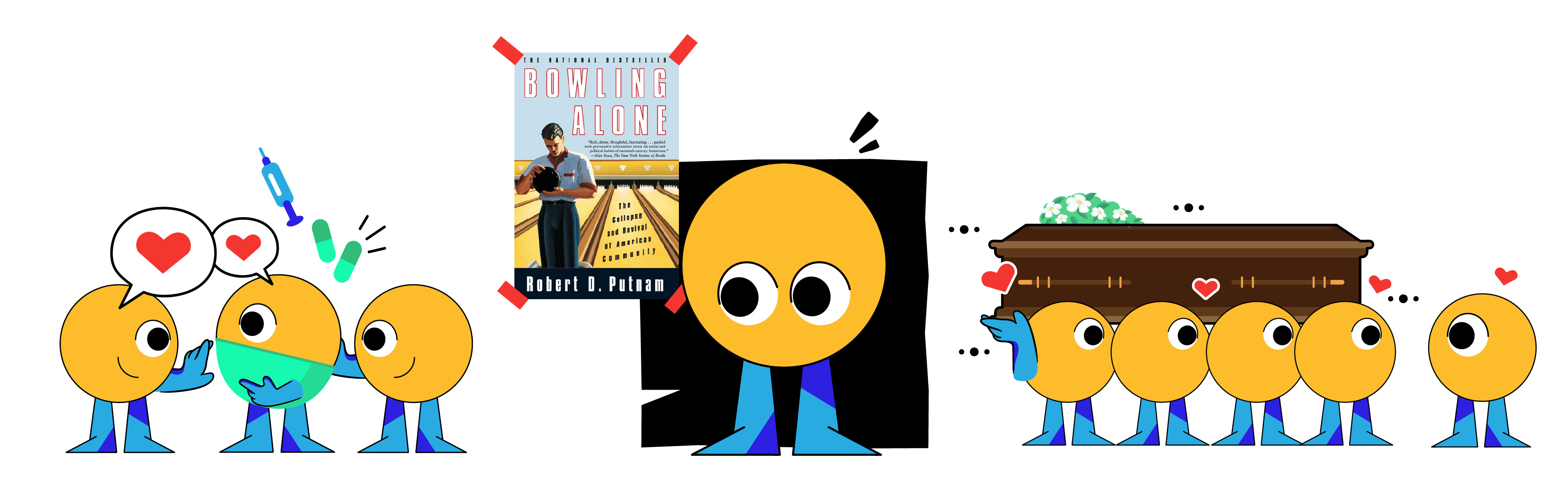
The first question is, what adds quality to our social networks? Decades of exposure to social media and mobile devices may first pull our minds toward images of large, wide spreading networks. How many connections we have on LinkedIn, how many likes or comments our posts receive, and so on. As natural as this may be, I’m assuming deep inside we also feel that this is one of those cases where quantity and quality are distant cousins.
Further reading on the topic and related research painted a picture quite different from the one shaped by digital social networks. Health and happiness appeared to be defined much more strongly by a few close friends and relatives who repeatedly proved that they had our backs. In good times, in bad times, in a crisis, as well as the mundane.
On some level this is so wonderful. It is almost like your doctor giving you a daily prescription of chocolate cake or homemade lasagna. Focusing on a tight social hub that improves both the quality and the length of our lives feels like a rare win-win situation.
Yet as early as the year 2000 Robert Putnam was warning us about the collapse of social ties in America. In Bowling Alone, he pointed to the erosion of civic groups, neighborhood spaces, and other kinds of shared environments where trust and relationships were once built more naturally.
Show of hands if you believe the situation improved with the spread of mobile devices, “social” networks, and the prolonged social isolation of the COVID pandemic?
It would take multiple books on the scale of Bowling Alone to dissect the many actors, trends, and perhaps even fallacies in human nature that brought us to this point. But if a study like The Harvard Study of Adult Development shows us a viable path out of this crisis, I would rather focus my energy on how we can collaboratively and realistically move in the right direction.
I’d be the first one to agree that at times the human mind can be fooled, that a variety of fallacies, some entertaining, some terrifying, reside in all of us. These can pull us into harmful behavior, sabotage our well-being, and at times keep us in a state of blissful ignorance. But the deep-seated belief that we have a reliable, robust social circle is not in the life-hack territory. In other words, we cannot use simple self-affirmations or calculated social touches to foster this deeply healthy state of mind.
It is through repeated solidarity in times of crisis or witnessing earnest, selfless acts that we create these ties. It is not the emoji-filled “get well” messages, it is days of coming over with hot soup that form the foundation of these bridges. It is the hand that holds your hair as you throw up, the shoulder touching yours as you lift a coffin. Your mind takes notes over and over before the healthy belief settles in as deeply as required.
You may have noticed that I’m focusing more on the deep sense of support as opposed to the actual support provided by our social ties. Friends can steer us away from unhealthy habits or a spouse can make sure we are fed and hydrated while we recover from an illness, but I believe that the primary benefit of strong social ties is surprisingly an internal one.
You may recall the fight-or-flight state that was covered in an earlier section. While this state is triggered by our bodies in response to danger, our definition of danger casts a very wide net, including a pop quiz, work-related deadlines, public speaking, and much more. It is a subconscious redirection of resources away from basic processes such as digestion and repair towards vigilant observation and the priming of our muscles for instant action. A more familiar modern name is “stress”.
In short bursts this state is not only fine, it is quite necessary. Stress becomes harmful when we cannot regulate ourselves back to a calmer state, one that fosters recovery, growth, and happiness. One of the greatest paradoxes of modern life is the amount of time we spend unconsciously seeking danger even as the world around us becomes much safer.
I believe the deep feeling of support from our social networks allows us to release this stress and switch over to a healthy idle mode. The harmful state of juggling doom scenarios at the office or the apocalypse that will result due to a poor math grade gives way to one that promotes healthy digestion and tissue repair. This to me is the primary driver that places social ties at the top of a healthy and long life.
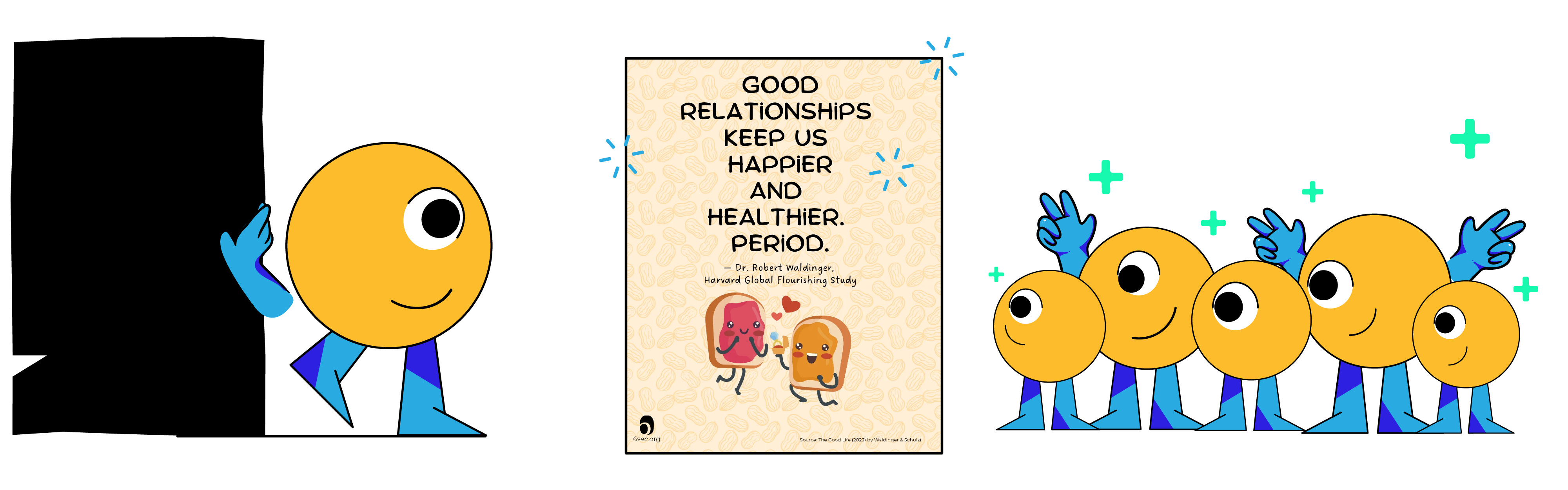
Having explored The Harvard Study of Adult Development and some of the deeper implications of its results, we are now ready to see how emerging technology can alter the landscape of health and happiness. There is no doubt that our social fabric was reshaped significantly with the digital revolution of the past couple decades. But as Putnam’s analysis shows, some of the decline started before the rise of social networks and our heavy use of screens, therefore a meaningful path isn’t as simple as letting our feet off the gas. Our design of new technology must not only address the recent decline but push us beyond the social richness we enjoyed in the “good old days”.
In the following sections I will outline a technological path that addresses the deeper implications of the results. But be ready to be surprised as the next leg of our journey may end up truly altering the way you fundamentally view technology.
No posts
Comments
Nothing yet. Say the first thing.
Sign in to join the conversation.