
Most of the themes I’ve explored in writing across the various facades of the Digital Twin tend to land around two thousand words—roughly five or six pages of text. This wasn’t by design; I just kept hovering around that range as my first set of articles reached their natural conclusion.
For the following topic, I was approaching a third of that mark—after an introductory section—when a realization surprised me. It was an odd sense of discovering something right under my nose, with writing as my mysterious guide. You may have noticed that I keep coming back to the power of discovery through writing, coding, and design across various articles, so perhaps I was prepared to be lucky—as the expression goes.
This moment comes later in the writing, so I won’t spoil it here. But I did want to reiterate my fondness for the kinds of discoveries we can all make through creative endeavors up front—just to avoid disrupting the flow of the piece later. Is this a ploy to keep you reading in suspense until we get there? All I can say is: I wish I were that clever.
So, without further ado, let’s continue our journey into the highly expressive dance between human and device.
Despite nearly a century and a half passing since Nietzsche held the Hansen Ball in his hands—and me running my fingers across a much duller keyboard (are we regressing when it comes to flair?)—designing our own hardware is still far from simple.
I do know that several companies—Arduino, Raspberry Pi, and the like—are on the verge of becoming household names, and that 3D printing now makes it possible to push an idea from sketch to a tangible object in just a few hours. Perhaps in ten or twenty years this paragraph will feel as outdated as the Hansen Ball, but for now, we turn to another domain for crafting systems that influence how we feel, behave, and live: software.
Devices like mobile phones and computers have a noticeable effect on how we behave and interact with others—but the software running on them is often just as powerful, if not more so. In some cases, hardware and software synchronize around a common bias, producing effects that go well beyond the sum of their parts.
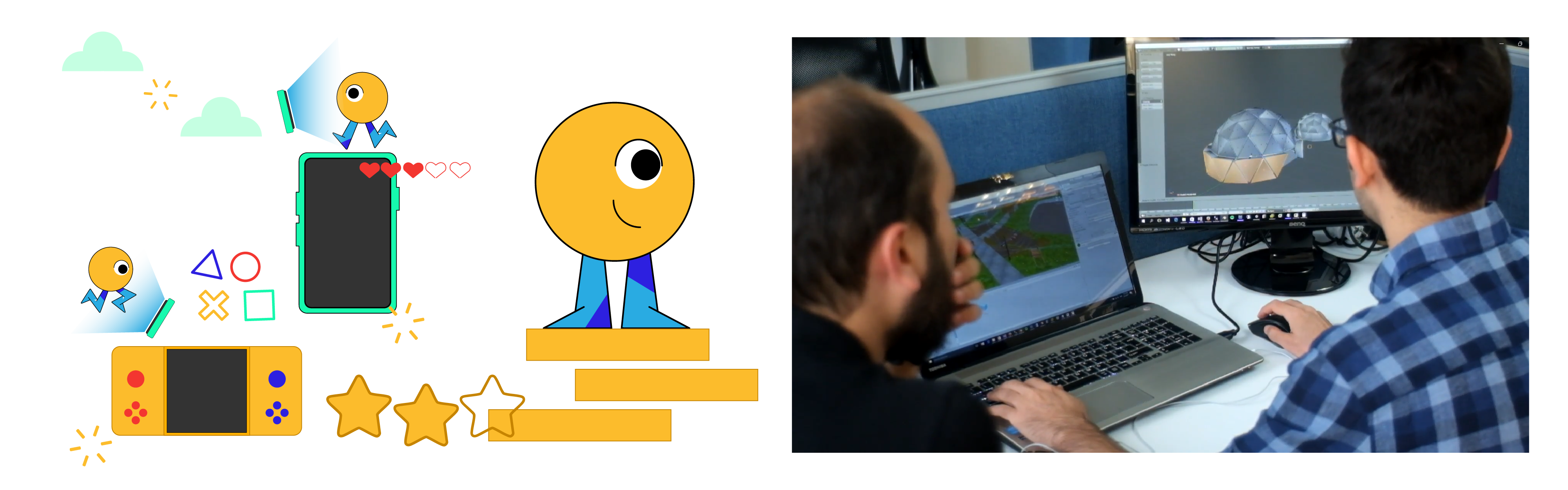
To illustrate this kind of double-pronged impact on behavior, I’ll draw an example from the mobile gaming industry. If anyone reading this feels that mobile games are mere diversions, not worthy of this kind of discussion, consider this: in 2023, nearly 40% of the global population played mobile games. The fastest-growing segment was those over the age of 45, and the industry as a whole generated over 110 billion dollars—more than triple the global movie box office. It’s hard to believe, and perhaps harder to accept, that mobile games have laid such a bold claim on our time, money, and even culture.
In his highly useful book Introduction to Game Design, Prototyping, and Development, Jeremy Gibson draws attention to some “nefarious mechanics”—namely “energy” and “spoilage”—as methods mobile game developers use to inject some (unfortunately) very effective behavioral biases into their games.
Games that use these mechanics rely on some form of energy (or resource) that builds up over time—even when the player isn’t actively playing. They typically introduce a cap system. For example: a player’s silo is constantly filling with grain, but there’s a storage limit, so the player needs to log in several times a day to sell the wheat.
Spoilage serves a similar function—only this time, the wheat (still sticking with the metaphor) must be harvested before it spoils in the field. Since the mechanic runs in real time, whether the game is open or not, it entices players to check in throughout the day. So the next time you see someone tapping their phone at a red light or during a quick elevator ride, they might just be gathering their virtual crops.
The (negative) synergy here is generated through the high accessibility of the mobile phone compared to a personal computer or even a gaming console. I find it hard to picture even the most dedicated gamers to leave a meeting—or a family gathering—to rush home and sell a virtual silo of wheat. But a quick peek at a phone? That’s such a widespread behavior, the virtual harvest simply blends in with the myriad of reasons to tap or swipe a smartphone.
Although the combination of hardware and software can synchronize to great—and at times terrible—effect, it’s also possible to override the tendencies of hardware through software. Usually, when I follow a train of thought like this, I pause to sift through memory or put aside some time to research illustrative examples. In this case, I startled myself a bit when I realized that one of the most impactful examples I could provide was actually a research project I led in 2015.
It might seem odd that I had not initially based this writing on a project built around these very principles—but life has a way of bringing you back full circle. I’ll provide a summary of the project over the next few paragraphs, followed by the results that illustrate just how powerfully software can shape behavior.
Around 2014, my team and I submitted a proposal for a mobile platform designed to support the social development of children using phones or tablets. The idea wasn’t to create more interactive experiences that foster communication, but rather to reformulate the role of mobile devices into props—where face-to-face interaction among children became the dominant form of play.
To illustrate this, just imagine a group of children huddled around a complex train set, as opposed to sitting with phones or tablets in their hands. Both intuition and experience tell parents that the train set fosters far richer interaction—even though it’s a much simpler setup compared to a smartphone.
The train set is relatively simple and, in fact, fades into a supporting role as children are compelled to invent rich scenarios around it—the train itself, the towns it passes through, what it carries, whether imaginary robbers attack, and so on. In essence, they’re filling in the blanks—both as individuals and as a small community.
Mobile devices, on the other hand, are rich with content—but leave far less space for children to contribute their own activity. They’re also designed with powerful incentives to hold attention, offering little room for users to wander off in different directions. A group of children on their smart devices will still talk, but most of the conversation is reduced to occasional calls for attention—usually when something on-screen feels worth advertising to the group.
Our goal with the project was to recreate dynamic scaffolds—like those offered by a train set, a dollhouse, or any similar play environment—where children could fill in the blanks together, perhaps a precursor to the co-creation facade of the Digital Twin that I value so much. Anyhow, I was both thrilled and - I must admit - a bit surprised when we received funding.
After exploring a variety of game ideas—building complex water pipelines, creating virtual music, and so on—we eventually settled on a cooking game.
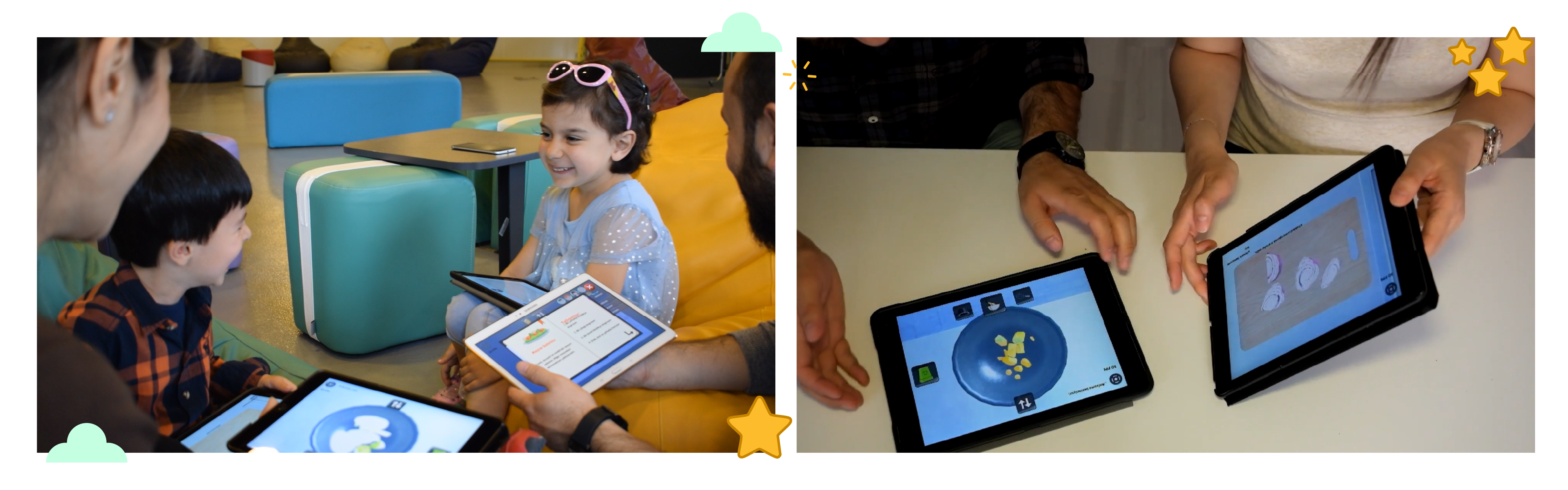
The game allowed up to four kids—each with their own smartphone or tablet—to cook a variety of dishes for virtual customers. Players could either lead the kitchen, with access to the recipe, or take on a station: cutting, mixing, or cooking.
The game had a very tactile feel. Each swipe of the finger would slice a tomato or an egg into realistic chunks, which rolled and settled on the virtual cutting board. Once the food was prepped, the player could tilt their tablet and watch the ingredients roll into another player’s pan. The mechanic felt so satisfying that I’ve done interviews where the interviewer spent more time playing the game than asking questions.
To validate our claim that software design can alter behavior, we needed to run the same game in two distinct modes. In the individual mode, each player completed all the tasks themselves—reading the recipe, cutting, mixing, and cooking—with orders unique to each player. In the group mode, players had to work together in a shared virtual kitchen and a shared list of orders.
All the neat ideas in the world can crumble to nothing if built without feedback from actual users. In our case, the idea was tested on 64 elementary school students, split into groups of four. Each setup—conducted under rigorous academic standards—ran the game in both individual and group modes.
The results were absolutely definitive. In the individual mode, children spoke only 13% of the time—even while playing the same game, in the same room. And even that 13% was mostly limited to questions about the game mechanics: a rather sterile exchange of information.
The group mode was a completely different story. Interaction levels rose nearly sixfold—to 80% of the time spent together. And it wasn’t just more interaction; the richness of it was easy to see. There were joyful moments of sharing, clear body language cues of dominance and defense, even a small fight—quite a bit like a playground, I’d say.
Following the success of our tests, our goal was to turn the project into a product—something accessible through Apple’s App Store and Google Play, targeting the two dominant mobile platforms. We put a valiant effort into development and dissemination, but one thing quickly became clear: the platform’s “secret sauce” only revealed itself through hands-on experience. In fact, one of the sweetest endorsements came from a teacher during an informal test of the game in her classroom—she emphatically told us that she’d love her own children to play the game at home.
So, we reoriented our efforts toward a grassroots campaign in schools and daycares, drawing up plans and pooling our resources. The launch was set for spring 2020. Guess what happened right around then? I’ve had my share of successes and disappointments over the years, but having a well-laid plan derailed by a global epidemic was a first.
The project—dubbed Seaburbs (the reason for the name is a bit long to explain)—was shelved, with hopes of revival in the years to come. Other projects and products took on greater urgency, but Seaburbs remained on the back burner. Its time will come—of that, I’m sure.
What we learned from the experience has stayed with us in everything we’ve done since: an intimate understanding of how hardware can shape human interaction, and how coders and designers can redirect those tides toward the shores we hope to reach—on a journey we share with generations past and generations to come.
No posts
Comments
Nothing yet. Say the first thing.
Sign in to join the conversation.