
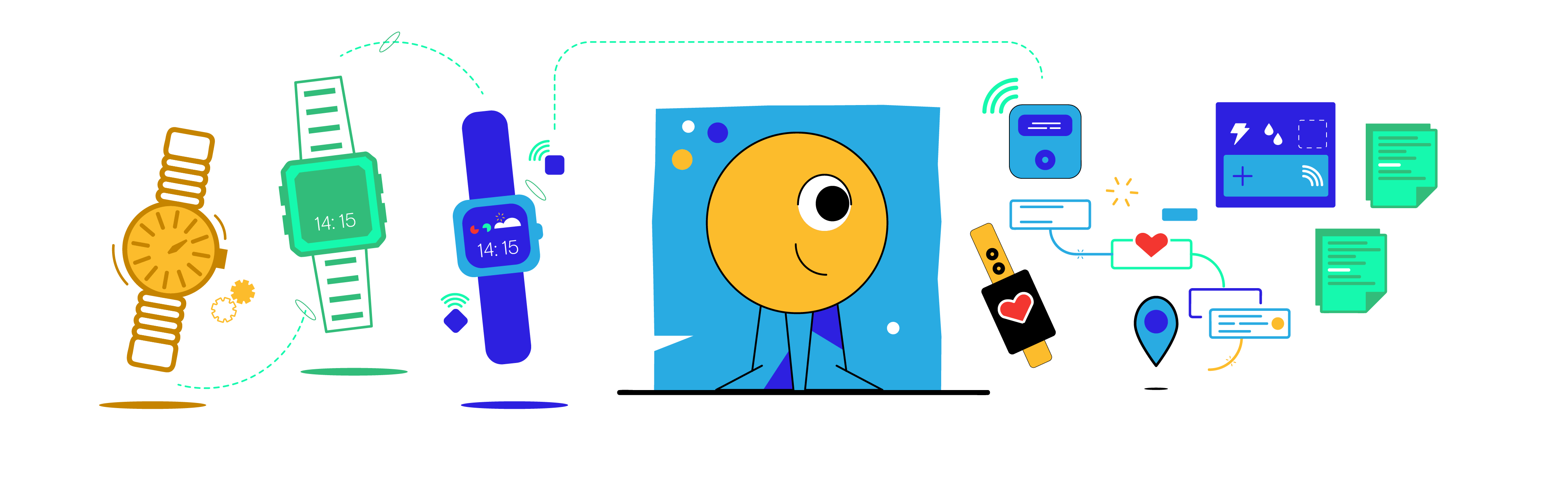
Since the 1950s, the rapid pace of technological change has led to a wide range of everyday objects receiving a “digital” upgrade — both in function and in name. Some watches became digital watches, and the transformation was so widespread that the original watch — which had held its singular identity for centuries — suddenly became the analog watch. The same fate befell other objects such as the camera, the calculator, and even the hearing aid.
As the “digital” continued to conquer the human experience — moving beyond objects to encompass music, platforms, documents, and more — it dragged along a set of technical terms like analog, bandwidth, and signal into everyday use. These words function well enough in daily conversation, yet a shallow grasp of their technical foundations limits their expressive power. In my view, digital is both the most misunderstood and the most promising — a term with untapped potential to expand the human experience.
We’re already reaping some of the benefits of the digital. Take “digital documents”: no longer printed on paper, they eliminate the need for physical presence. “Digital music” seems to replicate infinitely (is it free now?), and “digital platforms” offer global, instant access. While they don’t satisfy the stricter criteria of digital twins, these could be seen as early digital representations of physical or social functions. Curiously, some of them outgrew their origins — sometimes replacing the original entirely, or claiming an independent existence, justified by the benefits they provide.
I believe the digital twin offers a robust framework for exploring the next generation of digital phenomena — a canvas on which richer experiences and more responsive societies can be iterated. But to get there, we need a more fundamental understanding of what digital really means, and how digital models serve as a key extension. In a sense, this endeavor is akin to taking a few steps back — to build the momentum needed to leap across the gap to the next paradigm shift.
So please join me as I try to capture the fundamentals by adapting an analogy I once found both effective and amusing — originally used by one of my professors to illustrate the concept of entropy in communication.
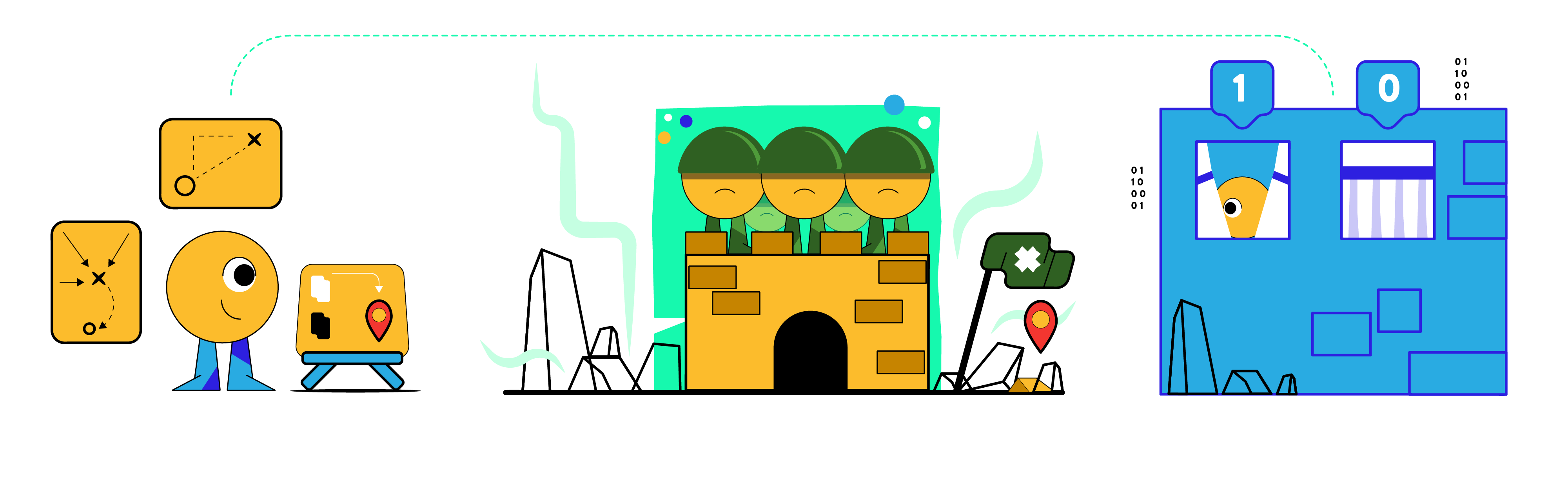
The illustration requires that we close our eyes and briefly imagine a town captured by enemy forces — let’s say somewhere in Europe during World War I. Picture the largest building in the center — a three-story affair — hastily converted into the enemy headquarters. There’s rubble in the streets, and houses with their insides exposed through bomb-blasted walls.
Feel free to step on the brakes before it gets too grim — that’s definitely not the intention.
A local resistance force watches from a distance, waiting for a chance to reclaim their homes. And one last thing before we open our eyes: imagine a member of that resistance — let’s call him Ernest (after all, who would suspect an Ernest of being deceptive?) — who has managed to infiltrate the town under the guise of a sympathizer.
Ernest needs to communicate a simple message to the resistance, who are watching the town from a distance through binoculars. His task is to observe the enemy headquarters and let them know whether or not to launch an attack.
He can’t use a radio, write a note, or leave the town to deliver the message in person. All he can do is reach one of the buildings on the edge and either close the curtains on a window or leave them open.
In technical terms, this setup conveys a single bit of information. If the preselected window has its curtains closed at the agreed-upon time, the resistance should proceed with the attack. If the curtains are open, they hold back. This is a binary signal — 0 to wait, 1 to attack — or in logical terms, a Boolean condition: true or false.
So far, so good. Since Ernest and the resistance have agreed on the specifics, they can communicate using a single bit of information — a pre-arranged signal that translates into one of two conditions: attack or wait.
This marks our first step into the digital. At its core, the digital world takes advantage of our ability to convey, store, and act on bits of information. The leap from the physical to the digital has been made possible by advances in electronics — think silicon transistors, laser reading of CDs and DVDs, and much more — though those details are outside our scope here.
But let’s take one more step forward.
Let’s now imagine that Ernest has been instructed to follow an attack message with additional information. Specifically, he needs to indicate the cardinal direction where enemy defenses are weakest: North, East, South, or West.
For this follow-up, a single bit — which can only express two conditions — is no longer enough. To represent four distinct options, Ernest now needs to work with two windows instead of one.
He and the resistance agree on a simple binary code:
a) both curtains open → attack from the North
b) first curtain drawn, second open → East
c) first open, second drawn → South
d) both curtains drawn → West
It’s a bit more effort, but Ernest can now proudly say he’s using the binary system for communication. Ernest is moving up in the world!
I’m assuming the idea is taking hold — that we can now imagine Ernest and his team agreeing on a system of 0s and 1s, where an open curtain represents a 0, and a closed curtain, a 1. Using this logic, they could encode more complex information, like letters. (In fact, every “A” in this document is represented in binary as 01100001, every “B” as 01000010, and so on.)
As long as Ernest has the stamina and patience, he can run along the house setting up 0s and 1s on the windows, while someone on the other side records the sequence through binoculars. Letter by letter, bit by bit, window by window — even the names of enemy spies could be transmitted.
It’s not exactly practical, but if Ernest and his partner in crime are both quick, why not? After all, when you type a message and send it to a (hopefully) loved one, the same kind of encoding and transmission is taking place — just at mind-boggling speed.
Ernest has proved his speed and stamina — perhaps it’s time to raise the challenge. Can he send the resistance an image of the town, marked with the current tank locations?
Well… yes. Just as you can share a digital image by pointing your smartphone and tapping a couple of virtual buttons, so can Ernest. With a lot more effort, though — much, much more.
Let’s quickly break down this example before we move into the topic of modeling — and perhaps give Ernest a well-earned break. Because at this point, he’s definitely wasting a lot of energy sending redundant information. We’ll get there. But first, the image.
A digital image is made up of individual points — pixels — which carry color information. (You’ve likely seen them referred to in terms like megapixels on smartphone ads.) For this example, I took the liberty of selecting a town near Normandy — Sainte-Mère-Église (why not?) — and captured a satellite image where I could make out the roads and buildings. Then I ran a few calculations.
Poor Ernest.
If Ernest wanted to send this image — the kind you casually store on your phone or toss to a friend over the Internet — he’d have to run around, opening and closing roughly 70 million windows.
I’ll skip over details like compression, but I think you get the idea: Ernest is in serious trouble.
I’m hoping these illustrations are starting to solidify the idea that something as simple as a bit — on/off, 0/1 — holds tremendous potential to store and convey all kinds of content. I haven’t even touched on audio, but you can easily imagine a soundwave being broken down into bits, much like an image is divided into pixels.
Of course, this all becomes meaningfully practical only when the process is sped up to incomprehensible levels — at least from Ernest’s point of view. But that’s exactly what we’ve done since the 1940’s, when thousands of vacuum tubes first took on the load for poor Ernest. From there, things just got faster, smaller, and cheaper.
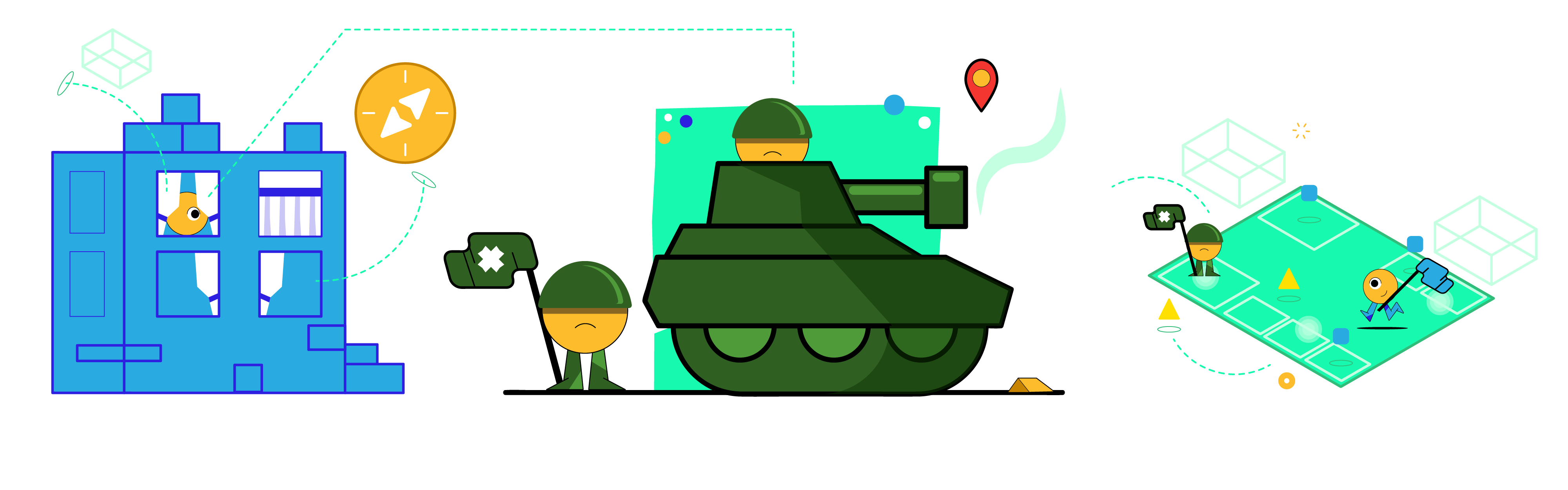
But let’s get back to Ernest — and how we’ve made him run around unnecessarily. This time, he needs a proper briefing on the concept of a model — which we can now easily connect to the digital, thanks to the groundwork we've laid.
In technical or engineering terms, a model is a selective representation of a system or concept — one that focuses on the elements necessary to achieve a particular goal.
In our example, Ernest tried to send the locations of enemy tanks to his allies by transmitting an image. But the image was both excessive and inefficient for the task. It included irrelevant details: building rooftops, tree colors, piles of rubble — all faithfully captured and transmitted, but not actually helpful.
Worse still, the ally receiving the image would need to manually locate the tanks, trace the buildings and roads, and draw reference lines around features like the river or bridge — all just to begin extracting information with actual military utility.
Instead, Ernest could have transmitted a data package containing points placed at the corners of buildings, roads, bridges, and the river — along with instructions on how to connect them, and attribute data (such as which points belong to which building, and so on).
In the same package, he could have included points at the center of each tank, with accompanying attributes indicating the model of each vehicle. Let the allies work out the finer details — we want Ernest opening as few windows as possible.
At this point, some of you have probably realized I’m describing a vectorization process — a shift from raster (image-based) to vector data. In this case, it’s closer to Computer-Aided Design (CAD) than to photography.
With a few rough estimates and back-of-the-envelope calculations, the amount of data Ernest needs to send drops to around 400,000 points. That’s a reduction factor of nearly 175 — in other words, a 99.4% decrease in effort.
You’re welcome, Ernest.
And it’s not just easier — it’s more useful. This model allows his allies to see clear outlines of buildings (complete with names), measure distances between tanks and key junctions, and extract actionable insights with far less manual work.
As you might expect, sending points, polylines, and attributes bit by bit is no different in principle — it just requires far fewer of them. In essence, digital models reduce the complexity of a phenomenon in order to make it easier to work with. They can also carry additional data — like building names or tank types — which makes them easier to integrate with other systems.
In a way, Ernest’s adventures have brought us right back to our core theme: digital twins. (Anyone surprised?)
His digital model serves as a meaningful representation of the town for strategic purposes. His real-time observations and ability to relay up-to-date information — like tank positions — effectively turn Ernest into a sensor.
And the benefits? Well-coordinated resistance attacks, guided by his transmissions, would make Ernest’s digital twin quite a useful one — at least for one of the sides.
I’m hoping that through Ernest’s efforts, it’s become easier to see how efficient models can be created — even for complex phenomena. This kind of modeling doesn’t just reduce computational costs and time; it also empowers people with modest resources to build meaningful digital systems.
In my humble opinion, the ability to start digital twins with useful simplicity — while staying open to new growth paths, both for the twin and for ourselves — and expanding them in ever more meaningful directions, is a journey well worth taking.
No posts
Comments
Nothing yet. Say the first thing.
Sign in to join the conversation.