
Here’s a quick — or should I say trick — question:
How many users does the Internet have?
You’ll probably sense it’s a trick, especially since I won’t accept any answer under 20 billion.
But how can that be, when the global population hovers around 8?
What’s the catch?
We’ve reached a point in history where devices that access the Internet have more than quadrupled the number of human users. And with the rapid rise of smart appliances, sensor nodes, wearable health trackers, connected cars, and more, that ratio is only poised to grow.
These “things” that access the Internet fall under a familiar term: the Internet of Things, or IoT for short, and you may recall I’ve mentioned it before — particularly as a key part of the digital twin, where sensors provide the real-time data layer that keeps the twin grounded in the physical world. But here’s the twist: IoT may need the digital twin even more if it’s ever going to fulfill its enormous potential in human life, and perhaps even become one of our most powerful tools for creating a sustainable planet.
Exploring the two-way relationship between IoT and the digital twin is a fruitful venture — one capable of unearthing novel solutions. But given how much time I’ve already devoted to the digital twin, I think it’s only fair that IoT gets its moment in the spotlight, to give this discussion a more balanced foundation.
Let’s begin with some of the more popular applications — quirks and surprises included — and then move on to the more unique setups we’ve implemented over the years.
Arguably the most well-known application of IoT is the use of environmental sensors, particularly in smart buildings and facilities. A relatively simple box can be installed in any room to measure temperature, humidity, light levels, noise, and air quality.
If that sounds like a glorified thermometer hanging on the wall, let’s quickly dispel the notion.
At the most basic level, these sensors can provide feedback to occupants, whether through detailed readings or simple color-coded warnings when air quality drops below a threshold. In essence, they distill environmental data into actionable indicators.
But even with these enhancements, the result is still just a snapshot: a reading tied to a specific moment and place. It’s useful, but still falls short of the full potential of a connected device.
Devices that feed information into an online system open up great possibilities — both in time and space. The following example illustrates how pushing along these dimensions can quickly dispel misunderstandings about spaces we often assume are under control, such as our homes, offices, or laboratories.
As part of a foundational setup for a larger scale project, we installed environmental sensors in several laboratories on a university campus. One comment we received about one of these labs was that the sensor readings were redundant, since the lab was located in a modern, energy-efficient building.
About a week after that conversation, I generated some graphs showing temperature, humidity, and air quality trends over time. The data revealed temperatures hovering around 30°C (86°F) on a Saturday night — in the middle of winter.
So much for a modern building with minimal waste.
This ability to look back at historical data, as well as its counterpart — the ability to predict future performance (best done using AI methods) — is a vital part of creating sustainable buildings. But not all IoT applications need to have world-altering goals. In the next example, our goal was to ensure the quality of coffee beans by monitoring storage conditions using IoT.
Some of you fellow coffee lovers may claim we’re still in the “world-altering” category. Let me just say, I’m with you — and this isn’t the only coffee-related anecdote.
In this case, we needed to determine if the coffee beans were stored in an environment where the temperature and humidity would not vary much, staying within a several-degree range. This is difficult to monitor without IoT, as people working in the warehouse would likely not notice large fluctuations because they happen gradually.
After setting up the IoT devices, we started gathering data via the warehouse digital twin. Plotting graphs over weekly and monthly periods, we noticed temperature ranges exceeding our initial threshold, requiring us to modify the warehouse or relocate the beans. This data even revealed certain events in the warehouse, such as when the delivery truck would come in, causing sudden drops in temperature.
Before moving on to the application that our customers demand the most, I’d like to champion a very simple sensor that often gets overlooked: the loadcell. It’s basically a sensor that measures weight. One of the reasons I like it so much is that it always surprises people with its ability to punch above its weight in providing insight into complex processes.
I’ll start with a cute example — naturally, it involves coffee — from our own offices, where we use it to illustrate the power of IoT combined with our custom workflow technology.
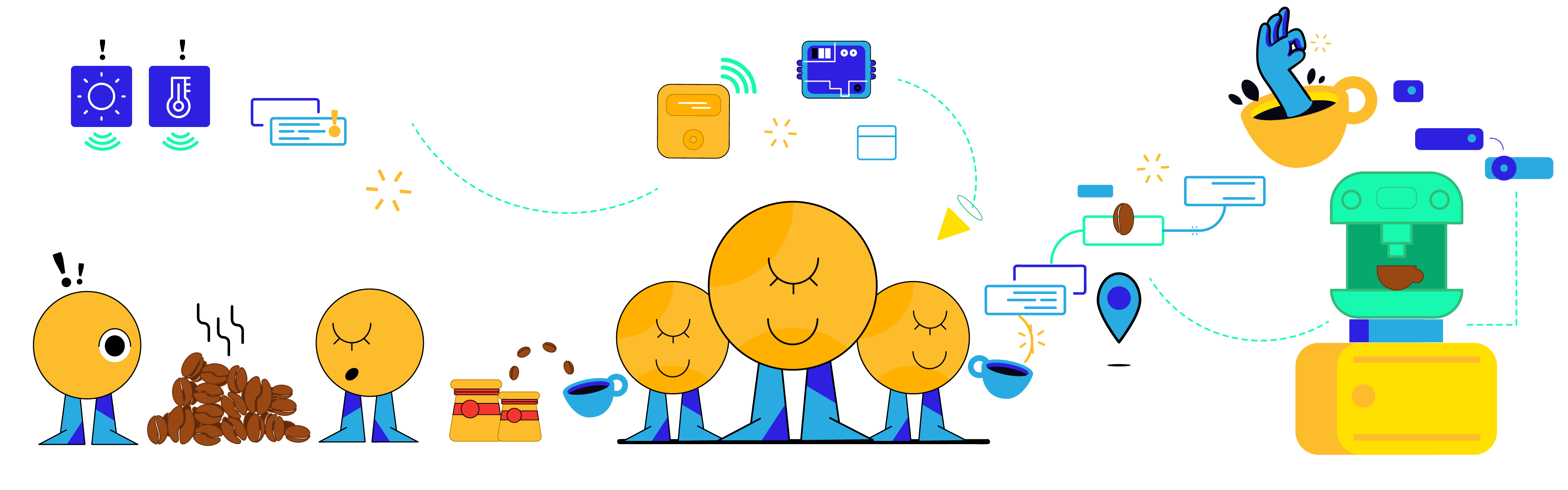
The setup is simple: our basic coffee brewer sits on top of a loadcell that transmits its weight value whenever it changes. Left at that, there’s not much to say. But once those values are connected to our evolved.city platform, we can model the phases of coffee brewing and consumption through a tailored workflow.
In essence, coffee brewing requires adding water and ground coffee — not too hard to detect. From that point on, our workflow sets up timers to notify us when the coffee is ready, keeps track of the number of cups left, and warns us when the batch goes stale. One of our programmers even added a personal alert for when the pot is down to the final cup.
This, to me, captures the power of IoT: even the simplest sensory data, when allowed to reach code, can be given a rich context that transforms it into something far more meaningful. A basic coffee brewer and a scale become a smart, personalized machine, perfectly tailored to our whims.
Another case where this simple sensor proved surprisingly useful was a proof-of-concept IoT application we developed for a university campus during Covid. Hate to bring up those stressful times, but I think most of us remember when our most basic human need to mingle was turned on its head — suddenly, we were all looking for the least crowded indoor spaces.
Building on that theme, the university wanted to monitor occupancy in the campus cafeteria, so that staff could check crowd levels before making the trip over from their offices.
The first (and most obvious) idea was a person counter using image recognition. Which immediately led us to our first wall: privacy. We countered with thermal cameras — too expensive. Laser-based motion detectors? Unreliable in a crowd. And so on we went, each idea hitting a snag.
Then we made a simple observation: everyone who eats at the cafeteria picks up a tray, and those trays are always stacked at the same entry point — if you can count cups of coffee, you can certainly count trays.
In fact, my team is currently building a similar setup as part of a Eurostars-funded project, where we’re working to increase the traceability of an electronics card assembly process for AI-driven optimization. Can you blame me for loving this simple sensor?
A couple of years ago, I was also glad to see the love shared by Esri’s Norwegian distributors, who used a similarly simple setup to detect chair occupancy for ArcGIS Indoors. Their breakdown of office occupancy data offered another great example of how simple sensory inputs can become powerful when placed in a rich digital context.
Or maybe they just wanted to pick on their marketing team for their frequent absences from the office. Still not sure.
There are so many more examples I’d love to cover, like burying sensor boxes ten meters deep in a landfill, monitoring and controlling water temperatures on a floating platform in a lake, or watching student projects spread organically within a university digital twin. But in the interest of staying within a coherent flow, I’ll save those for another time.

Let’s get back to the most consistent demand we’ve seen over the years for IoT: real-time location of mobile assets. What do I mean by this? Things get lost or misplaced in manufacturing facilities all the time, and most managers want a digital solution to locate assets on demand. If you’re imagining small objects like handheld drills or screwdrivers, that’s not what I’m referring to. Misplaced items often include automobile-sized carts carrying giant rolls of fabric, vats of chemicals on mobile platforms, or barrels of medical powder mixtures. It may sound hard to believe that such massive things can go missing, but in manufacturing sites that rival airplane hangars in size, it starts to make more sense.
The cost of pausing a production line for any reason, such as running out of raw materials or detecting a fault, can be highly damaging to the bottom line. But to suffer that loss because of a misplaced object adds insult to injury.
Most managers become aware of this risk through more dramatic examples. One that a general manager found humorous, at least in hindsight, involved a field operator walking off with a critical antibiotic sample that needed to be tested before production could begin.
While such extreme cases are rare, the same facility also had recurring issues with partial products, such as medical mixtures waiting to be pressed into pills. These were often placed in temporary zones while the next production station was being prepared. In many cases, the person responsible would move on to another task while waiting and forget to return to check the batch. I believe this type of behavior explains some of the variation in performance between shifts, as certain teams tend to be more vigilant than others.
This is a clear case where technology significantly enhances our ability to organize processes efficiently. When spatial understanding is tied to a process, we can optimize storage locations, create efficient routes, position stations and personnel strategically, and minimize losses across the board.
What surprised me during many of my analyses was how little geospatial capability is built into some of the most powerful digital solutions for manufacturing and facility management.
This may help explain why GIS — with geospatial intelligence at its core — is making inroads into indoor environments. A leading example is Esri’s Indoor GIS platform. I believe the broader management industry is also starting to recognize the limited spatiotemporal capabilities in their current systems, which has led to a growing number of integration packages between companies like IBM and SAP and geospatial leaders such as Esri.
You may have noticed I quietly shifted from spatial (location-based) to spatiotemporal. That extra element — time — is crucial. And in my view, it helps explain why this capability has lagged behind in systems that are otherwise quite robust. Here’s my take. Let me know if you agree.
As humans, our spatial awareness is an extraordinary capacity that we rely on constantly. Even the most routine day demands that we consume, filter, and interpret a vast stream of information — recognizing faces in a crowd, avoiding someone with an unusual gait, reacting to a car that’s moving just a bit too fast, and so on.
These are all skills that sharpen with repetition, especially in familiar environments. A manager or operator who revisits the same facility floor day after day gradually builds a deep, intuitive sense of how that space functions. On a typical day, they’re able to detect critical information, make real-time adjustments, and keep the process flowing smoothly.
But this is where the “temporal” part of spatiotemporal awareness comes into play. That kind of insight is only available to us while we’re physically present — it vanishes the moment we leave.
Those with dogs have no doubt experienced the contagious excitement their companions show when it's time for a walk. Curiously, that excitement only grows, even when the outing amounts to little more than a series of sniffs along an otherwise empty path or park.
The reason is simple: dogs aren’t just observing the moment. They’re able to smell their way back through a variety of stories that played out along the path over the past few days. As long as a trace of scent remains, there is something to discover.
Humans lack this ability, and we may even harbor a kind of chauvinism against its importance. Yet the ability to detect critical equipment that’s no longer within immediate view, to look back at the flow of resources, and to analyze those patterns for improvement — and, with AI, even predict possible outcomes — is immensely powerful.
But perhaps it requires a shift in mindset. Maybe it’s time we start treating spatiotemporal awareness as a kind of sixth sense, or a powerful tool in our belt.
In closing, there is growing recognition of IoT-based solutions as a way to address pain points or unlock new efficiencies. But the real power lies in weaving together a bigger picture — one where IoT, digital twins, and AI work in concert to connect the past, present, and future.
Awareness is certainly increasing within my industry, and I believe it’s only a matter of time before IoT becomes far more widespread across many domains. Yet how much of its potential we harness — and toward what ends — are questions that require vigilance, introspection, and active participation.
No posts
Comments
Nothing yet. Say the first thing.
Sign in to join the conversation.