
Life presents us with a sorely limited number of opportunities where we surf the waves of a passionate idea or theme that sees us either pulling off a highly inspiring landing on a new shore, or suffering an embarrassing wipeout into the harsh, salty waters of reality—with an audience to boot. I’d argue both are essential parts of a well-lived life.
In our twenties, such positive passions might take the form of discovering an influential philosophical book, one that gets both figuratively and literally shoved into the faces of friends and anyone willing to listen. It might mean joining an environmental movement with global aspirations. Or it could involve seeking the keys to unlocking the West in the East, or vice versa.
As life piles more and more responsibilities onto our shoulders (good luck seeking an Indian guru with two preschool kids in tow), these passionate outbursts tend to become more localized—and less demanding of our lives. You ask people if they’ve read Stoner or Voltaire’s Bastards, or if they’ve heard of quantum entanglement. Sometimes, fact really can be stranger than fiction.
These embers may once again roar into flame—now backed by experience and capacity—or they may fizzle into supplement advice and attempts to link everything to irrelevant historical facts. I’ve yet to reach that juncture, and it already seems trickier than I’m prepared to handle. But I digress.
On the flipside of such positive passions are the anger-inducing ones, where you feel like the only sane person in the room. Once again, in our twenties, these may be polarizing political views (where roughly half the people in the room are sane), or an outrage against ignorance of global inequalities. Many other colorful examples could be added, but they’d derail us, so we’ll let those lie dormant.
But what happens when positive passion and outrage against ignorance hurtle themselves toward the same target? The one I have in mind is a technological and cultural paradigm shift—one I’ve circled a number of times from various angles—encompassing terms like digital twins, the Internet of Things, and semantic knowledge graphs.
Each of these technologies already holds the power to shape our future. But put together, they form a force to be reckoned with, for better or worse. I still believe that with a shift in our behaviors, and the development of new platforms, we can channel this force toward building a more sustainable planet.
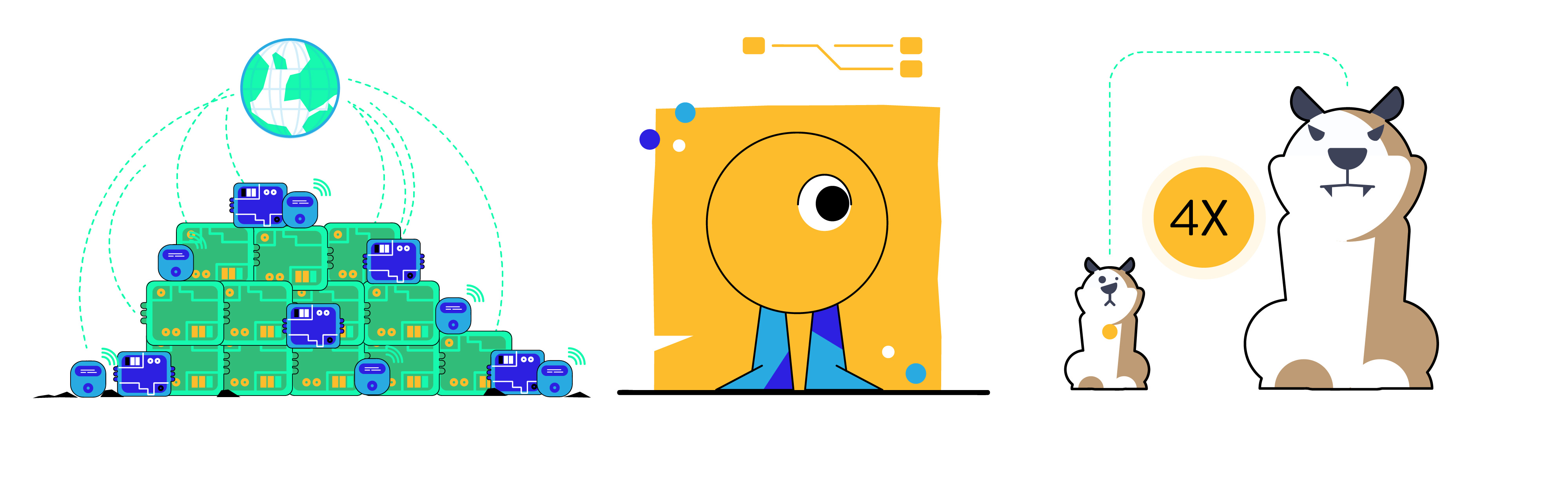
Let’s start with the positive passion—there’s plenty to be excited about. A major paradigm shift is underway as IoT devices connected to the internet continue to grow at an incredible (perhaps even alarming?) rate. By 2050, the number of IoT devices may reach 80 billion, compared to nearly 10 billion humans. That’s a growth rate nearly twice as fast as our own.
But caution is required. This rapid growth shouldn’t be conceptualized in biological terms, where, say, a puppy quadrupling in size results (hopefully) in a more consistent, coherent creature. With IoT, there’s no guarantee that such proliferation will gel into something coherent, or deliver benefits beyond its parts.
But the potential is there, very much so.
I’d like to illustrate this via a local and quite real example from one of our university campus projects, set to be completed later this year. I’ve used the word local to emphasize that these IoT components are close to me—and to each other. But I think you’ll agree, as the example unfolds, that scaling this up to a global level is entirely feasible.
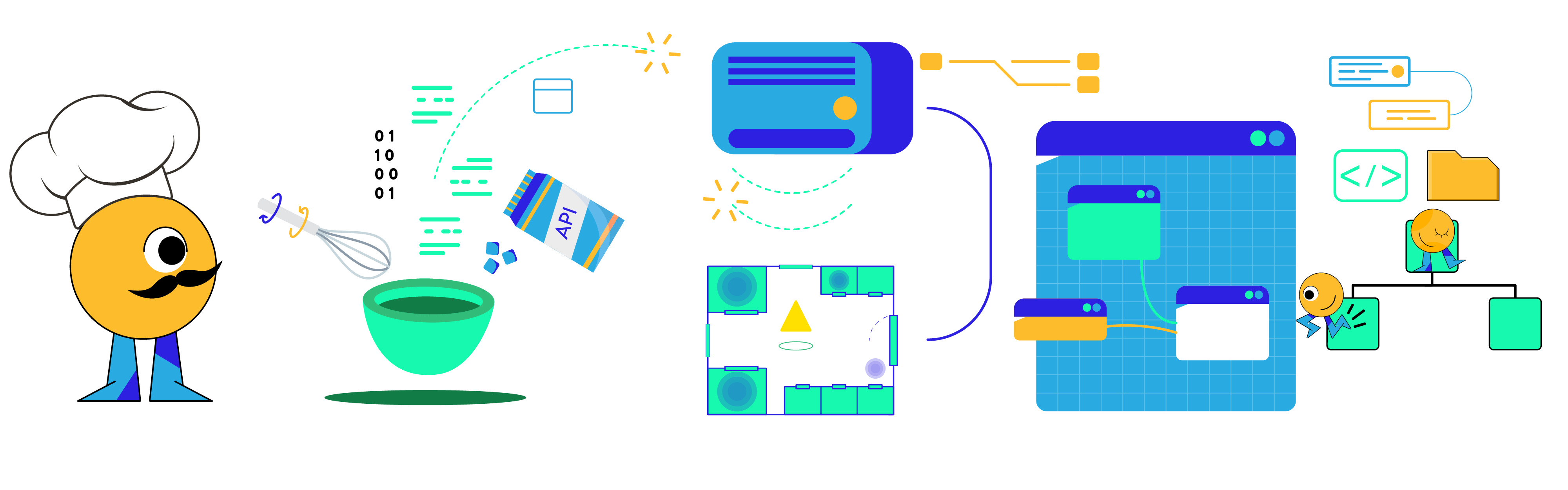
The application can be described as a simple IoT recipe that can cut your cooling bill by 40%, though it involves one unusual ingredient you may be hearing about for the first time. I’ve used the word recipe because, to me, IoT devices—sensors, smart appliances, and the like—are like ingredients. They can be combined in powerful ways inside a virtual kitchen: the digital twin.
But first, let’s look at the ingredients, as this will give us a chance to explore a few more IoT devices and the hidden potential they still carry.
The first device installed as part of a research project was a “smart” A/C unit (these are becoming more common by the day). I’m putting the word smart in quotes because it’s only smart if you put in the effort, not out of the box. What makes it capable of becoming smart is its ability to be remotely controlled: you can turn it on or off, adjust the fan angles, and access on-board sensors that report local temperature and humidity, all through a mobile application or an API (Application Programming Interface).
Here’s a critical element that deserves some attention. An API allows us to access a device’s functionality through our own code. If we only interact with this “smart” A/C (still in quotes—for now) through its mobile app, it’s little more than a glorified remote control. But once we use the API, we can start doing some genuinely smart things.
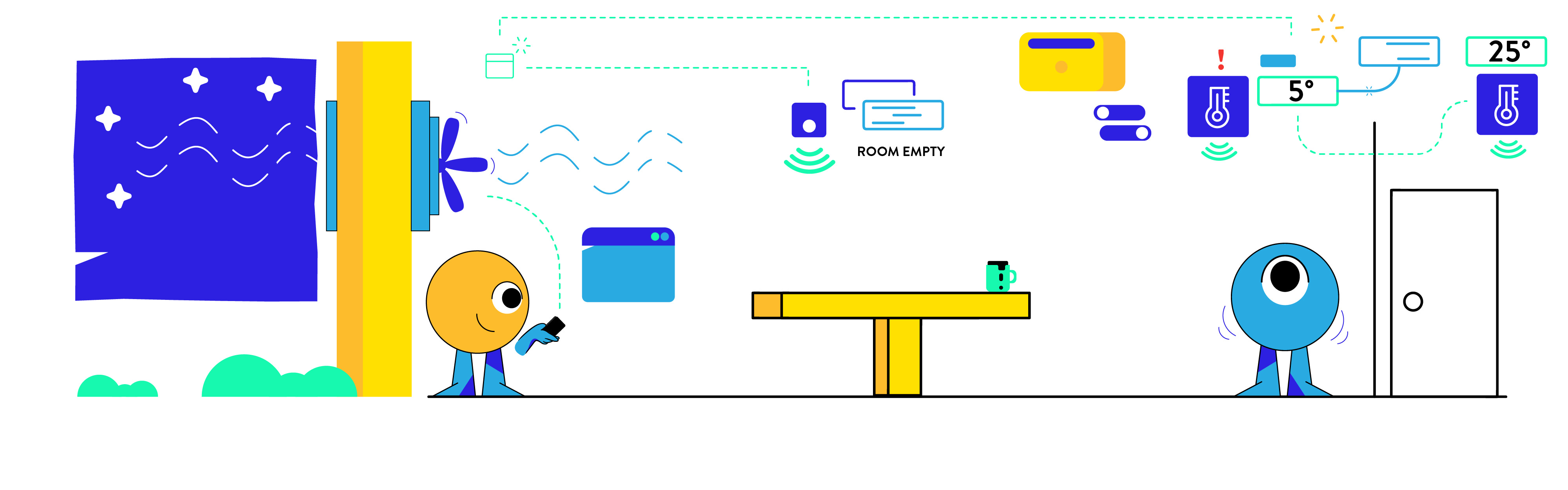
How about writing some code that checks the meeting schedule for the room and starts the A/C ten minutes before a meeting, so we always walk into a fresh, cool space? Or code that connects to another IoT device, like a person counter, to automatically shut off the A/C when the room has been empty for a while? Moves like these push us further into smart device territory.
The second device in this room was a circular panel mounted on the window, remotely rotatable via an API. Depending on its orientation, it could block airflow entirely or allow it in from a specific direction. At first glance, it might seem like something built for people too lazy to open a window—but as we’ll soon see, it’s a critical part of our recipe.
The final ingredient is something called PCM (Phase Changing Material), which refers to materials that can freeze and melt at specific temperatures. The most natural and abundant PCM is water, which freezes and melts around 0°C (32°F). But it’s also possible to create materials using substances like paraffins or salt hydrates that change phase at higher, more comfortable temperatures, such as around 20°C (68°F).
So how is this useful? Just imagine placing a huge block of ice in your office in the morning and letting it melt slowly until the afternoon—after which you could turn on the A/C for further cooling. PCM works on the same principle, but it’s far less messy and much more practical, since we don’t need to bring it down to 0°C (32°F), which would be both expensive and energy-intensive.
PCM has significant potential in sustainable building design because it functions as a passive element. It requires no electricity, yet provides cooling benefits that help reduce overall energy consumption. Despite being cost-effective and long-lasting, it remains surprisingly underused in the construction industry. In our case, I was fortunate that a researcher working with PCMs happened to be based just a couple of buildings over from our lab.
So these are the ingredients of what’s known as a “Passive Energy Stack,” a setup that uses passive elements to reduce the energy consumption of a system. In our case, the PCM is the passive element that reduces our dependence on air conditioning. The second component is the so-called “lazy man’s invention”: the window panel.
With a simple temperature sensor, we can program this panel to open during the night, allowing cool air to enter the office when it’s likely to be empty. That air freezes the PCM, preparing it for the next day. The panel then closes as temperatures begin to rise. The following day, our smart A/C remains off until the PCM fully melts—providing cooling throughout the morning without consuming any electricity. That alone can yield 30 to 50 percent savings on the A/C bill.
Like a fine Italian dish, simple ingredients come together to create some magic (Spaghetti Aglio e Olio, anyone?), but this doesn’t happen unless we have a kitchen to cook in. For IoT, that kitchen is the digital twin.
For the project, we had created a digital twin of the laboratory, including a 3D digital model with the room architecture, furniture, and the IoT devices in their respective positions and dimensions. But going beyond those, the digital twin also allowed us to monitor room temperatures, track the usage history of the devices, and even observe occupancy at one point.
Recall the A/C API access that allowed us to link meeting times with cooling? That same coding environment is provided by the digital twin. This means we can connect the sensors that detect night air temperatures and link them to the automated opening of the window panels. The twin then waits patiently as the PCM freezes overnight and later begins to melt, all while monitoring the room temperature. As it starts to rise, the system automatically brings the A/C into play.
This capacity of the digital twin to combine multiple IoT ingredients into powerful solutions is a major asset. But let’s step out of the picture for a moment and consider another benefit. How did we even know these ingredients existed in the first place? How did we know they could be accessed digitally?
This brings us to a critical risk—a fundamental mistake we continue to make in how we store, archive, and access knowledge that is inherently spatial. And this is where the angry passion returns, hurtling toward the very same goal.
I’ll cover this next, as it must be addressed in detail if we’re to ride this wave to a dazzling new shore.
No posts
Comments
Nothing yet. Say the first thing.
Sign in to join the conversation.