
“Where are you from?”
It was 1986. David sat on the hood of his black truck. His rifle was perched on the window behind his seat. He’d driven all the way from Cumming, Georgia to Midtown, the middle of Atlanta. A builder had told my Dad that David was the best carpenter he knew. Now there they were, David aloof on the hood of his car, my Dad standing close enough to him to talk but far enough that it was clear that these were two complete strangers — in both relationship and background — meeting for the first time.
My Dad responded, “I’m from Philadelphia.”
David rolled his eyes and said, “No, where are you really from.” The man in front of David was neither Black nor white, and therefore by David’s logic, clearly not from Philadelphia.
“I was born in East Africa but my parents are from India. I’m here by way of London.”
Soon, my Dad was walking David around the roof of the property he had just purchased, and they were drawing out ideas for how to re-do the old building. David was apparently fired up by the challenge of incorporating chamfered roofs, a unique type of construction that would complement the shape of the existing roof.
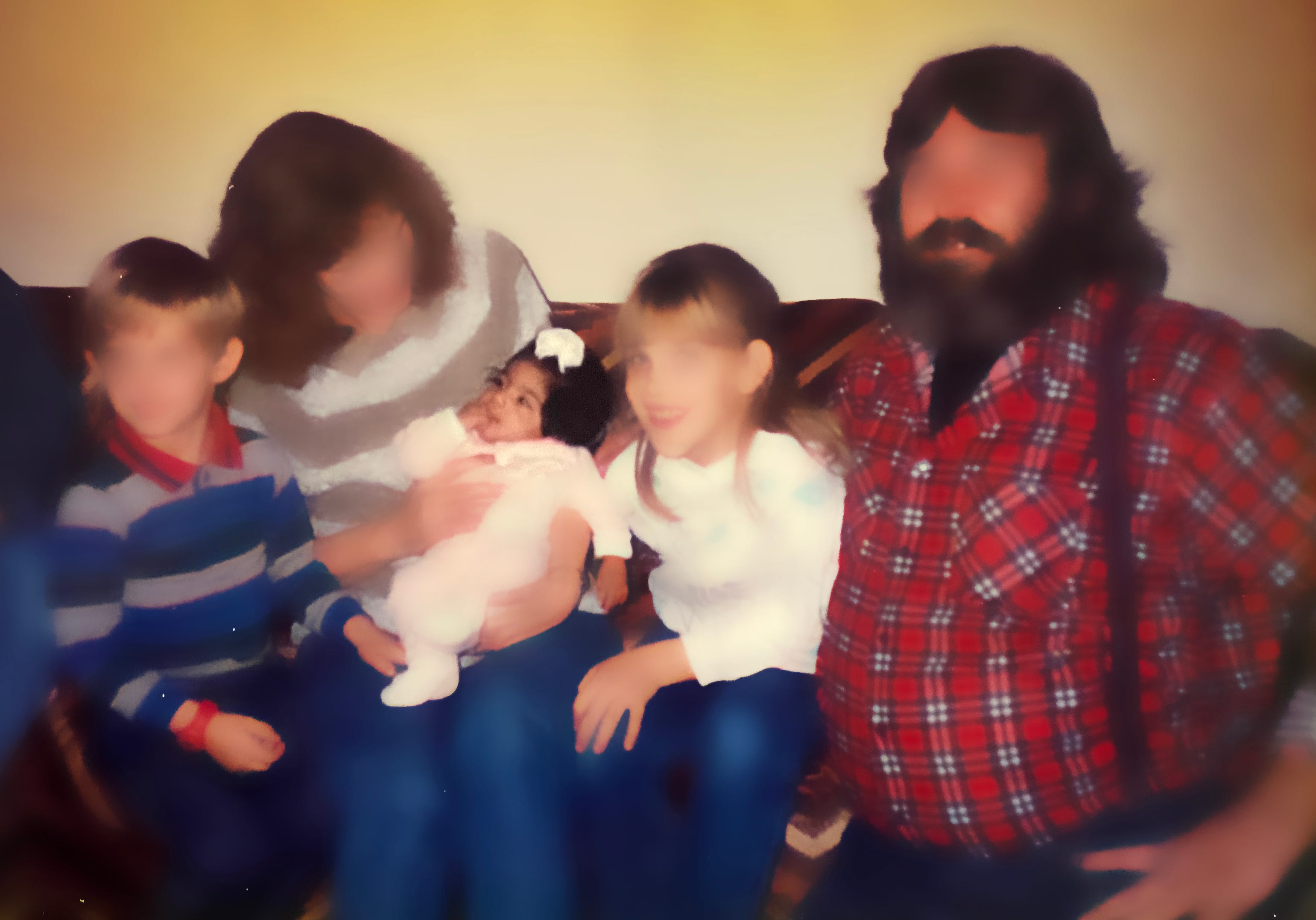
David, a bearded white man from a small town outside Atlanta, with his bandana around his forehead, his black pickup truck, and his rifle, later admitted that he had never met someone like my Dad. But after months of working together — and after my birth — he and his family showed up at my parents’ suburban Atlanta home with a baby-sized violet dress.
That day, David and his family were giving my parents a christening dress – for a religion they’d never heard of, for the first South Asian family they’d worked with, for a child whose life they would permanently shape but would never know.
Today, we often speak of the “Where are you from?” question as though it is taboo. That it creates a burden for those of us who sound or look foreign. That it suggests we are not from here.
And maybe there is a burden. Maybe we should all be thoughtful of when we ask this question or how. Someone in my partner’s family did this beautifully recently, asking, “I apologize but I can’t help but ask, what is your heritage?” He did it quietly, while the rest of the table was talking. He was humble that he wasn’t sure the right words for being curious.
After I shared my response, I asked him the same question back. “And what is your heritage?” By challenging him to have to give the same depth of genealogical account that I had just given, I was implicitly naming my own boundary — that I will put that same set of questions on the other person, in good faith implying that neither of us has any more or any less claim to this nation than the other does. Because if there is anything that defines America as a concept, it is that the color of our skin and the place our ancestors were born and whether we are here by choice have no bearing on our capacity to commit to e pluribus unum.
I’m not convinced that we arrive at a country that harnesses all our brilliance if we don’t get to understand the different lenses through which we experience the world. And I have a few thoughts about how to navigate the implicit tension between assumptions (which are inevitable) and curiosity (which is necessary) — and in fact, generally in this blog, I hope to explore and test out practical tips for realizing a diverse democracy.
But before we proceed, I think it is important to share a bit about me. From there, I invite you to thoroughly disagree with me, while also holding open to the possibility that there are ways to disagree and hold similar values. And that in fact, those disagreements might make the project of a diverse, resilient country more achievable — not less.
I’m from here. I was born in Crawford Long Hospital in Atlanta, Georgia. I am of South Asian descent, but so far, I have not stepped foot on the Indian subcontinent. I grew up in a multiracial elementary school that was one-third Black, one-third white, and one-third everything else. And I want more kids and more families to have the opportunity for difference to feel as heavenly for them as it felt for me.
Sometimes my friends and I disagree about how to realize a country where people with so many different lineages can go beyond co-existence and instead thrive, together.
Sometimes I vote for multiple parties on the same ballot.
Sometimes I spend time in communities that are wildly different from where I grew up, even if that will make me uncomfortable.
Like so many Americans, I don’t want to be in a box because of my age, race, or the work I do. I want to both wrestle with the reality that our families’ wealth, our race, and how visible our race is to others, and so many factors out of our control can shape the course of our lives — while also having agency to transform the world around me and even to transform myself. And while I am a “systems first” leader, I don’t think true systems change can happen without shifting cultural norms, including our own capacity for wonder and curiosity.
So what can we do? What are other conversations that get us to the relationship that David and my Dad forged?
For initiating, this HBR article offers a question such as “What is something that you’d like me to know about you?” A few years ago on a flight, sitting next to someone who was clearly in law enforcement, I asked him a question like this: “What is something about being in law enforcement today that you wish more people my age understood?”
And for responding, the children’s book Where are you from?, offers ways to transcend ancestry: “You’re from hurricanes and dark storms, and a tiny singing frog that calls the island people home when the sun goes to sleep.”
But ultimately, if the best that someone can muster is “Where are you really from?”— Who knows, you may form a bond that you never expected, you may build something novel with your combined talents, and they may even show up at your doorstep someday to share how much you have helped them become something new.
Written with my father, who is from East Africa, London, Philadelphia, Atlanta, and way back in generational history, from India too. Names changed for anonymity.
No posts
Comments
Nothing yet. Say the first thing.
Sign in to join the conversation.