
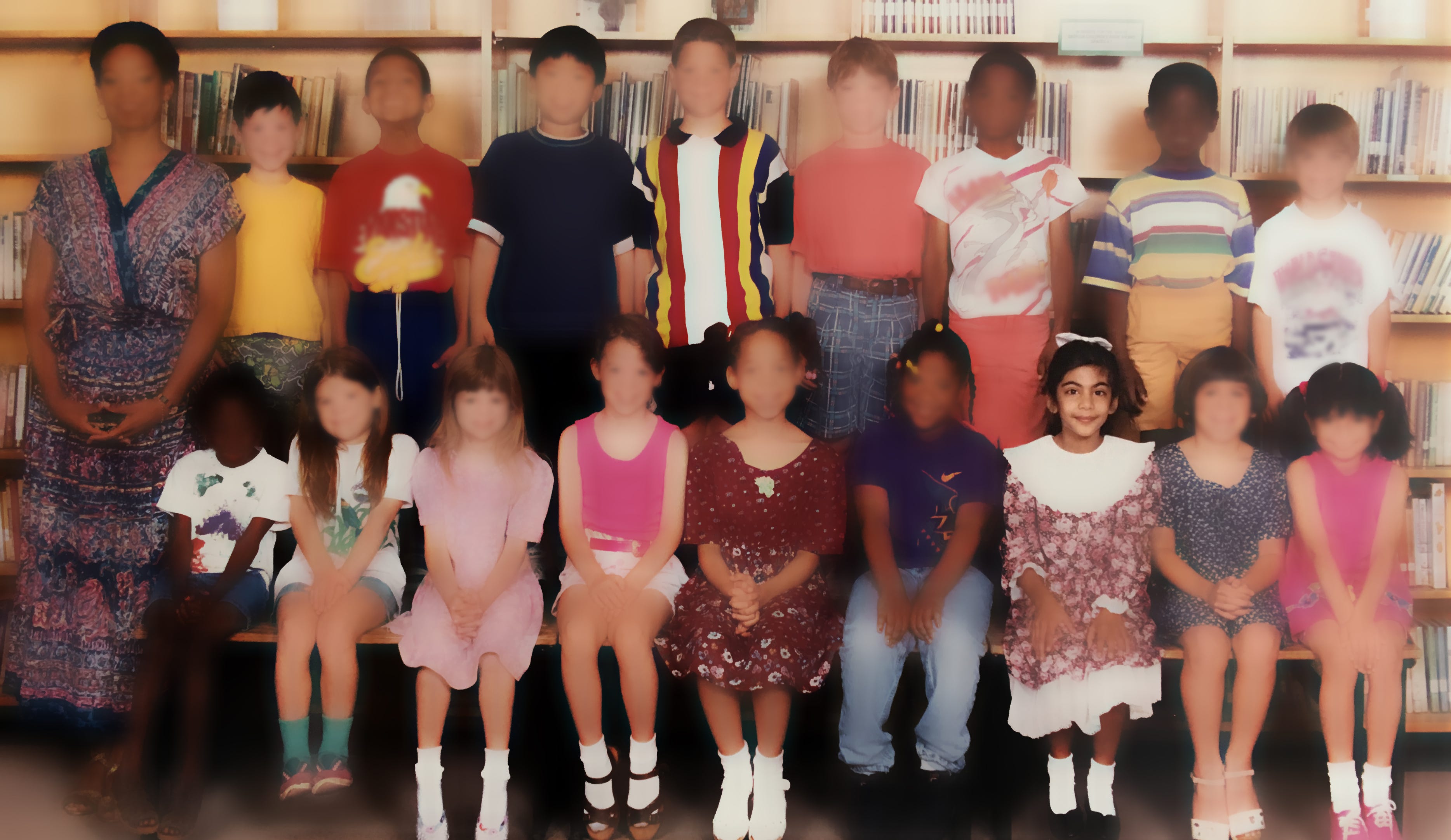
When I was young, I attended a private PreK, often carpooling with another family as it was quite far from home. After the main classes were over and I was left idle, I would crash the picnic tables where the older students did arts and crafts. Inevitably, my teacher would tell me that I was too young to play at that table, and like any creative child, I became angsty. On occasion, I found hair clips when my classmates dropped them on the floor and brought them home as gifts to my Mom.
According to my Mom, it was the celery that dealt the final blow. My Mom knew that I hated celery, but it was a prized snack at the expensive school. The PreK would not let her send my own snacks with me. So, my parents pulled me out, and they sent me to my neighborhood elementary school. It was called Evansdale Elementary, a school in DeKalb County, Georgia.
Evansdale was zoned to include the home-owning neighborhood where we lived plus a large nearby apartment complex. Under court-ordered policies to desegregate schools, families from South DeKalb County could bus their children north to attend a school like Evansdale. About a third of the students at Evansdale were enrolled as a result of this policy. Their parents had chosen to send them to a school that was often an hour away by bus because their own neighborhoods and schools had lacked investment and support. These families making the difficult choice to bus their kids north often faced isolation from their neighbors, and their kids woke up at early o’clock to navigate the hub and spoke bus system that got them from South DeKalb to North DeKalb.
The approach at Evansdale felt deliberate. It felt deliberate that children living in ranch homes attended the same school as children living in apartments. It felt deliberate that the best teachers were reserved for the students who were bussed from South DeKalb. It felt deliberate that after school, a Black elder and a white elder together watched over us as we yanked onion weed from the soil, drew unicorns into tree bark with thorns, and waited for our working parents to pick us up from the playground. It felt deliberate that our gym co-teachers were both Black and white. The reality is probably some mixture of chance and choice, but it felt like it was meant to be.
We were not fully integrated – I’m sure there were political reasons why students who arrived by bus were also in a different classroom – and yet, I have forever benefited from internalizing Evansdale’s resplendent diversity as normal. My classmates became my default lens for the world around me.
Evansdale was in the top 7% of elementary schools in Georgia. We planted peas, captured Black Widow spiders from our playground, and learned basket weaving. We celebrated Black history throughout the year. We were a wholesome, high-performing elementary school, and we looked like America.
A few years ago, well into my thirties, I began cleaning out old files. My parents had given me a stack of folders that had been labeled “Aliya” which were from various years of my childhood. Most of the contents was mundane, like report cards.
But one file had a set of letters that were exchanged between my parents and the private school that I had attended before I went to Evansdale.
It turns out, my departure wasn’t just about the celery.
As a 4-year-old, I had been labeled as misbehaving. The letters detailed that towards the end of the school year, my behavior had gone downhill. My parents were navigating really hard choices about whether to continue to send me to a school where I didn’t fit, or brave the unknown of another school — and according to the letters, the school’s administration was involved in the discussion, which as a former educator I know cannot be a good sign.
By the time I discovered this exchange of letters, I had both been a student for many years, and I had also been an educator. I knew I had not been perfect as a 4-year-old — I truly enjoyed finding and keeping ribbons and bows and hairclips that were not mine — but I had never imagined my behavior to be anything other than a normal part of childhood.
Discussing this with a mentor, she asked me if a part of what was happening at that private PreK was that I was brown in a school that had been very white. Whether I had been feeling the weight of not fitting in, whether teachers were possibly treating me as though I was different, and whether I was behaving a certain way because I was different.
I don’t know, and I probably never will. I will never be able to fully appreciate what 4-year-old Aliya was experiencing. I know both that people who look like me have often thrived at the same school, and that my Mom and I struggled with the ways that the school expected me to conform. Whether it was that I looked different or that I was stressed by other changes happening in my life at the time, or perhaps both — we simply don’t know.
But I do know this: In the many decisions to architect my childhood that came after that, my parents put diversity front and center. Their choice of Evansdale as well as the middle and high school I attended was largely influenced by the diversity of my peers. Even within our mosque, the parents who they sent me home with for sleepovers and weekend fun were from different countries than where my parents had grown up.
There are many structural forces that shape the diversity of our schools, and I will dig into these in future posts. Diversity of the housing stock, the level of neighborhood investment, how districts draw the lines of the school zones, and more. These dynamics require at least a few people to get together in order to change the direction of a school’s composition — it is hard to create a change in these arenas as an individual.
Yet, there is also a layer of living in a diverse democracy that requires an individual opt-in, a choice. As our neighbors change, as we make choices to use a former green space to house people from backgrounds different from our own, as we experience new zoning lines and the new routes we must take to school, we individually have to recommit. In recommitting, we have to stomach that feeling of change that comes with it — the loss of a favorite grove of trees, the loss of no longer knowing all of our neighbors’ and classmates’ names, the loss of cultural similarity.
These intangible losses play a tremendous role in how questions of race and class have played out in American democracy. In the nuanced interplay between structure and culture in any society, this is one critical element of culture that we each have to own to get to diverse, thriving communities.
P.S. This piece was shaped by countless friends, mentors, and education experts, and by my Mom.
No posts
Comments
Nothing yet. Say the first thing.
Sign in to join the conversation.