
For more than two decades, Google has held an unshakable grip on how we find information - its combination of PageRank and the ad machine (unmatched in scale) built a nearly impenetrable moat. “Google it” became the shorthand for looking up anything, anywhere, anytime. For Alphabet, Google Search ad revenue alone brought in over $190 billion in 2024, which is more than half of Alphabet’s total revenue.
But for the first time since its founding, Google faces a credible existential challenge — not from Microsoft’s Bing or another traditional search engine.
The threat is AI.
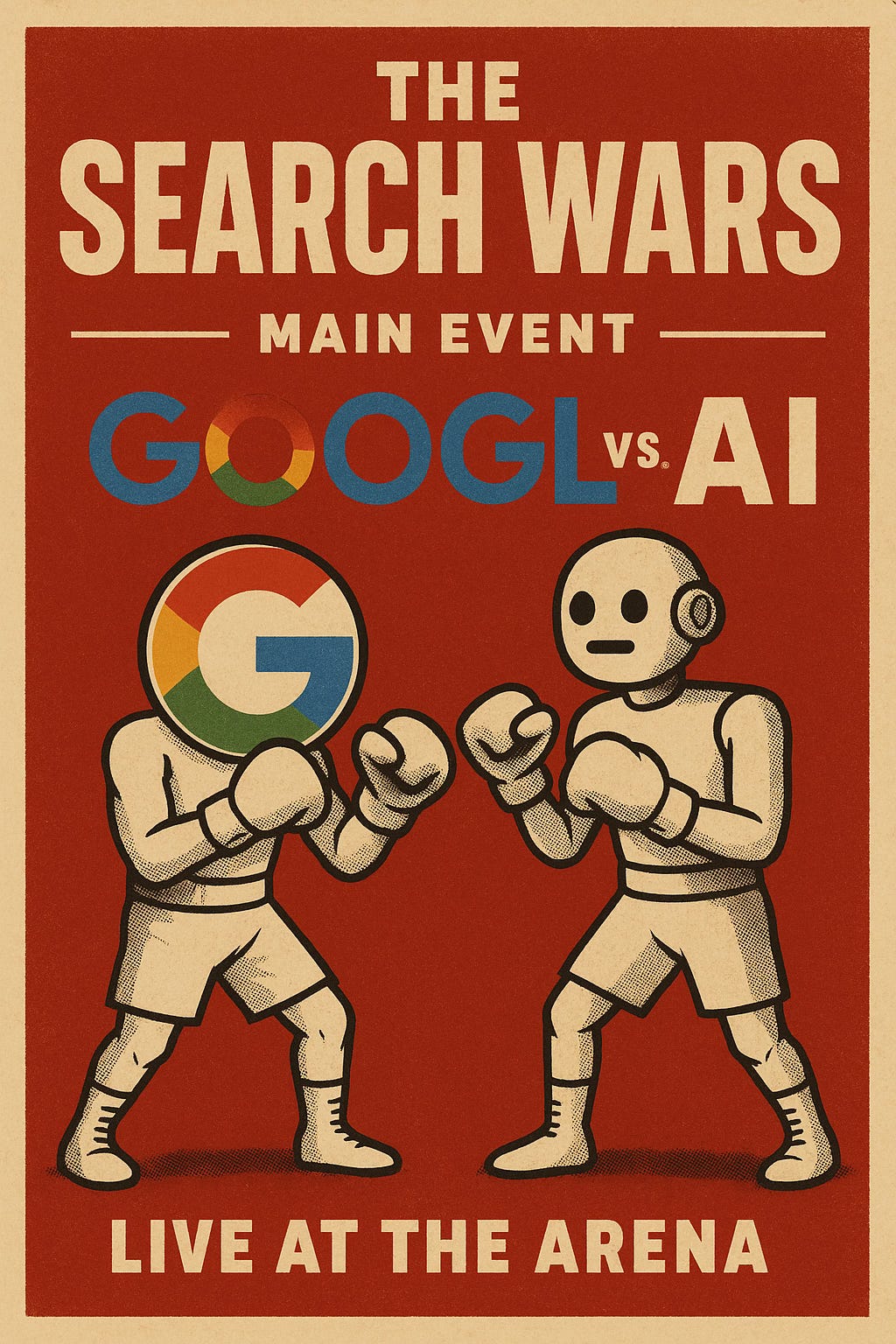
The Google Moat
In the late 1990s, the internet was a crowded frontier. Search engines like AltaVista, Yahoo, and Lycos offered directories or keyword-matching results.
Amidst this noise, two Stanford PhD students - Larry Page and Sergey Brin, began exploring how to rank the growing web. Their research project, BackRub, asked a deceptively simple question: what if we pages could be ranked not by keywords alone, but by how many other pages linked to them?
The result was PageRank, an algorithm that treated links like academic citations. In effect, it measured the “authority” of a page by who referenced it, not just what it contained. This academic experiment became the foundation of Google - a search engine that felt instantly better than anything else.
At the same time, the browser wars shaped how users accessed search. Marc Andreessen’s Mosaic (later Netscape) was the first mass market browser, eventually challenged by Microsoft’s Internet Explorer. Distribution became the critical layer: whoever controlled the browser controlled the search box. Google capitalized on this later in combination with its breakthrough PageRank technology and a clever AdWords business model to build the biggest moat.
The tech breakthrough, PageRank, ranked pages based on inbound links, and made results dramatically more relevant. The novel business model, AdWords, turned intent into the most valuable digital advertising real estate in history. And to top it all, mass distribution, by paying billions to Apple, Mozilla, and Android OEMs, Google became the default, it turned search into the most valuable real estate on the internet. Rivals like Bing or Yahoo couldn’t touch it because they lacked both technical edge and monetization muscle.
Technology (PageRank) got it started, but distribution and monetization through AdWords built the moat.
The Scale of Search
Google processes about 5 trillion searches annually, translating to about 13.7 billion searches per day, or 158,500 per second. That scale underpins its dominance. But more important statistic is that the revenue has grown faster than queries.
From 2019-2024, search ad revenue nearly doubled, while query volume rose by only ~ 30%.
As analyst Glenn Gabe put it:
“Google’s biggest threat isn’t that people stop searching, it’s that they stop clicking. AI answers could chip away at the clicks that fuel its $190B search business.”
AI vs. Google: What the Numbers Say
The headlines often suggest AI is about to dethrone Google.
The reality is more nuanced: AI search is gaining traction, but Google’s scale remains unmatched.
Recent data highlights the contrast:
• Google still dwarfs AI platforms: In 2024, Google received 373x more searches than ChatGPT (SparkToro). AI chatbots accounted for less than 3% of search engine traffic, with Google still driving over 1.6 trillion visits.
• AI is changing user behavior: According to Bain, about 80% of search users now rely on AI-generated summaries for at least 40% of their searches. This has contributed to a sharp rise in “zero-click” searches, where 60% of queries end without a user visiting a site (Bain & Co.).
• Click-through rates are dropping: When Google’s new AI Overview is displayed, organic CTRs fall by 34–64%, and traffic to publishers from AI-driven answers is 95% lower than from traditional search (Arc Intermedia).
• Trust is shifting, but not decisively: Surveys show 58% of U.S. consumers still prefer Google for factual queries, but 41% say they trust AI-generated answers more than traditional ads (eMarketer, Forbes).
The picture is clear: Google’s moat isn’t collapsing, but AI is eroding the edges.
Google’s strength lies in scale and distribution, but as users grow accustomed to direct, conversational answers, even small behavior shifts could have outsized effects on a business that generated $190B from search ads last year.
The AI Disruption Moment
Generative AI breaks the paradigm.
Instead of typing keywords and getting “10 blue links,” users can ask natural language questions and get direct answers, synthesized from multiple sources.
This flips the value chain: the answer engine becomes the product, not the index of web pages. That creates real consumer pull — especially for younger users who want immediacy, not links.
The Challenger Startups
Several AI-first startups are racing to reimagine search:
• Perplexity: Positions itself as an “answer engine.” It combines web crawling with LLMs to deliver conversational answers with citations. Unlike Google, it experiments with subscriptions (Perplexity Pro) rather than ads as its core business model.
• You.com: A multimodal search platform that lets users interact with AI across text, code, and images. It leans into customization — users can prioritize sources and workflows.
• Arc Search: From The Browser Company, Arc isn’t just a browser but an AI-native search experience. Its “Browse for Me” feature auto-generates summaries of pages and sources into a single view.
• Andi: A lightweight, privacy-first AI search engine targeted at younger users, combining visuals, chat, and direct answers.
Meanwhile, DeepSeek in China has emerged as a serious AI player, raising questions about regional dominance and competition beyond Baidu.
The Business Model Question
If AI search is better for users, why hasn’t Google already won?
The answer: economics.
Google’s ad machine depends on page views and clicks — not one-shot answers. Every direct answer is a potential hit to revenue. In Q1 2025, search ad revenue still rose 12% to a record $54.2 billion, thanks to AI features like “AI Overview”, although these same features may reduce downstream clicks.
Startups, unencumbered by that model, are free to try subscriptions, premium APIs, or enterprise search partnerships. But they face their own challenge: inference costs. Running cutting-edge LLMs is expensive, and scaling an AI search engine to billions of queries per day is a Herculean task.
The Strategic Question
So, will AI dethrone Google? The truth is more nuanced. Google still owns distribution, data, and cash flows that can fund massive AI investment. But history suggests monopolies crack not because of one superior product, but because user behavior shifts.
“We want to change how people learn online. Search today is broken—it forces you to sift through noise. We give you answers.” — Aravind Srinivas, CEO of Perplexity
The real search war isn’t about who has the best AI — it’s about who controls the gateway to knowledge and can make it sustainable.
And for the first time since PageRank, Google’s dominance doesn’t look unshakable.
The views expressed are those of the author and do not necessarily reflect the views of any investment firm or portfolio company. 
Google’s algorithm has nothing on your inbox when you subscribe!
Comments
Nothing yet. Say the first thing.
Sign in to join the conversation.