
The current AI boom feels reminiscent of the early internet or mobile revolutions - a moment when everything seemed possible and every startup claimed they’ll change the world. For the past two years, the AI race has looked like an arms race in model performance: bigger models, more parameters, faster benchmarks. Every week brings a new “frontier model” boasting higher score on MMLU, GPQA, or code benchmarks.
But, as the dust settles from the initial GPT-4 shock and awe, foundation models commoditize and open-source alternatives proliferate, a critical question will emerge soon (if not already):
Which AI companies will build truly durable competitive advantages?
As we know that Intel didn’t just build on tech alone. It was not just the clock speed, it was distribution (Wintel), ecosystem lock-in, and manufacturing scale. And in the AI world, performance or a better model alone is not the moat. The companies that will dominate the next decade are those building deeper, more defensible moats.

Let’s dive in:
Proprietary data is the most obvious starting point. Tesla’s self-driving dataset, Bloomberg’s financial corpus are examples of data flywheels that competitors can’t easily replicate. Companies like Waymo are not just building better vision models, they are creating a data collection network across millions of miles of real-world driving. Each mile driven generates edge cases and scenarios that improve the model for all future deployments. Competitors can’t simply buy this data, it must be earned through deployment.
Similarly, companies like Scale AI have built moats around data labelling and curation. Their advantage isn’t just having more data, but having higher-quality, domain-specific datasets that improve with scale and usage.
The strongest data moats come from being embedded in customer workflows where sensitive, proprietary data lives. Salesforce’s Einstein doesn’t just use CRM data - it becomes smarter as customers use it, creating switching costs that increase over time. GitHub Copilot improves by learning from how developers actually code, not just from public repositories.
These are great examples of “enduring” data moat which comes not from static assets, but from renewable feedback loops that compound over time.
If data is the starting point, distribution is the staying power.
Oracle dominated because it was embedded into every enterprise stack. Microsoft’s enduring advantage wasn’t just Windows - it was the default presence on every PC sold, reinforced by Office and developer ecosystems. Salesforce won SaaS 1.0 not because it was the most advanced CRM, but because it mastered distribution-as-a-product. So clearly, the most durable AI companies won’t just compete for attention - they will have to become indispensable parts of existing workflows.
ServiceNow’s AI agents aren’t separate tools; they’re woven into the IT service management processes that enterprises can’t live without.
Palantir’s success comes not from having the best models, but from being embedded so deeply in government and enterprise operations that replacement would be catastrophic. This embedded distribution creates multiple switching costs:
Process dependency: Workflows are built around the AI system
Institutional knowledge: Teams develop expertise specific to the platform
Integration complexity: The AI becomes part of a larger system architecture
The strongest distribution moats create network effects where the product becomes more valuable as more users adopt it. OpenAI's ChatGPT plugins ecosystem, Anthropic's growing integration partnerships, and Google's AI-first approach to search all demonstrate how AI companies can leverage existing platforms to create distribution advantages.
Companies that crack efficient customer acquisition and retention will compound their advantages. This means understanding not just how to build great AI, but how to sell it, support it, and expand within accounts.
The winners will have enterprise sales teams that understand AI deployment challenges, customer success teams that drive adoption, and product teams that build for scalable implementation, i.e., own the buyer relationship at scale - be it enterprise CIOs, developers, or consumers.
General-purpose LLMs are wide but shallow. Vertical players can win by going narrow + deep, embedding compliance, trust and expertise into specific domains.
In healthcare, where accuracy and HIPAA compliance are non-negotiable, the winner will be the “Epic” or “Cerner” of AI-native health workflows. Companies like Insitro, are not just applying AI to drug discovery - they are redefining how Pharma research happens by combining AI with deep biological understanding. Their competitive advantage comes from understanding both the AI and the domain at levels that generalist companies can’t match.
In legal, hallucinations can cost millions. The players who combine deep legal corpora with airtight validation may become the “SAP” of the industry. Harvey, as an example is built by legal experts who understand the nuances of legal research, document analysis, and regulatory compliance. Their moat isn’t model performance; it’s domain knowledge embedded in their training data, their product design, and their go-to-market strategy.
Similarly, in financial services, explainability and audibility will define trust. The moat isn’t the model - it’s the embedded risk/compliance frameworks.
The Professional Services Trap
However, domain depth can become a trap if companies become too much like consulting firms.
The key is building productized domain expertise—solutions that leverage deep vertical knowledge but can scale without proportional increases in human expertise.
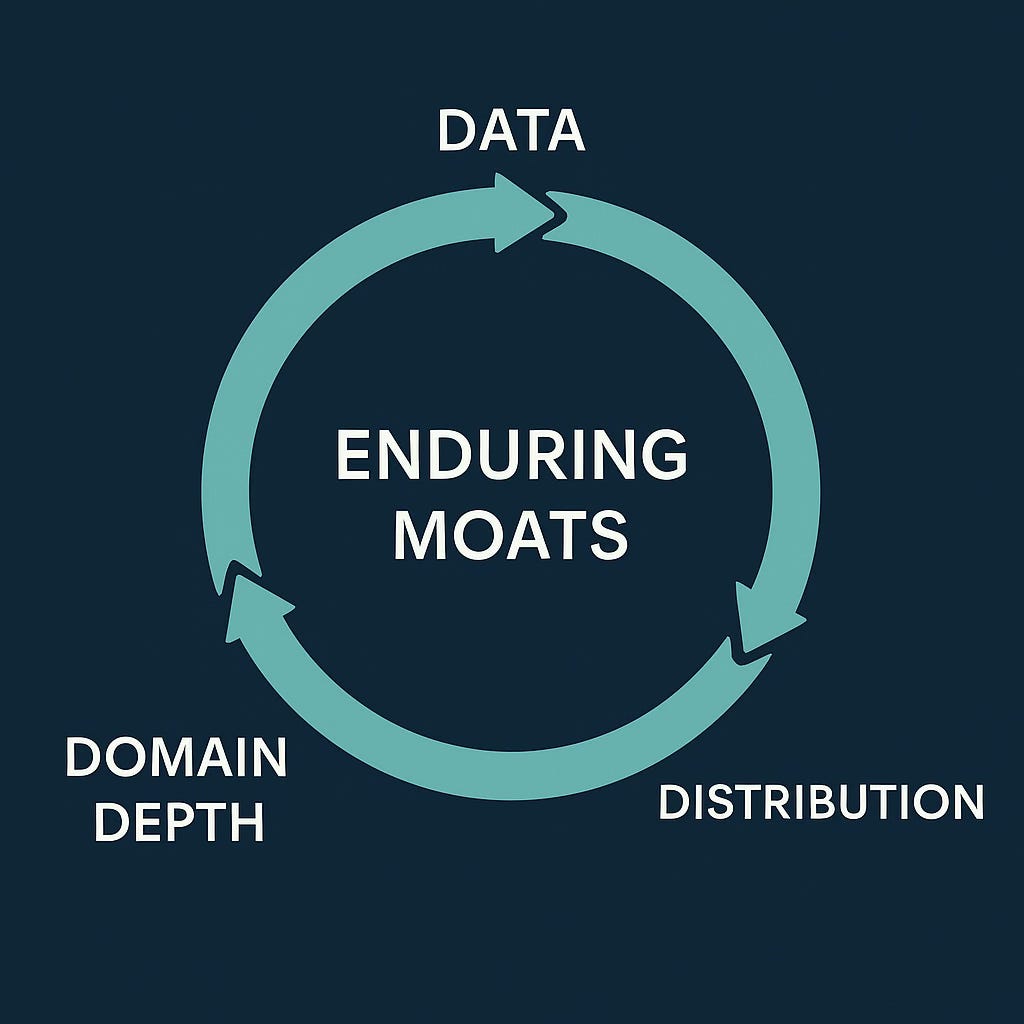
The most enduring moats will be built when these three reinforce each other:
Distribution creates new proprietary data
Domain depth increases switching costs, making distribution stickier
Proprietary data further strengthens distribution advantages
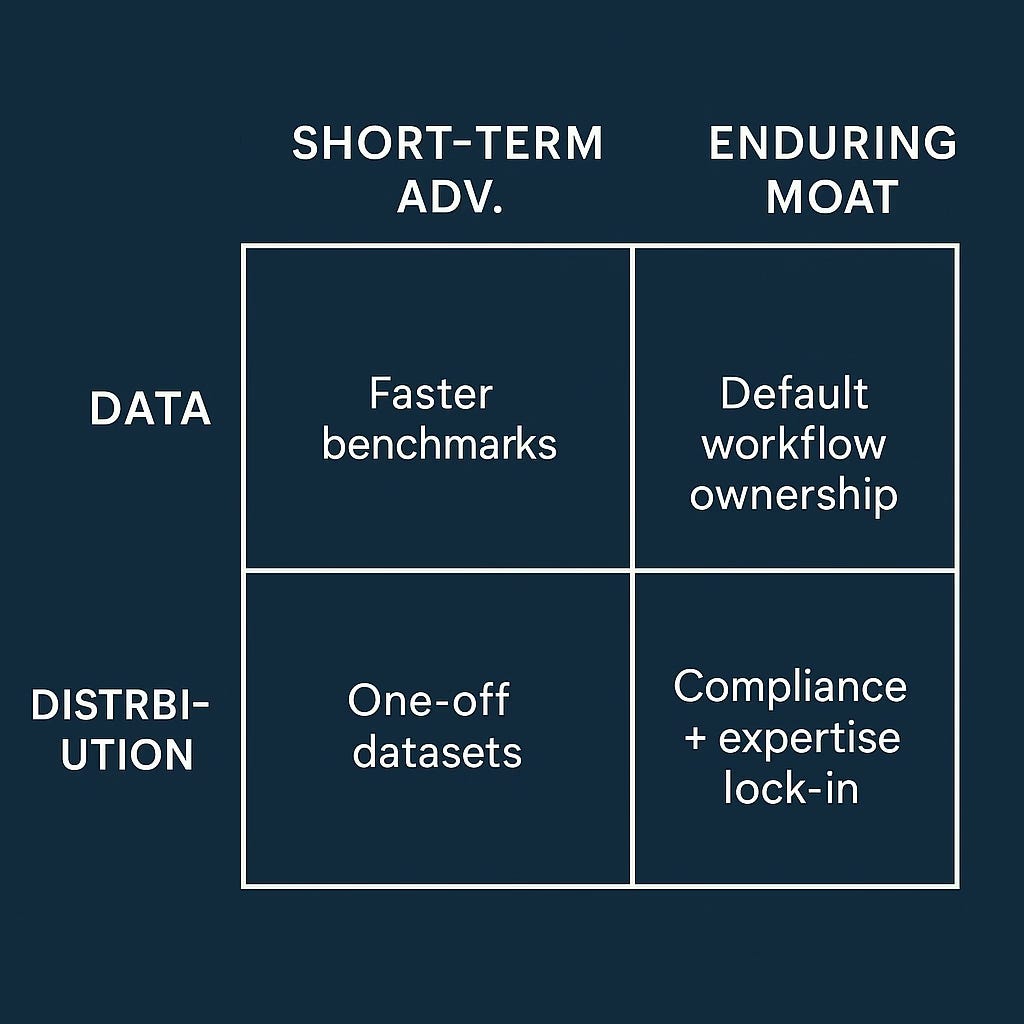
This is why Nvidia isn’t just a chip company. Its moat isn’t CUDA alone - it’s the entire developer ecosystem, tooling, and distribution channel that reinforces CUDA’s dominance. That’s why it’s valued like a platform, not a component. Performance and one-off data create the early buzz, but distribution, renewable data loops and domain depth are what endure.
Below is a simple way to visualise it:
The AI revolution is still in its early innings, but the patterns of durable competitive advantage are already emerging. So the strategic choices for the path forward would be:
→ Choose your Battlefield: Will you compete horizontally with board capabilities, or vertically with deep specialization? Both can work, but the strategies are fundamentally different.
→ Invest in Distribution Early: Great AI without distribution is a science project. Great distribution with good AI is a business.
→ Build for Compound Learning: Every customer interaction should make your product better. If it doesn't, you're not building a moat—you're building a service business.
→ Think Systems, Not Models: The companies that win won't just have better AI—they'll have better systems for deploying, monitoring, improving, and scaling AI solutions.
The views expressed are those of the author and do not necessarily reflect the views of any investment firm or portfolio company. 
Comments
Nothing yet. Say the first thing.
Sign in to join the conversation.