
As AI redefines the landscape of value creation, the critical shift isn’t happening at the user interface, but rather few layers further beneath it.
Today, infrastructure is the product, and winners are no longer just app builders, they are platform layer architects. This is where founders and investors must refocus their lens.
The AI Value Capture Paradox
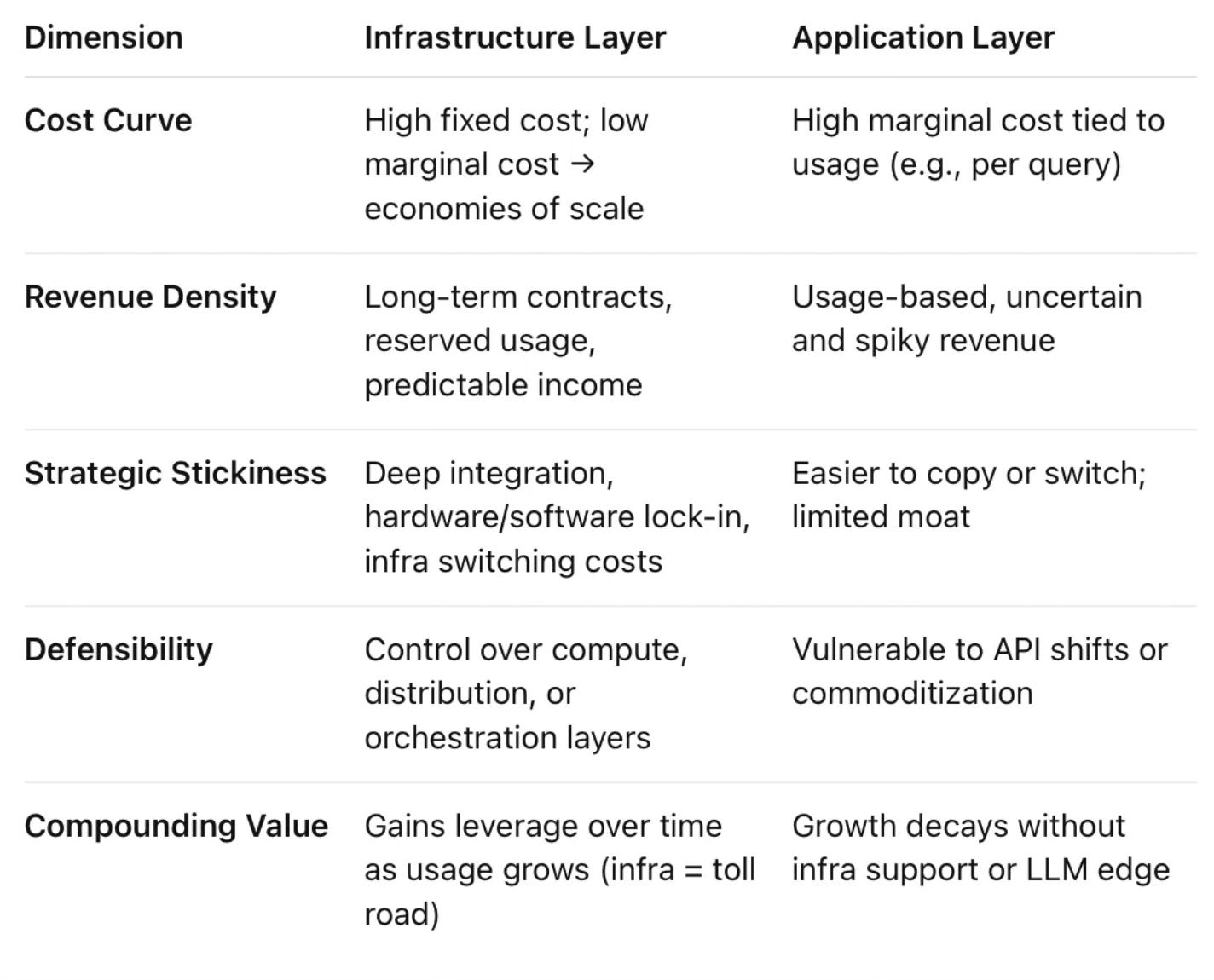
Clayton Chancey recently articulated what many in the industry now quietly admit: the AI Value Capture Paradox. In his February 2025 analysis, Chancey notes that while AI application firms slog through high variable costs per query, infrastructure players - cloud, chips, models - enjoy scalability and margins that compound upward as usage grows. In short: those who build the shovels, not the diggers, take most of the spoils.
CoreWeave: A Case Study in Value Capture
Consider CoreWeave, the once-crypto miner turned AI cloud provider. In just five months, its valuation ballooned from around $7 billion to $19 billion, powered by exclusive access to NVIDIA GPUs and early ties to OpenAI and Microsoft. By its IPO in March 2025, CoreWeave priced at ~ $23 billion fully diluted, despite heavy reliance on Microsoft for over 60% of revenue and billions in debt obligations.
Notice what happened: CoreWeave didn’t build the next ChatGPT. They build the cloud engine behind it. Despite backlash over valuation and leverage, their growth, as a pure infrastructure play, illustrates how strategic positioning at the base of the AI stack yields outsized returns.
Infrastructure Beyond Hardware
It’s not just chips. Look at LangChain, the orchestration toolkit chaining LLMs, APIs, databases, and logic into workflows. It raised ~ $100M at unicorn valuation for building the “glue” between applications and models - not for the models themselves.
Likewise, Cohere, backed by giants like Nvidia and Fujitsu, is building a data and compute stack for AI - signaling that the future value lies where compute, data infrastructure, and platform distribution converge.
Powering Agentic Systems
Agentic systems are only as powerful as the compute and orchestration layers supporting them. The most scalable startups are balancing hybrid automation with human-in-the-loop models - build on infrastructure, not just applications.
Why Infrastructure Wins (compared to App Layer)
In conclusion
The product-market fit today is not just about user acquisition. It is about the infra-market fit. The new power law applies under the hood, i.e., success compounds when costs drop fastest, GPUs, pipelines, orchestration frameworks, not just the application level. And finally, founders must architect vertically, not just horizontally with an infrastructure-first mindset.
If you think of AI startups as skyscrapers, infrastructure is the bedrock. And VCs who still think in terms of consumer layers risk missing structural shifts beneath.
Founders: Ask not “What features can I add”, but “How do I smoothly plug into the developer or enterprise infrastructure stack”
Investors: Don’t load up on the excitement of a flashy interface. Scan for capital-intensive infrastructure plays that trade opacity for leverage.
Operators/Boards: Your next set of strategic questions must include: “What’s our GPU buffer? Our orchestration layer? Our compute rollout plan?”
📆 Coming Soon
On deck for All That Noise:
The Real AI arms race: GPU supply chains
Agentic architecture deep dives
Invisible founders building in open-source
How analog obsessions (life craft tools) reveal empathic engineering mindsets
The views expressed are those of the author and do not necessarily reflect the views of any investment firm or portfolio company.

Join Now. Because your Twitter feed won’t explain this nearly as well.
Comments
Nothing yet. Say the first thing.
Sign in to join the conversation.