
A cultural shift in how we create software: welcome to Vibe Coding.
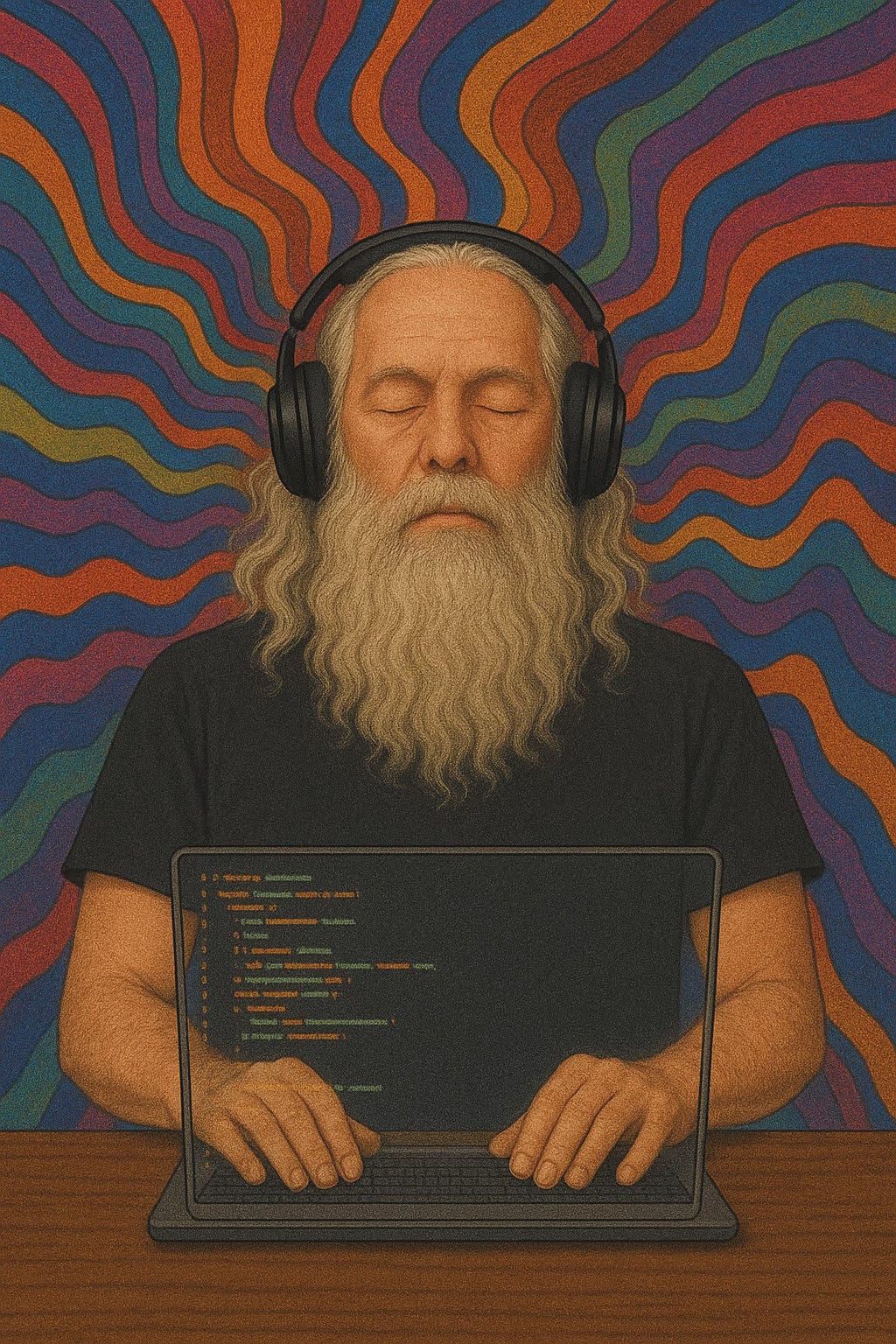
Andrej Karpthay, co-founder of OpenAI and former Tesla AI Director, coined “vibe coding” in February 2025. He defined it on X as:
“a new kind of coding I call ‘vibe coding’, where you fully give in to the vibes embrace exponentials, and forget that the code even exits.”
What started as careful “prompt engineering” has evolved into something far more intuitive and expressive - what Rick Rubin calls the “punk rock of software”. We are witnessing a cultural shift in how software is created - one that prioritises intention over syntax, creativity over rigid structure, an intuition-first approach that empowers anyone with an idea to start building, regardless of technical skills.
The term quickly gained traction - entering Merriam-Webster’s slang listings by March 2025. So much so that a playful meme made Rick Rubin the unofficial mascot of vibe coding, who soon leaned into the joke and created an interactive book called “The Way of Code: The Timeless Art of Vibe Coding”, a meditation on the art and science of vibe coding.
Traditional software development follows a predictable pattern:
requirements → architecture → code → test → deployVibe coding flips this entirely:
describe → generate → feel → iterate Instead of wrestling with syntax, developers descried what they want in natural language. The AI handles the heavy lifting while humans focus on the creative direction. It’s collaborative in a way that feels more like working with a highly capable partner than operating a tool.
Popular tools like Cursor with Claude, GitHub Copilot, and Replit’s Ghostwriter have made this workflow not just possible but genuinely enjoyable. Replit Ghostwriter and Replit Agent have “redefined the experience of full-stack development for solo AI startup founders in 2025 by seamlessly integrating advanced AI code assistance directly in the browser.”
As one Cambridge AI researcher put it: “For a total beginner..it can be incredibly satisfying to build something that works in the space of an hour.”
The developer role is evolving rapidly. Instead of writing every line of code, experienced developers focus on architecture, systems-level design, review and debugging. Tomorrow, even those responsibilities might shift as AI capabilities expand. We are also seeing new forms of collaboration emerge: pair programming with AI, multi-agent collaboration within IDEs, and a culture built around “vibe-driven coding” that celebrates rapid experimentation over perfect implementation.
This transformation feels different from previous developer tool improvements. It’s more playful, creative, accessible.
Think of it as the TopGolf effect applied to coding - making something traditionally complex feel fun, short, and accessible to a broader audience.
Take Base44, an AI-powered no-code app builder. Within six months of launching in late 2024, solo founder Maor Shlomo amassed over 100,000 users and profitability - then sold the startup to Wix for about $80 million in cash. Wix plans to integrate Base44’s natural-language interface into its platform while keeping it as a standalone product. This is one of the most vivid real-world example of vibe coding powering rapid startup creation and solo exit successes (nearly).
From a VC perspective, vibe coding represents massive productivity unlock that’s already reshaping startup economics. As one Silicon Valley CEO puts it, vibe coding “lets 10 engineers do the work of 100”, so essentially makes your engineer a 10x engineer. This productivity multiplier effect means:
More startups launching with smaller initial teams
Faster development cycles from idea to market
Lower barriers to entry for non-technical founders
New competitive dynamics where speed and creativity matter more than team size
But there’s risks and responsibilities every vibe coder must be aware of:
Security and Quality: AI-generated code may be buggy or insecure without careful review.
Tech debt and Architectural fragility: Experts caution code may be unmaintainable at scale.
Microsoft engineers say it can be “overhyped” and only capable of simple tasks; serious engineering remains complex. A sentiment shared by Andrew Ng, who believes in AI-assisted coding instead. Karpathy himself advises caution, reminding developers that LLMs can hallucinate, make simple mistakes, and always need human oversight.
Looking Ahead: Practical Advice
Having tried ‘vibe coding’ myself over the past few months, here are some practical tips I would like to share:
Avoid the “Prompt Trap”: Don’t bake everything into one messy prompt. Refactor logic, control flow, and testing structures - just as you would in traditional software engineering
Invest in durable assets: Focus on specs, interfaces, control flow, and eval datasets - the parts of your project that stay stable over time
Balance architecture: Build for today’s models, but design for future adaptability
Embrace Karpathy’s maxim:
“Tools will come and go. Only the vibe coder remains.”
This isn’t about discarding engineering discipline - it’s about evolving it.
Ready to embrace vibe coding? Start with Cursor, experiment with GitHub Copilot, or dive into Replit’s AI features. The barrier to entry has never been lower, and the potential has never been higher.
The views expressed are those of the author and do not necessarily reflect the views of any investment firm or portfolio company. 
Comments
Nothing yet. Say the first thing.
Sign in to join the conversation.